Spice Comparisons · Comparison
Black vs. White Sesame Seeds: Same Plant, Different Seed Coat
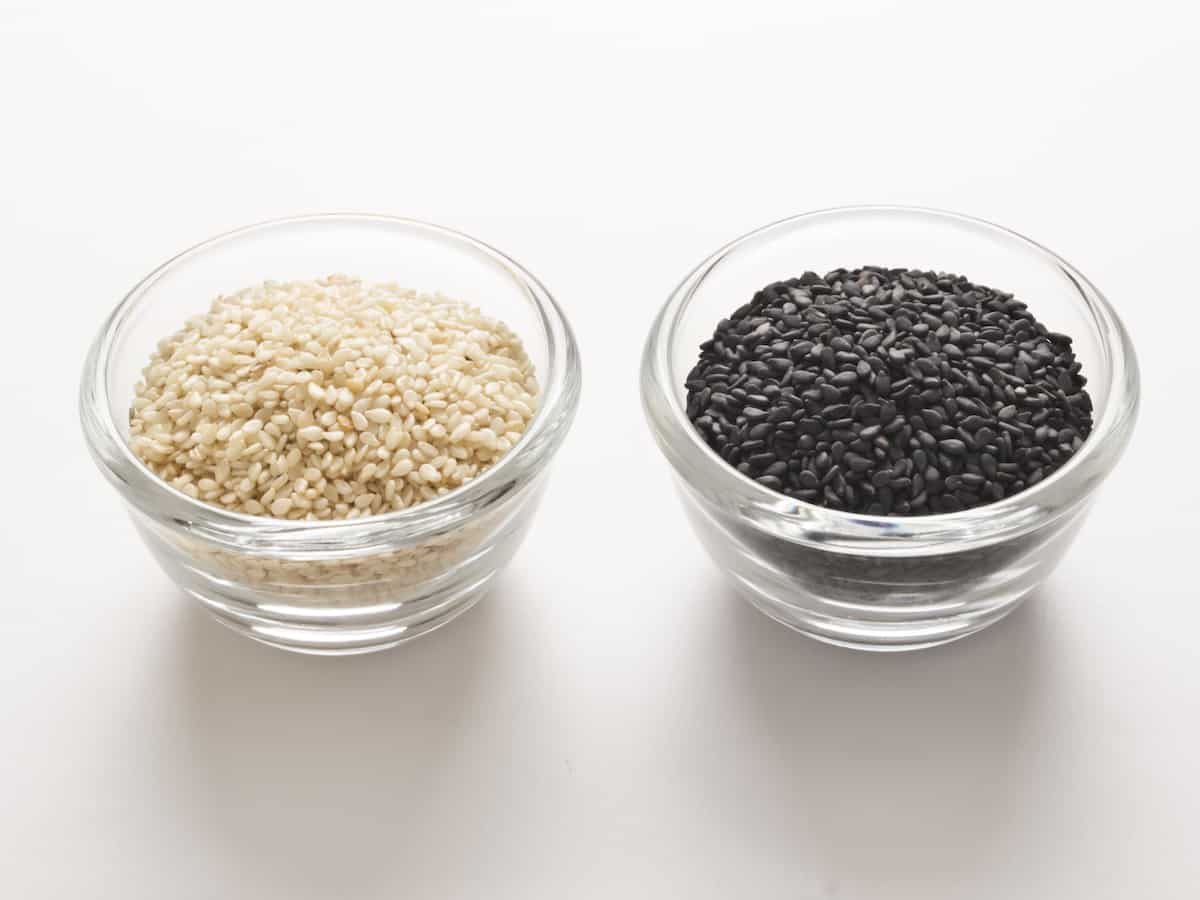
Black and white sesame are the same plant, Sesamum indicum.12 The difference starts in the seed coat: seed color is a trait of the cultivar, and black seeds carry a dark, melanin-like pigment in their coats.23 A second, separate difference is hulling. White sesame is often sold hulled and black sesame usually whole (a common retail pattern, not a sourced figure), and hulling changes the seed’s composition more than color does. In the kitchen the two taste close enough to swap; the bigger differences are how they look and, for whole versus hulled seed, their calcium.
Side by side
| Black sesame | White sesame | |
|---|---|---|
| Species | Sesamum indicum1 | Sesamum indicum1 |
| Family | Pedaliaceae1 | Pedaliaceae1 |
| Native range of the species | Indian Subcontinent per Kew; PROSEA favors Africa, most probably Ethiopia12 | Same species |
| What sets the color | Dark-coated cultivars; a melanin-like pigment in the seed coat23 | Pale-coated cultivars, and often hulling, which removes the coat |
| Forms sold | Usually whole (unhulled), raw or toasted | Whole, or hulled (decorticated) kernels; raw or toasted |
| Composition, per a 2017 review of earlier studies | More ash and carbohydrate; less protein, oil and moisture4 | Typically more oil, sesamin or sesamolin4 |
| Flavonoids | Rise with seed-coat darkness3 | Lower in paler seed3 |
| Flavor (editorial) | Earthier, a little more bitter, crunchier | Milder, sweeter and nuttier, especially hulled |
| Typical uses | Chinese black sesame soup, tang yuan, ice cream and cake5 | Breads and pastries, sweets, tahini26 |
| Allergen status | Sesame is a major food allergen in the US7 | Same |
| Price | No dated, sourced retail comparison found | No dated, sourced retail comparison found |
For each in depth, see the black sesame seeds and sesame seeds profiles.
Black is not just “unhulled”
A widely repeated explanation says black sesame is simply white sesame with its hull left on. It is not. PROSEA lists white, gray, yellow-white, brown and black seeded types of sesame as a cultivar characteristic,2 and Katzer’s Spice Pages notes that sesame seeds can be off-white, brown, gray or black.6 A 2022 study isolated the dark pigment from black sesame seed coats and found it similar to melanin from other sources.3 Since the pigment sits in the coat, hulling is a processing step that removes it, not what makes a seed black or white.
This matters because two different comparisons get mixed together:
- Black versus white is a difference between cultivars.
- Whole versus hulled is a difference in processing, and it applies to pale seed too. See hulled vs. unhulled sesame seeds.
What the composition data can and can’t show
Calcium. USDA’s figures show what hulling does: 989 mg of calcium per 100 g in whole, toasted sesame seed, against 131 mg in toasted, hulled kernels.89 Those entries do not state seed color.10 So the often-heard claim that black sesame is richer in calcium than white is really a whole-versus-hulled comparison. We found no published analysis that compares the calcium of black and white seed processed the same way.
Oil and lignans. A 2017 review in Frontiers in Plant Science, summarizing earlier studies, says white sesame seeds typically have higher oil, sesamin or sesamolin content, while black seeds usually have higher ash and carbohydrate and lower protein, oil and moisture.4 That is the review’s summary of other work, without sample counts on the page, so treat it as a general tendency rather than a figure for any bag of seeds. Sesamin and sesamolin are the lignans PROSEA credits with giving sesame oil its remarkable resistance to oxidation.2
Pigment and flavonoids. The 2022 pigment study reports that flavonoid content in sesame rises with seed-coat darkness.3 This is a compositional finding; it does not show any health effect.
Health claims. A 2016 meta-analysis of ten controlled trials found that sesame lowered blood triglycerides, but the effect came from sesame oil, not whole or ground seeds, and total cholesterol did not change significantly.11 Nothing here supports claims that black sesame is healthier than white.
Differences that change the dish
Look. This is the main one. Black seeds give contrast on pale breads, rice and noodles; white seeds disappear into light doughs and show up on dark crusts. That is kitchen judgment.
Flavor. Sesame tastes nutty, and toasting increases its flavor dramatically; Katzer notes that pyrazines dominate the flavor under mild toasting at 160 °C.6 PROSEA notes that sesame seed’s phytic and oxalic acids combine with calcium to give a slightly bitter taste.2 Black seed tastes earthier and a little more bitter to us, and hulled white seed milder and sweeter; no sensory study comparing them was found.
Toasting. Dark seeds don’t show browning, so judge by smell. The Woks of Life advises toasting even pre-roasted black seeds briefly in a dry pan or wok until fragrant.5
Cuisine. The Woks of Life describes sweet black sesame soup (zhī ma hú) as a traditional Chinese dessert, and lists black sesame tang yuan, ice cream and cake among other black sesame desserts.5 PROSEA notes that sesame in general is a major ingredient of sweets and a garnish for breads and pastries, and that it is ground into tahini.2
Can one stand in for the other?
Yes, in most dishes. They are the same species, so this is not a flavor substitution in the usual sense.
- Ratio (Method): 1 to 1 by volume. No source publishes a ratio, and none is needed for flavor in most dishes. Expect a change in appearance and, with black seed, a slightly stronger, more bitter edge; that is our judgment.
- Where it matters. Black sesame soup and other black sesame desserts depend on the seed’s color, so white seed changes the dish.5 Recipes that rely on hulled white seed for a pale, smooth paste will turn gray and more bitter with black seed; that is kitchen judgment.
- Poppy seed as a look-alike. If the point is dark specks on a roll, poppy seed is close by weight: USDA gives 9 g for a tablespoon of whole sesame and 8.8 g for a tablespoon of poppy seed, so a 1:1 swap by volume uses almost the same weight (Computed, weight only).1012 Poppy seeds are grayish blue to dark blue,13 and their flavor is not sesame’s. See sesame seed substitutes and poppy seeds.
Safety
Sesame became the ninth major food allergen in the United States on 1 January 2023, and US law requires labels to identify the food source of every major allergen.7 That applies equally to black and white seed.
What isn’t known
- No published analysis compares black and white sesame processed the same way (both whole or both hulled) for calcium.
- The oil and lignan tendencies come from a review’s summary of earlier studies; the primary studies were not opened.
- No sensory study compares the flavor of black and white seed.
- No production or price figure was found for black sesame specifically.
Related
- Black sesame seeds and sesame seeds profiles
- Hulled vs. unhulled sesame seeds
- Sesame seed substitutes and poppy seeds
- Gomasio, furikake and shichimi togarashi
- Cooking with za’atar
Footnotes
-
Sesamum indicum L., Plants of the World Online, Royal Botanic Gardens, Kew. powo.science.kew.org · Reference work ↩ ↩2 ↩3 ↩4 ↩5 ↩6
-
E.A. Weiss and Q.D. de la Cruz, Sesamum orientale, Plant Resources of South-East Asia (PROSEA). uses.plantnet-project.org · Reference work ↩ ↩2 ↩3 ↩4 ↩5 ↩6 ↩7 ↩8 ↩9
-
Dossou et al., “The Dark Pigment in the Sesame (Sesamum indicum L.) Seed Coat”, Frontiers in Nutrition, 2022. frontiersin.org · Peer-reviewed ↩ ↩2 ↩3 ↩4 ↩5 ↩6
-
Dossa et al., “The Emerging Oilseed Crop Sesamum indicum Enters the ‘Omics’ Era”, Frontiers in Plant Science, 2017. frontiersin.org · Peer-reviewed ↩ ↩2 ↩3
-
Judy, “Black Sesame Soup”, The Woks of Life, 2024. thewoksoflife.com · Publication ↩ ↩2 ↩3 ↩4
-
Sesame (Sesamum indicum), Gernot Katzer’s Spice Pages. gernot-katzers-spice-pages.com · Reference work ↩ ↩2 ↩3
-
“Food Allergies”, U.S. Food and Drug Administration. fda.gov · Regulator ↩ ↩2
-
Seeds, sesame seeds, whole, roasted and toasted (FDC 170151), USDA FoodData Central. fdc.nal.usda.gov · Regulator ↩
-
Seeds, sesame seed kernels, toasted (decorticated) (FDC 170152), USDA FoodData Central. fdc.nal.usda.gov · Regulator ↩
-
Seeds, sesame seeds, whole, dried (FDC 170150), USDA FoodData Central. fdc.nal.usda.gov · Regulator ↩ ↩2
-
Khalesi et al., “Sesame fractions and lipid profiles: a systematic review and meta-analysis of controlled trials”, British Journal of Nutrition, 2016. cambridge.org · Peer-reviewed ↩
-
Spices, poppy seed (FDC 171330), USDA FoodData Central. fdc.nal.usda.gov · Regulator ↩
-
“Opium poppy”, Encyclopaedia Britannica. britannica.com · Reference work ↩