Seasonings · Profile
Lemon Pepper Seasoning: What’s in It, Where the Flavor Comes From, and How to Use It
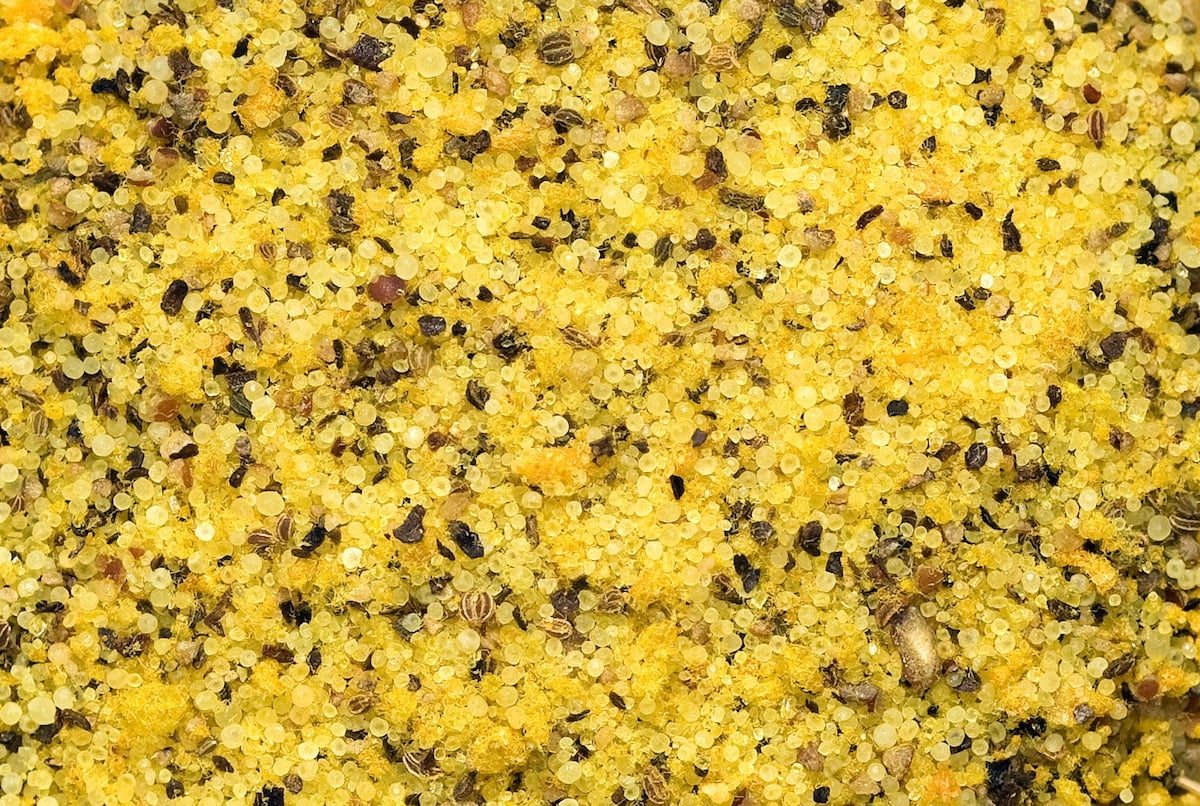
Lemon pepper is a seasoning blend built on black pepper and lemon flavor. At its simplest that means lemon zest and cracked pepper, but most store-bought versions are seasoned salts: salt is the first ingredient on McCormick’s label, followed by black pepper, citric acid, onion, sugar and garlic, with lemon oil supplying the lemon.1 It is best known on fish, seafood and chicken, and in Atlanta, on chicken wings.12 This page compares what named blends contain, explains where the flavor comes from, and covers uses, sodium and labeling.
At a glance
| Type | Seasoning blend; no standard recipe |
| Core ingredients | Black pepper and lemon (oil, peel or citric acid, depending on the blend)13 |
| Usually also contains | Salt, garlic, onion; some blends add sugar, celery seed or MSG13 |
| Pepper’s pungent compound | Piperine4 |
| Lemon oil’s main compound | Limonene (65.65% in one cold-pressed peel oil sample)5 |
| Sodium | 170 mg per 1/4 teaspoon on one McCormick label6 |
| Common uses | Fish and seafood, chicken, wings, pasta, vegetables1 |
Measured values
1 figure, sourced| Measure | Value | Scope | Source |
|---|---|---|---|
| Sodium | 170 mg per 1/4 teaspoon (7% of the Daily Value) | McCormick Signature Seasonings Lemon Pepper label, 5.75 ozBrand label figure; company's own figures | stopandshop.com |
Each figure is quoted as its source states it, with the samples or standard it applies to. Where sources differ, both are shown; nothing is averaged. All measured values
What’s in it: two labels side by side
There is no single recipe. These are the ingredient lists of two named products, in label order:
| McCormick Lemon & Pepper Seasoning1 | The Spice House Lemon Pepper Seasoning3 |
|---|---|
| Salt | Pepper |
| Black pepper | Salt |
| Citric acid | Monosodium glutamate |
| Onion | Citric acid |
| Sugar | Garlic |
| Garlic | Lemon peel |
| Calcium stearate, silicon dioxide and calcium silicate (anticaking) | Onion |
| Celery seed | |
| Lemon oil | |
| FD&C Yellow No. 5 Lake (color) |
The two blends get their lemon differently: McCormick from lemon oil and citric acid, The Spice House from dried lemon peel and citric acid.13 Salt is the first ingredient on McCormick’s list and the second on The Spice House’s.13
A homemade version can be as simple as finely grated lemon zest dried and mixed with coarsely ground black pepper, with salt to taste. We found no tested ratio from a source we could verify, so no quantities are given here.
Flavor and the compounds behind it
The pepper. Black pepper’s characteristic flavor comes principally from piperine,4 which makes up 4.9 to 7.7% of black pepper according to PROSEA.7 Piperine acts on the same heat receptor as chili’s capsaicin, TRPV1, but in laboratory tests on the human receptor it was a less potent activator than capsaicin.8 Black pepper’s essential oil is about 90% monoterpene and sesquiterpene hydrocarbons.7
The lemon. Lemon essential oil is pressed from the peel. In one study of cold-pressed peel oil from Venezuelan lemons, limonene made up 65.65% of the oil, and the aldehydes geranial (1.43%) and neral (0.87%), which the authors treat as quality indicators, were the main aldehydes.5 That is one orchard’s oil, not a figure for lemons in general.
The two halves of the blend share at least one compound: limonene is also the largest single component (24.0%) in an Indian black pepper oil sample analyzed by PROSEA.7
How it tastes is a matter of the blend. Salt-forward blends taste mainly salty and peppery with a sour lift from citric acid; blends with more peel or oil smell more distinctly of lemon. That is a cook’s description, not a measured comparison.
Origin
No source we found records when or where lemon and black pepper were first combined as a seasoning, and the blend has no documented inventor.
The ingredients themselves have separate histories. Black pepper is native to India’s Western Ghats according to PROSEA, though sources differ on its exact native range (see black pepper).7 The lemon is not a wild species at all: Kew describes Citrus × limon as a cultigen derived from artificial hybrids, involving citron, pomelo and mandarin (C. medica, C. maxima and C. reticulata).9 A widely repeated claim that both lemon and pepper originated in India therefore holds only for the pepper, and only with that caveat.
How lemon pepper is used
Fish and seafood. McCormick suggests it especially for fish, shrimp and other seafood, and recommends stirring it into melted butter or olive oil to brush over seafood while grilling or broiling.1
Chicken and wings. McCormick also suggests chicken breasts, pork chops and pasta, and a rub for chicken wings.1 In Atlanta, lemon pepper wings are a local fixture. Atlanta magazine describes two styles: at J.R. Crickets, buffalo wings finished with a heavy shake of dry lemon pepper seasoning, and at American Deli, a lemon pepper sauce that coats the wing.2 The phrase “lemon pepper wet,” popularized by the FX series Atlanta, was based on a menu item at American Deli, according to the show’s screenwriter Stephen Glover.2
Everything else. McCormick lists eggs, tuna salad, coleslaw, salad dressings, marinades and dips;1 The Spice House suggests chicken, vegetables, fish, avocado toast and fish-fry breading.3
Because most blends are salted, taste before adding more salt to a dish. That is common practice rather than a tested rule.
Buying and quality
Read the ingredient list for three things: whether salt comes first, how the lemon is delivered (oil, peel or only citric acid), and any added colors or flavor enhancers.13 McCormick’s blend contains FD&C Yellow No. 5 Lake;1 FDA rules require foods containing FD&C Yellow No. 5 to declare it by name in the ingredient list.10
Storage
We found no shelf-life figure for lemon pepper from a regulator or standards body. Keep it tightly closed, away from heat and light; that is common practice rather than a tested rule. Blends that have lost their lemon smell will mostly add salt and pepper.
Sodium and health
Lemon pepper is not a meaningful source of nutrients; McCormick’s label lists 0 calories per 1/4-teaspoon serving.6 Its main nutritional effect is sodium. The same label lists 170 mg of sodium per 1/4 teaspoon (7% of the Daily Value),6 which works out to about 680 mg per teaspoon. The FDA’s Daily Value for sodium is less than 2,300 mg a day,11 and the World Health Organization recommends adults stay below 2,000 mg, naming raised blood pressure as the main health effect of high intake.12
Claims that lemon pepper helps prevent obesity, high blood pressure or heart disease are not supported by any source we found. If you are watching sodium, read the label and salt the dish separately.
Substitutes and comparisons
- Lemon pepper substitutes
- Black pepper, black pepper substitutes and white pepper vs. black pepper
- Cracked vs. ground black pepper
- Seasoned salt
- Lemon myrtle and lemon thyme, other lemon-scented seasonings
- Too much pepper
Footnotes
-
McCormick Lemon & Pepper Seasoning, product page, McCormick & Company. mccormick.com · Merchant ↩ ↩2 ↩3 ↩4 ↩5 ↩6 ↩7 ↩8 ↩9 ↩10 ↩11 ↩12 ↩13
-
If FX’s Atlanta made you order J.R. Crickets’s Lemon Pepper Wet wings, Atlanta magazine. atlantamagazine.com · Publication ↩ ↩2 ↩3
-
Lemon Pepper Seasoning, product page, The Spice House. thespicehouse.com · Merchant ↩ ↩2 ↩3 ↩4 ↩5 ↩6 ↩7
-
Black pepper, Encyclopaedia Britannica, 2026. britannica.com · Reference work ↩ ↩2
-
Ojeda de Rodríguez et al., Composition of Venezuelan lemon essential oil, Revista de la Facultad de Agronomía (LUZ), 1998. produccioncientifica.luz.edu.ve · Peer-reviewed ↩ ↩2
-
McCormick Signature Seasonings Lemon Pepper, retailer listing with Nutrition Facts, Stop & Shop. stopandshop.com · Merchant ↩ ↩2 ↩3
-
Piper nigrum (PROSEA), Plant Resources of South-East Asia. uses.plantnet-project.org · Reference work ↩ ↩2 ↩3 ↩4
-
McNamara, Randall and Gunthorpe, Effects of piperine at the human vanilloid receptor (TRPV1), British Journal of Pharmacology, 2005. pmc.ncbi.nlm.nih.gov · Peer-reviewed ↩
-
Citrus × limon (L.) Osbeck, Plants of the World Online, Royal Botanic Gardens, Kew. powo.science.kew.org · Reference work ↩
-
21 CFR 74.705, FD&C Yellow No. 5, eCFR. ecfr.gov · Regulator ↩
-
Sodium in Your Diet, U.S. Food and Drug Administration. fda.gov · Regulator ↩
-
Sodium reduction, World Health Organization, 2026. who.int · Regulator ↩