Herbs · Profile
Marjoram: Flavor, Chemistry, Origins and How It Differs From Oregano
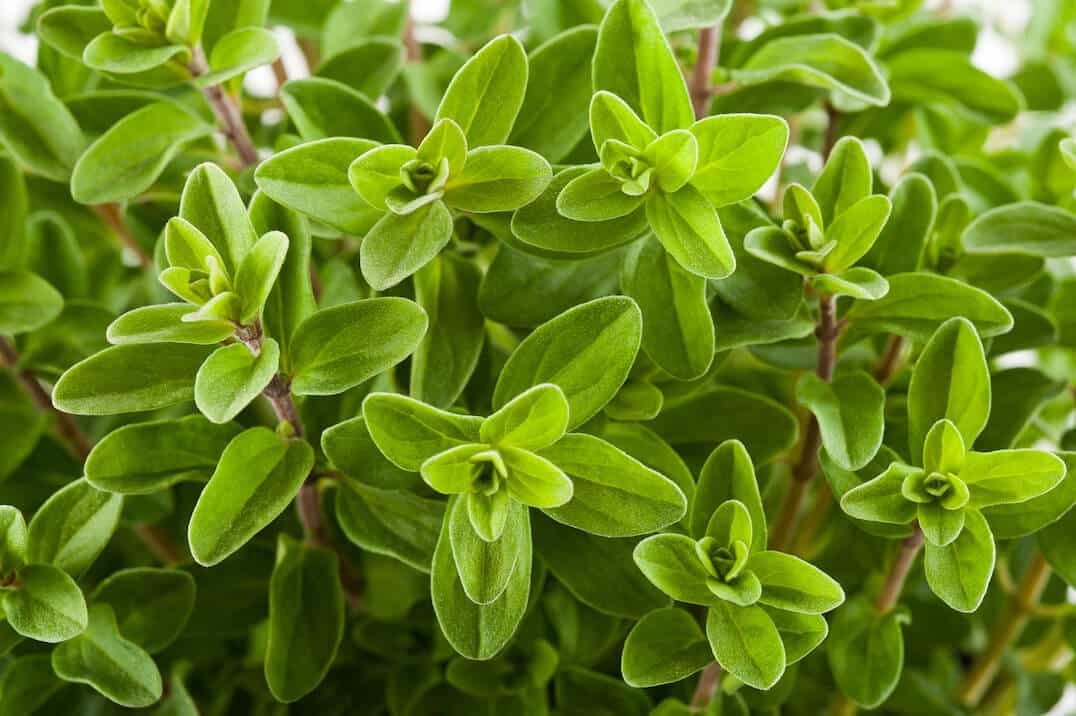
Marjoram is the leaf of Origanum majorana, a small, bushy herb in the same genus as oregano. It is sweeter, softer and more floral than oregano, and by common practice it goes into sausages, potato dishes and roast meats. This page covers what marjoram is, where it comes from, the compounds behind its smell, how it differs from oregano, and how to use and store it.
At a glance
| Botanical name | Origanum majorana L. (older name Majorana hortensis Moench)1 |
| Plant family | Lamiaceae (mint family)12 |
| Part used | Leaves and flowering tops, fresh or dried |
| Native range | Southern Türkiye and Cyprus per Kew; other references give wider ranges (see Origin)123 |
| Key aroma compounds | Terpinen-4-ol and cis-sabinene hydrate in one main chemotype; carvacrol and thymol in the other3 |
| Essential oil | About 2% (Britannica)2 |
| Forms sold | Dried leaf (whole or rubbed), ground, fresh sprigs |
| Production figures | No published figure found |
Measured values
7 figures, sourced| Measure | Value | Scope | Source |
|---|---|---|---|
| Essential oil | 2 % of the plant (about) | Britannica; scope not further stated | britannica.com |
| Essential oil: combined sabinene hydrates | 0.95 to 46.27 % of the oil | across the studies reviewed in a 2022 review (Life) | mdpi.com |
| Essential oil yield, aerial parts | 0.4 to 1.85 mL per 100 g of dry material | across the studies reviewed in a 2022 review (Life) | mdpi.com |
| Iron Nutrient | 82.7 mg per 100 g | USDA FoodData Central, dried marjoram (SR Legacy) | fdc.nal.usda.gov |
| Calcium Nutrient | 1,990 mg per 100 g | USDA FoodData Central, dried marjoram (SR Legacy) | fdc.nal.usda.gov |
| Vitamin C Nutrient | 51.4 mg per 100 g | USDA FoodData Central, dried marjoram (SR Legacy) | fdc.nal.usda.gov |
| Pyrrolizidine alkaloids, maximum (dried marjoram, oregano, borage, lovage and mixtures of only them) Limit | 1,000 µg/kg | EU Regulation 2023/915Other dried herbs: 400 µg/kg | eur-lex.europa.eu |
Each figure is quoted as its source states it, with the samples or standard it applies to. Where sources differ, both are shown; nothing is averaged. All measured values
What marjoram is
Kew describes Origanum majorana as an annual or perennial of the temperate biome, and lists Majorana hortensis among its synonyms, a name still seen on older labels and in older books.1 Britannica describes a bushy herbaceous plant typically 30–60 cm (1–2 feet) tall and gives “sweet marjoram” as another name for it.2
Marjoram and oregano
Both are Origanum species.14 Britannica notes that several aromatic herbs in the genus are called marjoram, and that oregano (O. vulgare) is also known as wild marjoram.25 So “sweet marjoram” for O. majorana and “wild marjoram” for oregano is a real naming convention, not a mix-up.
The two are distinct in trade. The Codex standard for dried oregano covers every Origanum species except Origanum majorana.6 For a side-by-side comparison, see marjoram vs. oregano and our oregano profile.
Name
The Online Etymology Dictionary traces “marjoram” through Old French majorane to Medieval Latin maiorana, a word of uncertain origin, possibly from India, with its form influenced by Latin major, “greater.”7 The often-repeated “joy of the mountain” belongs to oregano: Britannica derives oregano from Greek oros, “mountain,” and ganos, “brightness” or “joy.”5
Flavor and aroma
Marjoram smells sweet, floral and slightly piney, with a mild warmth and none of oregano’s sharp bite; that description is ours. Britannica describes it as warm, aromatic, slightly sharp and bitterish.2 The University of Delaware’s extension service puts it among the medium-strength herbs, with basil, oregano and thyme.8
The compounds
Britannica puts the essential oil at about 2% of the plant, with terpinene and terpineol as principal components.2 A 2022 review in the journal Life gives the fuller picture:
- Two main chemotypes. Researchers have classified marjoram into a terpinen-4-ol/cis-sabinene hydrate type and a carvacrol/thymol type, with exceptions such as a pulegone-rich Brazilian sample.3
- The sweet note. The review says cis-sabinene hydrate, with its acetate, is considered the compound responsible for sweet marjoram’s flavor.3
- Wide ranges. Combined sabinene hydrates ran from 0.95% to 46.27% of the oil across the studies reviewed.3
- Carvacrol types. Several samples in the review’s table, including ones from Greece and Türkiye, are carvacrol-rich, so some plants sold as marjoram are chemically close to oregano.3
- Yield. Oil from the aerial parts ranged from 0.4 to 1.85 mL per 100 g of dry material.3
The review attributes the variation to growth stage, climate, geography, soil salinity, storage and distillation method.3 These figures describe essential oils from specific samples, not dried retail marjoram.
Origin and history
| Source | Native range |
|---|---|
| Kew Plants of the World Online | Southern Türkiye and Cyprus1 |
| Kakouri et al. 2022 | Greece, Cyprus and Turkey3 |
| Britannica | The Mediterranean region and western Asia2 |
Kew records marjoram as introduced in North Africa (Algeria, Egypt, Libya, Morocco and Tunisia), southern Europe from Spain to Greece, Great Britain, India and Venezuela, among other places.1 The 2022 review notes cultivation in Morocco, Egypt, Tunisia and Algeria.3 A widely repeated claim that marjoram is indigenous to North Africa does not match Kew, which lists it there only as introduced.
Stories that ancient Egyptians used marjoram for healing and preserving, or that Greeks wove it into wreaths and garlands, circulate widely; no source for them could be traced, so this page does not repeat them. The association of an Origanum herb with happiness and Aphrodite is recorded by Britannica for oregano, not marjoram.5
How marjoram is used
The 2022 review says marjoram’s aroma and taste make it widely used in cooking.3 Britannica says only that it seasons many foods.2 By common practice it goes with:
- Roast and braised meats, especially pork, lamb and veal, and sausages
- Potatoes, beans, peas, mushrooms and egg dishes
- Tomato sauces, where it is a softer alternative to oregano
- Herb blends such as herbes de Provence
Technique
Marjoram’s flavor is in a volatile oil. The University of Delaware notes that extended cooking costs herbs their flavor and suggests adding them in the last 45 minutes of a long simmer, or adding part at the start and the rest later.8 Its starting amount for medium-strength herbs is 1 to 2 teaspoons for six servings.8 LSU AgCenter’s rule of thumb for swapping forms is one tablespoon of finely cut fresh herbs to one teaspoon of crumbled dried herbs.9 For more, see marjoram uses and cooking with marjoram.
Buying and quality
We found no Codex or other international grading standard for dried marjoram; the Codex oregano standard explicitly excludes it.6 Good dried marjoram is gray-green, with a sweet smell that comes up quickly when rubbed; that is kitchen judgment.
Storage
We found no published shelf-life figure for dried or fresh marjoram from a regulator or standards body. The 2022 review lists storage among the factors that change the oil’s composition but gives no shelf life.3 Smell is the practical test. For drying your own, see how to dry marjoram.
Nutrition
Dried marjoram is light: USDA gives 0.6 g per teaspoon and 1.7 g per tablespoon.10 Two tablespoons (3.4 g) supply about 2.8 mg of iron, roughly 16% of the FDA Daily Value of 18 mg, and about 68 mg of calcium, roughly 5% of the 1,300 mg Daily Value.1011 These are computed from USDA’s per-100 g values of 82.7 mg iron and 1,990 mg calcium; vitamin C (51.4 mg per 100 g) works out to under 2 mg in that amount.1011 A teaspoon, a more typical amount, supplies about 0.5 mg of iron.
Safety
- Pyrrolizidine alkaloids. EU law caps these plant toxins in dried marjoram, oregano, borage and lovage, and mixtures made only of them, at 1,000 µg/kg, compared with 400 µg/kg for other dried herbs.12
- Health claims. The NIH’s National Center for Complementary and Integrative Health has no fact sheet on marjoram.13 Claims that marjoram tea aids digestion, lowers blood pressure, prevents atherosclerosis, protects against staph or colds, or works as a sedative or antidepressant have no support from a systematic review or health agency that we could find, and this page makes no such claims.
Substitutes and comparisons
Oregano is the obvious substitute but stronger and sharper, so start with less; thyme also works in meat and bean dishes. These are kitchen judgments, not tested swaps. See marjoram substitutes for a ranked list, plus:
Footnotes
-
Origanum majorana L., Plants of the World Online, Royal Botanic Gardens, Kew. powo.science.kew.org · Reference work ↩ ↩2 ↩3 ↩4 ↩5 ↩6 ↩7
-
“Marjoram”, Encyclopaedia Britannica. britannica.com · Reference work ↩ ↩2 ↩3 ↩4 ↩5 ↩6 ↩7 ↩8 ↩9
-
Kakouri et al., “Origanum majorana Essential Oil: A Review of Its Chemical Profile and Pesticide Activity”, Life, 2022. mdpi.com · Peer-reviewed ↩ ↩2 ↩3 ↩4 ↩5 ↩6 ↩7 ↩8 ↩9 ↩10 ↩11 ↩12
-
Origanum vulgare L., Plants of the World Online, Royal Botanic Gardens, Kew. powo.science.kew.org · Reference work ↩
-
Anoushka Pant, “Oregano”, Encyclopaedia Britannica, 2026. britannica.com · Reference work ↩ ↩2 ↩3
-
Standard for Dried Oregano, CXS 342-2021, Codex Alimentarius. fao.org · Standard ↩ ↩2
-
“marjoram”, Online Etymology Dictionary. etymonline.com · Reference work ↩
-
“Using Herbs and Spices”, University of Delaware Cooperative Extension, 2025. udel.edu · Reference work ↩ ↩2 ↩3
-
“Flavorful Herbs”, LSU AgCenter. lsuagcenter.com · Reference work ↩
-
Spices, marjoram, dried (FDC 170928), USDA FoodData Central. fdc.nal.usda.gov · Regulator ↩ ↩2 ↩3
-
Daily Value on the Nutrition and Supplement Facts Labels, U.S. Food and Drug Administration. fda.gov · Regulator ↩ ↩2
-
Commission Regulation (EU) 2023/915, Annex I, point 2.4. eur-lex.europa.eu · Regulator ↩
-
Herbs at a Glance, National Center for Complementary and Integrative Health. nccih.nih.gov · Regulator ↩