Spice Substitutes · Substitutes
Marjoram Substitutes, Ranked by the Job the Herb Is Doing
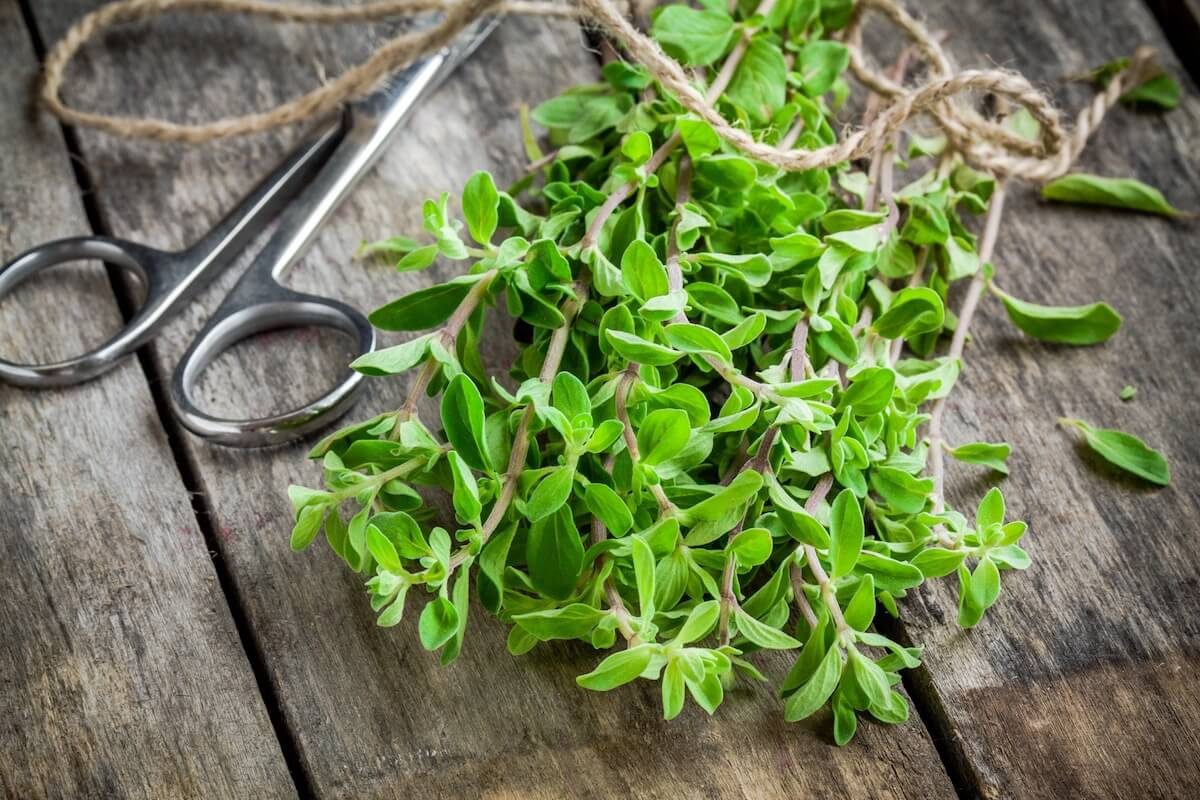
Marjoram is the leaf of Origanum majorana, an herb in the same genus as oregano.1 The Spice House describes it as a delicate, citrusy, piney-tasting herb, milder and sweeter than oregano.2 Britannica calls the flavor warm, aromatic, slightly sharp and bitterish.3 By common practice it goes into sausages, roast meats, potatoes, beans and tomato sauces, alone or as part of an herb blend.
Its close relatives make the best substitutes, but each is a little stronger or sharper, so start with less and taste.
Quick answer
| What marjoram is doing | Best substitute | Starting amount, per 1 part marjoram | Treatment |
|---|---|---|---|
| The main herb in a meat, bean or tomato dish | Oregano | 1/2 part | Attributed |
| A background herb in a long-cooked dish | Thyme | 3/4 part, then taste | Method |
| Seasoning beans, sausages or stuffing | Summer savory | 1/2 part, then taste | Method |
| One herb among several in a rub or stuffing | Poultry seasoning or herbes de Provence | 1 part, then taste | Method |
| A fresh herb added at the end | Fresh basil | 1 part, then taste | Method |
| Pork or poultry, where a strong herb is welcome | Sage | 1/4 part, then taste | Method |
| Recipe wants fresh marjoram, you have dried (or the reverse) | Dried marjoram | 1 teaspoon dried per 1 tablespoon fresh | Computed |
The rest of the page explains each choice.
How the ratios on this page are labeled
Every ratio carries one of four labels.
- Computed: based on a measurable physical relationship, with the source named.
- Attributed: a named source publishes this ratio. We quote it as theirs.
- Disputed: named sources give different answers to the same swap. We show each one and do not average them.
- Method: we found no published ratio. We give a direction and a cautious starting point, and say so.
The only herb-for-marjoram ratio we found from a credible source is The Spice House’s figure for oregano. It lists sweet basil, summer savory, thyme, sage and herbes de Provence as substitutes too, but gives no amounts for them.2 None of these figures say how they were reached.
Why the relatives work, and where they don’t
Marjoram’s oil comes in two main chemical types, according to a 2022 review: one led by terpinen-4-ol and cis-sabinene hydrate, and one led by carvacrol and thymol.4 The review says cis-sabinene hydrate, with its acetate, is considered the compound behind sweet marjoram’s flavor.4
Oregano and thyme oils are led by the other pair, and savory oils carry it too. Carvacrol and thymol make up about 78 to 85 percent of oregano essential oil,5 thymol and carvacrol are the characteristic constituents of thyme oil,6 and carvacrol ran from 11 to 67 percent in summer savory oils across the studies in one review.7 That shared carvacrol and thymol is why these herbs taste related to marjoram, and some plants sold as marjoram are themselves carvacrol-rich.4 In our judgment, what they don’t reproduce is the sweet note credited to cis-sabinene hydrate, which is why they taste sharper.
All of these figures describe essential oils from particular samples, not dried retail herbs.
If marjoram is the main herb
1. Oregano
Oregano is the closest relative: both are Origanum species,1 and Britannica notes that oregano is also called wild marjoram.8 The Spice House calls oregano the closest substitute.2
Where it falls short: oregano is sharper and less sweet. Britannica describes its warm, pungent taste,8 and The Spice House calls its flavor “much more pungent.”2
Ratio (Attributed): The Spice House says to use about half as much oregano as marjoram.2 It does not say whether that applies to fresh or dried herbs, so use the same form the recipe calls for.
The University of Delaware’s extension service puts marjoram, oregano, thyme and savory in the same medium-strength group of herbs.9 That grouping doesn’t contradict The Spice House’s figure, but it is a reason to taste before adding the rest.
2. Thyme
Thyme shares carvacrol and thymol with oregano and the carvacrol type of marjoram,64 and The Spice House lists it as a marjoram substitute.2 It holds up well in long cooking. In America’s Test Kitchen’s testing, dried thyme, rosemary and sage held up reasonably well in dishes cooked for more than 20 minutes with plenty of liquid.10
Where it falls short: thyme is more savory and less floral than marjoram. That is our kitchen judgment.
Ratio (Method): We found no published ratio. Start with about three-quarters as much thyme as marjoram, taste, and add more.
If marjoram is seasoning beans, sausages or stuffing
Summer savory
Summer savory is on The Spice House’s list.2 Its oil carries the same carvacrol and thymol, along with gamma-terpinene, in amounts that vary widely between studies.7
Where it falls short: it is sharper and more peppery than marjoram, in our judgment.
Ratio (Method): No published ratio was found. Start with about half as much savory as marjoram and add to taste.
If marjoram is one herb among several
Poultry seasoning or herbes de Provence
If marjoram is part of a mix for a stuffing, rub or roast, a blend that already contains it is a sensible swap. McCormick Culinary’s poultry seasoning lists thyme, sage, marjoram, rosemary, black pepper and nutmeg,11 and Bell’s Seasoning is described as a salt-free blend of rosemary, oregano, sage, ginger, marjoram, thyme and pepper.12 The Takeout lists marjoram among the herbs in commercial herbes de Provence blends,13 and The Spice House’s own herbes de Provence recipe includes it.14
Where it falls short: you get the other herbs too, and sage or rosemary can dominate a delicate dish.
Ratio (Method): No published ratio was found. Start with the same amount of blend as marjoram and taste.
Za’atar, with care
Za’atar can stand in for marjoram’s herbal note in Middle Eastern dishes. The University of California Master Food Preservers note that marjoram is often used in place of, or along with, oregano in the blend, alongside sumac, thyme and sesame.15 It also brings sesame and sumac’s sourness, so it suits only dishes where those belong. Check the label for salt.
Ratio (Method): No published ratio was found. Start with half as much za’atar as marjoram and taste.
If marjoram is a fresh herb added at the end
Fresh basil
Sweet basil is on The Spice House’s list.2 Its chemistry is different: Britannica names methyl chavicol and linalool as the main components of basil oil.16 What basil shares with fresh marjoram is a soft, sweet, green character, which is our kitchen judgment rather than a shared compound. LSU AgCenter counts basil among the delicate herbs best added in the last minute or two of cooking.17
Ratio (Method): No published ratio was found. Use about the same amount of fresh basil as fresh marjoram, added at the end, and taste.
If you want a stronger herb: sage
Sage is on The Spice House’s list,2 but handle it carefully. The University of Delaware puts sage among its strong herbs, and warns that the flavor can be extremely objectionable if too much is used.9 PROSEA attributes sage’s strong, characteristic smell to the thujones.18 It suits pork, poultry and stuffing more than tomato sauces or eggs, in our judgment.
Ratio (Method): No published ratio was found. Start with about a quarter as much sage as marjoram, taste, and add more only if needed.
Fresh and dried marjoram
If the only thing missing is the right form of marjoram itself, swap forms rather than herbs.
Ratio (Computed): LSU AgCenter’s rule is one tablespoon of finely cut fresh herbs to one teaspoon of crumbled dried herbs.17 America’s Test Kitchen tested the swap and found that 1 part dried herb to 3 parts fresh came closest to producing flavors of equal strength.10 Penn State Extension gives the dried amount as about a quarter to a third of the fresh.19 These figures are for herbs in general, not marjoram measured on its own. ATK’s testing found the swap worked best in long-cooked dishes with a good amount of liquid.10
What isn’t known
- No credible source we found gives a ratio for thyme, savory, basil, sage, za’atar or blends in place of marjoram. Those amounts are starting points for tasting.
- The Spice House’s half-as-much figure for oregano does not say how it was reached or whether it is for fresh or dried herbs.
- No study compares the flavor strength of dried marjoram with dried oregano or thyme. The chemical figures above come from essential-oil samples, not retail dried herbs.
- A common claim says dried oregano is the most potent of the three forms (fresh oregano, dried oregano, marjoram) and should be used at a third. We found no source for it.
Related
- Marjoram, marjoram vs. oregano, marjoram uses and cooking with marjoram
- Oregano, thyme, summer savory, sage and basil
- Poultry seasoning, herbes de Provence and za’atar
- Dried herbs vs. fresh and how to dry marjoram
Footnotes
-
Origanum majorana L., Plants of the World Online, Royal Botanic Gardens, Kew. powo.science.kew.org · Reference work ↩ ↩2
-
“Marjoram Substitute”, The Spice House, 2018. thespicehouse.com · Merchant ↩ ↩2 ↩3 ↩4 ↩5 ↩6 ↩7 ↩8 ↩9
-
“Marjoram”, Encyclopaedia Britannica. britannica.com · Reference work ↩
-
Kakouri et al., “Origanum majorana Essential Oil: A Review of Its Chemical Profile and Pesticide Activity”, Life, 2022. mdpi.com · Peer-reviewed ↩ ↩2 ↩3 ↩4
-
“A Recent Insight Regarding the Phytochemistry and Bioactivity of Origanum vulgare L. Essential Oil”, International Journal of Molecular Sciences, 2020. mdpi.com · Peer-reviewed ↩
-
S.H. Widodo, Thymus vulgaris, Plant Resources of South-East Asia (PROSEA). uses.plantnet-project.org · Reference work ↩ ↩2
-
Fierascu et al., “Phytochemical Profile and Biological Activities of Satureja hortensis L.: A Review of the Last Decade”, Molecules, 2018. mdpi.com · Peer-reviewed ↩ ↩2
-
Anoushka Pant, “Oregano”, Encyclopaedia Britannica, 2026. britannica.com · Reference work ↩ ↩2
-
“Using Herbs and Spices”, University of Delaware Cooperative Extension, 2025. udel.edu · Reference work ↩ ↩2
-
“Science: Substituting Dried Herbs for Fresh”, America’s Test Kitchen. americastestkitchen.com · Publication ↩ ↩2 ↩3
-
Poultry Seasoning, 12 oz, McCormick Culinary (product page). mccormick.com · Merchant ↩
-
Aimee Tucker, “Bell’s Seasoning: A New England Thanksgiving Classic”, Yankee Magazine, 2021. newengland.com · Publication ↩
-
Leah Kaplan, “What Is Herbs De Provence, Really?”, The Takeout, 2025. thetakeout.com · Publication ↩
-
“Herbes De Provence Substitute”, The Spice House, 2017. thespicehouse.com · Merchant ↩
-
“Za’atar Spice Blend”, UC Cooperative Extension Master Food Preservers of El Dorado County. ccfruitandnuts.ucanr.edu · Reference work ↩
-
“Basil”, Encyclopaedia Britannica. britannica.com · Reference work ↩
-
“Flavorful Herbs”, LSU AgCenter. lsuagcenter.com · Reference work ↩ ↩2
-
U.A. Dasuki, Salvia officinalis, Plant Resources of South-East Asia (PROSEA). uses.plantnet-project.org · Reference work ↩
-
Stacy Reed, “Preserving Herbs by Drying”, Penn State Extension, 2024. extension.psu.edu · Reference work ↩