Spice Comparisons · Comparison
Marjoram vs. Oregano: Same Genus, Different Chemistry, and How to Swap Them
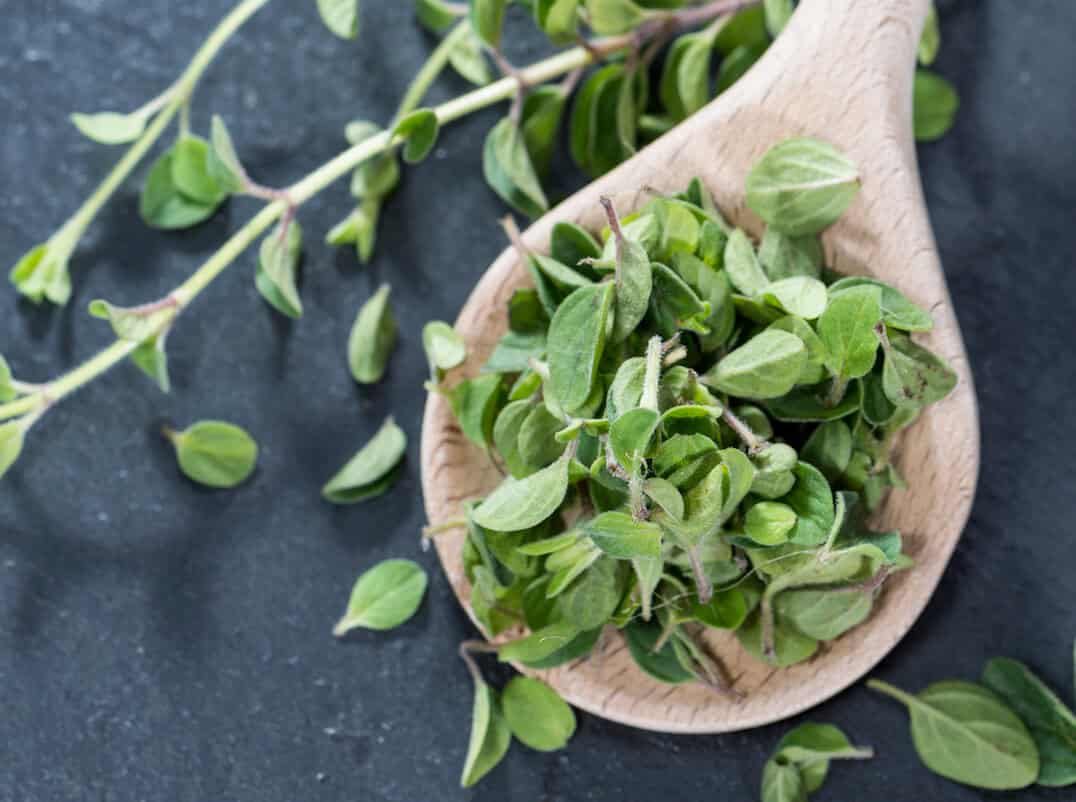
Marjoram and oregano are two species of the same genus, Origanum.12 Oregano’s bite comes from carvacrol and thymol, which make up most of its oil; marjoram’s sweeter, softer note is credited to cis-sabinene hydrate, although some marjoram plants are carvacrol-rich too.34 In the kitchen they swap well, with less oregano than marjoram, and the main things to watch are sweetness, sharpness and which kind of jar you bought.
Side by side
| Marjoram | Oregano | |
|---|---|---|
| Botanical name | Origanum majorana L. (older name Majorana hortensis)1 | Origanum vulgare L.; other Origanum species are also sold as oregano24 |
| Family | Lamiaceae (mint family)1 | Lamiaceae (mint family)5 |
| Also called | Sweet marjoram6 | Wild marjoram, European marjoram5 |
| Native range (Kew) | Southern Türkiye and Cyprus1 | Macaronesia to China2 |
| Key oil compounds | Two main chemotypes: terpinen-4-ol and cis-sabinene hydrate, or carvacrol and thymol3 | Carvacrol and thymol, together about 78 to 85% of the oil4 |
| Essential oil in the plant | About 2% (Britannica)6 | Varies widely by subspecies and growing conditions4 |
| Flavor | Warm, aromatic, slightly sharp and bitterish (Britannica);6 sweeter and more floral than oregano (editorial) | Strong aroma, warm and pungent taste (Britannica);5 sharper and more resinous (editorial) |
| Strength class (University of Delaware) | Medium7 | Medium7 |
| International standard | None found; the Codex oregano standard excludes it8 | Codex CXS 342-2021, dried oregano8 |
| Signature uses | Seasons many foods (Britannica);6 sausages, potatoes and roast meats by common practice | Italian pizza and pasta sauces, Greek salads and gyros (Britannica)5 |
| Adulteration | No survey found | 48% of oregano samples suspicious in an EU 2019 to 2021 check, mostly with olive leaves9 |
| Price | No dated, sourced comparison found | No dated, sourced comparison found |
For each herb in depth, see marjoram and oregano.
How related are they?
Close. Both are Origanum species,12 and the names overlap: Britannica lists “wild marjoram” and “European marjoram” as other names for oregano.5 A 2020 review of oregano chemistry notes that the name “oregano” itself is used for several Origanum species, marjoram among them.4
In trade, though, they are kept apart. The Codex Alimentarius standard for dried oregano covers every Origanum species except Origanum majorana.8 So marjoram is oregano’s sibling in the botany, and a separate product on the shelf.
Differences that change the dish
The chemistry behind the sweetness
A 2022 review of marjoram oil describes two main chemical types: one led by terpinen-4-ol and cis-sabinene hydrate, the other by carvacrol and thymol.3 It says cis-sabinene hydrate, with its acetate, is considered responsible for sweet marjoram’s flavor.3 Oregano oil is a different story: carvacrol and thymol together make up about 78 to 85 percent, according to a 2020 review, and carvacrol alone ran from 58.7 to 77.4 percent in one set of Spanish samples tabulated there.4
That is why most marjoram tastes sweeter and softer than oregano, and why some lots taste surprisingly close to it: the carvacrol type of marjoram shares oregano’s main compounds.3 Retail jars don’t say which type they hold. All of these are figures for distilled oils from particular samples, not for dried leaf, and the two reviews studied different plants.34
Strength
Oregano is usually described as the stronger herb, and The Spice House calls it the close relative to use instead of marjoram, at about half the amount.10 The University of Delaware’s extension service, however, puts both in the same medium-strength group, with basil and thyme.7 Those two views can both hold: oregano can taste sharper without being a “dominant” herb like sage or rosemary. Either way, taste before adding the rest.
Dried or fresh
A common claim says oregano is better dried and marjoram better fresh. America’s Test Kitchen lists both oregano and marjoram among the dried herbs worth keeping in the pantry,11 so dried marjoram is a sound choice too. For swapping forms, ATK’s Danielle Lapierre advises using one third the amount when substituting dried herbs for fresh;11 see fresh oregano vs. dried.
Timing
Both carry their flavor in a volatile oil. The University of Delaware notes that long cooking costs herbs their flavor and suggests adding them during the last 45 minutes of a long simmer.7 Adding marjoram late in particular is common practice, given its gentler aroma; that is our judgment rather than a tested rule.
Can one stand in for the other?
Yes, in most dishes. The treatments below are the ones on our marjoram substitutes and oregano substitutes pages.
| Swap | Starting amount | Treatment |
|---|---|---|
| Oregano in place of marjoram | About 1/2 part oregano per 1 part marjoram | Attributed: The Spice House says to use “about half the amount of oregano as you would marjoram”10 |
| Marjoram in place of oregano | 1 part, then up to 1 1/2 parts, tasting near the end | Method: no published ratio found |
- Oregano for marjoram. The Spice House calls oregano the closest substitute and also suggests Greek oregano specifically.10 It does not say whether its ratio is for fresh or dried, so use the form your recipe calls for. Expect a sharper, less sweet dish (our judgment).
- Marjoram for oregano. The Spice House says marjoram tastes the most similar to oregano.12 We found no number for this direction. A widely repeated rule says to use three parts marjoram for two of oregano; we found no source for it. Start with the same amount and add more if the dish needs it.
- Mexican oregano is a different plant from a different family; see Mexican oregano vs. oregano.
Where each is used
Britannica calls oregano a key ingredient in Mediterranean and Middle Eastern cooking and essential in Italian pizza and pasta sauces, Greek salads and gyros.5 It also says oregano became widely known in the United States after World War II, when returning soldiers who had developed a taste for Italian food made it popular.5
Marjoram’s sourced uses are vaguer. Britannica says only that it seasons many foods.6 By common practice it goes with sausages, pork, lamb and veal, potatoes, beans, mushrooms and eggs, and into tomato sauces as a softer alternative to oregano. Claims that it is especially English or French, or that its main use is in vinegars and dressings, could not be traced to a source.
Buying and safety
- Oregano is the herb to buy carefully. In the European Commission’s 2019 to 2021 coordinated control plan on herb and spice fraud, 48% of oregano samples were at risk of contamination, most often with olive leaves.9 We found no comparable survey for marjoram. Buying whole or crushed leaf rather than powder makes foreign leaf easier to spot; that is a practical suggestion, not a tested method.
- One shared limit. EU law caps pyrrolizidine alkaloids, plant toxins that can contaminate harvests, at 1,000 µg/kg in dried marjoram and oregano, against 400 µg/kg for most other dried herbs.13
- Health claims. This page makes no claim that either herb treats or prevents any condition.
What isn’t known
- No sensory study compares marjoram and oregano directly, and no measurement backs any swap ratio beyond The Spice House’s rule of thumb.
- Retail jars of marjoram do not state their chemotype, so a given jar may sit nearer to oregano than expected.3
- No adulteration survey of marjoram was found.
- No dated price comparison was found.
Related
- Marjoram, marjoram uses, cooking with marjoram and how to dry marjoram
- Oregano, oregano uses, cooking with oregano and too much oregano
- Marjoram substitutes and oregano substitutes
- Oregano vs. thyme, basil vs. oregano, Mexican oregano vs. oregano and herbes de Provence vs. Italian seasoning
Footnotes
-
Origanum majorana L., Plants of the World Online, Royal Botanic Gardens, Kew. powo.science.kew.org · Reference work ↩ ↩2 ↩3 ↩4 ↩5
-
Origanum vulgare L., Plants of the World Online, Royal Botanic Gardens, Kew. powo.science.kew.org · Reference work ↩ ↩2 ↩3 ↩4
-
Kakouri et al., “Origanum majorana Essential Oil: A Review of Its Chemical Profile and Pesticide Activity”, Life, 2022. mdpi.com · Peer-reviewed ↩ ↩2 ↩3 ↩4 ↩5 ↩6 ↩7
-
Lombrea et al., “A Recent Insight Regarding the Phytochemistry and Bioactivity of Origanum vulgare L. Essential Oil”, International Journal of Molecular Sciences, 2020. mdpi.com · Peer-reviewed ↩ ↩2 ↩3 ↩4 ↩5 ↩6 ↩7
-
Anoushka Pant, “Oregano”, Encyclopaedia Britannica. britannica.com · Reference work ↩ ↩2 ↩3 ↩4 ↩5 ↩6 ↩7
-
“Marjoram”, Encyclopaedia Britannica. britannica.com · Reference work ↩ ↩2 ↩3 ↩4 ↩5
-
“Using Herbs and Spices”, University of Delaware Cooperative Extension, 2025. udel.edu · Reference work ↩ ↩2 ↩3 ↩4
-
Standard for Dried Oregano (CXS 342-2021), Codex Alimentarius Commission. fao.org · Standard ↩ ↩2 ↩3
-
“Herbs and spices (2019-2021): EU coordinated action”, European Commission, EU Agri-Food Fraud Network. food.ec.europa.eu · Regulator ↩ ↩2
-
“Marjoram Substitute”, The Spice House, 2018. thespicehouse.com · Merchant ↩ ↩2 ↩3
-
Danielle Lapierre, “When You Should Actually Use Dried Herbs (and Which Ones to Avoid)”, America’s Test Kitchen, 2022. americastestkitchen.com · Publication ↩ ↩2
-
“The 8 Best Oregano Substitutes”, The Spice House, 2018. thespicehouse.com · Merchant ↩
-
Commission Regulation (EU) 2023/915 on maximum levels for certain contaminants in food. eur-lex.europa.eu · Regulator ↩