Herbs · Profile
Thyme: Flavor, Thymol and Its Chemotypes, History and How to Cook With It
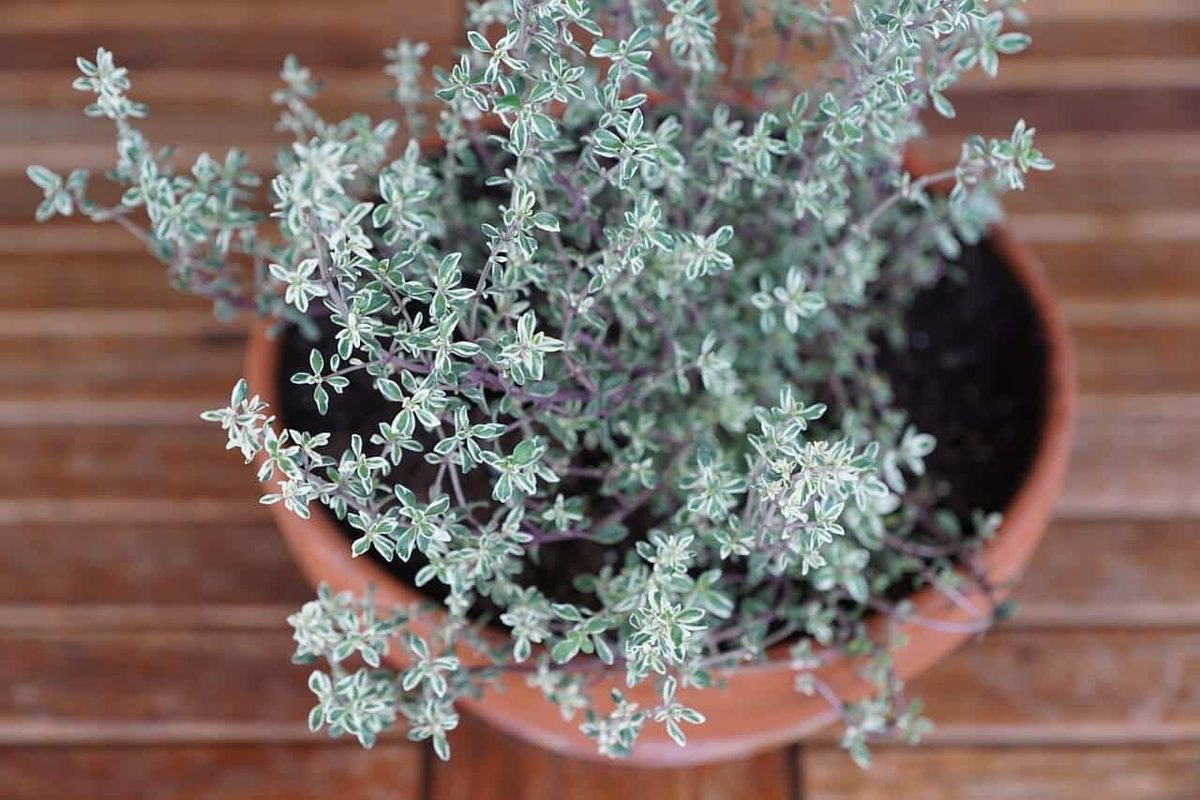
Thyme is the leaf of Thymus vulgaris, a small woody subshrub from southwestern Europe, used fresh and dried with meat, fish, soups, cheese and butter.12 Its sharp, savory flavor comes mostly from two related compounds, thymol and carvacrol.2 This page covers what thyme is, the main kinds sold, the chemistry behind the flavor, its role in classic blends, and the few safety points that apply.
At a glance
| Botanical name | Thymus vulgaris L. (common or garden thyme)13 |
| Plant family | Lamiaceae (mint family)1 |
| Part used | Leaves and flowering tops, fresh or dried23 |
| Native range | Southwestern Europe and southeastern Italy per Kew; Portugal to Greece per PROSEA (see Origin)12 |
| Main producers | Around the Mediterranean; PROSEA’s world estimate of 1,500 tonnes a year is decades old2 |
| Key aroma compounds | Thymol and carvacrol, plus p-cymene and γ-terpinene; varies by chemotype24 |
| Essential oil yield | About 1–3% on distillation2 |
| Forms sold | Fresh sprigs, dried leaves, ground, essential oil |
Measured values
15 figures, sourced| Measure | Value | Scope | Source |
|---|---|---|---|
| Essential oil yield | about 1–3 % on distillation | Thyme, PROSEA | uses.plantnet-project.org |
| Thymol | 39.1 % of essential oil | Danish thyme oil, as reported by PROSEA | uses.plantnet-project.org |
| Carvacrol | 5.1 % of essential oil | Danish thyme oil, as reported by PROSEA | uses.plantnet-project.org |
| Thymol | 22.5 % of essential oil | New Zealand thyme oil, as reported by PROSEA | uses.plantnet-project.org |
| Carvacrol | 6.2 % of essential oil | New Zealand thyme oil, as reported by PROSEA | uses.plantnet-project.org |
| Thymol and carvacrol (each) | below 5 % of essential oil | One non-phenolic chemotype profile cited by PROSEA (over half the oil 1,8-cineole, camphor and monoterpene alcohols)Mediterranean T. vulgaris has six chemotypes. | uses.plantnet-project.org |
| Thymol | 42.44 % of essential oil | One T. vulgaris oil in a 2023 study of eight thyme species | mdpi.com |
| Carvacrol | 2.28 % of essential oil | One T. vulgaris oil in a 2023 study of eight thyme species | mdpi.com |
| p-Cymene | 17.25 % of essential oil | One T. vulgaris oil in a 2023 study of eight thyme species | mdpi.com |
| γ-Terpinene | 17.80 % of essential oil | One T. vulgaris oil in a 2023 study of eight thyme species | mdpi.com |
| Vitamin A Nutrient | 3,800 IU per 100 g | Ground dried thyme, PROSEA composition figures | uses.plantnet-project.org |
| Protein Nutrient | 7–9 g per 100 g | Ground dried thyme, PROSEA composition figures | uses.plantnet-project.org |
| Fiber Nutrient | 19–24 g per 100 g | Ground dried thyme, PROSEA composition figures | uses.plantnet-project.org |
| Energy Nutrient | 1,155 kJ per 100 g | Ground dried thyme, PROSEA composition figures | uses.plantnet-project.org |
| Pyrrolizidine alkaloids, maximum Limit | 400 µg/kg | EU Regulation 2023/915, dried herbs (covers dried thyme, not among the named exceptions) | eur-lex.europa.eu |
Each figure is quoted as its source states it, with the samples or standard it applies to. Where sources differ, both are shown; nothing is averaged. All measured values
What thyme is
Common thyme is a small, erect or ascending evergreen subshrub, usually 10–30 cm tall and occasionally up to 50 cm.2 Its opposite leaves are only 3–8 mm long and dotted with oil glands, and its tiny lilac to pale purple flowers grow in spikes at the tips of the stems.2
Types of thyme
The genus is large, and several species and hybrids are sold for the kitchen:
| Type | Name | What the sources say |
|---|---|---|
| Common or garden thyme | Thymus vulgaris L. | The standard culinary thyme; native to Spain, France, Italy and the Balearic Islands13 |
| Lemon thyme | Thymus × citriodorus (Pers.) Schreb. | A hybrid, not a species: Kew gives its parents as T. pulegioides × T. vulgaris, native to southwestern Europe5 |
| Wild or creeping thyme | Thymus serpyllum L. | A complex species growing wild across Europe, used as a culinary herb and for oil; on the FDA’s GRAS spice list26 |
| Spanish thyme | Thymus zygis | Used as a condiment and the main source of thyme oil, about 85% of world output by PROSEA’s figures2 |
| Caraway thyme | Thymus herba-barona Loisel. | Native only to Corsica7 |
“English” and “French” thyme are trade names; we found no botanical source that defines them. See English thyme vs. French thyme and, for the citrus type, lemon thyme and thyme vs. lemon thyme.
Flavor and aroma
Thyme tastes savory, sharp and slightly medicinal, with a warmth that comes through even in long-cooked dishes; that description is ours. PROSEA names thymol and carvacrol as the characteristic constituents of the oil, and both are phenols.28
The compounds and chemotypes
Common thyme is chemically variable. PROSEA reports that Mediterranean T. vulgaris has six chemotypes with different main monoterpenes, under genetic control.2 One profile it cites had thymol and carvacrol each below 5%, with more than half the oil made up of 1,8-cineole, camphor and monoterpene alcohols.2 Others are thymol-led:
| Scope | Thymol | Carvacrol | Other main compounds | Source |
|---|---|---|---|---|
| Danish thyme oil, as reported by PROSEA | 39.1% | 5.1% | 2 | |
| New Zealand thyme oil, as reported by PROSEA | 22.5% | 6.2% | 2 | |
| One T. vulgaris oil in a 2023 study of eight thyme species | 42.44% | 2.28% | p-cymene 17.25%, γ-terpinene 17.80% | 4 |
In the 2023 study, six of the eight thyme oils were of the thymol type.4 These are distilled oils from particular samples, not dried leaf from a jar, so they show the range rather than what any given thyme will contain.
Oregano oil is built on the same two phenols: one review puts carvacrol and thymol together at about 78–85% of it.8 See oregano vs. thyme.
Fresh vs. dried
The University of Delaware’s extension guide notes that dried herbs are stronger than fresh, and equates 3/4 to 1 teaspoon of crumbled dried herb with 2 to 3 teaspoons of fresh.9 That is a general herb rule. For thyme specifically, see fresh thyme vs. dried.
Origin and history
Kew gives the native range of common thyme as southwestern Europe and southeastern Italy, listing Spain, France, Italy and the Balearic Islands, with introductions as far as Great Britain, Cuba, Puerto Rico and New Zealand.1 PROSEA puts its origin more broadly in the European Mediterranean, from Portugal to Greece.2 We treat Kew as the botanical authority, but the two references draw the line differently.
Britannica records a medieval custom in which noble ladies gave knights thyme, as sprigs or embroidered on scarves.3 Many other stories told about thyme, from Egyptian embalming and Greek temple incense to sprigs under pillows against nightmares, could not be traced to a source we could open, so they are left out.
How thyme is used
PROSEA describes thyme as a condiment and culinary herb used fresh and dried to flavor butter, cheese, fish, meat and soups.2 In practice it goes into poultry stuffings, braises, stocks, roast vegetables, tomato sauces and marinades.
- Bouquet garni. Britannica’s classic version is sprigs of parsley and thyme with a bay leaf, tied together and added to soups, stews, sauces and poaching liquids.10 See bouquet garni.
- Herbes de Provence. Thyme is one of the five herbs in the French Label Rouge specification for the blend, alongside rosemary, savory, oregano and basil.11 See herbes de Provence.
- Poultry seasoning. McCormick’s culinary poultry seasoning lists thyme first among its ingredients, ahead of sage, marjoram, rosemary, black pepper and nutmeg.12 US labeling rules require ingredients to be listed in descending order of predominance by weight.13 See poultry seasoning.
Technique and amounts
America’s Test Kitchen classes thyme as a “hearty” herb that goes in early, because the flavor compounds in hearty herbs are somewhat more heat-stable.14 The University of Delaware’s guide places thyme among the medium-strength herbs and suggests 1 to 2 teaspoons for six servings, without saying whether that means fresh or dried.9 Whole sprigs are easy to fish out at the end; leaves strip off the stem by running two fingers down it. If a dish has gone over, see too much thyme. More ideas: thyme uses and cooking with thyme.
Pairings
Common partners are rosemary, sage, oregano, parsley, bay leaves, garlic, black pepper, marjoram and lemon. Apart from the blends cited above, that list is cooking judgment. Comparisons: rosemary vs. thyme and tarragon vs. thyme.
Nutrition
Thyme is used by the pinch, so its nutrient content matters little in a normal recipe. PROSEA gives figures per 100 g of ground dried thyme, including 3,800 IU of vitamin A, 7–9 g of protein, 19–24 g of fiber and 1,155 kJ of energy.2 We could not open USDA FoodData Central during this review to check these or to give a vitamin C figure for fresh thyme.
Buying and quality
PROSEA notes that thyme oil is sometimes adulterated by adding terpenes and lowering the phenol content.2 We did not find an international grading standard for dried thyme leaf during this review. As kitchen judgment: dried thyme should be gray-green rather than brown and smell sharp when rubbed, and fresh sprigs should be springy with no black or slimy leaves.
Storage
We found no published shelf-life figure for fresh or dried thyme from a regulator or standards body. The practical test is smell: rub a pinch, and if the aroma is faint, it has faded. For methods, see how to store thyme and can you freeze thyme?.
Safety
- Food use. The FDA lists thyme (Thymus vulgaris) and wild or creeping thyme (Thymus serpyllum) as spices generally recognized as safe, and thyme oil from T. vulgaris and T. zygis among GRAS essential oils.615
- Thujone. The European Medicines Agency includes thyme in its list of plants that contain thujone in highly variable amounts.16 The statement concerns herbal medicines and gives no figure for culinary thyme.
- Contaminants. EU law caps pyrrolizidine alkaloids in dried herbs at 400 µg/kg, a limit that covers dried thyme since it is not among the named exceptions.17
This page makes no claim that thyme or thyme tea treats or prevents any condition.
Substitutes
Oregano, marjoram and savory cover much of thyme’s savory role, and dried thyme stands in for fresh at the smaller amount above. No source we found gives a tested swap ratio between different herbs. See thyme substitutes, lemon thyme substitutes, lemon thyme uses and summer savory.
Footnotes
-
Thymus vulgaris L., Plants of the World Online, Royal Botanic Gardens, Kew. powo.science.kew.org · Reference work ↩ ↩2 ↩3 ↩4 ↩5 ↩6
-
S.H. Widodo, Thymus vulgaris, Plant Resources of South-East Asia (PROSEA). uses.plantnet-project.org · Reference work ↩ ↩2 ↩3 ↩4 ↩5 ↩6 ↩7 ↩8 ↩9 ↩10 ↩11 ↩12 ↩13 ↩14 ↩15 ↩16 ↩17 ↩18 ↩19 ↩20
-
“Thyme”, Encyclopaedia Britannica. britannica.com · Reference work ↩ ↩2 ↩3 ↩4
-
Dong et al., “Chemical Compositions of Essential Oil Extracted from Eight Thyme Species”, Plants, 2023. mdpi.com · Peer-reviewed ↩ ↩2 ↩3
-
Thymus × citriodorus (Pers.) Schreb., Plants of the World Online, Royal Botanic Gardens, Kew. powo.science.kew.org · Reference work ↩
-
21 CFR 182.10, US Food and Drug Administration. ecfr.gov · Regulator ↩ ↩2
-
Thymus herba-barona Loisel., Plants of the World Online, Royal Botanic Gardens, Kew. powo.science.kew.org · Reference work ↩
-
Lombrea et al., “A Recent Insight Regarding the Phytochemistry and Bioactivity of Origanum vulgare L. Essential Oil”, International Journal of Molecular Sciences, 2020. pmc.ncbi.nlm.nih.gov · Peer-reviewed ↩ ↩2
-
“Using Herbs and Spices”, University of Delaware Cooperative Extension, 2025. udel.edu · Reference work ↩ ↩2
-
“Bouquet garni”, Encyclopaedia Britannica. britannica.com · Reference work ↩
-
Label Rouge “Herbes de Provence” (LA 02/03), specification modification request, INAO, 2014. extranet.inao.gouv.fr · Regulator ↩
-
McCormick Culinary Poultry Seasoning, product page, McCormick & Company. mccormick.com · Merchant ↩
-
21 CFR 101.4, US Food and Drug Administration. ecfr.gov · Regulator ↩
-
Liz Bomze, “Our Guide to Fresh Herbs”, America’s Test Kitchen, 2019. americastestkitchen.com · Publication ↩
-
21 CFR 182.20, US Food and Drug Administration. ecfr.gov · Regulator ↩
-
Public statement on herbal medicinal products containing thujone, European Medicines Agency, 2012. ema.europa.eu · Regulator ↩
-
Commission Regulation (EU) 2023/915, Annex I, section 2.4. eur-lex.europa.eu · Regulator ↩