Spice Comparisons · Comparison
Onion Powder vs. Fresh Onion: Water, Flavor, Equivalents and When to Use Each
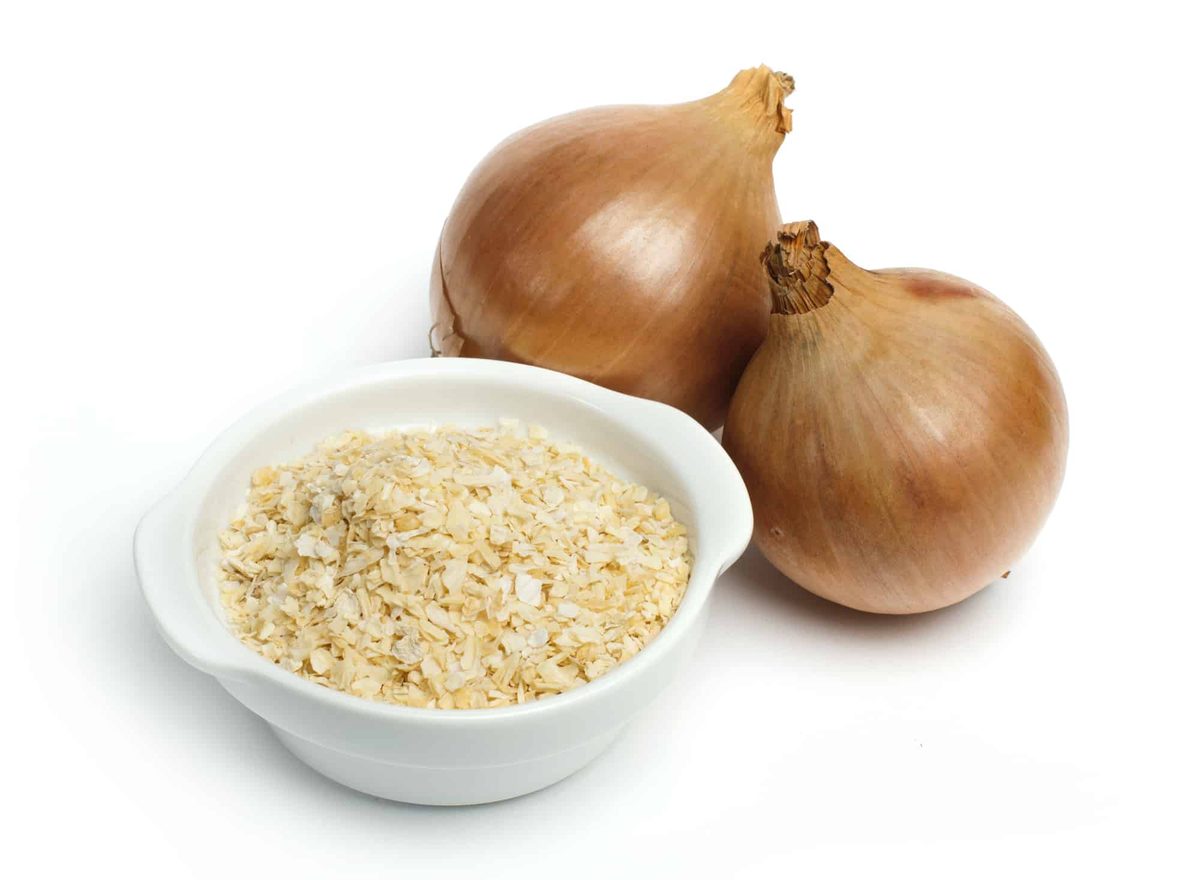
Onion powder is onion that has been dried and ground. The biggest difference from a fresh onion is water: USDA lists raw onion at 89.1 g of water per 100 g and onion powder at 5.39 g.12 Take the water out and you lose the crunch, the bulk and the juice, and you gain a seasoning that disperses evenly, stays dry in a rub and keeps for months. The flavor changes too, in ways no study we found has pinned down. And the onions are not quite the same: powder is usually made from white onions bred for drying.3
Side by side
| Fresh onion | Onion powder | |
|---|---|---|
| What it is | The bulb of Allium cepa41 | Dried, ground onion bulb2 |
| Onions used | Any | Mostly white varieties with high soluble solids, often hybrids bred for drying3 |
| Water, per 100 g (USDA) | 89.1 g1 | 5.39 g2 |
| Weights (USDA) | 1 small = 70 g; 1 medium = 110 g; 1 tablespoon chopped = 10 g1 | 1 teaspoon = 2.4 g; 1 tablespoon = 6.9 g2 |
| Equal to one onion | 1 teaspoon per small onion (NDSU) or 1 tablespoon per medium onion (NMSU); see below56 | |
| Tear-inducing compound | Formed by an enzyme when the onion is cut7 | No study found |
| Storage | Cool, dry and ventilated; weeks to months depending on variety and conditions89 | Airtight, away from heat, light and moisture; about 1 year is ATK’s general rule for ground spices10 |
| Flavor (editorial) | Sharp and crisp raw; sweet and deep when cooked slowly | Sweeter, rounder and less sharp than raw onion, with a slightly toasted note |
| Price | No dated, sourced comparison found | No dated, sourced comparison found |
For each form on its own, see onion powder. The equivalents are covered in full on onion powder substitutes.
Why they taste different
Fresh onion’s flavor starts when it is cut. The enzyme alliinase acts on sulfur-containing precursors, and the compounds that give fresh onion its flavor are thiosulfinates.7 The compound that makes your eyes water is a different product, made by a separate enzyme, lachrymatory-factor synthase, which a team publishing in Nature identified in 2002.7 So the sharpness and the tears of a freshly cut onion come from chemistry that happens at the cutting board.
What drying and grinding do to that chemistry is not something we found a published study on. Unlike garlic powder, whose dormant enzyme is well documented (see garlic powder vs. garlic), the behavior of onion powder’s enzymes is not covered by any source we could open. A common claim says onion powder won’t make you cry; nobody seems to have tested it. The flavor descriptions in the table above are ours.
The raw material also differs. Oregon State University’s guide to onions for dehydration names soluble solids and pungency as the key factors for growers, says white types are the most commonly used, and notes that varieties bred for drying may reach 23% soluble solids or more.3 Many are hybrids developed and supplied by the dehydrating companies.3 A supermarket yellow onion is not the same raw material.
How much powder replaces an onion
Two university extension guides give different equivalents, and they don’t measure the same onion:
| Source | Onion powder | Fresh onion |
|---|---|---|
| NDSU Extension, FN1985 | 1 tsp | 1 small onion, or 1/4 cup chopped |
| NMSU Extension, E-1316 | 1 Tbsp | 1 medium onion, chopped, or 4 Tbsp fresh chopped onion |
NMSU’s figure is three times as much powder, for a medium rather than a small onion. Measured against chopped onion, the gap is plain: NDSU sets 1/4 cup of chopped onion against 1 teaspoon of powder, and NMSU sets the same 1/4 cup (4 tablespoons) against 1 tablespoon. Both are round-number kitchen rules, not flavor measurements.
A check against USDA weights (our arithmetic). USDA weighs a small onion at 70 g, a medium at 110 g and a tablespoon of chopped onion at 10 g.1 So NDSU’s “small onion” and “1/4 cup chopped” are about 70 g and 40 g, and NMSU’s “medium onion” and “4 Tbsp chopped” are about 110 g and 40 g. Each guide’s two descriptions of the same onion differ in weight, NMSU’s by more than double. That is one more reason to treat every figure here as a starting point.
Our starting points (Method):
- Powder for fresh: 1 teaspoon of powder per small onion, the lower figure, then taste and add more.
- Fresh for powder: about 1 1/3 tablespoons of chopped onion per teaspoon of powder (NMSU’s ratio), up to 1/4 cup (NDSU’s), tasting as you go.
What the water does
Adding fresh onion adds liquid. A small onion weighs 70 g and is 89.1% water,1 so it carries about 62 g of water by our arithmetic, a little over 1/4 cup. In a soup that doesn’t matter. In a dry rub, it turns the rub into a paste; in a meatloaf, a burger or a dip, it loosens the mix. Cook the onion down first or cut another liquid.
Using powder takes that liquid away. Swapping powder into a recipe built for fresh onion removes the onion’s water and bulk. In a braise or sauce, add a little extra liquid if the dish looks tight. That is kitchen judgment.
Heat. Ground spices don’t fare well under intense heat and can turn bitter.11 Add onion powder with liquid or after the pan has other ingredients in it, not to a dry, hot pan on its own.
Nutrition: what drying changes
At cooking amounts neither matters much nutritionally, but the USDA records show what drying does. They are two separate analyses of different samples, not one onion measured before and after drying.
| Per 100 g (USDA) | Onions, raw1 | Onion powder2 |
|---|---|---|
| Water | 89.1 g | 5.39 g |
| Energy | 40 kcal | 341 kcal |
| Fiber | 1.7 g | 15.2 g |
| Potassium | 146 mg | 985 mg |
| Sodium | 4 mg | 73 mg |
| Vitamin C | 7.4 mg | 23.4 mg |
Most differences come from removing water: everything else is concentrated. Per amount actually used, the picture flips. By our arithmetic, a small onion (70 g) carries about 1.2 g of fiber; the teaspoon of powder (2.4 g) that NDSU puts in its place carries about 0.4 g.125 Vitamin C also falls relative to the dry matter, from about 68 mg per 100 g of dry matter in the raw record to about 25 mg in the powder record, though with two separate samples that comparison is rough.
A claim that onion powder is easier to digest than fresh onion for people who have trouble with onions circulates widely. We found no source that supports it, and it is not repeated here as advice.
Storage
Fresh onions. Two sources give storage advice for different situations, and they disagree on temperature:
| Source and scope | Temperature | How long |
|---|---|---|
| Iowa State University Extension, home-grown cured onions8 | 32 to 40°F, 65 to 70% relative humidity | Good keepers several months; poor keepers such as ‘Walla Walla’ and ‘Candy’ a few weeks |
| National Onion Association, foodservice handling9 | 45 to 55°F, dry and well ventilated | 30 to 60 days for spring and summer onions; 30 to 180 days for fall and winter onions |
Both say to keep onions where air can circulate,89 and the National Onion Association advises against storing them with potatoes or in plastic bags.9 Cut onions keep for several days sealed and refrigerated, according to the association.9 A widely repeated rule of “six weeks at room temperature, two months in the fridge” matches neither source.
Onion powder. Keep it airtight and away from the stove: ATK says heat, light and moisture shorten a spice’s shelf life, and gives about a year for ground spices as a general rule.10 A claim that onion powder lasts four years has no source we could find. Clumps mean it has taken on moisture.
When to use which
These are kitchen judgments:
- Onion powder in dry rubs, spice blends and seasoned flour; in dips and dressings, where chopped onion would be too sharp or chunky; in burgers and meatloaf, where you want flavor without pieces; and in smooth sauces such as barbecue sauce. It pairs naturally with garlic powder and paprika.
- Fresh onion where texture and bulk matter: soups, stews, braises and stir-fries; anything that starts by softening an onion in fat; and raw, for crunch, on burgers, hot dogs and salads.
- Both together in many slow-cooked dishes: fresh onion for body, a pinch of powder to round out a sauce or gravy at the end.
What isn’t known
- No study compares the flavor strength of onion powder with fresh onion. Every equivalent is a rule of thumb, and the two extension guides differ about threefold.
- No study was found on how drying changes onion’s thiosulfinates or whether onion powder can form the tear-inducing compound.
- USDA’s raw and powder records are separate samples, so the nutrient table is not a before-and-after measurement.
- No regulator or standards body gives a shelf life for onion powder.
Related
- Onion powder and onion powder substitutes
- Onion salt, onion salt vs. onion powder and onion salt substitutes
- Garlic powder vs. garlic and chives vs. green onions
- French onion soup spices
Footnotes
-
Onions, raw (FDC ID 170000), USDA FoodData Central. fdc.nal.usda.gov · Regulator ↩ ↩2 ↩3 ↩4 ↩5 ↩6 ↩7 ↩8
-
Spices, onion powder (FDC ID 171327), USDA FoodData Central. fdc.nal.usda.gov · Regulator ↩ ↩2 ↩3 ↩4 ↩5 ↩6
-
Onions for Dehydration, Oregon Vegetables, Oregon State University, 2010. horticulture.oregonstate.edu · Reference work ↩ ↩2 ↩3 ↩4
-
Allium cepa L., Plants of the World Online, Royal Botanic Gardens, Kew. powo.science.kew.org · Reference work ↩
-
Julie Garden-Robinson, Ingredient Substitutions (FN198), NDSU Extension, 2018. ksre.ksu.edu · Reference work ↩ ↩2 ↩3
-
In a Pinch Ingredient Substitution (E-131), NMSU Cooperative Extension, 2016. pubs.nmsu.edu · Reference work ↩ ↩2
-
Imai S, Tsuge N, Tomotake M et al., “An onion enzyme that makes the eyes water”, Nature, 2002. nature.com · Peer-reviewed ↩ ↩2 ↩3
-
How do you harvest, dry, and store onions?, Iowa State University Extension and Outreach, 2025. yardandgarden.extension.iastate.edu · Reference work ↩ ↩2 ↩3
-
Receiving, Handling and Storage, National Onion Association. onions-usa.org · Merchant ↩ ↩2 ↩3 ↩4 ↩5
-
Keeping Spices and Dried Herbs Fresher Longer, America’s Test Kitchen. americastestkitchen.com · Publication ↩ ↩2
-
Marco Rossi, How To Improvise Instant Pot Seasoning Without Burning Your Spices, Tasting Table, 2023. tastingtable.com · Publication ↩