Spices · Profile
Onion Powder: What It Is, How It Tastes, and How Much Replaces an Onion
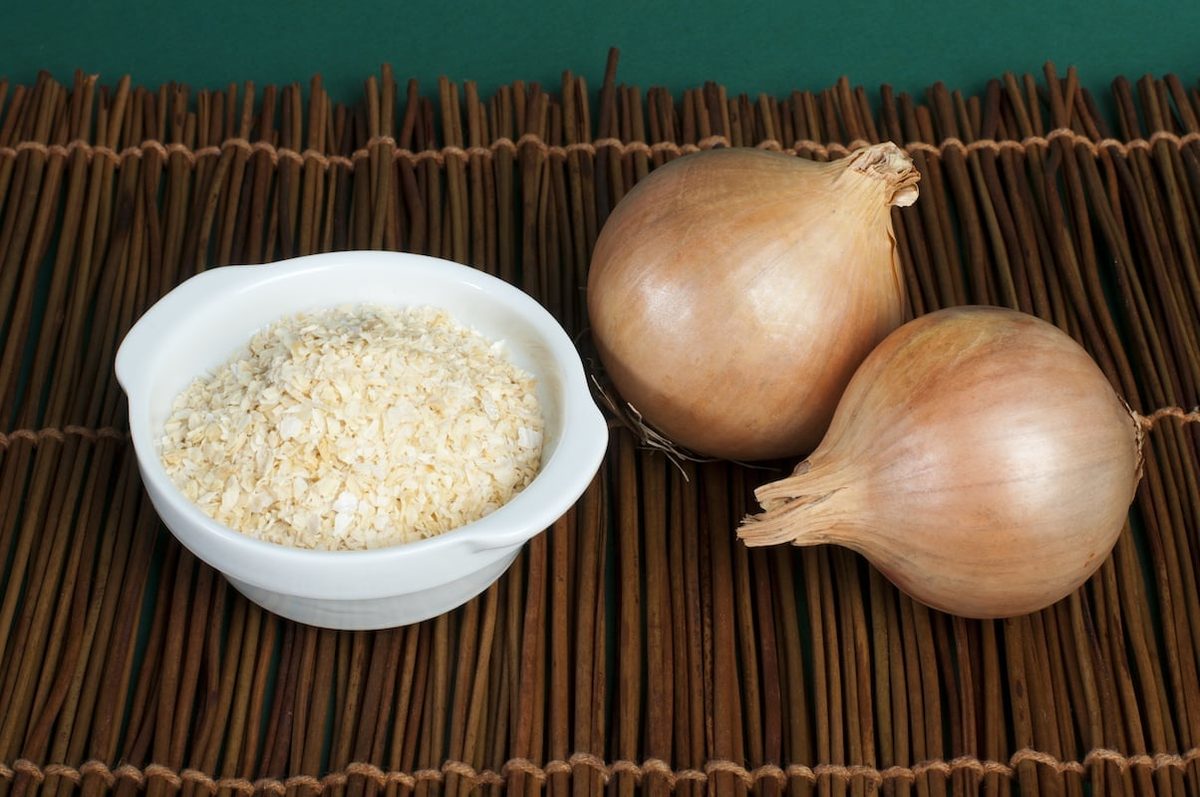
Onion powder is onion that has been dried and ground to a fine powder. It gives a dish onion flavor without the moisture, texture or chopping of a fresh onion, which is why it turns up in dry rubs, seasoning blends, dips and dressings. This page covers what it is made from, where onion’s flavor and its tear-inducing compound come from, how much powder replaces a fresh onion (published equivalents disagree), how to use it, and what it does and doesn’t add nutritionally.
At a glance
| Made from | Bulbs of onion, Allium cepa L.12 |
| Plant family | Amaryllidaceae1 |
| Origin of the plant | Known only as a cultigen, from Central Asia1 |
| Onions grown for drying | Mostly white varieties with high soluble solids, 23% or more in varieties bred for the purpose3 |
| Flavor chemistry | Thiosulfinates for flavor; a separate enzyme makes the tear-inducing compound4 |
| One teaspoon weighs | 2.4 g (USDA)2 |
| Forms sold | Powder, granulated onion, minced and flaked dried onion, onion salt |
Measured values
7 figures, sourced| Measure | Value | Scope | Source |
|---|---|---|---|
| Energy Nutrient | 341 kcal per 100 g | USDA FoodData Central, onion powder (FDC ID 171327, SR Legacy) | fdc.nal.usda.gov |
| Fiber Nutrient | 15.2 g per 100 g | USDA FoodData Central, onion powder (FDC ID 171327, SR Legacy) | fdc.nal.usda.gov |
| Potassium Nutrient | 985 mg per 100 g | USDA FoodData Central, onion powder (FDC ID 171327, SR Legacy) | fdc.nal.usda.gov |
| Calcium Nutrient | 384 mg per 100 g | USDA FoodData Central, onion powder (FDC ID 171327, SR Legacy) | fdc.nal.usda.gov |
| Magnesium Nutrient | 113 mg per 100 g | USDA FoodData Central, onion powder (FDC ID 171327, SR Legacy) | fdc.nal.usda.gov |
| Sodium Nutrient | 73 mg per 100 g | USDA FoodData Central, onion powder (FDC ID 171327, SR Legacy) | fdc.nal.usda.gov |
| Vitamin C Nutrient | 23.4 mg per 100 g | USDA FoodData Central, onion powder (FDC ID 171327, SR Legacy) | fdc.nal.usda.gov |
Each figure is quoted as its source states it, with the samples or standard it applies to. Where sources differ, both are shown; nothing is averaged. All measured values
What onion powder is
USDA’s food composition data list onion powder as a spice made from Allium cepa,2 the common onion. Kew places the onion in the Amaryllidaceae and describes its native range as “a cultigen from Central Asia”: it is known from cultivation rather than as a wild plant.1
Onions grown for drying are bred for the job. Oregon State University’s guide to onions for dehydration names soluble solids content and pungency as the key economic factors, and notes that varieties developed specifically for dehydration may reach 23% soluble solids or more.3 White types are the most commonly used, to make processing easier; yellow types are used only for special purposes.3 Many are hybrids developed and supplied by the dehydrating companies themselves.3 In the United States, OSU mentions Oregon’s Hermiston-Boardman area and California’s San Joaquin and Imperial valleys as growing areas.3
We found no statistical source for onion powder production by country. The often-repeated claim that the US is the largest producer and India the second could not be traced.
Flavor and the chemistry behind it
Onion powder tastes sweeter, rounder and less sharp than raw onion, with a slightly toasted note; it lacks both the crisp bite of raw onion and the deep caramel flavor of onions browned slowly in fat. That description is ours.
Fresh onion’s sulfur chemistry starts with the enzyme alliinase acting on a sulfur-containing precursor. For a long time it was assumed that alliinase alone produced the compound that makes your eyes water. In 2002 a team publishing in Nature showed otherwise: the tear-inducing “lachrymatory factor” is made by a separate enzyme they named lachrymatory-factor synthase, and the compound formed only when alliinase, the precursor and the new enzyme were all present.4 The flavor of fresh onion, they wrote, comes from thiosulfinates, a different group of compounds.4 So the sulfur compound that makes you cry and the ones that make onion taste like onion are not the same thing.
How drying and grinding change these compounds in onion powder is not something we found a published study on, and we won’t guess. Unlike garlic powder, whose dormant enzyme is well documented (see garlic powder), the behavior of onion powder’s enzymes once rehydrated is not covered by any source we could open.
How much powder replaces an onion
Two university extension guides give different equivalents, and they don’t measure the same onion:
| Source | Onion powder | Fresh onion |
|---|---|---|
| NDSU Extension, FN1985 | 1 tsp | 1 small onion |
| NMSU Extension, E-1316 | 1 Tbsp | 1 medium onion, chopped, or 4 Tbsp fresh chopped onion |
NMSU’s figure works out to three times as much powder, for a medium rather than a small onion; the two sources don’t define those sizes, so the gap can’t be resolved from their tables. Both are round-number kitchen rules rather than flavor measurements. NDSU also lists 1 1/3 teaspoons of onion salt, or 1 to 2 tablespoons of minced dried onion, for a small onion.5 A sensible starting point is the lower figure, 1 teaspoon per small onion, then taste and add more.
For other swaps, see onion powder substitutes, and for the side-by-side comparison, onion powder vs. onion.
How onion powder is used
By common practice, onion powder goes where chopped onion would be unwelcome or would add too much moisture: dry rubs for grilled and smoked meat, seasoning blends, breading and seasoned flour, dips, salad dressings, soups and gravies. It is a regular part of blends such as taco seasoning, cajun seasoning, creole seasoning, adobo seasoning, poultry seasoning and seasoned salt, and it pairs naturally with garlic powder, paprika and black pepper. Those are kitchen observations, not measured facts. For onion-forward cooking, see French onion soup spices.
Technique
- Let it sit before tasting. In dips and dressings, many cooks let the mix rest a few minutes before adjusting the seasoning; that is common practice rather than a measured finding.
- Keep it out of a hot, dry pan. Ground spices do not fare well under intense heat and can turn bitter.7 Add onion powder with liquid or after the fat has some other ingredients in it.
- Don’t double up on salt. Onion salt is a different product; see onion salt vs. onion powder.
Buying and storage
Good onion powder is free-flowing and pale cream to off-white, and smells clearly of onion; clumps mean it has absorbed moisture. Those are kitchen judgments. We found no grading standard for dried onion and no shelf-life figure from a regulator or standards body. Store it airtight, away from heat and humidity, and replace it when the aroma is faint.
Nutrition
USDA data for onion powder, per 100 g, show 341 kcal, 15.2 g fiber, 985 mg potassium, 384 mg calcium, 113 mg magnesium, 73 mg sodium and 23.4 mg vitamin C.2 A teaspoon weighs 2.4 g and a tablespoon 6.9 g,2 so at cooking amounts the numbers are small:
| Per serving | 1 tsp (2.4 g) | 1 Tbsp (6.9 g) |
|---|---|---|
| Energy | 8 kcal | 24 kcal |
| Fiber | 0.4 g | 1.0 g (4% of the 28 g Daily Value) |
| Potassium | 24 mg (under 1% of the 4,700 mg Daily Value) | 68 mg |
| Calcium | 9 mg | 26 mg |
| Magnesium | 3 mg | 8 mg |
| Sodium | 2 mg | 5 mg |
Calculated from USDA’s per-100 g values and portion weights; Daily Values from the FDA.28 Plain onion powder adds almost no sodium; onion salt, as the name says, adds salt. It is not a meaningful source of any nutrient at the amounts used in cooking, and no evidence reviewed here shows that it treats or prevents any condition.
History
Onions have a long record as both food and folk medicine. Pliny the Elder recommended onion for the eyes, having the patient smell it until tears came or rubbing the eyes with its juice, and fresh onion in vinegar, or dried onion with wine and honey, for dog bites.9 A note in the Bostock and Riley translation calls those reputed healing virtues quite erroneous.9
Other widely repeated history (onions in use by 5000 BC, onions in pharaohs’ tombs as symbols of eternal life, Roman soldiers carrying onions to Britain, and Egypt as the first place to grind dried onion) could not be traced to a source we could open, and is left out.
Substitutes and comparisons
- Onion powder substitutes
- Onion powder vs. onion
- Onion salt vs. onion powder
- Onion salt and onion salt substitutes
- Garlic powder
- Chives
Footnotes
-
Allium cepa L., Plants of the World Online, Royal Botanic Gardens, Kew. powo.science.kew.org · Reference work ↩ ↩2 ↩3 ↩4
-
Spices, onion powder (FDC ID 171327), USDA FoodData Central. fdc.nal.usda.gov · Regulator ↩ ↩2 ↩3 ↩4 ↩5 ↩6
-
Onions for Dehydration, Oregon Vegetables, Oregon State University. horticulture.oregonstate.edu · Reference work ↩ ↩2 ↩3 ↩4 ↩5
-
Imai S, Tsuge N, Tomotake M et al., “An onion enzyme that makes the eyes water”, Nature, 2002. nature.com · Peer-reviewed ↩ ↩2 ↩3
-
Julie Garden-Robinson, Ingredient Substitutions (FN198), NDSU Extension, 2018. ksre.ksu.edu · Reference work ↩ ↩2
-
In a Pinch Ingredient Substitution (E-131), NMSU Cooperative Extension, 2016. pubs.nmsu.edu · Reference work ↩
-
Marco Rossi, How To Improvise Instant Pot Seasoning Without Burning Your Spices, Tasting Table, 2023. tastingtable.com · Publication ↩
-
Daily Value on the Nutrition and Supplement Facts Labels, U.S. Food and Drug Administration. fda.gov · Regulator ↩
-
Pliny the Elder, Natural History 20.20, Perseus Digital Library. perseus.tufts.edu · Reference work ↩ ↩2