Spices · Profile
Onion Salt: What It Is, How Much Sodium It Carries, and How to Use It
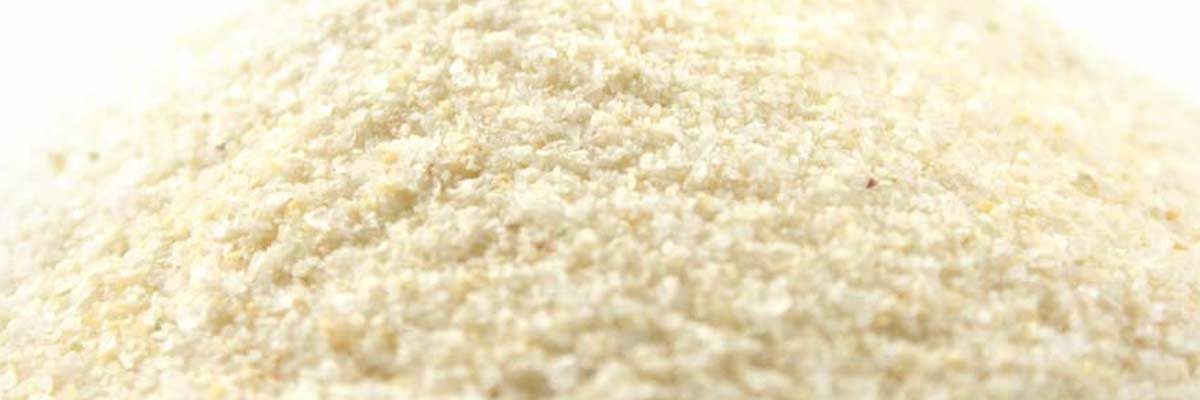
Onion salt is salt blended with dried onion. McCormick’s version lists salt, onion, an anticaking agent and extractives of onion, and carries 440 mg of sodium per ¼ teaspoon.1 That is about three-quarters of the sodium in the same measure of Morton’s iodized table salt, 590 mg.2 It seasons a dish the way salt does, with a toasty onion flavor on top.
At a glance
| What it is | Salt plus dried onion, usually with an anticaking agent1 |
| Plant | Onion, Allium cepa L., family Amaryllidaceae3 |
| Origin of onion | Known only as a cultigen; Kew places its origin in Central Asia3 |
| Sodium, per ¼ teaspoon | McCormick Onion Salt 440 mg; Morton Iodized Table Salt, for comparison, 590 mg12 |
| Plain onion powder, for comparison | 73 mg sodium per 100 g (USDA)4 |
| Swap with fresh onion | 1⅓ teaspoons onion salt for 1 small onion (NDSU Extension)5 |
Measured values
1 figure, sourced| Measure | Value | Scope | Source |
|---|---|---|---|
| Sodium Nutrient | 440 mg per 1/4 teaspoon | McCormick Onion Salt, label Nutrition Facts via retailer listingCompany's own figures. | stopandshop.com |
Each figure is quoted as its source states it, with the samples or standard it applies to. Where sources differ, both are shown; nothing is averaged. All measured values
What’s in it
McCormick’s label lists salt, onion, sodium silicoaluminate (to keep it free flowing) and extractives of onion.1 The label does not give the proportion of salt to onion. Plain onion powder contains very little sodium, 73 mg per 100 g in USDA’s data, so nearly all the sodium in onion salt comes from the salt.41
The onion part is dehydrated onion. Oregon State University’s horticulture department notes that white onions are the type most commonly grown for dehydration, and that varieties bred for drying can reach 23% soluble solids or more.6 We found no published account of how any commercial onion salt is processed.
Flavor and the compounds behind it
In fresh onion, the flavor comes from compounds called thiosulfinates, while the compound that makes eyes water is produced by a separate enzyme, lachrymatory-factor synthase.7 We found no study of how drying and grinding change those compounds in onion powder or onion salt.
McCormick describes its onion salt as bringing a savory, toasty flavor.1 In practice it tastes of salt first, then of cooked onion rather than the sharpness of raw onion. Like any flavored salt, you cannot add more onion without adding more salt. Those flavor points are editorial.
Origin and history
Onion is known only in cultivation, and Kew gives its origin as Central Asia.3 Widely repeated stories about onions in Egyptian carvings, in the Roman army’s baggage and on early colonial ships, and a claim that onion salt was first sold in the early 1900s as a breath-friendly seasoning, could not be traced to a source we could open, so they are left out.
How onion salt is used
As the salt in a dish. Onion salt works best when it stands in for some of the plain salt. McCormick suggests it for soups, stews and burgers.1 It is also common in barbecue dry rubs, salad dressings, dips, and sprinkled on roasted vegetables, fries or popcorn; those are common uses rather than sourced claims.
In place of fresh onion. NDSU Extension lists 1⅓ teaspoons of onion salt as a stand-in for one small onion, alongside 1 teaspoon of onion powder or 1 to 2 tablespoons of minced dried onion.5 Onion salt adds salt that fresh onion does not, so reduce the recipe’s salt when you use it, and add salt back when you go the other way.
Instead of onion powder. The two are not interchangeable one for one. Onion powder adds onion with almost no sodium; onion salt adds both.41 See onion salt vs. onion powder.
Buying and quality
Read the ingredient list: a plain onion salt lists salt and onion, plus perhaps an anticaking agent and onion extractives.1 Seasoned salts and onion-flavored blends with sugar, garlic or other spices are different products. Common practice is to replace a jar once it no longer smells clearly of onion.
Storage
We found no shelf-life figure for onion salt from a regulator or standards body. Store it closed, dry and away from heat, as is common practice for ground seasonings.
Safety and health
Sodium. By McCormick’s label, one teaspoon of onion salt carries about 1,760 mg of sodium (4 × 440 mg).1 The FDA’s Daily Value for sodium is less than 2,300 mg a day,8 and the World Health Organization recommends that adults stay below 2,000 mg a day, naming raised blood pressure as the main health effect of high intake.9 Table salt is about 40% sodium,10 so no blend of salt and onion can be “at least 50 percent sodium,” a figure that circulates; it can only be less than 40%.
Health claims. Onion salt is sometimes presented as a low-calorie seasoning that helps with weight loss or heart health, or as a source of fiber and minerals. We found no evidence for any of that at the amounts used, and its sodium content makes the heart-health claim the wrong way round. This page makes no health claim for onion salt.
Substitutes and comparisons
- Onion salt substitutes
- Onion salt vs. onion powder
- Onion powder, onion powder substitutes and onion powder vs. fresh onion
- Other flavored salts: garlic salt, celery salt, seasoned salt
- Table salt and too much salt
Footnotes
-
McCormick Onion Salt, label ingredients, Nutrition Facts and description as listed by Stop & Shop. stopandshop.com · Merchant ↩ ↩2 ↩3 ↩4 ↩5 ↩6 ↩7 ↩8 ↩9 ↩10
-
Morton Iodized Table Salt, Nutrition Facts, Morton Salt. mortonsalt.com · Merchant ↩ ↩2
-
Allium cepa L., Plants of the World Online, Royal Botanic Gardens, Kew. powo.science.kew.org · Reference work ↩ ↩2 ↩3
-
Spices, onion powder, USDA FoodData Central. fdc.nal.usda.gov · Regulator ↩ ↩2 ↩3
-
Julie Garden-Robinson, Ingredient Substitutions, NDSU Extension, 2018. ksre.ksu.edu · Reference work ↩ ↩2
-
Onions for Dehydration, Oregon Vegetables, Oregon State University, 2010. horticulture.oregonstate.edu · Reference work ↩
-
Imai S et al., An onion enzyme that makes the eyes water, Nature, 2002. nature.com · Peer-reviewed ↩
-
Sodium in Your Diet, U.S. Food and Drug Administration. fda.gov · Regulator ↩
-
Sodium reduction, World Health Organization fact sheet, 2026. who.int · Regulator ↩
-
Sodium Sources: Where Does All That Sodium Come From?, American Heart Association, 2025. heart.org · Reference work ↩