Spice Substitutes · Substitutes
Orris Root Substitutes, Ranked by the Job Orris Is Doing
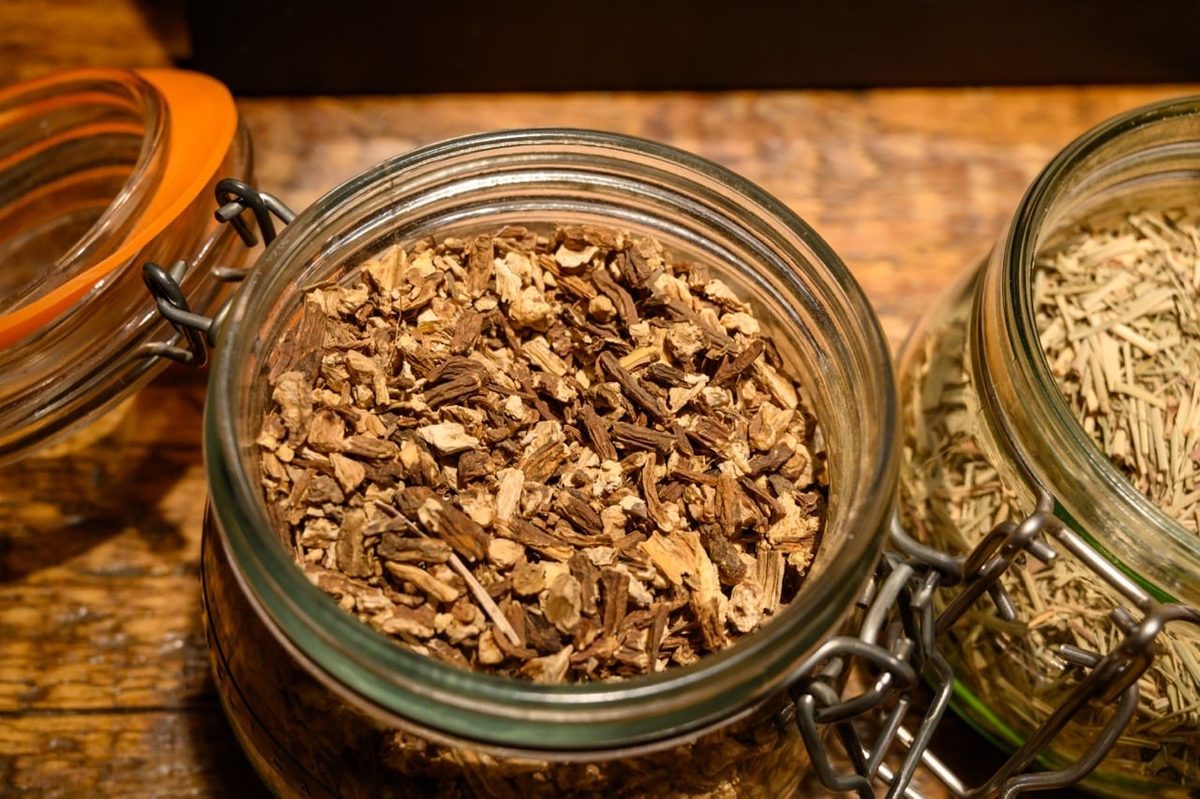
Orris root is the dried rhizome of certain irises, and what it brings is scent: Britannica describes orris oil as warm and violet-like.1 That note comes from irones, which form slowly as the harvested rhizome is stored and its iridals oxidize; traditional storage lasts up to 3 to 4 years.2 Nothing in an ordinary spice cabinet contains irones, so every substitute below is a different floral or rooty note, not a copy. Orris’s use in foods has declined because some people react to it,1 and today a recipe that calls for it is usually a spice blend or a homemade gin or botanical infusion. Which substitute works depends on which of those you are making.
Quick answer
| What orris is doing | Best substitute | Starting amount, per 1 part orris root | Treatment |
|---|---|---|---|
| Floral note in ras el hanout or another dry spice blend | Dried, food-grade rosebuds or rose petals, ground | 1 part, then taste | Method |
| Floral note in a syrup, sweet or drink | Rose water | A few drops per teaspoon of orris, then taste | Method |
| A root botanical in gin or a bitters-style infusion | Angelica root | 1/2 part | Method |
| One minor ingredient in a long blend | Leave it out | None | Method |
The rest of the page explains each choice and where it falls short.
How the ratios on this page are labeled
Every ratio carries one of four labels.
- Computed: based on a measurable physical relationship, with the source named.
- Attributed: a named source publishes this ratio. We quote it as theirs.
- Disputed: named sources give different answers to the same swap. We show each one and do not average them.
- Method: we found no published ratio. We give a direction and a cautious starting point, and say so.
We found no published ratio for any orris root substitute, so every amount on this page is a Method starting point, not a measured equivalence.
Why orris is hard to replace
Fresh iris rhizomes do not smell of violets. The irones that give orris its character form during storage, and a 2026 study of Tuscan Iris pallida describes the natural conversion as a very long process of 2 to 3 years.2 The same study calls orris oil among the most expensive materials in perfumery.2 None of the substitutes below is reported in the sources we used to contain irones. They are chosen for doing a similar job in the recipe.
We also found no reference work that describes how orris tastes in food, as distinct from how it smells. A widely repeated claim says it tastes like licorice; no source we found supports it.
If orris is a floral note in a spice blend
The blend most often mentioned with orris is the North African mix ras el hanout. The Oxford Companion to Food’s entry lists its standard ingredients as cumin, coriander, turmeric, ginger, cardamom and nutmeg, with cinnamon, cayenne and rosebud usually included, and does not mention orris.3 World Spice Merchants’ 24-ingredient version lists roses and lavender.4 So the floral ingredients these sources do document in ras el hanout are rose and lavender, which makes them the natural stand-ins.
1. Dried rosebuds or rose petals
The Oxford Companion names the rosebud as damask rose.3 Gernot Katzer describes rose’s flavor as flowery, perfume-like and sweet, and gives the main constituents of rose oil as geraniol (up to 75%), citronellol and nerol.5 That chemistry is unrelated to orris’s irones, so the result will read as rose rather than violet; in our judgment it still fills the floral gap in a warm spice blend.
Buy petals sold for eating. The New York Botanical Garden’s library advises against eating flowers from florists or nurseries,6 and the FDA’s list of substances generally recognized as safe covers rose buds and flowers from four species: Rosa alba, R. centifolia, R. damascena and R. gallica.7 The same library notes that dark red varieties can taste too strong.6
Ratio (Method): No published ratio. Grind the dried petals and start with the same amount as the orris, then taste the finished blend before adding more.
2. Dried culinary lavender
Lavender appears in World Spice’s ras el hanout label.4 Its essential oil is dominated by linalool and linalyl acetate.8 Choose true lavender (Lavandula angustifolia): the Herb Society of America notes that lavandin and Spanish lavender carry high levels of cineole and camphor, which cooks may not want.9 Lavender is the stronger and more medicinal-tasting of the two flowers in our judgment, and it has nothing of violet about it.
Ratio (Method): No published ratio. Start with about a quarter of the orris amount. The Herb Society suggests adding lavender as you go,9 which suits a blend you can taste as you build it. If you have fresh flowers, the same source says dried buds are about three times as concentrated as fresh.9
If orris is a floral note in a syrup, sweet or drink
Orris oil was once popular in candies, soft drinks and gelatin desserts.1 For a liquid, a powder of petals is awkward; rose water is easier.
Rose water
Rose water is mostly made by distilling fresh Rosa damascena flowers.10 Katzer notes that 2-phenylethanol, a rose aroma compound, is lost from the oil during steam distillation and collects in the rose water,5 and that rose water is used in marzipan, many Indian sweets, and Arabic and Iraqi rice dishes.5
Ratio (Method): No published ratio. Rose waters vary in strength, so start with a few drops for each teaspoon of orris root in the recipe, stir and taste, and add more drop by drop.
Lavender also works here: Britannica notes that it is sometimes used to flavor beverages and sweets.11 Infuse a pinch of dried culinary lavender in the warm syrup and strain it out; in our judgment a little goes a long way.
If orris is a root botanical in gin or an infusion
Britannica lists orris among the botanicals combined with juniper in gin, alongside angelica and licorice roots.12 If you are building a home infusion and have no orris, another root from the same list is the practical swap.
Angelica root
Angelica (Angelica archangelica) belongs to the parsley family, Apiaceae.13 Hank Shaw calls it one of the most important herbs in gin and describes its flavor as more floral, a little bitter and a bit carroty.14 Its root oil is dominated by monoterpenes: one Italian sample was mostly α-pinene, δ-3-carene and limonene.15 None of those is a violet note, so angelica replaces orris’s place in the recipe more than its scent. The FDA lists angelica root among substances generally recognized as safe.7
Angelica root contains furocoumarins. The European Medicines Agency’s committee on herbal medicines notes that some of these are phototoxic, judges the risk from dietary intake to be very small, and advises that angelica preparations be contraindicated for children and pregnant women and carry a warning about exposure to UV light.16 Those cautions are written for herbal medicinal preparations, not for a few grams in a bottle of gin.
Ratio (Method): No published ratio. Start with half the orris amount, because angelica adds bitterness that orris does not, and taste the infusion daily.
Licorice root
Licorice root is on Britannica’s list of gin botanicals too.12 We found no source comparing its flavor with orris, so we do not rank it here.
If orris is one minor ingredient: leave it out
Ratio (Method): In a blend of a dozen or more spices, orris is a small part of the whole. Since the Oxford Companion’s account of ras el hanout does not include it at all,3 leaving it out is a legitimate option. Make the blend without it, taste, and add rose only if the floral note is missing.
What isn’t known
- No published ratio exists for any orris root substitute, and no study compares orris’s scent strength with rose, lavender or angelica.
- No reference work we found describes orris’s taste in food. The claim that it tastes like licorice could not be traced.
- We found no reference that documents orris in ras el hanout. Rose and lavender are the documented floral ingredients.34
- Lavender is often said to be best known as an ingredient of herbes de Provence. The French Label Rouge specification for herbes de Provence lists thyme, rosemary, savory, oregano and basil, without lavender.17
- The US flavoring regulation still lists orris root as a natural flavoring substance with no specific limitation,18 but we found no regulator’s statement on how common reactions to it are.
Related
- Orris root and ras el hanout, with ras el hanout substitutes
- Rose petals and rose petal substitutes
- Lavender, cooking with lavender and lavender substitutes
- Angelica and juniper berries
Footnotes
-
“Orris oil”, Encyclopaedia Britannica. britannica.com · Reference work ↩ ↩2 ↩3
-
Meucci et al., “Exploring plant-environment interaction in Iris pallida Lam.”, Industrial Crops & Products, 2026. iris.santannapisa.it · Peer-reviewed ↩ ↩2 ↩3
-
Alan Davidson, “Ras-el-hanout”, The Oxford Companion to Food, 2014. app.ckbk.com · Reference work ↩ ↩2 ↩3 ↩4
-
Ras El Hanout, World Spice Merchants (product page). worldspice.com · Merchant ↩ ↩2 ↩3
-
Gernot Katzer, “Rose (Rosa damascena Mill.)”, Gernot Katzer’s Spice Pages. gernot-katzers-spice-pages.com · Reference work ↩ ↩2 ↩3
-
Anita Finkle, “Which flowers are edible?”, LuEsther T. Mertz Library, New York Botanical Garden. libanswers.nybg.org · Reference work ↩ ↩2
-
21 CFR 182.20, Essential oils, oleoresins (solvent-free), and natural extractives, FDA. ecfr.gov · Regulator ↩ ↩2
-
Pokajewicz et al., Essential oil of new Lavandula angustifolia cultivars bred in Ukraine, Molecules, 2021. mdpi.com · Peer-reviewed ↩
-
Paola Legarre, “Lavender in the Kitchen”, The Herb Society of America blog, 2025. blog.herbsociety.org · Publication ↩ ↩2 ↩3
-
Mahboubi and Lu, “Rose water, quality control, and its application”, Journal of Medicinal Plants, 2024 (abstract). jmp.ir · Peer-reviewed ↩
-
“Lavender”, Encyclopaedia Britannica. britannica.com · Reference work ↩
-
“Gin”, Encyclopaedia Britannica. britannica.com · Reference work ↩ ↩2
-
Angelica archangelica L., Plants of the World Online, Royal Botanic Gardens, Kew. powo.science.kew.org · Reference work ↩
-
Hank Shaw, “Candied Angelica”, Hunter Angler Gardener Cook. honest-food.net · Publication ↩
-
Sowndhararajan et al., “A Review of the Composition of the Essential Oils and Biological Activities of Angelica Species”, Scientia Pharmaceutica, 2017. mdpi.com · Peer-reviewed ↩
-
Reflection Paper on the Risks Associated with Furocoumarins Contained in Preparations of Angelica archangelica L., European Medicines Agency, 2007. e-lactancia.org · Regulator ↩
-
Label Rouge Herbes de Provence (LA 02/03) specification, INAO, 2014. extranet.inao.gouv.fr · Regulator ↩
-
21 CFR 172.510, Natural flavoring substances and natural substances used in conjunction with flavors, FDA. ecfr.gov · Regulator ↩