Spice Substitutes · Substitutes
Safflower Substitutes: Matching the Color Without Adding Flavor
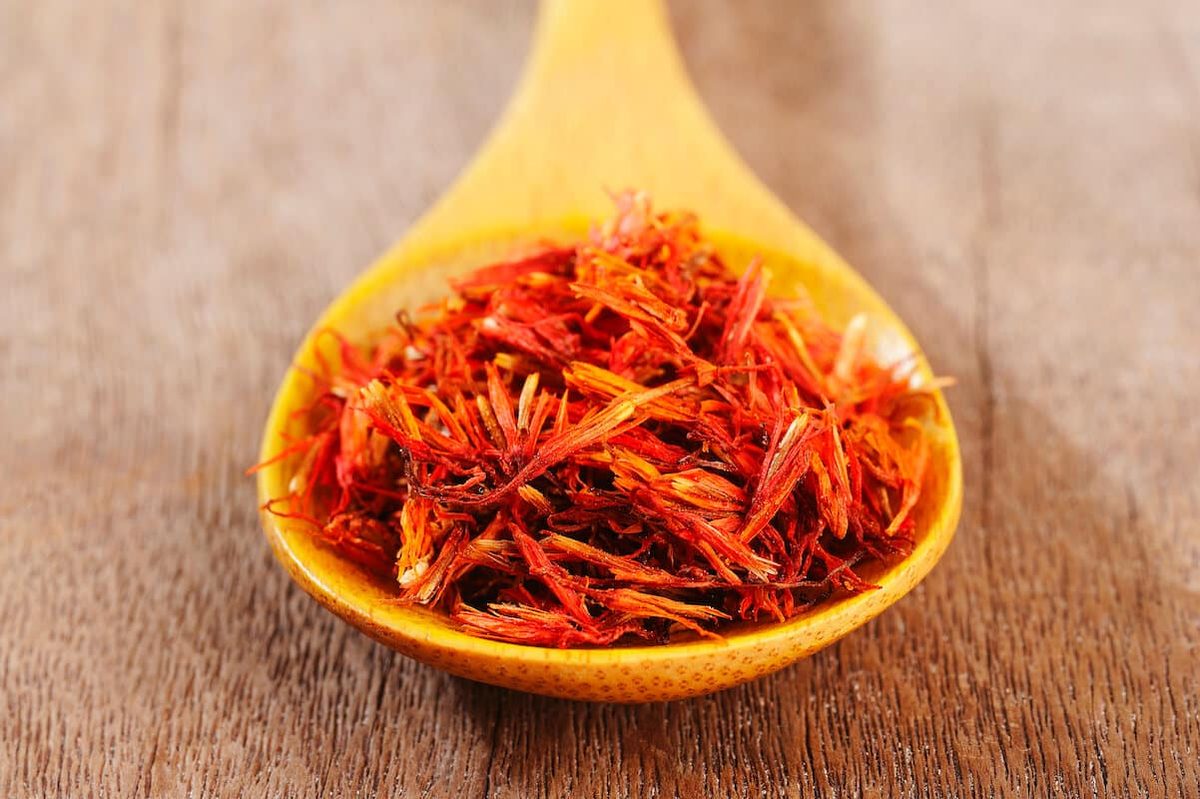
Safflower petals are a coloring, not a flavoring. Gernot Katzer describes their flavor as very weak and herbaceous, says the flowers contain no essential oil, and calls their value as a spice nearly nil, while noting that their staining power earns them a place in the kitchen.1 PROSEA names the pigments: the water-soluble yellow carthamidin and carthamin,2 which Britannica describes as a red textile dye.3 Safflower is often called “false saffron”,4 and it has been used to adulterate saffron.3
That makes the substitution question simple to state: you need something that colors food yellow, and ideally nothing else. Every substitute below adds some flavor that safflower doesn’t, so use a lighter hand than you would with safflower.
Quick answer
| What safflower is doing | Best substitute | Starting amount | Treatment |
|---|---|---|---|
| Yellow color in rice, broth, soup or stew | Ground turmeric | A small pinch (about 1/8 tsp), then more for color | Method |
| Color plus a floral, saffron-like note | Saffron threads, steeped | A few threads, then more | Method |
| Warm orange color, very little flavor | Annatto, steeped in oil or water | A pinch of seeds, strained out | Method |
| Petals for color or garnish | Dried calendula petals | 1 part by volume | Method |
How the ratios on this page are labeled
- Computed: based on a measurable physical relationship, with the source named.
- Attributed: a named source publishes this ratio. We quote it as theirs.
- Disputed: named sources give different answers to the same swap. We show each and do not average them.
- Method: we found no published ratio. We give a direction and a cautious starting point, and say so.
We found no published ratio for replacing safflower with anything. The one published figure involving safflower runs the other way: Food Republic says safflower can replace saffron in equal proportions.5 Because safflower brings so little flavor and its color is described as “rather pale”,1 every amount on this page starts small and builds up by eye.
How safflower is used
Katzer reports safflower as quite common in the cooking of Azerbaijan, where it improves the color of broths, soups and stews; in the soup piti it goes in toward the end and gives the liquid a yellowish hue.1 He also notes some use as a poor imitation of saffron in Middle Eastern cooking.1 PROSEA says the florets are commonly mixed with rice, bread and pickles.2
If safflower is coloring a dish yellow
1. Turmeric
Turmeric comes from a plant in the ginger family, and curcumin, one of its major components, gives the spice its yellow color.6 It is widely used in South Asian and Middle Eastern cooking and gives curry its yellow color.7 It is also the easiest of these substitutes to find.
Where it falls short is flavor. One reference describes turmeric’s taste as bitter, slightly acrid, yet sweet.7 Safflower has almost no taste, so too much turmeric changes the dish where safflower would not.
Ratio (Method): No published ratio for turmeric in place of safflower was found. Food Republic suggests half a teaspoon of turmeric for every large pinch of saffron,5 but that is a saffron swap, and we did not chain it into a safflower figure. Start with a small pinch, about 1/8 teaspoon, for a pot of rice or soup, and add more only if you need more color.
2. Curry powder
Curry powder colors food yellow because it contains turmeric. The USDA’s federal purchasing specification lists turmeric first among its ingredients, followed by coriander, fenugreek, cinnamon, cumin, black pepper, ginger and cardamom.8 All of those add flavor safflower doesn’t, so use curry powder only where a curry flavor suits the dish.
Ratio (Method): No published ratio was found. Start with a small pinch and taste.
If safflower is standing in for saffron
Saffron
If the dish is one where safflower was itself replacing saffron, the obvious answer is saffron. Britannica describes saffron as the golden stigmas of a crocus and still calls it the most expensive spice in the world.9 Its coloring matter is crocin.9 Unlike safflower, it brings a strong aroma and a bitter taste,9 so it changes the dish rather than only coloring it.
Ratio (Method): Food Republic treats safflower and saffron as an equal swap,5 but only in the saffron-to-safflower direction, and safflower’s near-absent flavor makes an equal amount of saffron far stronger. Start with a few threads steeped in a spoonful of warm liquid, and add more if the color is too pale.
If safflower is giving a warm color with little taste
Annatto
Annatto seeds have a weak, perfumed odor, according to Katzer.10 PROSEA says the dye can be extracted by soaking the seeds in water and squeezing them,11 and Katzer notes that the seeds are usually fried in fat to release their color.10 One of annatto’s pigments, norbixin, is water-soluble.12 Food Republic warns that annatto will dye food more red than yellow,5 so expect orange rather than safflower’s yellow.
Ratio (Method): No published ratio was found. Warm a pinch of seeds in the cooking oil or water until it colors, then strain them out.
If you need petals
Calendula
Calendula petals look closest to dried safflower florets; that comparison is ours. The New York Botanical Garden’s librarian lists calendula, also called English marigold, as an edible flower with a sharp taste resembling saffron.13 A 2022 bulletin on saffron fraud, as reported by NutraIngredients, lists safflower and calendula flowers among the plant materials used to adulterate saffron.14
Names matter here. The same NYBG list describes African marigold (Tagetes erecta) as strongly pungent,13 which is not what you want in place of a near-flavorless spice. Katzer adds that the yellow flowers used in Georgian cooking usually come from marigold, which has even less flavor than safflower.1 Buy petals sold for food: the NYBG warns not to eat flowers from florists or nurseries.13
Ratio (Method): No published ratio was found. Start 1:1 by volume and adjust by eye.
What isn’t known
- No published ratio for any safflower substitute was found. Every amount above is a starting point.
- No source measures how much color safflower gives compared with turmeric, saffron, annatto or calendula.
- Safflower is sometimes said to be a common spice in Latin American and Eastern European cooking. The sources reviewed here document its use in Azerbaijan and as a saffron imitation in the Middle East, and note that it is sold as “saffron” to tourists in Hungary and North Africa.1
Related
- Safflower, safflower uses and safflower vs saffron
- Saffron, saffron substitutes and saffron vs turmeric
- Turmeric and turmeric substitutes
- Annatto seeds and annatto seed substitutes
- Curry powder
Footnotes
-
Safflower, Gernot Katzer’s Spice Pages. gernot-katzers-spice-pages.com · Reference work ↩ ↩2 ↩3 ↩4 ↩5 ↩6
-
Oyen and Umali, Carthamus tinctorius, PROSEA. uses.plantnet-project.org · Reference work ↩ ↩2
-
Safflower, Encyclopaedia Britannica. britannica.com · Reference work ↩ ↩2
-
Still, Dyeing for Color, The Metropolitan Museum of Art, 2015. metmuseum.org · Publication ↩
-
Dand, The Best Money-Saving Substitute For Saffron, Food Republic, 2024. foodrepublic.com · Publication ↩ ↩2 ↩3 ↩4
-
Turmeric: Usefulness and Safety, NCCIH. nccih.nih.gov · Regulator ↩
-
Prasad and Aggarwal, Turmeric, the Golden Spice, in Herbal Medicine, 2011. ncbi.nlm.nih.gov · Reference work ↩ ↩2
-
Commercial Item Description A-A-20001C, Spices and Spice Blends, USDA Agricultural Marketing Service, 2023. ams.usda.gov · Regulator ↩
-
Saffron, Encyclopaedia Britannica. britannica.com · Reference work ↩ ↩2 ↩3
-
Annatto, Gernot Katzer’s Spice Pages. gernot-katzers-spice-pages.com · Reference work ↩ ↩2
-
Rajendran, Bixa orellana, PROSEA. uses.plantnet-project.org · Reference work ↩
-
Rivera-Madrid et al., Carotenoid Derivates in Achiote Seeds, Frontiers in Plant Science, 2016. frontiersin.org · Peer-reviewed ↩
-
Finkle, Which flowers are edible?, LuEsther T. Mertz Library, New York Botanical Garden. libanswers.nybg.org · Reference work ↩ ↩2 ↩3
-
Daniells, Adulterants Bulletin highlights multifaceted fraud associated with saffron, NutraIngredients, 2022. nutraingredients.com · Publication ↩