Seasonings · Profile
Curry Powder: What’s in It, Where It Came From, and How to Use It
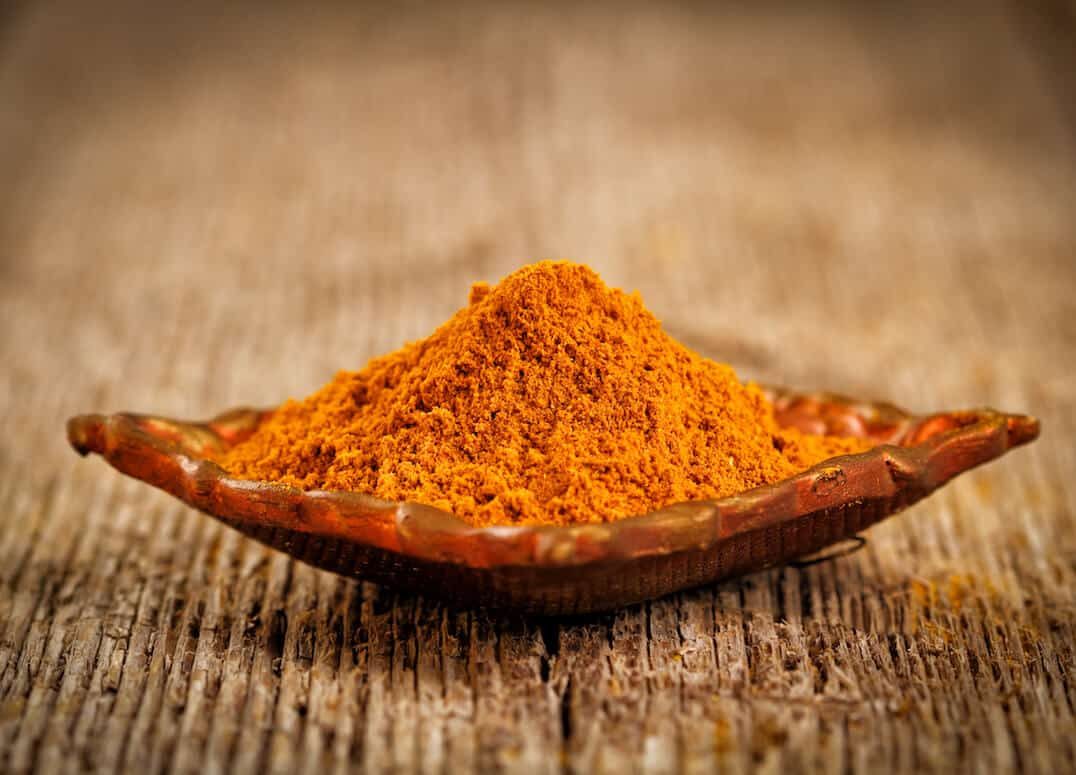
Curry powder is a ground spice blend, usually yellow from turmeric, sold as a ready-made base for curries. It is a British adaptation rather than a traditional Indian product: in Indian home cooking the spice mixtures are masalas, blended by the cook. This page covers what goes into it, where it came from, the compounds that give it its smell and color, how to cook with it, and what to know about quality and safety.
At a glance
| What it is | A ground blend of spices for making curries1 |
| Typical components | Turmeric, coriander, fenugreek, cinnamon, cumin, black pepper, ginger and cardamom, as a minimum (USDA purchase specification)2 |
| Fixed recipe? | No: “there has never been a set combination of spices” (Atlas Obscura)3 |
| Origin | Adapted by British settlers in India1 |
| Color | Yellow, from turmeric14 |
| Forms sold | Ground blend; regional styles such as Madras, Jamaican and Japanese are sold separately |
| Standards | ISO 2253:1999 (curry powder specification); USDA A-A-20001C for US government purchases25 |
| USDA limits | Moisture 9.0% max, total ash 7.2% max, 95% through a No. 30 sieve2 |
Measured values
4 figures, sourced| Measure | Value | Scope | Source |
|---|---|---|---|
| Moisture, maximum Limit | 9.0 % | USDA purchase specification A-A-20001C (2023) | ams.usda.gov |
| Total ash, maximum Limit | 7.2 % | USDA purchase specification A-A-20001C (2023) | ams.usda.gov |
| Granulation Limit | 95 % minimum through U.S. sieve No. 30 | USDA purchase specification A-A-20001C (2023) | ams.usda.gov |
| Piperine loss in cooking | 50–60 % lost | pepper boiled 15–30 minutes as part of a curry powder blend (1992 study, abstract) | agris.fao.org |
Each figure is quoted as its source states it, with the samples or standard it applies to. Where sources differ, both are shown; nothing is averaged. All measured values
What is in it
The USDA’s purchase specification for spices and spice blends says curry powder should include, but is not limited to, turmeric, coriander, fenugreek, cinnamon, cumin, black pepper, ginger and cardamom.2 It sets no proportions and lists no chile, so blends that meet it can still differ a great deal. Atlas Obscura’s history of the blend makes the same point from the other side: there has never been a set combination of spices, and it quotes an 1870 recipe from a Mrs. Hill using coriander seed, turmeric, ginger, black pepper, mustard, allspice, cumin and cardamom.3
Britannica lists the spices that typically flavor Indian curries as cardamom, cinnamon, cloves, coriander, cumin, fennel seed, fenugreek, mustard seed and turmeric, which gives its characteristic yellow color.1 Commercial blends draw from the same pool.
There is also an international standard, ISO 2253:1999, Curry powder: Specification. Its text is sold rather than published, so its requirements could not be checked for this page; ISO’s catalogue lists it as current but due for revision.5
What the USDA specification requires
The specification is written for US government food purchasing, not for retail labeling, but it is one of the few published, checkable descriptions of curry powder:2
| Requirement | Curry powder |
|---|---|
| Minimum ingredients | Turmeric, coriander, fenugreek, cinnamon, cumin, black pepper, ginger, cardamom |
| Appearance | Uniform color; must not stratify in layers or lump |
| Aroma and taste | “A fragrant aromatic aroma and a warm bitter taste” |
| Moisture, maximum | 9.0% |
| Total ash, maximum | 7.2% |
| Granulation | 95% minimum through U.S. sieve No. 30 |
Flavor and the compounds behind it
The USDA specification expects a warm, bitter taste,2 and the bitterness has an obvious source: fenugreek seed tastes strong, sweetish and somewhat bitter, and turmeric is bitter, slightly acrid and yet sweet.64 The rest of the profile comes from the individual spices:
| Spice | What it contributes | Source |
|---|---|---|
| Turmeric | Yellow color from curcumin; aroma from turmerone, ar-turmerone and zingiberene | 47 |
| Coriander seed | Oil that is 60–80% linalool | 8 |
| Cumin | Cuminaldehyde, 20–72% of the oil across studies | 9 |
| Fenugreek | Sotolon, which PROSEA says is responsible for fenugreek’s characteristic curry aroma | 10 |
| Black pepper | Piperine, which partly survives cooking (below) | 11 |
Cooking changes the balance. A 1992 study of household cooking found that piperine losses reached 50–60% when pepper was boiled for 15–30 minutes as part of a curry powder blend.11 That is one study, read here as an abstract, but it suggests that a long-simmered curry loses some of its pepper bite.
History
The word
Britannica derives “curry” from the Tamil kari, “sauce.”1 The often-repeated claim that the Portuguese carried the word to Europe could not be traced to a source we could open.
Ancient spice use in South Asia
At Farmana, a Harappan site in Haryana, archaeologists Arunima Kashyap and Steve Weber recovered starch grains tentatively identified as ginger and turmeric from a cooking pot, from occupation dated 2600–2200 BC.12 The finding is often reported as the world’s oldest curry. The researchers did not make that claim about the residue itself; “curry” appears in their work only in modern cooking experiments based on local recipes.12
A British blend
Britannica says curry powder was adapted by British settlers in India, letting British cooks recreate the flavor of Indian food, while in traditional Indian cookery the spice mixtures are called masala and are prepared at home.1 Atlas Obscura quotes Madhur Jaffrey, writing in 1974, that “no Indian ever uses curry powder.”3 Claims about the first British advertisements for curry powder in the 1780s, and their link to the botanist Daniel Solander, could not be traced to any source we could open, so this page does not repeat them.
How curry powder is used
Curry powder goes into curries of chicken, lamb, seafood and vegetables such as cauliflower and chickpeas, and into marinades, soups and dressings. That is common practice rather than a sourced finding. Regional styles have their own pages: Madras, Jamaican, Japanese, Malaysian and vindaloo curry powders.
Technique
Ground spices added straight into liquid can taste bland and musty, so America’s Test Kitchen recommends blooming them in fat first; it takes anywhere from 30 seconds to several minutes, and ground spices burn fairly quickly.13 For more, see cooking with curry powder. If a dish has gone over, see too much curry powder. Whether a given blend is hot depends on whether chile has been added, since the USDA’s minimum list contains none; see is curry powder spicy?.
Buying and quality
Read the label. Because the USDA list is a minimum and sets no proportions,2 two jars called curry powder can lean very differently, one toward turmeric and coriander, another toward chile or fenugreek. A good blend should be evenly colored and free-flowing, without layers or lumps, which is also what the USDA specification requires.2
Storage
No regulator or standards body we found gives a shelf life for curry powder. Like other ground spices, it carries its aroma in volatile oils, so a sealed container away from heat and light is the usual advice, and a faint smell when rubbed between the fingers means it has faded. That is common practice, not a measured figure.
Safety
Lead in spices. A New York City health department review of 1,496 spice samples from 41 countries, collected from 2008 to 2017, found detectable lead in more than half and above 2 parts per million in more than 30%, with higher average levels in spices bought abroad.14 The abstract does not break the results out by curry powder.
Turmeric adulteration. Turmeric, the main coloring spice in curry powder, has a documented problem with lead chromate, a yellow pigment added to improve color. A 2026 study of 503 turmeric samples from 34 cities in eastern India found 30% above India’s 10 µg/g lead limit, with the pigment mainly added when dried roots are polished.15 See turmeric for the full picture.
Health claims
The spices in curry powder are often credited with health effects. NCCIH, part of the National Institutes of Health, says there is not enough evidence to conclude that turmeric or curcumin is beneficial for any health purpose.7 For fenugreek, NCCIH says some research suggests it may help lower blood sugar in people with type 2 diabetes, but many of those studies were not of high quality.16 Neither applies to the small amounts of either spice in a curry powder, and this page makes no health claim for the blend. Claims that coriander helps the body eliminate mercury and lead could not be traced to any credible source.
Substitutes and comparisons
- Garam masala vs. curry powder
- Curry paste vs. curry powder
- Cumin vs. curry powder
- Turmeric vs. curry powder
- Tikka masala vs. curry powder
- Madras curry powder vs. curry powder
- Jamaican curry powder vs. Indian curry powder
Curry powder is not the same as curry leaves, which come from a different plant. For the spices themselves, see turmeric, coriander, cumin, fenugreek, ginger, cardamom, cinnamon and black pepper, and our overview of curry spices.
Footnotes
-
“Curry”, Encyclopaedia Britannica, 2026. britannica.com · Reference work ↩ ↩2 ↩3 ↩4 ↩5 ↩6
-
Commercial Item Description A-A-20001C, Spices and Spice Blends, USDA Agricultural Marketing Service, 2023. ams.usda.gov · Regulator ↩ ↩2 ↩3 ↩4 ↩5 ↩6 ↩7 ↩8
-
Rohini Chaki, “The Subversive, Surprising History of Curry Powder”, Atlas Obscura, 2019. atlasobscura.com · Publication ↩ ↩2 ↩3
-
Prasad and Aggarwal, “Turmeric, the Golden Spice”, in Herbal Medicine: Biomolecular and Clinical Aspects, 2011. ncbi.nlm.nih.gov · Reference work ↩ ↩2 ↩3
-
ISO 2253:1999, Curry powder: Specification, International Organization for Standardization (catalogue page). iso.org · Standard ↩ ↩2
-
“Fenugreek”, Encyclopaedia Britannica. britannica.com · Reference work ↩
-
“Turmeric: Usefulness and Safety”, National Center for Complementary and Integrative Health, 2025. nccih.nih.gov · Regulator ↩ ↩2
-
Al-Khayri et al., “Essential Oil from Coriandrum sativum: A Review”, Molecules, 2023. mdpi.com · Peer-reviewed ↩
-
P.C.M. Jansen, Cuminum cyminum, Plant Resources of South-East Asia (PROSEA). uses.plantnet-project.org · Reference work ↩
-
C.S. Tawan and N. Wulijarni-Soetjipto, Trigonella foenum-graecum, Plant Resources of South-East Asia (PROSEA). uses.plantnet-project.org · Reference work ↩
-
Srinivasan, Sambaiah and Chandrasekhara, “Loss of active principles of common spices during domestic cooking”, Food Chemistry, 1992. agris.fao.org · Peer-reviewed ↩ ↩2
-
Arunima Kashyap and Steve Weber, “Harappan plant use revealed by starch grains from Farmana, India”, Antiquity Project Gallery. antiquity.ac.uk · Peer-reviewed ↩ ↩2
-
“How to Bloom Spices”, America’s Test Kitchen, 2023. americastestkitchen.com · Publication ↩
-
Hore et al., “A Spoonful of Lead”, Journal of Public Health Management and Practice, 2019. scholars.mssm.edu · Peer-reviewed ↩
-
Forsyth et al., “Systemic drivers of toxic food adulteration: lead chromate in turmeric across eastern India”, npj Science of Food, 2026. nature.com · Peer-reviewed ↩
-
“Fenugreek”, National Center for Complementary and Integrative Health, 2025. nccih.nih.gov · Regulator ↩