Spice Comparisons · Comparison
Safflower vs. Saffron: Color Without the Flavor, and a Long History of Fakes
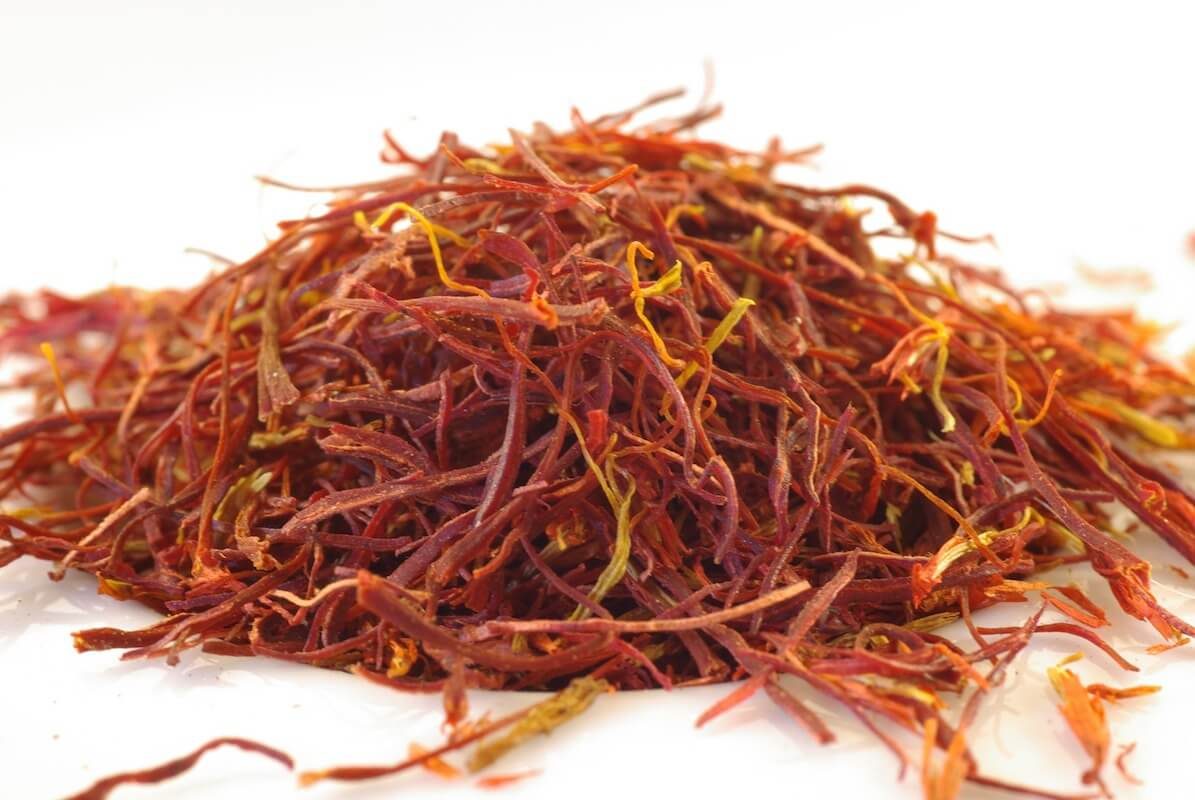
Saffron is the dried stigma of a crocus. Safflower is the dried flower of an unrelated daisy-family plant grown mostly for its oil seed. Both turn food yellow, but only saffron brings a strong aroma and a bitter taste: safflower florets contain no essential oil, and their flavor is very weak.12 That gap is why safflower has served for centuries as a cheap stand-in for saffron, and too often as a fake.
Side by side
| Safflower | Saffron | |
|---|---|---|
| Species | Carthamus tinctorius L.3 | Crocus sativus L.4 |
| Family | Asteraceae (daisy family)3 | Iridaceae4 |
| Native range | Central and eastern Türkiye to Iran (Kew); PROSEA says it is known only from cultivation and probably arose in the Middle East35 | A cultigen from Greece (Kew);4 most likely domesticated in ancient Greece6 |
| Part sold as a spice | Dried florets (petals)5 | Dried stigmas1 |
| Main crop | The seed, pressed for oil7 | The stigmas themselves |
| Coloring compounds | Carthamidin (yellow, water-soluble) and carthamin (orange-red)5 | Crocin1 |
| Taste and aroma compounds | None to speak of: the flowers contain no essential oil2 | Picrocrocin (bitterness) and safranal (aroma)8 |
| Flavor | “Very weak, herbaceous” (Katzer)2 | Strong aroma, bitter taste (Britannica)1 |
| Forms | Loose dried florets | Whole threads, cut threads, powder9 |
| Quality standard | None found | ISO 363298 |
| Main producer | India, per Britannica (no year given)7 | Iran, about 90% of the world crop in two 2022 papers (no crop year given)106 |
| Price | No dated, sourced figure found | Up to 20,000 EUR/kg, a ceiling quoted in a 2022 paper, not an average10 |
| Safety | No regulator assessment of the florets found; PROSEA records their traditional use in China to induce labor5 | Culinary amounts are not generally linked to toxicity; more than 5 g has uterine stimulant effects11 |
Everyday descriptions of saffron as honeyed or hay-like are cooks’ words, not measurements. A claim that safflower tastes of chocolate circulates widely; no source for it was found.
Color: the one job they share
Each colors food with a different pigment. Saffron’s coloring matter is crocin.1 Safflower florets hold two pigments: a water-soluble yellow, carthamidin, and carthamin, an orange-red dye that was once commercially important.5 Carthamin was used as a red textile dye.7
The strength is not the same. Gernot Katzer says safflower gives food a “rather pale” color.2 Saffron’s coloring strength is measured: under ISO 3632, absorbance at about 440 nm tracks crocin, and the 2025 edition sets minimums from 120 for the lowest grade to 230 for Extra Class, as reported in Agilent’s application note on the method.8 No comparable measurement for safflower was found, so how much safflower matches a pinch of saffron’s color is not known.
Flavor: where they part ways
Katzer describes safflower’s flavor as very weak and herbaceous and puts its value as a spice at “nearly nil.”2 Saffron is the opposite: Britannica describes a strong aroma and a bitter taste,1 and the ISO test measures both, picrocrocin for bitterness at about 257 nm and safranal for aroma at about 330 nm.8 In a dish, that means safflower changes how food looks and saffron changes how it looks and tastes.
How safflower is used to fake saffron
The two come from different plant families: safflower from the daisy family,3 saffron crocus from the Iridaceae.4 Safflower’s long career as a saffron stand-in shows in its names: “false saffron” in English, and safran bâtard, “bastard saffron,” in French.122
- Openly. PROSEA describes safflower as a natural food colorant that substitutes for saffron, and Katzer notes some use as a poor imitation of saffron in Middle Eastern cooking.52
- As an adulterant. Britannica records safflower’s use to adulterate saffron.7 A 2022 bulletin from the Botanical Adulterants Prevention Program, as reported by NutraIngredients, lists safflower among the materials found sold as or mixed into saffron.13
- Sold as saffron. Katzer says safflower is frequently sold as “saffron” to tourists in Hungary and North Africa.2
Saffron is one of the most adulterated spices, and powdered saffron is the easiest form to cheat.10 Fraud is old. Records from mid-14th-century Montpellier describe inspectors seizing impure saffron from a pepperer’s shop and the town ordering it burned.14 A Metropolitan Museum of Art essay, citing a secondary herbal reference, says a 15th-century Nuremberg trader was buried alive with his adulterated product.12
Telling them apart. Whole, they look different: saffron is sold as threads, the stigmas;1 safflower as loose florets.5 Because powder is the form most open to fraud, threads are the safer buy. As a rule of thumb rather than a test, “saffron” that is very cheap and colors food without much smell deserves suspicion. See saffron for how ISO grading works and its limits.
Can one stand in for the other?
Only for color. See saffron substitutes and safflower substitutes for the full lists.
| Swap | Ratio | Treatment |
|---|---|---|
| Safflower in place of saffron | Food Republic says safflower can replace saffron in equal proportions15 | Attributed |
| Saffron in place of safflower | No published ratio. Start with a few threads steeped in a spoonful of warm liquid and add more if the color is too pale | Method |
Safflower for saffron. Food Republic’s equal swap does not say whether it means volume or weight, and given Katzer’s “rather pale” color,2 expect to judge by eye. The yellow pigment is water-soluble,5 so steeping the florets in some of the recipe’s warm liquid before use is a sensible step. You get the color and lose the aroma. Britannica defines paella as saffron-flavored rice,16 and safflower will make it yellow, not saffron-flavored. That last point is our judgment.
Saffron for safflower. It works, but it changes the dish, adding bitterness and a strong aroma where safflower added almost none.1 Use far less than the safflower called for.
Where each is used
Saffron. Britannica lists Mediterranean and Asian dishes, especially rice and fish; English, Scandinavian and Balkan breads; and bouillabaisse, in which it is an important ingredient.1 In Spain it is part of paella.16 Risotto, Persian rice dishes and Indian sweets are commonly linked to saffron, but no qualifying source was found for each here.
Safflower. PROSEA says the florets are commonly mixed into rice, bread and pickles to color them.5 Katzer reports them improving the color of broths, soups and stews in Azerbaijan, and giving a yellowish hue to the broth of piti.2 Specific Syrian and Spanish uses that are often repeated could not be traced.
What isn’t known
- No published measurement compares how strongly safflower and saffron color food.
- Food Republic’s one-for-one swap is a rule of thumb, with no stated basis or unit.
- No current, sourced price for safflower was found, and the saffron figure is a ceiling, not a market price.
- No regulator safety assessment of safflower florets was found.
Related
- Safflower, safflower uses and safflower substitutes
- Saffron, saffron uses, cooking with saffron and saffron substitutes
- Why is saffron so expensive?
- Saffron vs. turmeric and saffron vs. sassafras
- Turmeric and annatto seeds, two more spices used mainly for color
Footnotes
-
“Saffron”, Encyclopaedia Britannica. britannica.com · Reference work ↩ ↩2 ↩3 ↩4 ↩5 ↩6 ↩7 ↩8 ↩9
-
Gernot Katzer, “Safflower (Carthamus tinctorius L.)”, Gernot Katzer’s Spice Pages. gernot-katzers-spice-pages.com · Reference work ↩ ↩2 ↩3 ↩4 ↩5 ↩6 ↩7 ↩8 ↩9 ↩10
-
Carthamus tinctorius L., Plants of the World Online, Royal Botanic Gardens, Kew. powo.science.kew.org · Reference work ↩ ↩2 ↩3 ↩4
-
Crocus sativus L., Plants of the World Online, Royal Botanic Gardens, Kew. powo.science.kew.org · Reference work ↩ ↩2 ↩3 ↩4
-
L.P.A. Oyen and B.E. Umali, Carthamus tinctorius, Plant Resources of South-East Asia (PROSEA). uses.plantnet-project.org · Reference work ↩ ↩2 ↩3 ↩4 ↩5 ↩6 ↩7 ↩8 ↩9
-
Kazemi-Shahandashti et al., “Ancient Artworks and Crocus Genetics Both Support Saffron’s Origin in Early Greece”, Frontiers in Plant Science, 2022. frontiersin.org · Peer-reviewed ↩ ↩2
-
“Safflower”, Encyclopaedia Britannica. britannica.com · Reference work ↩ ↩2 ↩3 ↩4
-
“Quality Assessment of Saffron by UV-Vis Spectroscopy in Accordance with ISO 3632”, Agilent Technologies application note, 2025. agilent.com · Publication ↩ ↩2 ↩3 ↩4
-
ISO 3632-1:2025, Spices, Saffron (Crocus sativus L.), Part 1: Specification, ISO. iso.org · Standard ↩ ↩2
-
Bergomi et al., “Determination of Saffron Quality through a Multi-Analytical Approach”, Foods, 2022. pmc.ncbi.nlm.nih.gov · Peer-reviewed ↩ ↩2 ↩3
-
“Saffron”, Drugs.com professional monograph. drugs.com · Reference work ↩
-
Carly Still, “Dyeing for Color”, The Metropolitan Museum of Art, 2015. metmuseum.org · Publication ↩ ↩2
-
Stephen Daniells, “Adulterants Bulletin highlights ‘multifaceted fraud’ associated with saffron”, NutraIngredients, 2022. nutraingredients.com · Publication ↩
-
Reyerson, “Commercial fraud in the middle ages: the case of the dissembling pepperer”, Journal of Medieval History, 1982. experts.umn.edu · Peer-reviewed ↩
-
Khyati Dand, “The Best Money-Saving Substitute For Saffron”, Food Republic, 2024. foodrepublic.com · Publication ↩
-
“Paella”, Encyclopaedia Britannica. britannica.com · Reference work ↩ ↩2