Spices · Uses
Safflower Uses: Golden Rice, Soups, Stews and Arroz Caldo
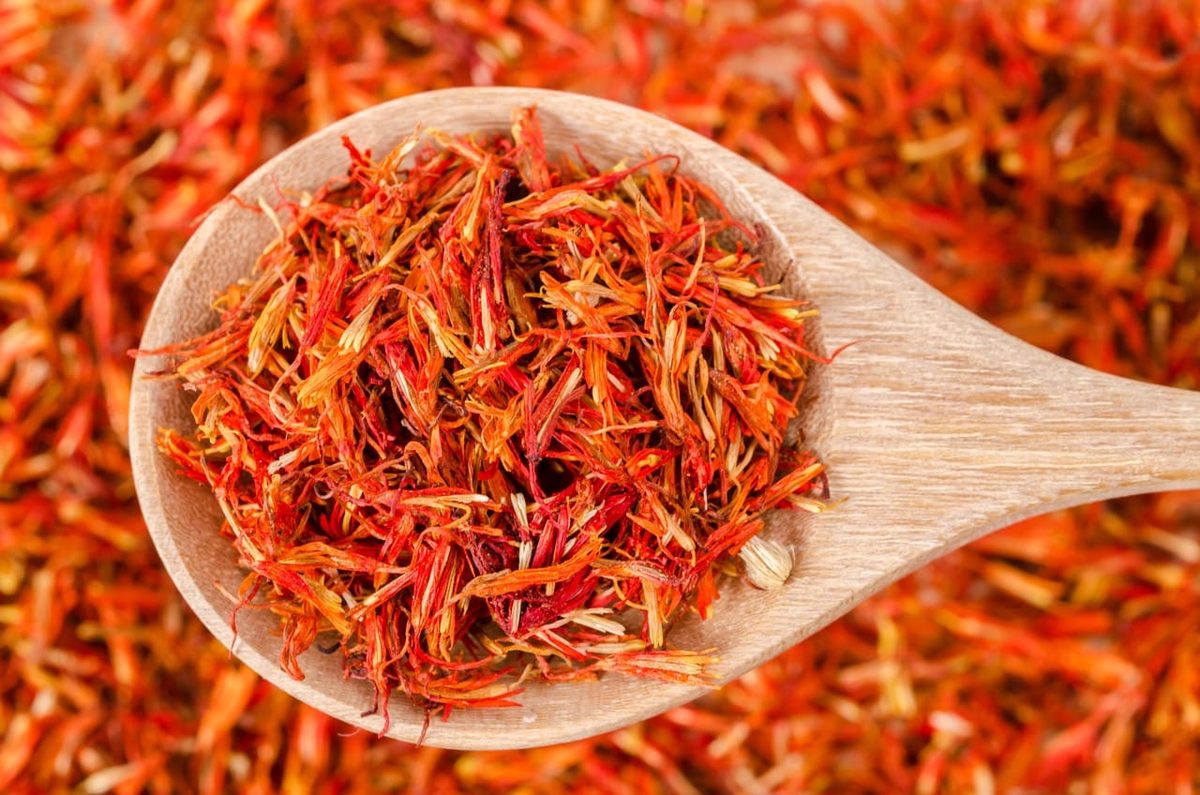
Safflower (Carthamus tinctorius) is grown mainly for the oil in its seeds; Britannica calls that oil the plant’s chief modern use.1 The part that reaches the spice shelf is the dried orange-red florets. Their use in the kitchen is color. Gernot Katzer puts their value as a spice at “nearly nil” but says their staining power justifies using them,2 and PROSEA describes them as a natural food color that substitutes for saffron.3 So the question for any dish is simple: do you want it yellow? If you also want saffron’s aroma, safflower can’t supply it.
Where safflower goes
| Use | What it does | Source |
|---|---|---|
| Rice, bread and pickles | Turns them orange | PROSEA3 |
| Broths, soups and stews | Improves their color; in Azerbaijan, a yellowish tint in piti | Katzer2 |
| Filipino arroz caldo | Yellow color in chicken rice porridge | Pepper.ph4 |
| Middle Eastern cooking | A poor imitation of saffron | Katzer2 |
| Georgian spice mixes | A stand-in for the usual marigold | Katzer2 |
| In place of saffron | Color only, at equal amounts | Food Republic5 |
Rice and porridge
PROSEA says the florets are commonly mixed into rice, bread and pickles to give them an orange color.3 Plain rice is a simple place to start, since safflower changes the color far more than the taste; that is our judgment, based on Katzer’s description of its weak flavor.
Arroz caldo. In the Philippines, safflower is kasubha, which Pepper.ph describes as a coloring agent used to give Filipino food a yellow hue, also known as Philippine saffron.4 Its recipe sums up the dish as basic lugaw (rice porridge) with chicken, ginger and kasubha added.4 Ally Estrada’s version uses 1/2 to 1 tablespoon of dried kasubha for four servings, alongside chicken, ginger, garlic, glutinous and jasmine rice and dried shrimp.4 The same page warns not to confuse kasubha with Spanish saffron: it comes from a different plant and has a milder flavor and aroma.4
Soups, broths and stews
Katzer notes that safflower is quite common in Azerbaijani cooking, where it improves the color of broths, soups and stews.2 His example is piti, a soup made in single-serving clay pots from mutton, mutton tail fat and chickpeas, often with fresh or dried fruit, nuts or chestnuts.2 Safflower goes in toward the end and gives the broth a yellowish tint.2
PROSEA describes the yellow pigment, carthamidin, as water-soluble.3 Adding the florets near the end of any soup, as in piti, and judging by eye is our suggestion.
Middle Eastern and Georgian cooking
- Middle East. Katzer says the florets have some use as a poor imitation of saffron in Middle Eastern cooking, but are rarely used as a spice in their own right.2 The modern Arabic name is al-usfur, also written asfour or asfur, and Katzer notes that this Arabic word is the source of the English name.2
- Georgia. Katzer says the yellow flowers in Georgian cooking usually come from marigold, often ground and sold as “Imeretian saffron” for spice mixes; safflower can stand in, though it has even less flavor.2 Saveur’s guide to khmeli suneli lists dried marigold among that blend’s ingredients.6
In place of saffron
Safflower is sold as the poor relation of saffron, and sometimes passed off as it. Many European languages call it “false saffron” or the like,2 and Britannica records its use as an adulterant of saffron.1 Katzer adds that many cooks think of safflower as a cheaper grade of saffron, and that it is frequently sold as “saffron” to tourists in Hungary and North Africa.2
The two are not the same thing. Saffron is the stigmas of a crocus,7 and Britannica describes it as having a strong aroma and a bitter taste.7 Safflower, by Katzer’s description, tastes very weak and herbaceous and gives food a rather pale color.2 Food Republic suggests using safflower in equal proportions to replace saffron;5 treat that as a color swap. See safflower vs. saffron and saffron substitutes.
Safflower tea
Steeping the florets in hot water makes a yellow drink. Claims that safflower tea improves heart or bone health could not be traced to any study or regulator. PROSEA records the florets’ place in traditional Chinese medicine, including use to induce labor.3 That is a record of traditional use, not evidence it works, but it is reason enough to check with a doctor before drinking safflower tea while pregnant; that caution is ours.
What isn’t sourced
Several uses often attributed to safflower could not be traced for this page: Mexican or Latin American rice dishes, Syrian dishes such as stuffed zucchini (kousa mahshi) and the omelet ejjeh, Filipino atchara pickles specifically, and Portuguese fish stews. They may well exist; we found no recipe or reference to cite.
Related
- Safflower and safflower substitutes
- Saffron uses and cooking with saffron
- Other spices used for color: turmeric and annatto seeds
Footnotes
-
“Safflower”, Encyclopaedia Britannica. britannica.com · Reference work ↩ ↩2
-
Gernot Katzer, “Safflower (Carthamus tinctorius L.)”, Gernot Katzer’s Spice Pages. gernot-katzers-spice-pages.com · Reference work ↩ ↩2 ↩3 ↩4 ↩5 ↩6 ↩7 ↩8 ↩9 ↩10 ↩11 ↩12 ↩13
-
L.P.A. Oyen and B.E. Umali, Carthamus tinctorius, Plant Resources of South-East Asia (PROSEA). uses.plantnet-project.org · Reference work ↩ ↩2 ↩3 ↩4 ↩5
-
Ally Estrada, “Chicken Arroz Caldo”, Pepper.ph. pepper.ph · Publication ↩ ↩2 ↩3 ↩4 ↩5
-
Khyati Dand, “The Best Money-Saving Substitute For Saffron”, Food Republic, 2024. foodrepublic.com · Publication ↩ ↩2
-
Benjamin Kemper, “This Secret Weapon Spice Blend From Georgia is Good on Everything”, Saveur, 2017. saveur.com · Publication ↩
-
“Saffron”, Encyclopaedia Britannica. britannica.com · Reference work ↩ ↩2