Blog · Uses
Saffron Uses: Rice Dishes, Fish Soup, Breads, Sweets and Drinks
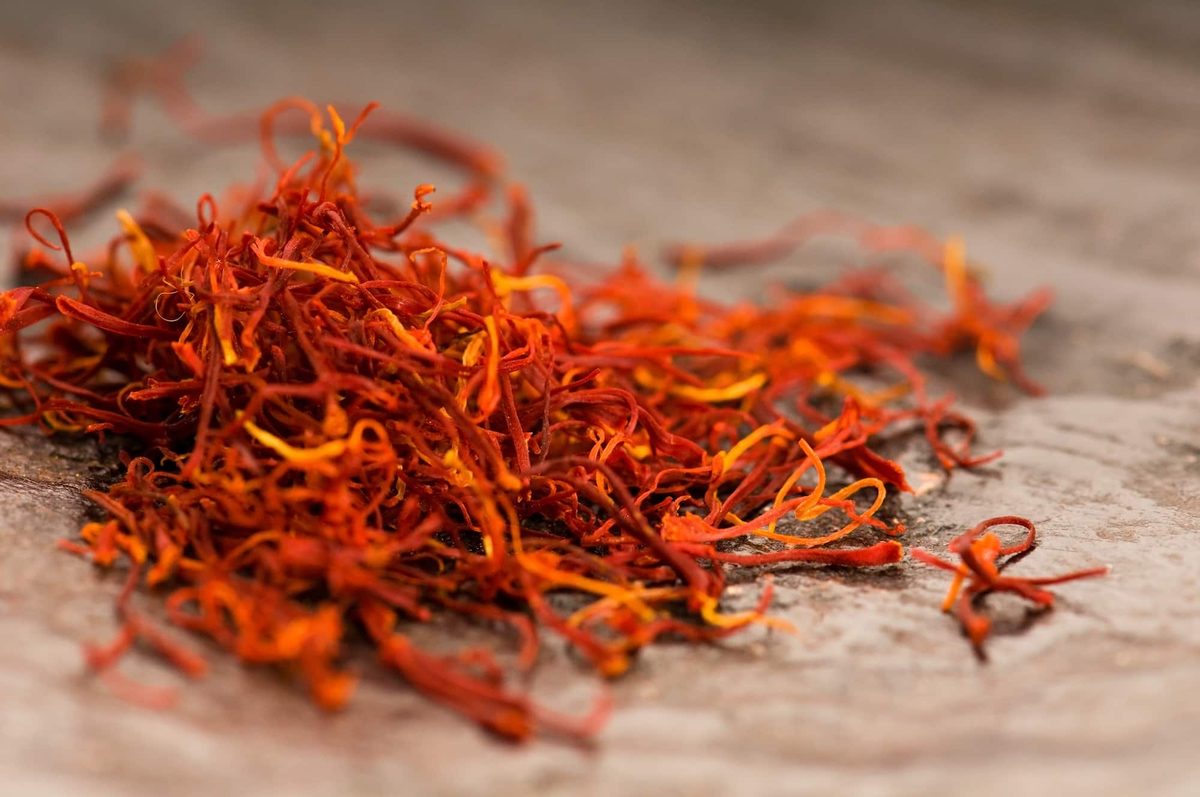
Saffron is the dried stigma of the saffron crocus, and Britannica still calls it the most expensive spice in the world; a pound represents 75,000 blossoms.1 It brings three things to a dish: a golden color from crocin, a strong aroma and a bitter taste.1 Britannica sums up where it goes: Mediterranean and Asian dishes, particularly rice and fish, plus English, Scandinavian and Balkan breads.1 Gernot Katzer adds that saffron matters more in Central Asia and northern India than in modern Europe, where it plays a minor role.2
This page is about what to use saffron in. For steeping, grinding and timing, see cooking with saffron.
Where saffron goes
| Use | Classic examples | Source |
|---|---|---|
| Rice | Paella, risotto alla milanese, biryani, Persian jeweled rice, Gulf rice pots | Britannica; Katzer; University of Vermont3245 |
| Fish soup | Bouillabaisse | Britannica6 |
| Breads and cakes | Swedish Lucia buns; English, Scandinavian and Balkan breads; a few European cakes | The Local; Britannica; Katzer712 |
| Sweets | Zarda, kheer, ras malai, custard, bastani ice cream, shortbread | Katzer; Nissim; University of Vermont285 |
| Drinks | Lassi | Katzer2 |
| Sauces and marinades | Saffron mayonnaise; a Moroccan chicken rub | University of Vermont5 |
Rice dishes
Katzer says it is used extensively for rice dishes in Central Asia and northern India.2
- Paella. Britannica defines paella as saffron-flavored rice cooked with meats, seafood and vegetables.3 Katzer calls paella Valenciana Spain’s national dish and describes it as dry short-grain rice with seafood or chicken.2 For the full spice list, see paella spices.
- Risotto alla milanese. Katzer’s example from Italy is moist short-grain rice with bone marrow.2
- Biryani. Britannica describes biryani as a rice dish of Persian origin that became a celebratory dish in South Asia.4 The rice is fried until half-cooked, the other ingredients are briefly precooked, and everything is layered in a pot so the juices steam the rice.4 Katzer lists saffron alongside Indian bay leaves, cinnamon, cloves, green cardamom, star anise and nutmeg or mace, and likes it with peppermint in Persian-style biryanis.2 Hyderabad’s biryani, Britannica says, is made with goat meat and seasoned with coconut and saffron.4
- Persian jeweled rice. A University of Vermont recipe uses 1 teaspoon of threads, about half a gram, in hot water.5
- Gulf rice pots. Katzer notes similar rice dishes, with saffron and a hint of heat, in the countries around the Gulf.2
Pilaf or pulao is often described as the one-pot cousin of biryani. We found no source on its use of saffron within this review, so this page doesn’t make claims about it.
Bouillabaisse and other fish dishes
Britannica calls bouillabaisse a complex fish soup from the Mediterranean coast of France and counts the Marseilles version as the most authentic.6 Besides fish and shellfish, it lists olive oil, onions, tomatoes, garlic, parsley, saffron, fennel, thyme, bay leaf and orange peel.6 Katzer notes that saffron’s Mediterranean uses are often tied to fish and seafood.2
Breads, buns and cakes
Britannica names English, Scandinavian and Balkan breads.1 Swedish Lucia buns (lussekatter) are one example; Swedes eat them on 13 December.7 The Local’s recipe uses 0.4 to 0.5 grams (about 1 teaspoon) of threads to 500 grams of flour for 12 buns, warming the threads in the milk and letting it cool before mixing.7 Katzer adds that saffron turns up in a few European cake recipes, for flavor as well as color.2
A Vermont shortbread uses a smaller dose, 1/4 teaspoon of threads.5
Sweets and desserts
- Indian sweets. Katzer says kheer and ras malai are sometimes made with saffron, and that zarda, a sweet saffron rice, is made by Indian Muslims at the end of the fasting month and on other festive days.2
- Custard. Katzer puts half a teaspoon of saffron, which he estimates at about a fifth of a gram, as enough for a liter of saffron custard.2
- Bastani. Persian saffron ice cream pairs saffron with rose water. Joanna Nissim calls rose and saffron the two most popular Persian flavors.8 Her quick version grinds a pinch of saffron to powder, melts two ice cubes over it, and stirs the saffron water and 2 tablespoons of rose water into condensed milk, for six servings.8 Her recipe uses no egg yolks.8
Drinks
Katzer reports saffron in the Indian yogurt drink lassi, and singles out the saffron butter lassi (makhaniya lassi) of Jodhpur.2
Saffron is also steeped in hot water as a tea. Claims that saffron tea treats depression, lowers blood pressure or protects the heart are common online. The research behind the mood claims tested saffron supplements, not tea: a 2019 meta-analysis found benefit over placebo but also evidence of publication bias.9 See saffron for what that research does and doesn’t show. We found no source for blood pressure or heart benefits, or for a standard steeping time.
Sauces, marinades and savory baking
The University of Vermont’s saffron recipes include a mayonnaise made with 1/2 teaspoon of ground saffron soaked in lemon juice, and a rub for Moroccan chicken that mixes 1/4 teaspoon of pulverized threads with garlic, ginger, paprika, cumin and turmeric.5 In our view, both show that saffron can hold its own next to stronger flavors.
How much, by dish
These are amounts from named recipes (Attributed), not rules.
| Dish | Saffron | Source |
|---|---|---|
| Lucia buns, 12 | 0.4 to 0.5 g (about 1 tsp) threads per 500 g flour | The Local7 |
| Persian jeweled rice | 1 tsp threads, about 1/2 g | University of Vermont5 |
| Saffron custard, 1 liter | 1/2 tsp, about 1/5 g | Katzer2 |
| Bastani, serves 6 | 1 pinch, ground | Nissim8 |
| Mayonnaise | 1/2 tsp, ground | University of Vermont5 |
| Moroccan chicken rub | 1/4 tsp, pulverized | University of Vermont5 |
| Shortbread | 1/4 tsp threads | University of Vermont5 |
Too much makes a dish bitter; see too much saffron. At these amounts saffron isn’t a safety concern: the Drugs.com monograph says it is not generally linked to toxicity in culinary amounts, and that doses above 5 grams are far beyond food use.10
Related
- Saffron and cooking with saffron
- How to store saffron and why saffron is so expensive
- Saffron substitutes, saffron vs. turmeric and safflower vs. saffron
- Safflower uses, for the cheaper flower used mainly for color
Footnotes
-
“Saffron”, Encyclopaedia Britannica. britannica.com · Reference work ↩ ↩2 ↩3 ↩4 ↩5
-
Gernot Katzer, “Saffron (Crocus sativus L.)”, Gernot Katzer’s Spice Pages. gernot-katzers-spice-pages.com · Reference work ↩ ↩2 ↩3 ↩4 ↩5 ↩6 ↩7 ↩8 ↩9 ↩10 ↩11 ↩12 ↩13 ↩14 ↩15 ↩16
-
“Paella”, Encyclopaedia Britannica. britannica.com · Reference work ↩ ↩2
-
Gregory Lewis McNamee, “Biryani”, Encyclopaedia Britannica. britannica.com · Reference work ↩ ↩2 ↩3 ↩4
-
Margaret Skinner, “A Sample of Saffron Delicacies”, North American Center for Saffron Research and Development, University of Vermont, 2021. uvm.edu · Reference work ↩ ↩2 ↩3 ↩4 ↩5 ↩6 ↩7 ↩8 ↩9 ↩10
-
“Bouillabaisse”, Encyclopaedia Britannica. britannica.com · Reference work ↩ ↩2 ↩3
-
“How to make your own saffron buns”, The Local Sweden, 2015 (updated 2024). thelocal.se · Publication ↩ ↩2 ↩3 ↩4
-
Joanna Nissim, “Bastani: saffron and rosewater ice cream”, The Jewish Chronicle, 2024. thejc.com · Publication ↩ ↩2 ↩3 ↩4 ↩5
-
Marx et al., “Effect of saffron supplementation on symptoms of depression and anxiety”, Nutrition Reviews, 2019. pure.bond.edu.au · Peer-reviewed ↩
-
“Saffron”, Drugs.com professional monograph. drugs.com · Reference work ↩