Spices · Profile
Sansho Pepper: Japan’s Citrusy, Numbing Prickly Ash Spice
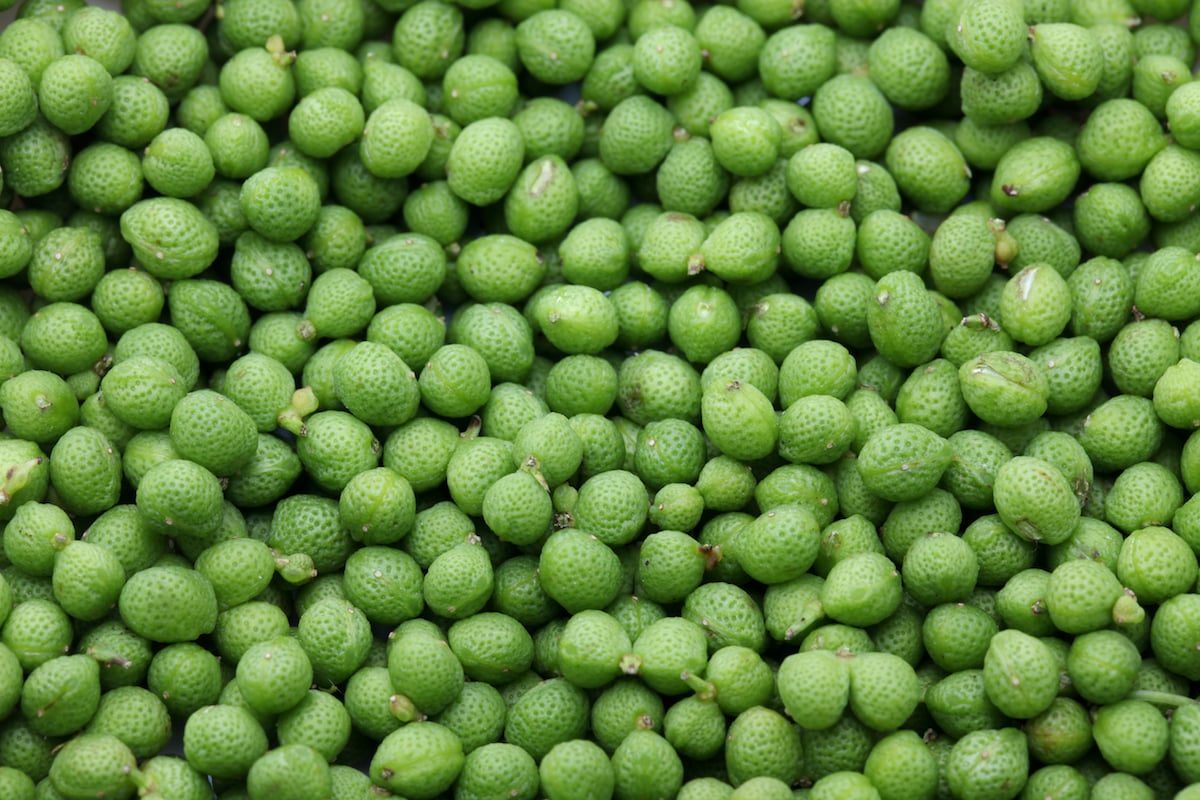
Sansho is Japan’s member of the Sichuan pepper group: the dried, ground fruit husks of the Japanese prickly ash, Zanthoxylum piperitum.12 It smells of lime and leaves a tingling numbness on the tongue. It is sprinkled over grilled eel and is one of the standard ingredients in shichimi togarashi. This page covers the plant, the flavor and the compounds behind it, where it is grown, how it is used, and how it relates to Chinese Sichuan pepper.
At a glance
| Botanical name | Zanthoxylum piperitum (L.) DC.12 |
| Plant family | Rutaceae (Kew); Britannica calls it the rue and citrus family13 |
| Part used | Dried fruit wall (husk), ground; young leaves (kinome) fresh2 |
| Native range | China to South Korea and Japan (Kew)1 |
| Main producer in Japan | Wakayama Prefecture, 308 of 462 tonnes in 2023 (66.7%)4 |
| Flavor | Lime-like fragrance, pungent, numbing2 |
| Pungent compounds | Sanshools (alkamides), up to 3% total amides reported2 |
| Forms sold | Ground sansho (kona-zansho), whole dried husks, fresh green berries, leaves |
Measured values
1 figure, sourced| Measure | Value | Scope | Source |
|---|---|---|---|
| Total amides (sanshools) | as high as 3 % | Z. piperitum fruit wall, per KatzerNo essential oil analysis specific to Japanese sansho was found; the page's 4% oil figure is for Chinese Sichuan pepper. | gernot-katzers-spice-pages.com |
Each figure is quoted as its source states it, with the samples or standard it applies to. Where sources differ, both are shown; nothing is averaged. All measured values
The plant and its relatives
Zanthoxylum piperitum is a shrub or small tree.1 Kew gives its native range as China to South Korea and Japan.1 Katzer’s Spice Pages identifies Japanese sansho as this species, and notes that the Japanese name is adapted from the Chinese shan jiao.2
“Sichuan pepper” is not one species but a spice taken from several closely related Zanthoxylum plants.2 In China, according to Katzer, Z. bungeanum, Z. simulans, Z. planispinum and Z. armatum are the ones most commonly used, even though Chinese product is often labeled Z. piperitum.2 So sansho and most Chinese Sichuan pepper are close relatives but different species. Korea grows the same species as Japanese sansho, where it is called chopi.2 See Szechuan pepper and timut pepper for other members of the group.
None of these are related to black pepper. Britannica places the prickly ashes in the rue and citrus family.3
Which part is used
The aroma and pungency live in the brown fruit wall, not the seeds.2 The black seeds are usually removed: Katzer calls their texture unpleasant and gritty, “almost like sand between the teeth.”2 In Japan the fresh young leaves, kinome, are used too, both to flavor and to garnish.2
Flavor and the compounds behind it
Katzer describes Japanese sansho as having a fresh, pleasant lime fragrance and a well-developed pungency.2 The Zanthoxylum spices generally build slowly to a numbing, almost anesthetic feeling on the tongue.2 To us, sansho is brighter and more citrusy than Chinese red Sichuan pepper, with a slightly softer tingle; that comparison is ours, not a measurement.
The tingling comes from alkamides called sanshools, stored in the fruit wall; Katzer reports total amide content as high as 3% in Z. piperitum.2 The citrus side comes from the essential oil, which reaches up to 4% in Chinese Sichuan pepper and is made up mostly of terpenes.2 We found no oil analysis specific to Japanese sansho to quote.
A widely repeated claim compares sansho’s heat with chile peppers on the Scoville scale; we found no Scoville measurement for sansho.
Where it is grown
Japan’s sansho comes overwhelmingly from Wakayama Prefecture. Wakayama’s own fruit-tree booklet, drawing on Ministry of Agriculture statistics, gives:4
| Measure (2023 crop) | Japan | Wakayama | Wakayama share | Rank |
|---|---|---|---|---|
| Area planted | 310 ha | 169 ha | 54.5% | 1st |
| Harvest | 462 t | 308 t | 66.7% | 1st |
The prefecture’s separate profile of budo sansho puts Wakayama’s national share at about 70%, without a year.5 We found no figure for world production, so the claim that most of the world’s sansho comes from Wakayama cannot be checked; what the data show is Wakayama’s dominance within Japan.
Budo sansho
Budo means grape: this Wakayama variety fruits in clusters like bunches of grapes, with large, thick-fleshed berries.5 According to the prefecture, it is said to have begun in the Tenpo era (1830–1844), when wild plants growing in the Toi area of what is now Aridagawa town were brought into cultivation, at first for medicinal use; the town’s Shimizu district is known as its birthplace.5 It is in season from early May to mid-August, and is used mainly for tsukudani and ground as a spice.5
History
The documented history of sansho is thinner than most accounts suggest. The budo sansho origin above, from the Wakayama prefectural government, is the oldest dated record we could open.5
Several claims circulate without a source we could find: that sansho was found in Jomon-period clay vessels, that it was called naruhajika in the Nara period, that it treated diarrhea in the Heian period, that samurai used it when hunting in the Kamakura period, and that its pairing with eel began then. This page does not present any of them as fact.
How sansho is used
- Grilled eel. Just One Cookbook’s unagi don recipe lists ground sansho as an optional topping and garnishes the bowl with a kinome leaf.6
- Shichimi togarashi. Sansho is one of the seven ingredients in the blends of both Yagenbori in Tokyo and Shichimiya Honpo in Kyoto.78 Shichimiya calls it so important that the quality of the sansho decides the flavor of the blend.8 PepperScale also lists sansho among the seven, and says the blend’s heat comes almost entirely from the red chile, with sansho contributing at most a mild kick.9 Nanami togarashi is another name for the same blend.10 See also nanami togarashi.
- Tsukudani. This is the main use of Wakayama’s budo sansho.5
- Leaves. Fresh kinome serve as both flavoring and garnish.26
- Grilled meats. Katzer notes that sansho flavors teppanyaki meats, though it is often replaced by cheaper white pepper.2
In Western cooking, sansho works much like a citrusy pepper on grilled steak, duck, pork belly and fried foods. That is cooking judgment. Like Sichuan pepper, it is at its brightest freshly ground.
Buying and storage
Look for ground sansho with a strong lime scent and a green to greenish-brown color; a dull, dusty smell means it has faded (kitchen judgment). For whole husks, pick out any black seeds and thorny stem pieces, which Katzer warns can be harmful if swallowed.2 No source gives a shelf life. Common practice is to buy small jars and keep them sealed, cool and dark.
Health claims
Yagenbori, the shichimi maker, says sansho has long been used as a traditional analgesic and stomach remedy, and that the ripe fruit wall has been used as a crude drug.7 That is a merchant’s description of tradition, not evidence of effect. We found no source showing that sansho is a meaningful source of vitamin A, B vitamins or minerals in the amounts used, or that it helps bone density, asthma or rheumatism, so this page makes none of those claims. For the research on the Chinese species, see Szechuan pepper.
Substitutes and comparisons
Chinese Sichuan pepper is the nearest substitute, with less citrus and often a heavier numbing effect; a little grated lemon or yuzu zest can restore the citrus. No source gives a tested ratio. See sansho pepper substitutes, Szechuan pepper, shichimi togarashi and Japanese spices.
Footnotes
-
Zanthoxylum piperitum (L.) DC., Plants of the World Online, Royal Botanic Gardens, Kew. powo.science.kew.org · Reference work ↩ ↩2 ↩3 ↩4 ↩5 ↩6
-
Gernot Katzer, “Sichuan pepper (Zanthoxylum species)”, Gernot Katzer’s Spice Pages. gernot-katzers-spice-pages.com · Reference work ↩ ↩2 ↩3 ↩4 ↩5 ↩6 ↩7 ↩8 ↩9 ↩10 ↩11 ↩12 ↩13 ↩14 ↩15 ↩16 ↩17 ↩18 ↩19
-
Melissa Petruzzello, “Sichuan pepper”, Encyclopaedia Britannica. britannica.com · Reference work ↩ ↩2
-
和歌山の果樹 (Fruit Trees of Wakayama), Wakayama Prefectural Government, June 2026. pref.wakayama.lg.jp · Regulator ↩ ↩2
-
ぶどう山椒 (Budo sansho), Wakayama Prefectural Government. pref.wakayama.lg.jp · Regulator ↩ ↩2 ↩3 ↩4 ↩5 ↩6
-
Namiko Hirasawa Chen, “Unagi Don (Unadon)”, Just One Cookbook. justonecookbook.com · Publication ↩ ↩2
-
七味について, Yagenbori. yagenbori.jp · Merchant ↩ ↩2
-
京名物七味唐がらし, Shichimiya Honpo. shichimiya.co.jp · Merchant ↩ ↩2
-
Matt Bray, “What Is Shichimi Togarashi? The Story Behind The Spice”, PepperScale, 2022. pepperscale.com · Publication · PepperScale is also owned by Matt Bray, the editor of this site. ↩
-
Namiko Hirasawa Chen, “Shichimi Togarashi”, Just One Cookbook. justonecookbook.com · Publication ↩