Spices · Profile
Szechuan Pepper: The Numbing Spice, Its Species, Chemistry and Uses
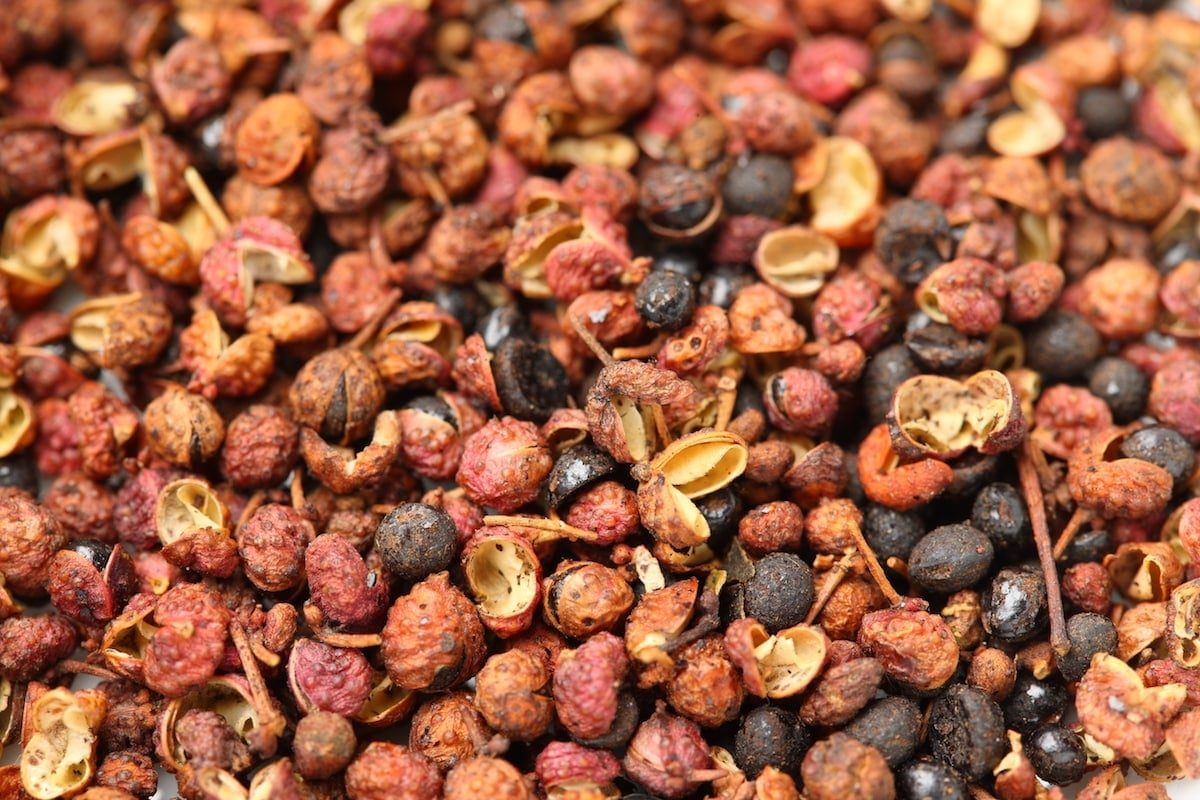
Szechuan pepper, also spelled Sichuan pepper and called huajiao in China, is made from the dried, papery fruit husks of several species of prickly ash (Zanthoxylum), shrubs and trees in the rue and citrus family.12 It is not related to black pepper or to chiles. What sets it apart is a buzzing, numbing tingle on the lips and tongue, which researchers have measured, and which Sichuan cooks pair with chile heat. This page covers which plants it comes from, the chemistry behind the tingle, how it is used, how to buy it, the US import ban, and what the health research shows.
At a glance
| Botanical source | Several Zanthoxylum species; in China mainly Z. bungeanum, Z. simulans, Z. planispinum and Z. armatum3 |
| Plant family | Rutaceae (rue and citrus family)41 |
| Part used | Dried fruit husk (pericarp); seeds removed13 |
| Native range (Z. bungeanum) | Himalaya to China4 |
| Main producing area | Sichuan province, China2 |
| Tingling compound | Hydroxy-α-sanshool2 |
| Essential oil | Up to 4% (Chinese Sichuan pepper)3 |
| Forms sold | Whole red or green husks, ground, oil |
Measured values
1 figure, sourced| Measure | Value | Scope | Source |
|---|---|---|---|
| Essential oil | up to 4 % | Chinese Sichuan pepper, per KatzerThe 2017 review reports more than 65 terpenoids but no single typical breakdown. | gernot-katzers-spice-pages.com |
Each figure is quoted as its source states it, with the samples or standard it applies to. Where sources differ, both are shown; nothing is averaged. All measured values
Which plants it comes from
“Sichuan pepper” names a spice, not a single species.3 Katzer’s Spice Pages notes that Chinese product is often labeled Zanthoxylum piperitum, but that Z. bungeanum, Z. simulans, Z. planispinum and Z. armatum are the species most commonly used in China, with Z. bungeanum the most valued in traditional Chinese medicine.3 Britannica’s photograph of the spice is captioned as Z. simulans.1
| Species | Native range (Kew) | Where it is used |
|---|---|---|
| Z. bungeanum | Himalaya to China, including Tibet, Nepal and the eastern Himalaya4 | China’s main red Sichuan pepper; also cultivated in Japan, Korea and India2 |
| Z. piperitum | China to South Korea and Japan5 | Japanese sansho and Korean chopi3 |
| Z. armatum (syn. Z. alatum) | Not checked for this page | Nepal’s timur3; see timut pepper |
A 2017 systematic review describes Z. bungeanum as native to China, with Sichuan province holding the largest production areas, “famous for their high production and quality.”2
Red Sichuan peppercorns are the most common, but there is also a green variety, which The Woks of Life says tastes slightly different and usually numbs more strongly.6
Flavor and the chemistry of the tingle
Katzer describes most Sichuan pepper species as lemon-like, with warm and woody overtones, and the taste as pungent and biting, building to a numbing, almost anesthetic feeling on the tongue.3 Chinese cooking has its own word for that numbness, ma, distinct from la, the heat of chiles.3 Our own description: floral and piney on the nose, with a citrus-peel brightness.
What causes the numbing
The tingle comes from alkamides called sanshools, stored in the fruit wall.3 A 2017 review of Z. bungeanum names hydroxy-α-sanshool as the compound most responsible for the tingling sensation.2 Not every sanshool works the same way: the review notes that a close relative, hydroxy-β-sanshool, has no effect when applied to the human tongue.2
In a 2013 study led by Nobuhiro Hagura at University College London, volunteers had Szechuan pepper applied to their lips and then matched the tingling to a vibrating stimulus. The sensation corresponded to about 50 light taps a second, and the researchers concluded that sanshool activates a specific class of touch fibers (RA1 fibers) in the lips and tongue.7 The press release does not give the number of volunteers.
The essential oil
Katzer gives the essential oil of Chinese Sichuan pepper as up to 4%.3 The 2017 review reports more than 65 terpenoids identified in it by gas chromatography, and explains differences between studies by genetics, growing conditions and extraction method.2 Neither source gives one typical breakdown, so this page does not.
How Szechuan pepper is used
- Sichuan cooking. Katzer calls Sichuan pepper most characteristic of, but not limited to, Sichuan cooking, where it is paired with chiles for the combination called ma la, “hot-and-numbing.”3 The 2017 review counts the pericarp among China’s “eight essential condiments” and lists pickles and hotpots among its uses.2
- Kung pao chicken. The Woks of Life recipe uses ½ teaspoon of ground Sichuan peppercorn, added to the wok with the garlic, ginger, chiles and scallions and cooked a minute or two until fragrant.8
- Five-spice powder. Britannica lists Szechuan pepper as one of the five spices, alongside fennel seed, cassia, cloves and star anise, and describes it as adding a slightly numbing accent.9 See Chinese five-spice powder.
- Chili crisp. PepperScale’s homemade chili crisp stirs 2 teaspoons of ground Sichuan peppercorn into the dry chile mix for “a bright, citrusy tingle,” and marks it optional: leave it out and you lose the tingle but still get a good crisp.10
- Sichuan salt-and-pepper. Coarse salt and Sichuan pepper are dry-toasted together until they begin to smoke, then ground into a table condiment.3
- The Himalayas. Katzer calls Sichuan pepper one of the few spices important in Himalayan cuisines; Tibetan cooking pairs it with chiles, and in Nepal timur is used in curries and pickles.3
- Japan and Korea. Japan uses its own species, sansho, including in shichimi togarashi; Korea uses two species, chopi and sancho.3 See sansho pepper and shichimi togarashi.
Technique
These are cooking judgments, not measured facts: toast in a dry pan just until fragrant, grind fresh, and add ground pepper toward the end, since long cooking dulls the tingle. Whole husks infused in hot oil make a numbing oil for dressings and dipping sauces. It pairs well with star anise, ginger, garlic, dried chiles and red pepper flakes, and with rich meats such as duck and pork.
Buying and quality
The Woks of Life’s buying advice: the brighter red the husks, the fresher they are and the stronger the numbing; avoid packs with many seeds and stems.6 Katzer gives reasons for both. The black seeds have an unpleasant, gritty texture, and commercial product can contain tough, pointed thorns that may be harmful if swallowed and are best picked out.3
Storage
The Woks of Life says whole Sichuan peppercorns can last a few years if kept airtight and away from light and moisture, while ground pepper loses potency after a few months.6 That is a publication’s guidance, not a measured shelf life; no regulator or standards body publishes one.
The US import ban
For decades Sichuan pepper was hard to buy legally in the United States, because the plants can carry citrus canker, a bacterial disease of citrus.311 Sources agree on the reason and on a heat-treatment condition for lifting the ban, but not on all the dates:
| Point | Honolulu Magazine (2007) | Katzer’s Spice Pages | The Woks of Life (2020, updated 2022) |
|---|---|---|---|
| When restrictions began | 1968, by the USDA and FDA11 | Not stated3 | Not stated; “prohibited for about 40 years”6 |
| Enforcement | Not strictly enforced until 200211 | Not stated | Not stated |
| When lifted | 2005, if heated to 160 degrees to kill bacteria11 | 2005, for heat-treated pepper3 | “Partially lifted in 2004”6 |
None of these is a primary USDA record, which we did not locate. The commonly cited span of 1968 to 2005 matches the Honolulu Magazine account.
Health claims and safety
Sichuan pepper has a long place in traditional Chinese medicine. The 2017 systematic review lists traditional uses for digestive complaints, toothache, stomach ache, diarrhea, vomiting and ascariasis (roundworm), among others.2 It reports wide-ranging biological activity for extracts and compounds, but calls for further laboratory and animal experiments and for exploring clinical effects; we found no clinical trial in people described in it.2 We found no source showing that Sichuan pepper lowers blood pressure, prevents cancer, or is a useful source of vitamins or minerals in culinary amounts, so this page makes none of those claims.
On safety, the review says the plant has long been regarded in Chinese medicine as low in toxicity, but that toxicity studies are scarce.2 Reported LD50 values for a water extract in mice are 45 g/kg and 51.14 g/kg.2 These are animal figures for an extract, not guidance on kitchen use.
Substitutes and comparisons
Japanese sansho is the closest substitute, more citrusy; there is no true stand-in for the numbing effect. No source gives a tested ratio. See Szechuan pepper substitutes, sansho pepper, timut pepper, black pepper and spices for Chinese food.
Footnotes
-
Melissa Petruzzello, “Sichuan pepper”, Encyclopaedia Britannica. britannica.com · Reference work ↩ ↩2 ↩3 ↩4
-
Zhang et al., “Zanthoxylum bungeanum Maxim. (Rutaceae): A Systematic Review of Its Traditional Uses, Botany, Phytochemistry, Pharmacology, Pharmacokinetics, and Toxicology”, International Journal of Molecular Sciences, 2017. mdpi.com · Peer-reviewed ↩ ↩2 ↩3 ↩4 ↩5 ↩6 ↩7 ↩8 ↩9 ↩10 ↩11 ↩12 ↩13
-
Gernot Katzer, “Sichuan pepper (Zanthoxylum species)”, Gernot Katzer’s Spice Pages. gernot-katzers-spice-pages.com · Reference work ↩ ↩2 ↩3 ↩4 ↩5 ↩6 ↩7 ↩8 ↩9 ↩10 ↩11 ↩12 ↩13 ↩14 ↩15 ↩16 ↩17 ↩18 ↩19
-
Zanthoxylum bungeanum Maxim., Plants of the World Online, Royal Botanic Gardens, Kew. powo.science.kew.org · Reference work ↩ ↩2 ↩3
-
Zanthoxylum piperitum (L.) DC., Plants of the World Online, Royal Botanic Gardens, Kew. powo.science.kew.org · Reference work ↩
-
“Sichuan Peppercorns”, The Woks of Life. thewoksoflife.com · Publication ↩ ↩2 ↩3 ↩4 ↩5
-
“Tingling sensation caused by Asian spice could help patients with chronic pain”, University College London, 2013. ucl.ac.uk · Publication ↩
-
Judy, “Kung Pao Chicken”, The Woks of Life. thewoksoflife.com · Publication ↩
-
Tony Hill, “Five-spice powder”, Encyclopaedia Britannica. britannica.com · Reference work ↩
-
Matt Bray, “Homemade Chili Crisp”, PepperScale, 2026. pepperscale.com · Publication · PepperScale is also owned by Matt Bray, the editor of this site. ↩
-
Joan Namkoong, “The Taste Is Back”, Honolulu Magazine, 2007. honolulumagazine.com · Publication ↩ ↩2 ↩3 ↩4