Spices · Profile
Soy Sauce Powder: How Brewed Soy Sauce Becomes a Dry Seasoning
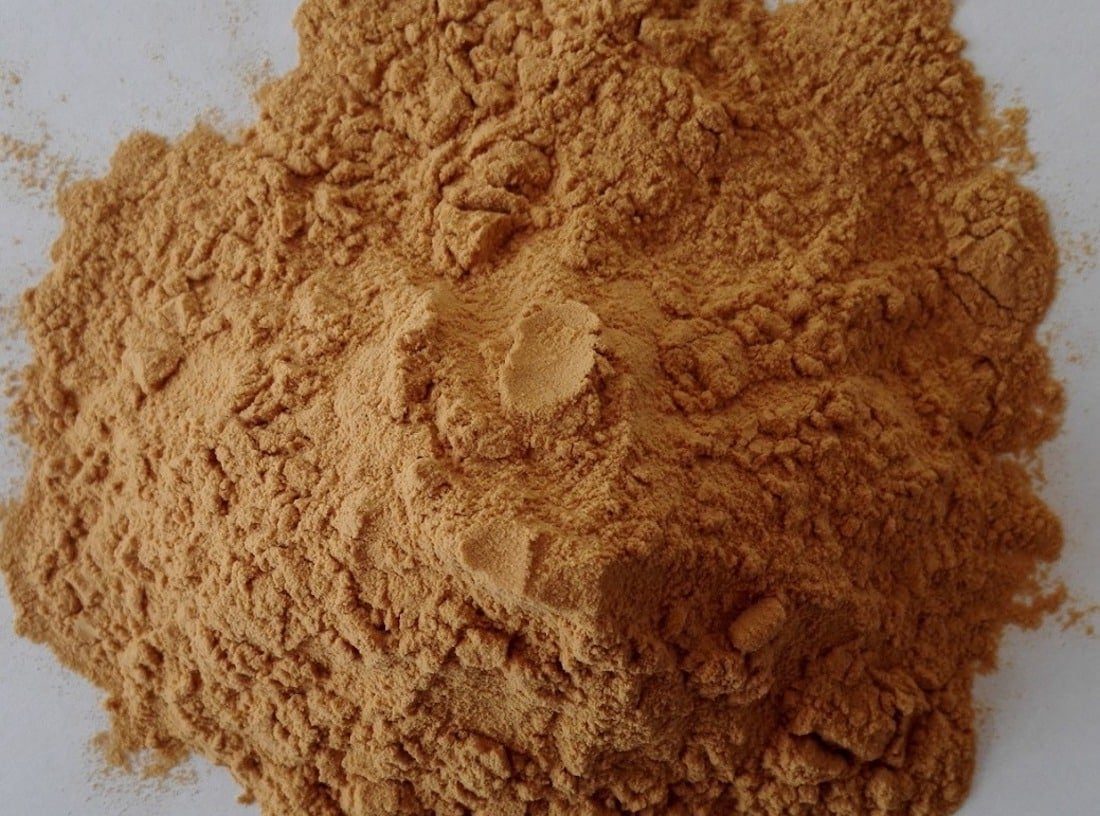
Soy sauce powder is brewed soy sauce that has been dried into a free-flowing powder. Kikkoman, for example, makes it by spray-drying its brewed soy sauce with maltodextrin as a carrier, and lists the ingredients as soy sauce (soybeans, wheat, salt), maltodextrin and salt.1 It brings the salty, savory taste of soy sauce to places a liquid can’t go easily: dry rubs, seasoning blends, bouillon and breadcrumb coatings.2
At a glance
| What it is | Brewed soy sauce, spray-dried onto a carrier1 |
| Typical ingredients | Soy sauce (soybeans, wheat, salt), maltodextrin, salt12 |
| Carrier | Maltodextrin, a starch product made from corn, potato or rice starch13 |
| Appearance | Golden tan, free-flowing powder (Kikkoman SN-1)1 |
| Forms sold | Regular, milder and lower-salt grades; a gluten-free version made without wheat2 |
| Main uses | Dry bouillons, soups, sauces, marinades, spice mixtures, breadcrumb coatings, glazes2 |
| Main caution | Sodium; check the label’s Nutrition Facts4 |
How it is made
The process starts with ordinary brewed soy sauce. Kikkoman describes its SN-1 powder as “spray-dried, instant soy sauce powder made from traditionally brewed Kikkoman Soy Sauce,” with maltodextrin “used as carrier in spray-drying process.”1 Its European plant says the same of its whole range: the powder concentrates are spray-dried using maltodextrin.2
Maltodextrin is defined in U.S. regulations as a nonsweet nutritive saccharide polymer made by partial hydrolysis of corn, potato or rice starch.3 FDA allows it in food with no limitation other than current good manufacturing practice.3 Labels on the products we checked do not say which starch was used.12
Not every powder is the same. Kikkoman Europe sells several grades: two with a strong soy sauce taste, one milder, one with less salt, and a gluten-free powder made from soybeans, salt and spirit vinegar instead of wheat.2 The regular powders all list soybeans and wheat.12
Flavor
A 2025 analysis of soy sauce taste found it is characterized mainly by salty and umami notes, with sour, bitter and sweet in smaller parts.5 Kikkoman describes its powder as having a meaty, rich, concentrated soy sauce flavor with a pronounced brewed bouquet.1 In practice the powder tastes like soy sauce without the liquid, which makes it easy to overdo: it is mostly salt and savoriness, so add it in small amounts and taste.
Where soy sauce comes from
Soy sauce itself is made from fermented soybeans, wheat, yeast and salt, according to Britannica.6 It descends from jiang, the thick fermented pastes that, in food writer Fuchsia Dunlop’s account, the Chinese have made and eaten for more than 2,000 years.7
When the liquid we call soy sauce took on its modern name is disputed:
| Source | When the name jiangyou (醤油) appears |
|---|---|
| Fuchsia Dunlop, Saveur, 2016 | The first written reference by its modern name is in a 13th-century cookbook7 |
| Hideaki Otsuka, Kikkoman Institute for International Food Culture | The two-character word for the condiment emerged in the 16th century; the 13th century is “too soon”8 |
Otsuka also notes that Yiya Yiyi, a cookbook sometimes dated to the 14th century, survives only in an edition from 1597.8 We have not resolved the question, so both positions are shown.
In Japan, the word for soy sauce settled early on shoyu.8 Dunlop writes that the names for soybean in European languages come from that Japanese word, and that the first known Western reference to the sauce is in the journal of the English philosopher John Locke, who in 1679 mentioned a sauce called “Saio” from the East Indies.7 In 1688 the English navigator William Dampier described encountering it, and Dutch traders shipped Japanese soy sauce to India in the 17th century.7 Soy was also one of the original ingredients of Worcestershire sauce, which went on sale in 1837.9 See Worcestershire powder.
How to use it
Kikkoman positions its powder for dry bouillons, soups, sauces and marinades, and for spice mixtures, breadcrumb coatings and glazes.2 At home it works well in places where liquid soy sauce would make things soggy or clump:
- In a dry rub for beef, pork or chicken, alongside garlic powder, onion powder and pepper.
- In a popcorn or roasted-nut seasoning.
- Whisked into a stir-fry sauce base, or stirred into a soup or gravy, where it dissolves.
- Mixed with water as a quick stand-in for liquid soy sauce. No producer we checked gives a reconstitution ratio, so start with a little powder, taste and adjust.
Because the powder already contains salt, cut back on any other salt in the recipe. Some cooks pair it with MSG for extra savoriness; see MSG vs salt.
Buying and storage
Look for a short ingredient list: soy sauce, maltodextrin and salt is typical.1 If you need to avoid wheat, look for a powder labeled gluten-free; Kikkoman’s is made with soybeans, salt and spirit vinegar instead.2 Neither Kikkoman page we checked gives a shelf life or storage conditions.12 Keeping it sealed in a cool, dry place is common practice; we found no published shelf-life figure.
Sodium
Soy sauce powder is a salty seasoning. The U.S. Daily Value for sodium is less than 2,300 mg a day,4 and WHO recommends that adults eat less than 2,000 mg of sodium a day.10 WHO identifies raised blood pressure as the main health effect of diets high in sodium.10 Neither Kikkoman page gives a sodium figure for its powders,12 so check the Nutrition Facts on the package you buy. Kikkoman Europe sells a lower-salt grade.2
Related
- Too much soy sauce: how to rescue an over-salted dish
- Worcestershire powder and vinegar powder, two other dried condiments
- Monosodium glutamate, cooking with MSG and MSG substitutes
- Garlic powder and onion powder for rubs
Footnotes
-
Dehydrated Soy Sauce SN-1, Kikkoman Sales USA. kikkomanusa.com · Merchant ↩ ↩2 ↩3 ↩4 ↩5 ↩6 ↩7 ↩8 ↩9 ↩10 ↩11 ↩12
-
Dehydrated Soy Sauce, Kikkoman Europe. kikkoman.eu · Merchant ↩ ↩2 ↩3 ↩4 ↩5 ↩6 ↩7 ↩8 ↩9 ↩10 ↩11 ↩12 ↩13
-
21 CFR 184.1444, Maltodextrin, FDA. ecfr.gov · Regulator ↩ ↩2 ↩3
-
Soy sauce, Encyclopaedia Britannica. britannica.com · Reference work ↩
-
Fuchsia Dunlop, “The Rise (and Potential Fall) of Soy Sauce,” Saveur, 2016. saveur.com · Publication ↩ ↩2 ↩3 ↩4
-
Hideaki Otsuka, “Soy Sauce in the Chinese Language,” Food Culture, Kikkoman Institute for International Food Culture. kikkoman.com · Reference work ↩ ↩2 ↩3
-
Worcestershire sauce, Encyclopaedia Britannica. britannica.com · Reference work ↩
-
Sodium reduction, World Health Organization. who.int · Regulator ↩ ↩2