Spice Comparisons · Comparison
MSG vs. Salt: Umami, Sodium and How Far One Can Replace the Other
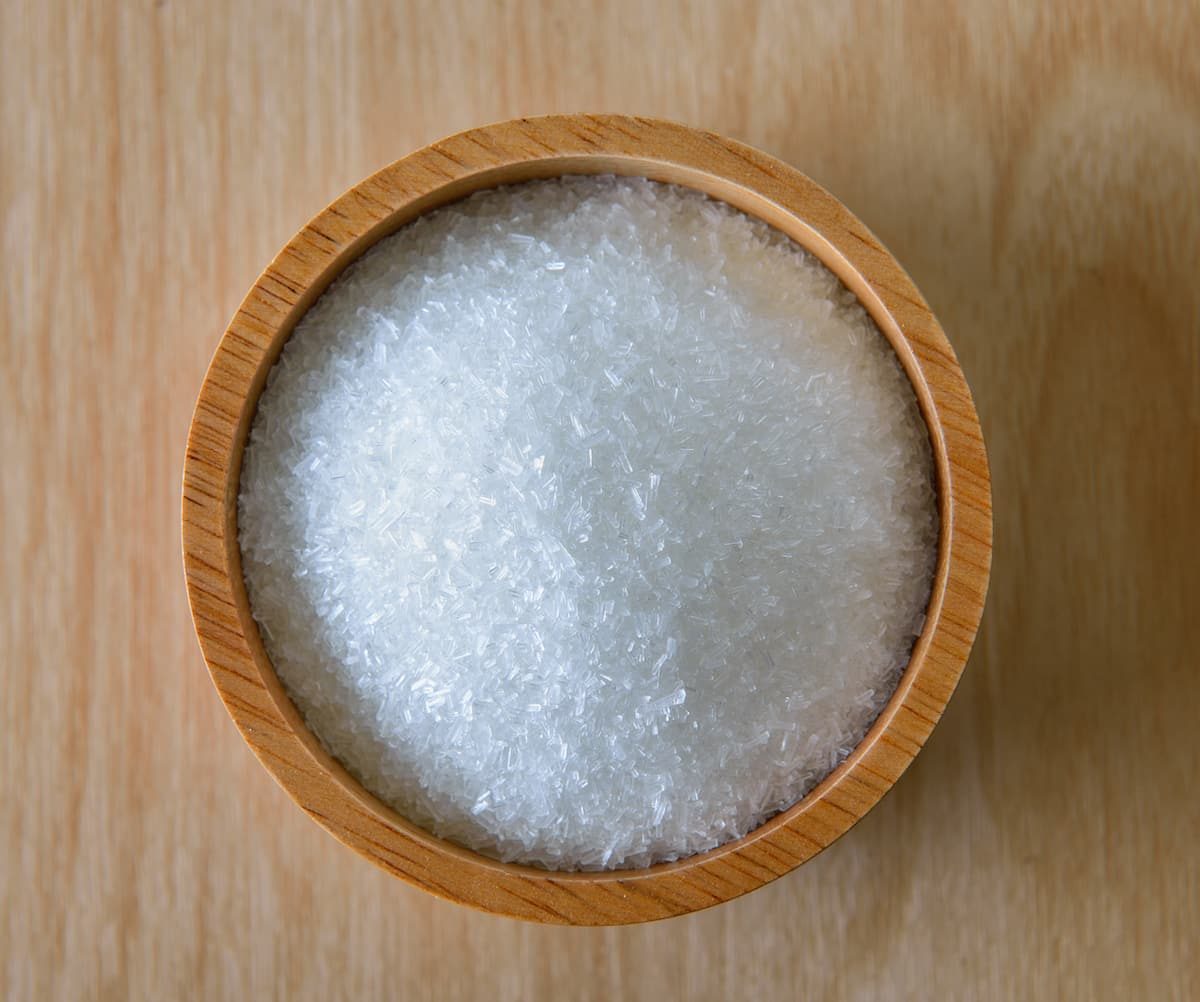
Salt and MSG look alike, but they do different jobs. Table salt is sodium chloride, about 40% sodium by weight, and it makes food taste salty.1 Monosodium glutamate (MSG) is the sodium salt of glutamic acid, a common amino acid, and its job is the savory taste called umami.23 Because MSG carries far less sodium than salt, about 12% against 39% in one peer-reviewed analysis,4 cooks and food scientists use it to replace part of the salt in a dish. It can’t replace all of it, because umami is not saltiness.
Side by side
| Table salt | MSG | |
|---|---|---|
| What it is | Sodium chloride; about 40% sodium and 60% chloride1 | Sodium salt of glutamic acid2 |
| Where it comes from | Sea, underground rock deposits or natural brine5 | Fermentation of starch, sugar beets, sugar cane or molasses2 |
| Looks like | Fine, uniform crystals in table salt; other salts range to coarse grains and flakes6 | A white crystalline substance7 |
| Taste | Salty | Umami, a savory or meaty taste3 |
| Sodium by weight | 39% (Wallace et al.); about 40% (AHA)41 | About 12%4 |
| Amount in use | The FDA’s Daily Value for sodium, under 2,300 mg, is about 1 teaspoon of table salt8 | A typical serving of food with added MSG contains less than 0.5 g2 |
| Iodine | Often iodized; US iodized salt carries 45 mcg per gram9 | No source reviewed here addresses iodine in MSG |
| US status | Labeling rules for iodized and plain salt10 | Generally recognized as safe; must be listed by name on labels2 |
| Intake guidance | WHO: adults under 2,000 mg of sodium a day11 | EFSA: group acceptable daily intake of 30 mg per kg of body weight for added glutamates12 |
Two different tastes
Salt’s effect goes beyond saltiness. In lab taste studies, sodium chloride together with sugar was the main source of bitterness suppression in taste mixtures,13 which is one reason a pinch of salt can make a dish taste rounder. That was a test of simple solutions, so it shows the direction of the effect rather than how it plays out in every recipe.
MSG supplies glutamate. Britannica counts umami among the five basic tastes and traces it to three natural substances: glutamate, guanylate and inosinate.3 The glutamate in MSG is nothing exotic. FDA notes that the free glutamate in foods such as tomatoes and cheeses is chemically the same as the glutamate in MSG.2 Glutamate was first identified in 1908, by the Japanese chemist Kikunae Ikeda.27
In a dish, the two work together rather than as rivals. Salt sets how salty the food tastes; MSG adds savory depth, the quality of a long-simmered stock. That description is ours, not a measurement.
Sodium: the number that matters
MSG is still a sodium salt, so it adds some sodium. The peer-reviewed figure is about 12% sodium for MSG, less than a third of the 39% in table salt.4 By our arithmetic, a gram of MSG carries about 120 mg of sodium and a gram of salt about 390 mg.
Three studies have tested what that difference can do:
| Study (scope) | What was done | Result |
|---|---|---|
| Wallace, Cowan & Bailey, 2019: US dietary data, modeled | Glutamate salts substituted for 25% to 45% of the sodium in select savory food groups | Universal use in those foods would cut US sodium intake by 3% (162 mg a day), and by 7 to 8 percentage points among people who eat them4 |
| Jinap et al., 2016: two spicy soups, trained panelists | Salt and MSG levels varied from 0% to 1.2% | Adding 0.7% MSG made a 32.5% sodium reduction feasible without losing acceptability14 |
| Halim et al., 2020: four “better-for-you” dishes, 163 consumers | Salt reduced and some MSG added | The MSG versions were liked the same as the standard recipes, or more for a savory yogurt dip, while still substantially reducing total sodium15 |
Read these with their limits in mind. The Wallace study is a model, not a feeding trial; its authors note conservative assumptions, that they left out restaurant food, and that consumer acceptance of MSG must be considered. It was funded by an unrestricted educational grant from Ajinomoto, which makes MSG.4 The Halim abstract gives no single percentage for the sodium saved and no funding statement.15 None of the three replaced all of the salt.
Safety
MSG. FDA considers adding MSG to food generally recognized as safe.2 It notes that some sensitive people who eat 3 grams or more of MSG without food may have short-term, generally mild symptoms such as headache, numbness or flushing, that eating more than 3 grams without food at one time is unlikely, and that FDA was never able to confirm that MSG caused the reactions reported to it.2 Britannica reports no conclusive link between those symptoms and normal levels of MSG.7 In the EU, EFSA set a group acceptable daily intake of 30 mg per kg of body weight a day for glutamic acid and its salts in 2017,12 which is 2.1 g a day for a 70 kg adult by our arithmetic. EFSA found that people whose diets are high in foods with these additives may exceed it.12
Salt. The WHO names raised blood pressure as the main health effect of a high-sodium diet and recommends adults stay under 2,000 mg of sodium a day.11 The FDA’s Daily Value is less than 2,300 mg.8
A widely repeated claim says MSG raises blood pressure too, only more slowly than salt. We found no regulator or review that says so; the sodium MSG adds is counted like any other sodium.
Labels. Foods with added MSG must list it by name; it cannot be hidden under “spices and flavoring.”2 Ingredients such as hydrolyzed vegetable protein naturally contain free glutamate, and FDA says products containing them cannot claim “No MSG” or “No added MSG.”2
Can one stand in for the other?
Partly. No published source gives a kitchen ratio for swapping MSG and salt, so every amount below is a starting point.
| Swap | Starting amount | Treatment |
|---|---|---|
| MSG for part of the salt in a savory dish | Cut the salt by about a quarter, add a small pinch of MSG, then taste | Method |
| MSG for all of the salt | Not recommended: the dish will taste flat rather than salty | Method |
| Salt for MSG | Season to taste; salt adds no glutamate | Method |
| A glutamate-rich ingredient for MSG | See MSG substitutes | Method / Attributed |
How these were worked out. The quarter cut is the low end of the 25% to 45% sodium reduction Wallace and colleagues modeled,4 and the studies above replaced part of the salt, never all of it.1415 Start small with MSG, since FDA puts a typical serving of food with added MSG at under half a gram.2 Going the other way, salt cannot supply umami; if MSG is missing, a glutamate-rich food does the job better. Parmesan carries about 1.2 g of free glutamate per 100 g and soy sauce 0.4 to 1.3 g, in figures from a 2003 Australian–New Zealand regulatory report tabulated by Germany’s food-safety commission.16
Which to use when
- Salt: in everything, sweet or savory, where you want food to taste seasoned. It is the one you can’t do without.
- MSG: in savory dishes that need depth: soups and broths, stir-fry sauces, fried rice, marinades, eggs and vegetables. A little goes a long way.
- Both: a little MSG alongside a reduced amount of salt, if you are cutting sodium.
These are kitchen judgments, not tested rules. For techniques, see cooking with MSG.
What isn’t known
- No source gives a tested kitchen ratio for replacing salt with MSG, or MSG with salt.
- No study we found measured how salty MSG tastes compared with salt, gram for gram.
- The sodium savings above come from one model and two sensory studies of specific dishes, not from long-term feeding trials.
- No source we reviewed addresses whether MSG contains iodine.
Related
- Monosodium glutamate (MSG) and table salt, the full profiles
- MSG substitutes and cooking with MSG
- Soy sauce powder
- Iodized vs. non-iodized salt and table salt vs. sea salt
- Too much salt? How to rescue a dish
Footnotes
-
Sodium Sources: Where Does All That Sodium Come From?, American Heart Association, 2025. heart.org · Reference work ↩ ↩2 ↩3
-
Questions and Answers on Monosodium glutamate (MSG), U.S. Food and Drug Administration. fda.gov · Regulator ↩ ↩2 ↩3 ↩4 ↩5 ↩6 ↩7 ↩8 ↩9 ↩10 ↩11 ↩12
-
Umami, Encyclopaedia Britannica. britannica.com · Reference work ↩ ↩2 ↩3
-
Wallace TC, Cowan AE, Bailey RL, Current Sodium Intakes in the United States and the Modeled Effects of Glutamate Incorporation into Select Savory Products, Nutrients, 2019. mdpi.com · Peer-reviewed ↩ ↩2 ↩3 ↩4 ↩5 ↩6 ↩7
-
Standard for Food Grade Salt, CXS 150-1985 (rev. 2012), Codex Alimentarius. services.bis.gov.in · Standard ↩
-
Salt Types and Measurements, America’s Test Kitchen. americastestkitchen.com · Publication ↩
-
Monosodium glutamate, Encyclopaedia Britannica. britannica.com · Reference work ↩ ↩2 ↩3
-
Sodium in Your Diet, U.S. Food and Drug Administration. fda.gov · Regulator ↩ ↩2
-
Iodine: Fact Sheet for Health Professionals, NIH Office of Dietary Supplements. ods.od.nih.gov · Regulator ↩
-
21 CFR 100.155, Salt and iodized salt, Electronic Code of Federal Regulations. ecfr.gov · Regulator ↩
-
Sodium reduction, World Health Organization fact sheet, 2026. who.int · Regulator ↩ ↩2
-
EFSA reviews safety of glutamates added to food, European Food Safety Authority, 2017. efsa.europa.eu · Regulator ↩ ↩2 ↩3
-
Green BG et al., Taste Mixture Interactions: Suppression, Additivity, and the Predominance of Sweetness, Physiology & Behavior, 2010. pmc.ncbi.nlm.nih.gov · Peer-reviewed ↩
-
Jinap S et al., Reduction of sodium content in spicy soups using monosodium glutamate, Food & Nutrition Research, 2016. foodandnutritionresearch.net · Peer-reviewed ↩ ↩2
-
Halim J et al., The Salt Flip: Sensory mitigation of salt (and sodium) reduction with MSG in Better-for-You foods, Journal of Food Science, 2020 (abstract). escholarship.org · Peer-reviewed ↩ ↩2 ↩3
-
The potential involvement of glutamate ingestion in chronic neurodegenerative diseases, DFG Senate Commission on Food Safety (SKLM), 2005; tabulating FSANZ 2003. dfg.de · Regulator ↩