Spice Comparisons · Comparison
Cardamom vs. Cloves: Two Plants, Two Chemistries, One Spice Rack
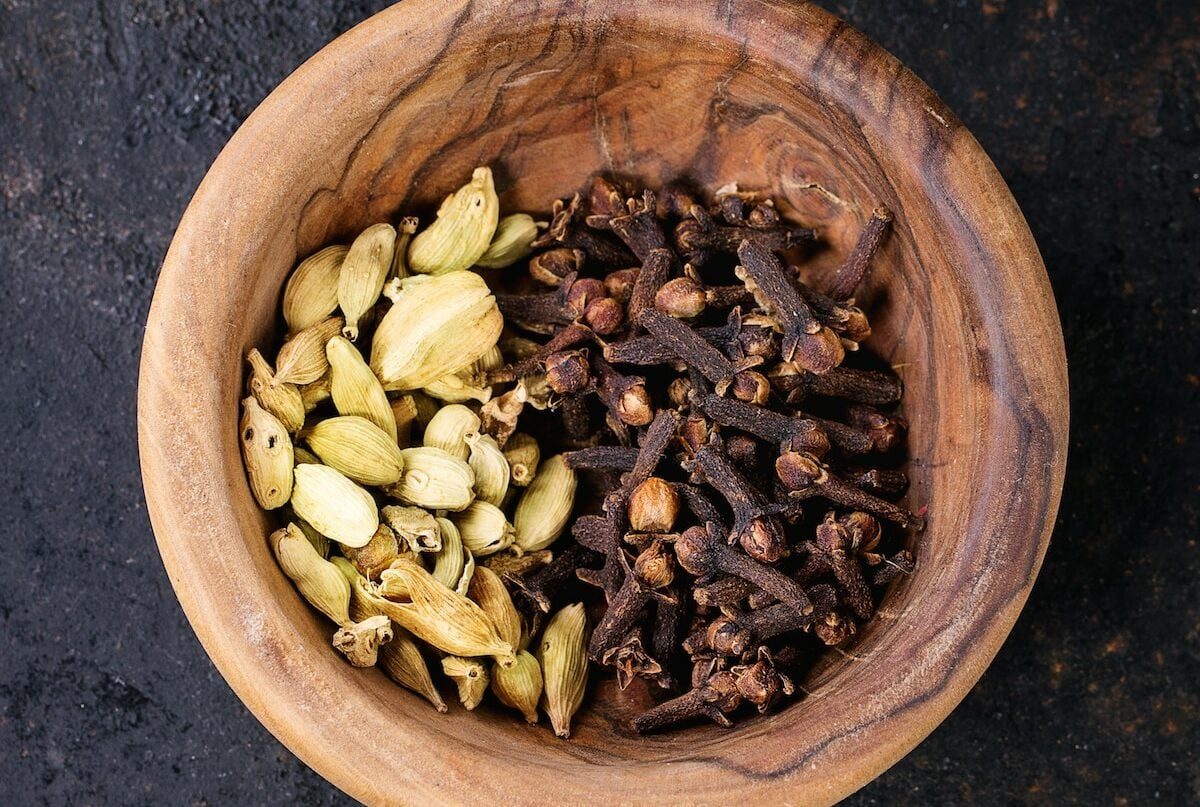
Cardamom and cloves share a shelf and often a recipe, but they come from unrelated plants and smell of different chemistry. Cardamom is the fruit of a ginger-family plant from southwest India, and its oil is led by 1,8-cineole and alpha-terpinyl acetate.12 Cloves are the dried flower buds of a myrtle-family tree from the Maluku islands, and their oil is mostly eugenol.345 That difference is why each can only partly stand in for the other.
Side by side
| Cardamom (green) | Cloves | |
|---|---|---|
| Species | Elettaria cardamomum1 | Syzygium aromaticum3 |
| Family | Zingiberaceae (ginger family)1 | Myrtaceae (myrtle family)34 |
| Native range | Southwest India1 | Maluku, Indonesia3 |
| Part used | The fruit, a small capsule, and the seeds inside it, picked green2 | The flower bud, picked just before it opens5 |
| Essential oil | 3.5 to 7% of whole fruits (PROSEA)2 | 14 to 20% of the bud (Britannica)6 |
| Main oil compounds | 1,8-cineole 20 to 60% and alpha-terpinyl acetate 20 to 53% (PROSEA);2 alpha-terpinyl acetate 36 to 62% in eight commercial samples (2025)7 | Eugenol 70 to 90%, eugenyl acetate up to 17% (PROSEA);5 eugenol about 85 to 92% (2020 review)4 |
| Flavor (editorial) | Sweet, floral and resinous with a cool, camphor-like lift | Sweet-warm, medicinal and numbing, bitter in quantity |
| Forms | Whole green pods, decorticated seeds, ground seed2 | Whole buds, ground cloves, oleoresin5 |
| Typical uses | Curries, spiced rice and meat dishes; coffee and tea; Scandinavian pastries28 | Meats and baked goods;6 garam masala, alongside cardamom9 |
| Price | PROSEA calls it one of the highest-priced spices on the market;2 no dated retail comparison found | No dated retail comparison found |
| Safety note | No regulator concern found at food amounts | Clove oil, not the spice, carries EMA cautions (see below)10 |
The oil figures in the table come from different reference works and studies and describe different plant parts, so they show which compound leads in each spice, not a like-for-like strength comparison. The flavor row is ours. It fits the chemistry: 1,8-cineole has a camphor-like odor,11 and cloves are built almost entirely on eugenol.54 Britannica describes cloves as strong in aroma and hot and pungent in taste.6
The differences that change a dish
What you are buying
Cardamom pods are fruits. The seeds inside are angled, about 3 mm long and dark brown, 15 to 20 to a fruit.2 Cardamom fruits ripen very irregularly, so PROSEA says they should be harvested individually at the right stage, picked fully developed but still green.2 That hand labor is often given as the reason cardamom costs so much; PROSEA confirms the high price but does not connect the two, and neither does any other source we found.
A clove is a whole flower bud. The flower cluster is picked just before the first buds open.5 The English name comes, through Old French, from the Latin word for a nail, “so called from its shape.”12
Two kinds of cardamom, one kind of clove
“Cardamom” on its own means green cardamom, Elettaria cardamomum. Black cardamom is a different plant, Amomum subulatum, native from Nepal to central China.13 The Spice House says black cardamom is smoke-dried, which makes it better suited to braised meats and savory recipes.14 For a clove comparison, green is the one that matters. See black vs. green cardamom.
Where the eugenol goes
Eugenol is the reason cloves taste like cloves, and other spices share it. It is one of the three main constituents of allspice oil, another myrtle-family spice.1516 Ceylon cinnamon bark oil carries eugenol at 5 to 18%,17 while Chinese cassia bark oil has only traces of it.18 Cardamom’s oil is led by other compounds entirely.27 In practice that means cloves sit comfortably next to allspice and cinnamon, and cardamom brings something none of them has.
The myrtle family also includes the eucalyptus genus.19 That is a family tie, not a flavor one: the cool, eucalyptus-like note in this pair belongs to cardamom’s 1,8-cineole, not to cloves.115
Strength in the pot
How much a cook can use differs a lot, though no study measures it. Madhur Jaffrey’s garam masala, published by Saveur, calls for a quarter cup of cardamom seeds.20 In our judgment a single clove is noticeable in a pot of rice, and the safest habit with whole cloves is to count them in so you can count them out.
Can one stand in for the other?
Only in part. Both appear in garam masala,9 so in a mixed spice blend one can cover a gap left by the other. Where either is the lead flavor, the swap will be noticed.
- Cloves in place of cardamom. The Spice House lists cloves among its pantry substitutes for cardamom.21 For baking it recommends a mix of equal parts ginger, nutmeg, cloves and cinnamon, used 1:1 for the cardamom (Attributed).21 For a single strong spice like cloves alone, it says to “cut the amount to half or three quarters because cloves can overpower a dish” (Attributed).21 None of these will give cardamom’s cool, floral lift. See cardamom substitutes.
- Cardamom in place of cloves. We found no published ratio (Method). Cardamom does not supply eugenol, so it changes the dish rather than imitating cloves. The closer clove stand-in is allspice, which two sources swap 1:1; see clove substitutes. If cardamom is all you have and cloves are one spice among several, start with an equal amount of ground cardamom and taste. Where cloves are the point, as in a clove-studded ham, cardamom will not do the job.
Clove oil is not the spice
The European Medicines Agency’s monograph on clove oil, a traditional herbal medicine for the mouth and throat, says its use in children and adolescents under 18 is not recommended.10 That concerns the concentrated oil, not cloves used as a spice. In our judgment clove oil should never stand in for ground cloves in a recipe; it is a different product. More on the cloves page.
What isn’t known
- No sensory study compares cardamom and cloves directly; the flavor row and the strength notes are editorial.
- No published ratio exists for cardamom in place of cloves.
- No dated retail price comparison was found. PROSEA’s “highest-priced” remark is the only sourced statement on cost.
- Cardamom’s oil varies a lot by sample. One 2025 study found 1,8-cineole anywhere from under 1% to about 31% across eight commercial samples,7 so one jar can be much more camphor-forward than another.
Related
- Cardamom and cloves, the full profiles
- Cardamom substitutes and clove substitutes
- Cardamom pods vs. seeds and ground vs. whole cloves
- Allspice vs. cloves, nutmeg vs. cloves, cloves vs. cinnamon, cloves vs. star anise
- Black vs. green cardamom
- Cooking with cardamom, cooking with cloves, too much cardamom, too much clove
- Garam masala
Footnotes
-
Elettaria cardamomum (L.) Maton, Plants of the World Online, Royal Botanic Gardens, Kew. powo.science.kew.org · Reference work ↩ ↩2 ↩3 ↩4
-
T.H. Wardini and A. Thomas, Elettaria cardamomum, Plant Resources of South-East Asia (PROSEA). uses.plantnet-project.org · Reference work ↩ ↩2 ↩3 ↩4 ↩5 ↩6 ↩7 ↩8 ↩9 ↩10
-
Syzygium aromaticum (L.) Merr. & L.M.Perry, Plants of the World Online, Royal Botanic Gardens, Kew. powo.science.kew.org · Reference work ↩ ↩2 ↩3 ↩4
-
Batiha et al., “Syzygium aromaticum L. (Myrtaceae): Traditional Uses, Bioactive Chemical Constituents, Pharmacological and Toxicological Activities”, Biomolecules, 2020. mdpi.com · Peer-reviewed ↩ ↩2 ↩3 ↩4
-
E.W.M. Verheij and C.H.A. Snijders, Syzygium aromaticum, Plant Resources of South-East Asia (PROSEA). uses.plantnet-project.org · Reference work ↩ ↩2 ↩3 ↩4 ↩5 ↩6 ↩7
-
“Clove”, Encyclopaedia Britannica. britannica.com · Reference work ↩ ↩2 ↩3
-
Blažeković et al., “Content and Chemical Composition of Essential Oil from Cardamom”, Croatica Chemica Acta, 2025. hrcak.srce.hr · Peer-reviewed ↩ ↩2 ↩3
-
Gregory Lewis McNamee, “Cardamom”, Encyclopaedia Britannica. britannica.com · Reference work ↩
-
“How to make garam masala”, Great British Chefs, 2025. greatbritishchefs.com · Publication ↩ ↩2
-
Community herbal monograph on clove oil, European Medicines Agency, 2011. ema.europa.eu · Regulator ↩ ↩2
-
1,8-Cineole (CID 2758), PubChem, U.S. National Library of Medicine. pubchem.ncbi.nlm.nih.gov · Reference work ↩ ↩2
-
“clove”, Online Etymology Dictionary. etymonline.com · Reference work ↩
-
Amomum subulatum Roxb., Plants of the World Online, Royal Botanic Gardens, Kew. powo.science.kew.org · Reference work ↩
-
Black Cardamom Pods, The Spice House. thespicehouse.com · Merchant ↩
-
Andrade Avila, Cruz-Olivares and Pérez-Alonso, “Antioxidant Effect and Medicinal Properties of Allspice Essential Oil”, IntechOpen, 2022. intechopen.com · Peer-reviewed ↩
-
Pimenta dioica (L.) Merr., Plants of the World Online, Royal Botanic Gardens, Kew. powo.science.kew.org · Reference work ↩
-
Cinnamomum verum, PROSEA Handbook No. 13: Spices. prosea.prota4u.org · Reference work ↩
-
Cinnamomum (PROSEA Spices), Pl@ntUse. uses.plantnet-project.org · Reference work ↩
-
Eucalyptus L’Hér., Plants of the World Online, Royal Botanic Gardens, Kew. powo.science.kew.org · Reference work ↩
-
Madhur Jaffrey, “Garam Masala”, Saveur, 2014. saveur.com · Publication ↩
-
Cardamom Substitute, The Spice House, 2017. thespicehouse.com · Merchant ↩ ↩2 ↩3