Cooking · Cooking with
Cooking With Cardamom: Pods, Seeds, Grinding and How Much to Use
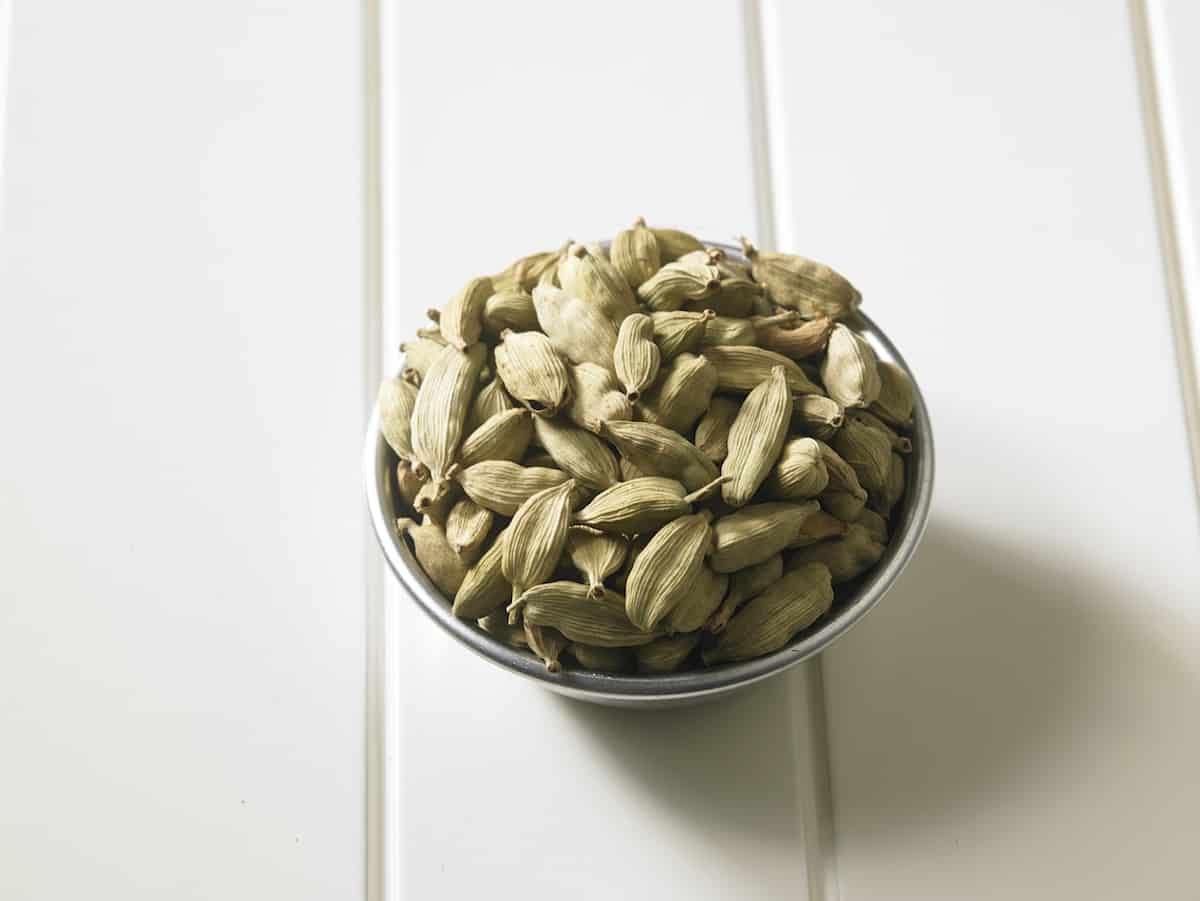
Cardamom is the dried fruit of Elettaria cardamomum, a member of the ginger family (Zingiberaceae).1 Almost all of its aroma sits in the small seeds inside the pod: PROSEA reports that freshly harvested seeds can hold up to 11% essential oil, while the husk rarely holds more than 1%.2 Nearly every decision about cooking with it follows from that: whether to use the whole pod, crack it, or grind the seeds, and how soon. For the plant, its chemistry and its trade, see the cardamom profile.
At a glance
| Question | Answer | Source |
|---|---|---|
| Green or black? | Green, unless a recipe says black; they are different plants | Kew; Tasting Table134 |
| Whole or ground? | Whole pods keep better; grind as needed | Croatica Chemica Acta; The Spice House56 |
| Pods to ground | About 12 pods, dehusked, for 1 teaspoon ground | McCormick7 |
| Whole pods in savory dishes | Fried briefly in fat at the start | Food52 pilaf8 |
| Ground in baking | Seeds ground yourself, coarsely or to powder with flecks | Saveur; Milk Street910 |
| Starting amount | About 1 teaspoon for six servings, for strong spices generally | University of Delaware11 |
Green or black
“Cardamom” in a recipe means green cardamom, Elettaria cardamomum, native to southwest India.1 Black cardamom is a different plant, Amomum subulatum, native from Nepal to central China.3 Tasting Table describes green cardamom as much more intense than black, and notes that you can use green in place of black but the dish will taste different.4 The Spice House describes green cardamom as fragrant and lemony and used in sweets and breads.6 See black cardamom vs. green and black cardamom.
Whole pods, seeds or ground
Three forms are sold: whole pods, decorticated (loose) seeds and ground seed.2 They differ in how well they keep:
- A 2025 analysis of eight commercial cardamom samples found the whole fruit of superior quality to the powdered form.5
- The Spice House says grinding green cardamom pods fresh gives the best aroma and flavor.6
- Milk Street’s recipe for Swedish cardamom buns insists on seeds you grind yourself, and says pre-ground cardamom does not come close in flavor, aroma or appearance.10
PROSEA calls true cardamom one of the highest-priced spices on the market,2 which is another reason to buy pods and grind only what you need. If you use cardamom rarely and in small amounts, a small jar of ground cardamom is a reasonable convenience; buy little, and if it no longer smells strongly when opened, it has faded. That is kitchen judgment, not a measured shelf life. See cardamom pods vs. seeds for the full comparison.
Converting. McCormick counts about 12 pods, dehusked, for 1 teaspoon of ground cardamom.7 That is a volume conversion, not a measure of strength.
Cooking with whole pods
Whole or lightly cracked pods suit dishes cooked in liquid or fat, where the flavor can seep out and the pods can be removed. PROSEA notes that in Asia cardamom plays an important role in spiced rice, vegetable and meat dishes and is an important ingredient of curries.2
A typical pattern is to fry the whole spices in fat at the start. Erin Alexander’s Indian rice pilaf on Food52 sautés 2 whole green cardamom pods with cinnamon, cloves, bay leaves, star anise and cumin seeds in ghee for 2 to 3 minutes to release the spices’ oils before the rest of the dish goes in.8 PROSEA also notes cardamom’s use to flavor coffee and tea, especially in Arab countries.2
Cracking the pods. Pressing a pod with the flat of a knife or a pestle until it splits lets liquid reach the seeds, and it makes the seeds easy to pick out if you want to grind them. That is common practice; we found no source that tests whether cracked pods release more flavor than whole ones, or that recommends a garlic press for the job. Whole pods are unpleasant to bite into, so fish them out or warn diners; that too is kitchen judgment.
Cooking with ground cardamom
Ground cardamom goes where it needs to disappear into the food: doughs, batters, custards and spice blends. Two kinds of recipe show how much is used.
Scandinavian baking. Britannica notes cardamom’s popularity in Scandinavian pastries,12 and PROSEA names Scandinavian countries as major consumers for baked goods.2 Saveur’s Swedish-style cardamom buns use 1 tablespoon of coarsely ground cardamom seeds, with the pods discarded, combined with sugar and cinnamon.9 Milk Street’s kardemummabullar call for decorticated seeds ground in a mortar or pulsed in an electric spice grinder to a mix of powder and tiny flecks.10
Spice blends. Madhur Jaffrey’s garam masala, published by Saveur, uses a quarter cup of cardamom seeds, and the blend is not toasted before grinding.13 See garam masala and chai spices.
Grinding tools. Milk Street’s recipe allows either a mortar and pestle or an electric spice grinder.10 A common claim says blade grinders cannot grip a small amount of cardamom seed; we found no source for it, though a mortar is the simpler tool for a teaspoon or two. That is kitchen judgment.
How much to use
The University of Delaware groups cardamom with the spices to use with care because their flavors stand out, at approximately 1 teaspoon for six servings.11 That is a general starting point for the group, not a cardamom-specific test. The recipe amounts above are the only cardamom-specific figures found: 2 pods in a pot of pilaf,8 1 tablespoon of ground seed in a batch of buns,9 and a quarter cup in a garam masala meant to be used a little at a time.13
Too much cardamom tastes medicinal and can overwhelm the other spices; that description is ours. A common claim says stale cardamom, used in quantity to make up for lost flavor, gives food a chalky texture; we found no source for it. If a dish has gone over, see too much cardamom.
Storage
No regulator or standards body gives a shelf life for cardamom. PROSEA says that for green cardamom, light must be excluded in storage.2 Store pods sealed, cool and dark, and judge them by smell when cracked.
What isn’t sourced
- A common claim says cardamom is chewed as a breath freshener; no source checked here addresses it.
- Cardamom’s use in North American desserts is often mentioned; no source checked describes it.
Related
- Cardamom, the full profile
- Cardamom pods vs. seeds
- Cardamom substitutes and black cardamom substitutes
- Black cardamom vs. green and cardamom vs. cloves
- Too much cardamom
- Garam masala and chai spices
Footnotes
-
Elettaria cardamomum (L.) Maton, Plants of the World Online, Royal Botanic Gardens, Kew. powo.science.kew.org · Reference work ↩ ↩2 ↩3
-
T.H. Wardini and A. Thomas, Elettaria cardamomum, Plant Resources of South-East Asia (PROSEA). uses.plantnet-project.org · Reference work ↩ ↩2 ↩3 ↩4 ↩5 ↩6 ↩7
-
Amomum subulatum Roxb., Plants of the World Online, Royal Botanic Gardens, Kew. powo.science.kew.org · Reference work ↩ ↩2
-
Natasha Bailey, “How Are Green And Black Cardamom Different?”, Tasting Table, 2022. tastingtable.com · Publication ↩ ↩2
-
Blažeković et al., “Content and Chemical Composition of Essential Oil from Cardamom”, Croatica Chemica Acta, 2025. hrcak.srce.hr · Peer-reviewed ↩ ↩2
-
“Cardamom Substitute”, The Spice House, 2017. thespicehouse.com · Merchant ↩ ↩2 ↩3
-
“How to Grind Your Own Spices, Plus Spice Conversions for Your Favorite Seasonings”, McCormick, 2025. mccormick.com · Merchant ↩ ↩2
-
Erin Alexander, “Indian Rice Pilaf With Tomato-Onion Raita & Crispy Papad”, Food52. api.food52.com · Publication ↩ ↩2 ↩3
-
“Swedish-Style Cardamom Buns”, Saveur, 2018. saveur.com · Publication ↩ ↩2 ↩3
-
“Swedish Cardamom Buns (Kardemummabullar)”, Milk Street. 177milkstreet.com · Publication ↩ ↩2 ↩3 ↩4
-
“Using Herbs and Spices”, University of Delaware Cooperative Extension, 2025. udel.edu · Reference work ↩ ↩2
-
Gregory Lewis McNamee, “Cardamom”, Encyclopaedia Britannica. britannica.com · Reference work ↩
-
Madhur Jaffrey, “Garam Masala”, Saveur, 2014. saveur.com · Publication ↩ ↩2