Spice Substitutes · Substitutes
Cardamom Substitutes, Ranked by the Job Cardamom Is Doing
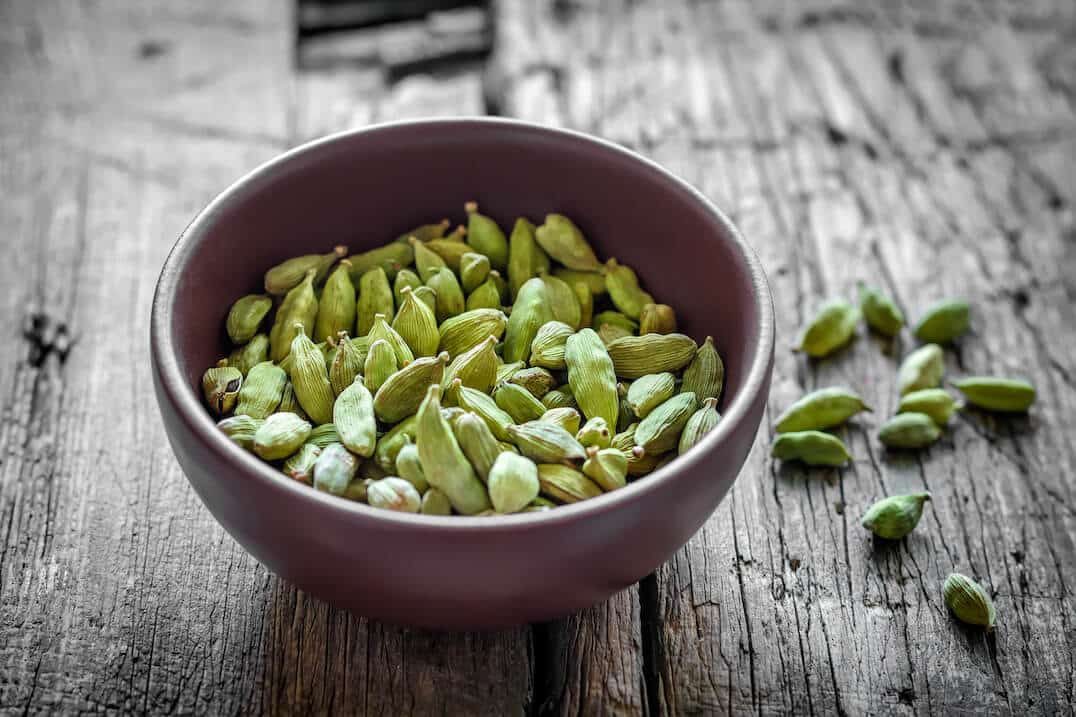
Cardamom here means green cardamom, the dried fruit and seeds of Elettaria cardamomum, a ginger-family plant native to southwest India.1 Its aroma comes from an essential oil made up mainly of 1,8-cineole and alpha-terpinyl acetate.2 1,8-Cineole has a camphor-like odor.3 No other common spice is built on that pair of compounds, so every substitute is a compromise. The best one depends on whether cardamom is perfuming a pastry, warming a curry, or scenting a drink.
Quick answer
| What cardamom is doing | Best substitute | Starting amount, per 1 part cardamom | Treatment |
|---|---|---|---|
| Sweet spice in baking (buns, cakes, cookies) | Equal parts ginger, nutmeg, cloves and cinnamon, mixed | 1 part of the mix | Attributed |
| Warmth in curries, rice and meat dishes | Cinnamon plus ginger | 1/2 part each, or 1 part each | Disputed |
| One spice in a savory blend | Garam masala | 1 part | Attributed |
| Scent in coffee, tea or a syrup | Nothing close; a pinch of coriander or citrus zest with cinnamon | A small pinch | Method |
| Pods in place of ground, or ground for pods | Ground cardamom | 1 teaspoon ground for about 12 pods | Computed |
How the ratios on this page are labeled
- Computed: based on a measurable physical relationship, with the source named.
- Attributed: a named source publishes this ratio. We quote it as theirs.
- Disputed: named sources give different answers to the same swap. We show each one and do not average them.
- Method: we found no published ratio. We give a direction and a cautious starting point, and say so.
The only published cardamom-substitute ratios we found come from one merchant, The Spice House. None says how it was arrived at, and no study compares cardamom’s strength with any substitute.
What the substitutes can and can’t copy
PROSEA puts 1,8-cineole at 20 to 60 percent of cardamom oil and alpha-terpinyl acetate at 20 to 53 percent.2 A 2025 study of eight commercial samples found alpha-terpinyl acetate to be the largest component in all of them, from about 36 to 62 percent, with 1,8-cineole anywhere from under 1 to about 31 percent.4 The usual stand-ins are built differently. Clove oil is about 85 to 92 percent eugenol,5 and cinnamon bark oil is dominated by cinnamaldehyde.6 Ginger is in the same plant family as cardamom,71 but its pungency comes from gingerols.8 These spices supply warmth and sweetness. None supplies cardamom’s cool, camphor-and-flower lift, which is why a blend of several usually comes closer than any one.
The Spice House lists cinnamon, ginger, cloves, nutmeg, allspice and apple pie spice as good pantry substitutes,9 and its own recommendations below are mostly mixes of them.
If cardamom is a sweet spice in baking
Britannica notes cardamom’s popularity in Scandinavian pastries as well as South Asian dishes.10 In a cardamom bun or cake it is often the main flavor, and a substitute will be noticed.
1. Ginger, nutmeg, cloves and cinnamon in equal parts
Ratio (Attributed): For baking, The Spice House says to “use equal parts of ginger, nutmeg, cloves and cinnamon,” and to start with a 1:1 swap when using a blended substitute.9 That is 1 teaspoon of the mix for each teaspoon of ground cardamom.
Cloves are a quarter of this mix and are very strong. If the result tastes too clove-heavy, the same source suggests cutting back on strong spices like cloves.9
2. Apple pie spice or another sweet blend
The Spice House lists apple pie spice among its pantry substitutes.9 Brand blends are mostly cinnamon; see apple pie spice.
Ratio (Attributed): The Spice House’s general rule is to start with a 1:1 swap when using a blended substitute.9
3. One spice alone
Ratio (Attributed for cloves, Method for the rest): For a single strong spice like cloves, The Spice House says to “cut the amount to half or three quarters because cloves can overpower a dish.”9 We found no ratio for cinnamon, nutmeg or allspice on its own. As a starting point, use half to three quarters of the cardamom amount and taste.
If cardamom is warmth in curries, rice and meat dishes
PROSEA calls cardamom an important ingredient of curries and says it plays an important role in spiced rice, vegetable and meat dishes.2 Here it is usually one spice among several, and a substitute is easier to hide.
1. Cinnamon and ginger
Ratio (Disputed): The Spice House recommends cinnamon and ginger for curry, but its page gives two different amounts for the same swap.
| Where on the page | What it says | Works out to, per 1 teaspoon cardamom |
|---|---|---|
| Body text | 2 teaspoons cardamom: use 1 teaspoon cinnamon and 1 teaspoon ginger9 | 1/2 teaspoon each |
| FAQ | Swap 1 teaspoon cardamom for 1 teaspoon cinnamon plus 1 teaspoon ginger, then adjust9 | 1 teaspoon each |
The two figures differ by a factor of two, and we found no second credible source to settle it. Start with the lower amount, 1/2 teaspoon each of cinnamon and ginger per teaspoon of cardamom, taste once the dish has simmered, and add more if the warmth is missing. That is our Method starting point, not a measurement.
2. Garam masala
Cardamom is a common garam masala ingredient. Great British Chefs lists it among the spices commonly used,11 and Madhur Jaffrey’s recipe in Saveur uses a quarter cup of cardamom seeds.12 The Spice House says garam masala works well in savory Indian dishes because it often has cardamom notes.9 It will also bring cloves, cinnamon, pepper and other spices, so check what else the recipe already contains.
Ratio (Attributed): Start 1:1, per The Spice House’s rule for blended substitutes.9
3. Black cardamom
Black cardamom is a different plant, Amomum subulatum, native from Nepal to central China.13 India’s Indian Institute of Spices Research describes it as strong, smoky and slightly camphoraceous, with 1,8-cineole as the main component of its oil.14 That shared cineole is a real link to green cardamom. The smoke is the problem: The Spice House says black cardamom is smoke-dried and better suited to braised meats and savory recipes than green.15 Use it only in savory dishes.
Sources disagree on which is stronger. The Spice House calls black cardamom stronger than green;15 Tasting Table says green is “much more intense” than black.16 Neither gives a measurement.
Ratio (Method): No published ratio. As our starting point, use one black pod in place of two or three green pods, crack it, and taste before adding more. See black cardamom.
If cardamom is the scent in coffee, tea or a syrup
PROSEA says cardamom is used to flavor coffee and tea.2 In a drink, cardamom is the whole point, and nothing on this page will be mistaken for it.
Ratio (Method): No published ratio. The Spice House suggests a small pinch of ground coriander, or a little lemon or orange zest, to recreate cardamom’s lemony note.9 Coriander’s oil is mainly linalool,17 not cineole, so it adds a floral, citrus brightness but not the camphor note. A small pinch of coriander with a little cinnamon, steeped with the coffee or tea, is our starting point. Or choose another spiced drink altogether; see chai spices.
If you have pods and need ground, or the reverse
Ratio (Computed): McCormick’s conversion is approximately 12 pods, dehusked, for 1 teaspoon ground cardamom.18 This is a volume conversion, not a measure of potency.
Freshness matters here. The Spice House says grinding green pods fresh gives the best aroma and flavor,9 and the 2025 study concluded that the whole fruit was of superior quality to the powdered form.4 If your ground cardamom is old, you may need a little more of it; that is kitchen judgment, not a measurement. See cardamom pods vs. seeds.
What isn’t known
- No published study compares the flavor strength of cardamom with any substitute. All ratios here are a merchant’s rules of thumb or our starting points.
- The Spice House gives two amounts for its cinnamon-and-ginger swap, and we found no second credible source for this or any other cardamom swap within this review.
- No source gives a ratio for black cardamom in place of green, and sources disagree on which is stronger.
- How much cardamom a given brand of garam masala or apple pie spice contains is not published.
Related
- Cardamom, cooking with cardamom, too much cardamom, cardamom pods vs. seeds
- Black cardamom, black cardamom vs. green, black cardamom substitutes, Thai cardamom
- Cardamom vs. cloves, cinnamon, ginger, nutmeg, cloves, allspice, coriander
- Garam masala, apple pie spice, chai spices
Footnotes
-
Elettaria cardamomum (L.) Maton, Plants of the World Online, Royal Botanic Gardens, Kew. powo.science.kew.org · Reference work ↩ ↩2
-
T.H. Wardini and A. Thomas, Elettaria cardamomum, Plant Resources of South-East Asia (PROSEA). uses.plantnet-project.org · Reference work ↩ ↩2 ↩3 ↩4
-
1,8-Cineole (CID 2758), Odor, PubChem. pubchem.ncbi.nlm.nih.gov · Reference work ↩
-
Blažeković et al., Content and Chemical Composition of Essential Oil from Cardamom, Croatica Chemica Acta, 2025. hrcak.srce.hr · Peer-reviewed ↩ ↩2
-
Batiha et al., “Syzygium aromaticum L. (Myrtaceae)”, Biomolecules, 2020. mdpi.com · Peer-reviewed ↩
-
Ranasinghe et al., “Medicinal properties of ‘true’ cinnamon”, BMC Complementary and Alternative Medicine, 2013. link.springer.com · Peer-reviewed ↩
-
Zingiber officinale Roscoe, Plants of the World Online, Royal Botanic Gardens, Kew. powo.science.kew.org · Reference work ↩
-
H. Sutarno, E.A. Hadad and M. Brink, Zingiber officinale, PROSEA. uses.plantnet-project.org · Reference work ↩
-
Cardamom Substitute, The Spice House. thespicehouse.com · Merchant ↩ ↩2 ↩3 ↩4 ↩5 ↩6 ↩7 ↩8 ↩9 ↩10 ↩11 ↩12
-
Gregory Lewis McNamee, “Cardamom”, Encyclopaedia Britannica. britannica.com · Reference work ↩
-
How to make garam masala, Great British Chefs. greatbritishchefs.com · Publication ↩
-
Garam Masala, recipe from Madhur Jaffrey, Saveur. saveur.com · Publication ↩
-
Amomum subulatum Roxb., Plants of the World Online, Royal Botanic Gardens, Kew. powo.science.kew.org · Reference work ↩
-
Large cardamom, ICAR-Indian Institute of Spices Research. spices.res.in · Regulator ↩
-
Black Cardamom Pods, product page, The Spice House. thespicehouse.com · Merchant ↩ ↩2
-
Natasha Bailey, How Are Green And Black Cardamom Different?, Tasting Table, 2022. tastingtable.com · Publication ↩
-
Al-Khayri et al., Essential Oil from Coriandrum sativum, Molecules, 2023. mdpi.com · Peer-reviewed ↩
-
How to Grind Your Own Spices, McCormick. mccormick.com · Merchant ↩