Spice Comparisons · Comparison
Cardamom Pods vs. Seeds: Where the Flavor Is and How to Convert
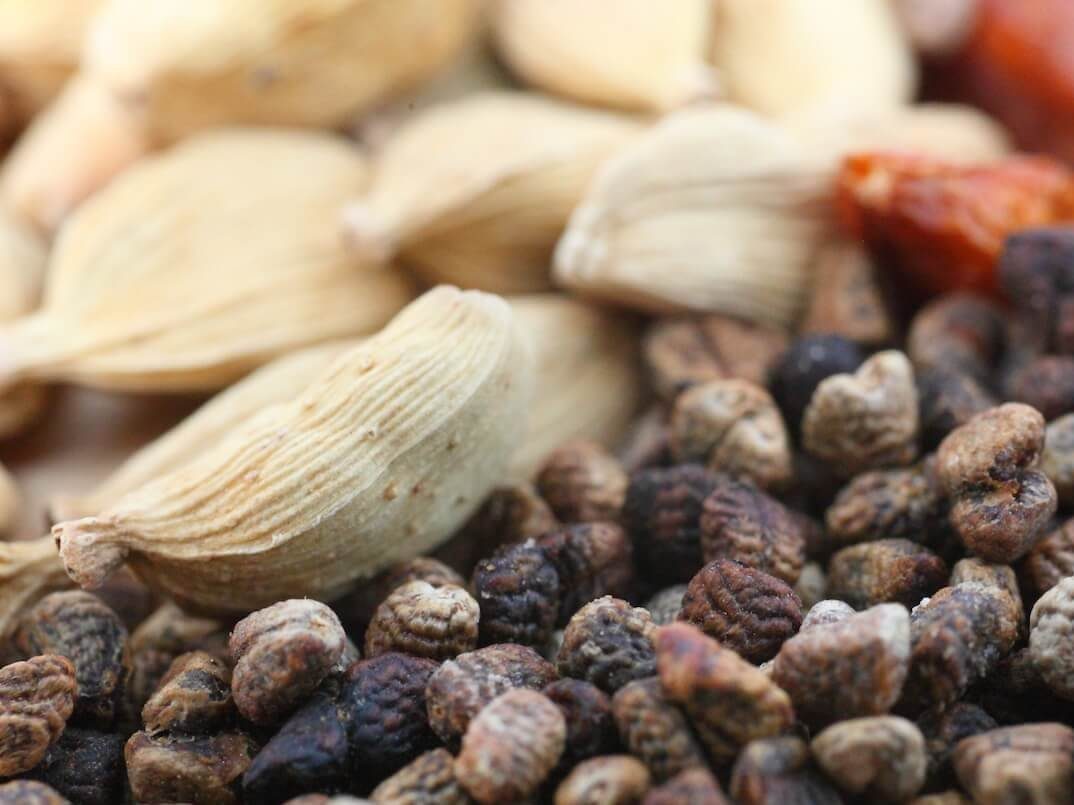
Cardamom pods and cardamom seeds are the same spice in two states. The pod is the dried fruit of Elettaria cardamomum; the seeds inside it carry nearly all the aroma.1 PROSEA’s spice handbook puts it plainly: freshly harvested seeds can hold as much as 11% essential oil, while the husk rarely holds more than 1%.1 So the practical differences are about keeping and convenience, not flavor. Whole pods protect the seeds; loose and ground seeds are easier to measure but give up their aroma sooner.
Side by side
| Whole pods | Loose seeds (decorticated) | Ground cardamom | |
|---|---|---|---|
| What it is | The dried fruit, a capsule holding 15–20 seeds1 | The seeds removed from the husk1 | Milled seeds1 |
| Share of the aroma | Whole fruits usually 3.5–7% essential oil;1 the husk adds little1 | Seeds up to 11% oil when freshly harvested1 | Same seeds, but see “Keeping” below |
| Share of the weight | Seeds are 59–79% of the dried fruit’s weight1 | 100% seed | 100% seed |
| Keeping | Whole fruit rated superior in quality to the powder in a 2025 analysis2 | No published comparison with whole pods found | The spice loses aroma by evaporation;1 grinding fresh gives the best aroma, per The Spice House3 |
| Where it is ground | n/a | n/a | Almost entirely in the countries that consume it, per PROSEA1 |
| Typical uses (editorial) | Rice, braises, syrups, tea and coffee, removed before serving | Spice blends and baking, ground as needed | Baking and quick sauces |
Pods, loose seeds and ground seed are the three forms PROSEA lists for the spice in use.1
Where the flavor is
The figures above all come from PROSEA, which explains that cardamom’s essential oil is located predominantly in the seeds.1 Two consequences for a cook follow from that, by our arithmetic:
- By weight, pods are a diluted form. If seeds are 59–79% of a dried pod’s weight,1 then 10 g of whole pods holds roughly 6 to 8 g of seed. A recipe written in grams of seed needs more weight in pods. (Computed from PROSEA’s range; the husk’s small oil content is ignored.)
- A cracked pod and a seed release the same compounds. The husk contributes little oil,1 so whether you use pods or seeds changes how fast the flavor gets out and how much you can control the dose, not what the flavor is.
That oil is mostly α-terpinyl acetate and 1,8-cineole, in proportions that vary from lot to lot;2 see cardamom for the figures.
Keeping: pods vs. seeds vs. ground
Cardamom’s aroma is volatile. PROSEA notes that the spice loses quality through evaporation, unlike the extracted oil, which changes chemically instead.1 Two sources point the same direction on form:
- A 2025 study of eight commercial cardamom samples concluded that the whole fruit was of superior quality to the powdered form.2
- The Spice House says grinding green cardamom pods fresh gives the best aroma and flavor.3
PROSEA also lists decorticated seeds among the trade’s quality categories as a product of poor processing,1 which is one more reason to prefer pods when the goal is keeping quality.
We found no published shelf life, in months, for pods, loose seeds or ground cardamom, and no study comparing loose seeds with whole pods over time. The usual advice (buy pods, store them airtight and dark, and grind as needed) is consistent with the sources above but is not a measured result. PROSEA recommends that green cardamom be packed so that light is excluded.1
Converting between them
| From | To | Ratio | Treatment |
|---|---|---|---|
| Whole pods | Ground cardamom | About 12 pods, dehusked, for 1 teaspoon ground, per McCormick4 | Computed (volume conversion) |
| Whole pods, by weight | Seeds, by weight | 1 part pods gives about 0.6 to 0.8 part seed | Computed (from PROSEA’s 59–79% seed share)1 |
The McCormick figure is a volume conversion,4 not a measure of strength, and older ground cardamom may need more. That last point is kitchen judgment. For substitutes when you have neither, see cardamom substitutes.
Using each form
These are cooking judgments, not sourced findings.
- Pods. Crack or lightly crush them so liquid reaches the seeds, then simmer in rice, braises, syrups, tea or coffee. Fish them out before serving, or tie them in a spice bag; a whole pod is unpleasant to bite into.
- Loose seeds. Bruise them for infusions or grind them for blends and baking. A mortar and pestle handles a small amount better than most blade grinders.
- Ground. Convenient for baking and last-minute seasoning. Buy small amounts.
PROSEA notes cardamom’s important role in Asian spiced rice, vegetable and meat dishes and in curries, and its use to flavor coffee and tea.1 Britannica notes its popularity in Scandinavian pastries,5 where it is usually ground. See cooking with cardamom and, if a dish has gone over, too much cardamom.
Green, bleached and black
Green pods are usually flue-cured in special curing rooms. Pale or “white” pods are sun-dried, sometimes followed by bleaching in sulfur fumes.1 Both are Elettaria cardamomum, native to southwest India.6 Black cardamom is a different plant, Amomum subulatum, native from Nepal to central China;7 see black cardamom vs. green.
PROSEA calls true cardamom one of the highest-priced spices on the market.1 A widely repeated claim ranks it third, after saffron and vanilla; we found no source for that ranking.
What isn’t known
- No published shelf life for whole pods, loose seeds or ground cardamom.
- No study comparing aroma loss in loose seeds against whole pods over time.
- How many pods make a teaspoon of loose seeds is not published; McCormick’s figure is for ground.
Related
- Cardamom, cardamom substitutes, cooking with cardamom, too much cardamom
- Black cardamom, black cardamom vs. green, Thai cardamom
- Cardamom vs. cloves, garam masala, chai spices
Footnotes
-
T.H. Wardini and A. Thomas, Elettaria cardamomum, Plant Resources of South-East Asia (PROSEA). uses.plantnet-project.org · Reference work ↩ ↩2 ↩3 ↩4 ↩5 ↩6 ↩7 ↩8 ↩9 ↩10 ↩11 ↩12 ↩13 ↩14 ↩15 ↩16 ↩17 ↩18 ↩19 ↩20 ↩21 ↩22
-
Blažeković et al., “Content and Chemical Composition of Essential Oil from Cardamom”, Croatica Chemica Acta, 2025. hrcak.srce.hr · Peer-reviewed ↩ ↩2 ↩3
-
“Cardamom Substitute”, The Spice House, 2017. thespicehouse.com · Merchant ↩ ↩2
-
“How to Grind Your Own Spices, Plus Spice Conversions for Your Favorite Seasonings”, McCormick, 2025. mccormick.com · Merchant ↩ ↩2
-
Gregory Lewis McNamee, “Cardamom”, Encyclopaedia Britannica. britannica.com · Reference work ↩
-
Elettaria cardamomum (L.) Maton, Plants of the World Online, Royal Botanic Gardens, Kew. powo.science.kew.org · Reference work ↩
-
Amomum subulatum Roxb., Plants of the World Online, Royal Botanic Gardens, Kew. powo.science.kew.org · Reference work ↩