Spice Fixes · Fix
Too Much Cardamom? How to Save Your Dish, Fastest Fix First
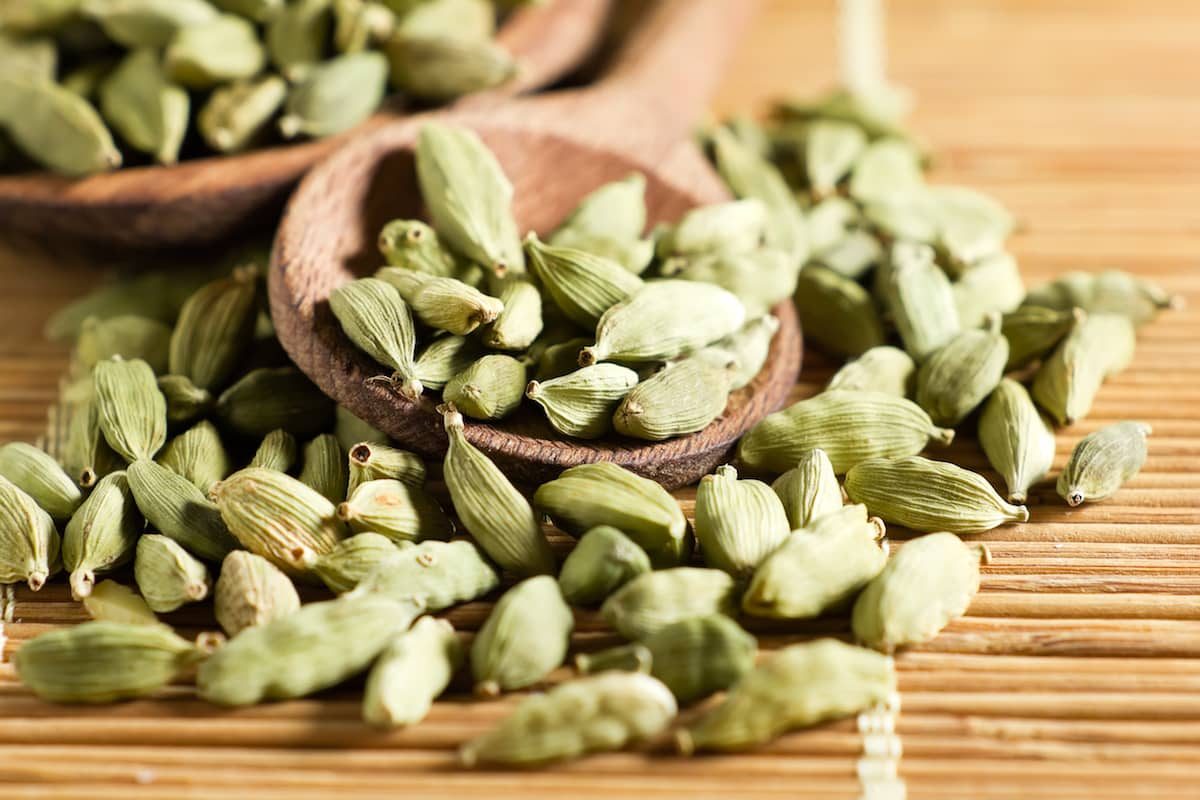
Too much cardamom turns a dish from fragrant to medicinal: the bright, floral note that works in the background takes over and starts to taste like cough drops or soap. The fixes depend on whether you used whole pods or ground cardamom. Within each section the fastest fix comes first.
Quick answer
| What’s wrong | Fastest fix | If that’s not enough |
|---|---|---|
| Whole pods in rice, a curry, tea or a syrup | Fish them out now | Dilute what’s left |
| Too much ground cardamom, overall | Add more of everything else, or split the dish and build half back up | Balance with sweetness or more of the dairy already in the dish |
| Medicinal or bitter edge | Dilute | A little sugar or honey |
Why cardamom turns medicinal
A 2025 analysis of eight commercial cardamom samples (Elettaria cardamomum) found alpha-terpinyl acetate was the most abundant compound in the essential oil of every sample (about 36 to 62%), followed by 1,8-cineole (about 0.2 to 31%).1 1,8-Cineole has a camphor-like odor.2 In our judgment, that camphor note is what comes to the front when there’s too much cardamom. The wide range in cineole between samples also means one jar can be a lot more assertive than another.1
This page is about green cardamom, Elettaria cardamomum. For black cardamom, see black vs. green cardamom.
Whole pods: get them out
Remove whole pods as soon as you notice. In our judgment they keep releasing flavor while they sit in hot liquid, so pulling them out stops the problem growing. In rice, they’re easiest to find on the surface before you fluff it; in tea or a syrup, strain. If the pods were cracked and the seeds have escaped, a strainer catches most of them in liquids. More on the forms in cardamom pods vs. seeds.
Sheer volume: too much ground cardamom
Dilute. This is the one fix that actually lowers the amount of cardamom in each bite. Add more of every other ingredient except cardamom; because you’re using the recipe’s own ingredients, the dish keeps its character. If you can’t add to the pot without changing the dish, Tasting Table’s method for an over-garlicked dish works the same way: cook a second batch without the spice and combine the two.3
Split, then rebuild. To avoid a double batch, remove half of the over-spiced dish (freeze it), then add the other ingredients to the remaining half to bring it back to a full recipe.
Add more of the dairy that’s already there. If the dish is a milky one (rice pudding, chai, a custard, a creamy curry), more of the milk, cream or yogurt the recipe already uses is dilution that fits the dish. We could not find a source showing that dairy binds cardamom’s flavor compounds, so treat this as dilution, not a neutralizer.
A medicinal or bitter edge
Add sweetness. In controlled taste tests, sweet tastes and sodium salts both suppressed bitterness, with sugar the strongest suppressor; citric acid was the weakest.4 Those were pure taste solutions, not food, but they support the kitchen habit. In a sweet dish, add a little more of the sugar or honey it already uses. In a savory dish, add sweetener a pinch at a time and taste between additions.
Fixes that don’t hold up
A potato to soak it up. The idea that a raw potato absorbs excess flavor comes from the oversalted-soup trick, and even for salt the evidence is thin: a Tasting Table writer who uses it calls the potato “more of an aid than a final answer.”5 We found no test of a potato against cardamom, and nothing to suggest it pulls out cardamom’s flavor compounds while leaving the dish’s other seasonings alone. If you like potato in the dish, leave it in and count it as dilution.
Covering it with other strong flavors. Cloves, cinnamon, oregano, rosemary, onion or garlic are all suggested as ways to mask cardamom. In our judgment this usually leaves two overpowering flavors instead of one, and cloves in particular are easy to overdo themselves (see too much clove). Use another spice only to round off a dish that is slightly heavy on cardamom, and only one that already belongs in it.
Is too much cardamom a safety issue?
We found no regulator or clinical source that sets a level at which cardamom eaten in food becomes a concern. Treat an over-cardamomed dish as a flavor problem.
Preventing it next time
Prefer whole pods in liquids. A pod can be pulled out the moment the flavor is right; ground cardamom can’t. The 2025 analysis also found whole fruit of superior quality to the powdered form.1
Start low and taste. We found no published guideline for how much cardamom a dish should take, and samples vary a lot.1 The method that works: start with about half of what you think you need, let it cook in or steep, taste, and add more in stages. More in cooking with cardamom.
Shake into your hand, not over the pot. Common kitchen practice: a loose lid or a clogged shaker hole that suddenly clears spills onto the counter, not into dinner.
Related
Footnotes
-
Blažeković B et al., Content and Chemical Composition of Essential Oil from Cardamom (Elettaria cardamomum), Croatica Chemica Acta, 2025. hrcak.srce.hr · Peer-reviewed ↩ ↩2 ↩3 ↩4
-
1,8-Cineole, PubChem (Hazardous Substances Data Bank), U.S. National Library of Medicine. pubchem.ncbi.nlm.nih.gov · Reference work ↩
-
Simple Ways To Tone Down The Pungency Of Garlic, Harmony Colangelo, Tasting Table, 2023. tastingtable.com · Publication ↩
-
Green BG et al., Taste Mixture Interactions: Suppression, Additivity, and the Predominance of Sweetness, Physiology & Behavior, 2010. pmc.ncbi.nlm.nih.gov · Peer-reviewed ↩
-
How To Fix An Oversalted Soup, Alison Spiegel, Tasting Table, 2016. tastingtable.com · Publication ↩