Spice Substitutes · Substitutes
Fennel Seed Substitutes, Ranked by the Job Fennel Is Doing
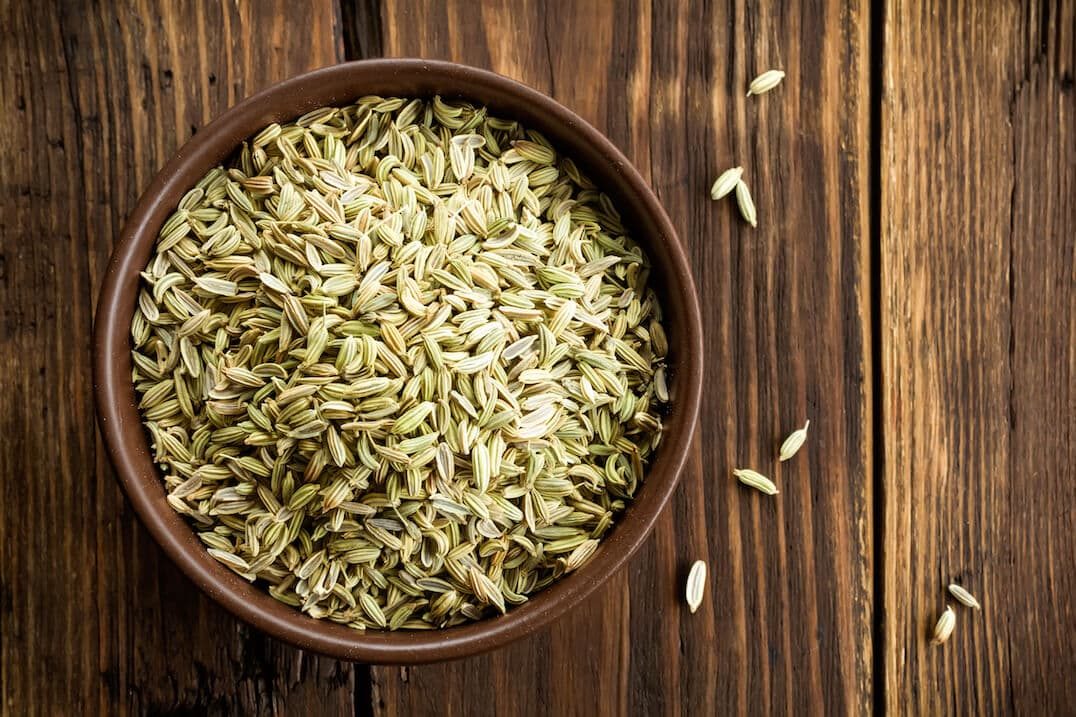
Fennel seed is the dried fruit of Foeniculum vulgare, a perennial herb of the carrot family (Apiaceae).1 Its sweet, anise-like taste comes mainly from anethole, which makes up as much as 70 to 80 percent of sweet fennel’s oil.2 Illinois Extension notes its use in sausage,3 and Britannica lists it among the five spices of Chinese five-spice powder.4 The closest substitutes share that anethole. Others fill a different part of fennel’s job, so the right choice depends on what the seed is doing in your recipe.
Quick answer
| What fennel seed is doing | Best substitute | Starting amount, per 1 part fennel seed | Treatment |
|---|---|---|---|
| Sweet anise note (Italian sausage, tomato sauce, biscotti) | Anise seed | 1/2 to 3/4 part, then add to taste | Attributed |
| Seed flavor in bread, slaw or a baked pasta | Caraway seed | 1 part | Attributed |
| One of several warm spices in a curry | Cumin and celery seed, mixed | Equal total volume, then adjust | Attributed |
| Steeped in a broth, braise or syrup | Whole star anise | About 1 star per teaspoon of fennel, removed before serving | Method |
How the ratios on this page are labeled
- Computed: based on a measurable physical relationship, with the source named.
- Attributed: a named source publishes this ratio. We quote it as theirs.
- Disputed: named sources give different answers to the same swap. We show each one and do not average them.
- Method: we found no published ratio. We give a direction and a cautious starting point, and say so.
The only fennel-seed ratios we could attribute come from one merchant, The Spice House. They are rules of thumb. No published study compares the flavor strength of fennel seed with any substitute.
Why the anise-flavored substitutes work, and where they fall short
Three common spices get their licorice note from the same compound.
| Fennel seed | Anise seed | Star anise | |
|---|---|---|---|
| Plant | Foeniculum vulgare1 | Pimpinella anisum5 | Illicium verum6 |
| Anethole in the oil | Up to 70 to 80% in sweet fennel2 | 80 to 95%5 | 70 to 93%6 |
Each range comes from a different PROSEA entry and different samples, so the table shows overlap, not a ranking. America’s Test Kitchen (ATK) traces the licorice flavor of all three to high levels of trans-anethole, but notes that each comes from a different plant with its own secondary compounds.7 When ATK swapped them in recipes, tasters noticed.7 Expect a substitute to come close, but not to go unnoticed.
If fennel is a sweet anise note
This is fennel in Italian sausage, tomato sauces, pork, and sweet baking.
1. Anise seed
PROSEA notes that fennel and anise fruits are often confused and substituted for each other.2 They look different up close: anise is about 3.5 mm long,8 fennel about 6 mm.1 Anise has the higher anethole content of the two,25 and The Spice House calls anise closer in flavor to fennel but stronger.9
Ratio (Attributed): The Spice House says to start with half to three quarters of the fennel amount and adjust to taste.9 Use it whole or ground, to match the recipe.
ATK found the difference harder to notice in a dish with many other spices, such as Italian sausage meatballs, and easy to spot in biscotti.7 So anise is a safer swap in a sausage or sauce than in a cookie where fennel is the main flavor.
If you have ground fennel but the recipe wants seed, or the reverse
You don’t need a substitute at all, only a conversion.
Ratio (Computed): McCormick’s conversion is 1 teaspoon fennel seeds to 1 1/4 teaspoons ground fennel.10 That is a volume figure for grinding, not a measure of strength.
If fennel is seed flavor in bread or a savory bake
Caraway seed
Britannica describes caraway’s aroma as reminiscent of anise, with a warm, slightly sharp taste.11 Its oil is different, though. PROSEA names carvone and limonene as its principal components,12 not anethole. The Spice House says caraway has a similar effect in lasagna but is not as sweet as fennel.9 Expect a rye-bread flavor with a hint of anise.
Ratio (Attributed): The Spice House says to use caraway 1 to 1.9
Dill seed
Dill is an herb of the parsley family (Apiaceae), like fennel, and Britannica describes its flavor as warm and slightly sharp, somewhat like caraway.13 PROSEA gives dill fruit oil as up to 70 percent limonene and up to 60 percent carvone.14 The Spice House says dill seeds give lasagna a similar texture but without the strong licorice or anise flavor.9 It works where fennel is mostly texture and background.
Ratio (Method): No published ratio. Start with an equal amount and expect less sweetness. To bring back some anise note, The Spice House suggests a small pinch of crushed anise seed.9
If fennel is one of several spices in a curry
In a curry or spice blend, fennel adds sweetness and aroma alongside other warm spices.
Cumin and celery seed
The Spice House suggests cumin and celery seed together for a curry, saying they bring a similar aroma and sweetness.9 Neither carries fennel’s anethole, so this is a blend-level fix. In our judgment it suits dishes where fennel is one note among many.
Ratio (Attributed): The Spice House says to start with an equal total volume to the fennel called for and adjust.9
If fennel is steeped in a liquid
Whole star anise
Star anise oil is mostly trans-anethole, with an anise-like odor and sweet flavor.6 A whole star is easy to remove from a broth or poaching liquid.
Ratio (Method): We found no published ratio for star anise in place of fennel seed. The Spice House says star anise is stronger than anise seed and that 1/2 teaspoon of anise seed replaces one whole star.15 Combined with its advice that anise is stronger than fennel,9 that suggests one star stands in for somewhat more than 1/2 teaspoon of fennel. That is arithmetic across two pieces of merchant advice, not a tested ratio. Start with one star per teaspoon of fennel seed, taste as it simmers, and take it out before serving.
If you only have ground star anise, McCormick’s conversion is 1 whole star = 1/2 teaspoon ground.10
Other options
Chinese five-spice powder. Britannica lists fennel seed itself among the five spices, with cassia, cloves, star anise and Sichuan pepper.4 The cassia and cloves will change the dish. Ratio (Method): start with half the fennel amount, only where those flavors suit.
Fennel fronds or bulb. Illinois Extension says both herb fennel and bulb fennel have an anise or licorice flavor.3 Chopped fronds can add a fresh fennel note to a finished dish, but they are a leafy herb, not a seed. Ratio (Method): add to taste at the end.
Anise liqueur. The Spice House says Pernod or anise liqueur adds licorice brightness and suggests starting with a teaspoon.9 It brings alcohol and sugar, so in our judgment it suits sauces and braises with liquid to cook it off.
Licorice root. PROSEA notes that anise’s flavor is often confused with licorice, and that anise oil is traditionally used with licorice in candy.5 We found no credible source giving an amount for using licorice root in place of fennel seed.
What isn’t known
- No published measurement compares the flavor strength of fennel seed with anise, caraway, dill or star anise in a dish. The ratios above are a merchant’s rules of thumb.
- No source gives a tested ratio for star anise, dill seed, five-spice or fennel fronds in place of fennel seed.
- Anethole content varies with the type of fennel and the sample. Bitter fennel has a pungent, camphor-like taste,2 and labels rarely say which type is in the jar.
Related
- Fennel seed, fennel pollen, bronze fennel
- Fennel seed vs. anise seed, caraway seeds vs. fennel seeds, fennel seeds vs. cumin seeds, fennel pollen vs. fennel seed, fennel vs. dill
- Anise seed, star anise, caraway seeds, dill, celery seeds, Chinese five-spice powder
- Anise seed substitutes, star anise substitutes, caraway seed substitutes, fennel pollen substitutes
- Our master list of herbs and spices
Footnotes
-
“Fennel”, Encyclopaedia Britannica. britannica.com · Reference work ↩ ↩2 ↩3
-
Purwaningsih, Harmida and M. Brink, Foeniculum vulgare, Plant Resources of South-East Asia (PROSEA). uses.plantnet-project.org · Reference work ↩ ↩2 ↩3 ↩4 ↩5
-
“Fennel”, University of Illinois Extension. extension.illinois.edu · Reference work ↩ ↩2
-
Tony Hill, “Five-spice powder”, Encyclopaedia Britannica. britannica.com · Reference work ↩ ↩2
-
L.B. Cardenas and C.C. de Guzman, Pimpinella anisum, PROSEA. uses.plantnet-project.org · Reference work ↩ ↩2 ↩3 ↩4
-
Vu Ngoc Lô, Illicium verum, PROSEA. uses.plantnet-project.org · Reference work ↩ ↩2 ↩3
-
Andrew Janjigian, “Why Anise Seed, Fennel Seed, and Star Anise aren’t Interchangeable”, America’s Test Kitchen, 2020. americastestkitchen.com · Publication ↩ ↩2 ↩3
-
“Anise”, Encyclopaedia Britannica. britannica.com · Reference work ↩
-
“12 Best Fennel Substitutes”, The Spice House, 2018. thespicehouse.com · Merchant ↩ ↩2 ↩3 ↩4 ↩5 ↩6 ↩7 ↩8 ↩9 ↩10
-
“How to Grind Your Own Spices”, McCormick. mccormick.com · Merchant ↩ ↩2
-
“Caraway”, Encyclopaedia Britannica. britannica.com · Reference work ↩
-
H. Toxopeus and J.H. Lubberts, Carum carvi, PROSEA. uses.plantnet-project.org · Reference work ↩
-
“Dill”, Encyclopaedia Britannica. britannica.com · Reference work ↩
-
Nguyen Thi Tâm, C.C. de Guzman and P.C.M. Jansen, Anethum graveolens, PROSEA. uses.plantnet-project.org · Reference work ↩
-
“Star Anise Substitute”, The Spice House, 2018. thespicehouse.com · Merchant ↩