Cooking · Storage
Can You Freeze Tarragon? Why Freezing Beats Drying, and How to Do It
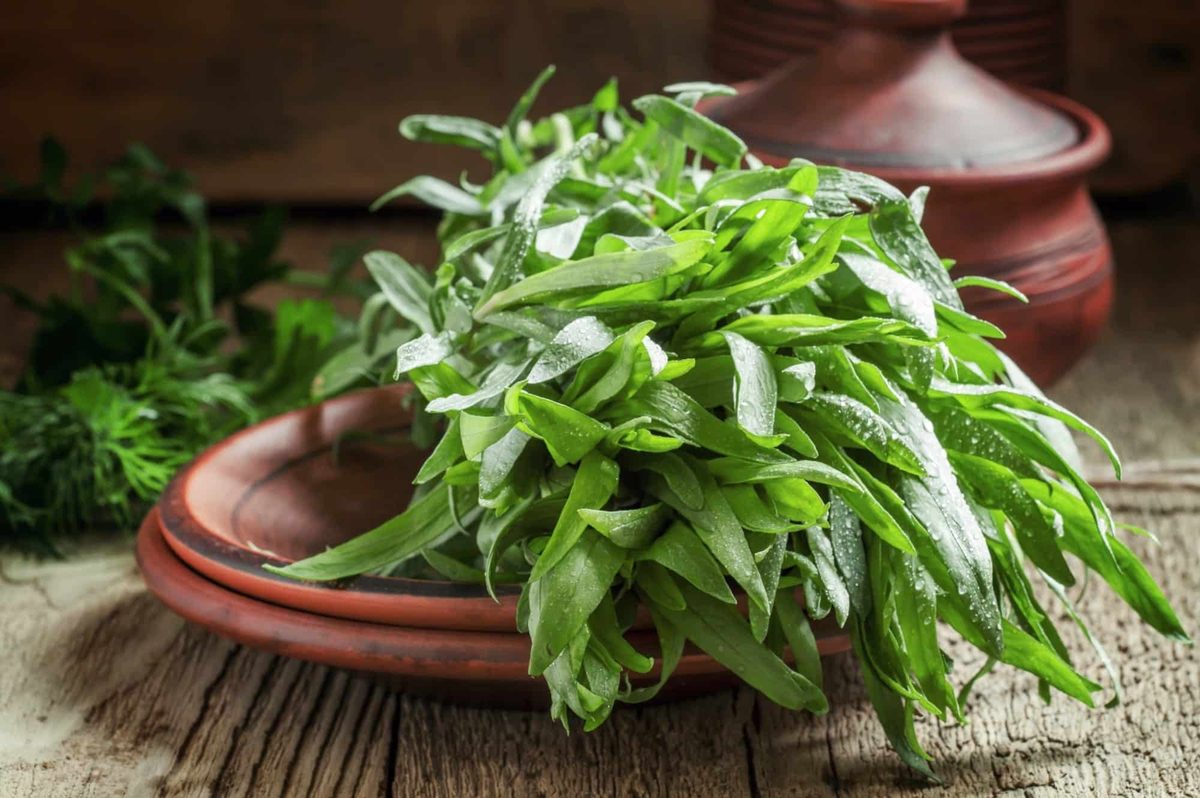
Yes, and for tarragon, freezing is the better way to keep it. Tarragon’s flavor is quickly lost when the leaves are dried,1 while a 2022 study found that frozen tarragon kept its essential oil and its green color better than leaves that were oven-dried at 60°C or freeze-dried.2 Penn State Extension lists tarragon among the herbs that can be frozen.3
Two cautions. Frozen tarragon is not identical to fresh: in the same study, every preservation method, freezing included, changed the taste of the leaves.2 And like all frozen herbs, it goes limp when it thaws, so it belongs in cooked food.34
At a glance
| Question | Short answer |
|---|---|
| Can it be frozen? | Yes.3 |
| Why freeze rather than dry? | Drying costs tarragon much of its flavor.15 |
| Best methods | Tray-freeze leaves, then bag them; or freeze chopped leaves in ice cube trays under water, broth or oil.64 |
| Blanch first? | No source recommends it for tarragon; washing and drying is enough (editorial). |
| Freezer temperature | 0°F or below.64 |
| How long | For best quality, 3 to 6 months (Ohio State). Other figures below. |
| Thaw first? | No. Add it frozen to cooked dishes.3 |
What freezing does to tarragon
Tarragon is related to mugwort and wormwood, and is an essential ingredient in béarnaise sauce.7 Its sweet, anise-like scent8 is what you are trying to keep, and America’s Test Kitchen counts tarragon among the delicate herbs whose flavors are more volatile.5
A 2022 study compared six ways of preserving two French tarragon varieties: freezing, shade drying, oven drying at 40°C and 60°C, freeze drying (lyophilization), and microwave drying.2
| Finding | Freezing | Other methods |
|---|---|---|
| Essential oil kept | Among the best: freezing and shade drying retained the most, 2.77 to 4.41 mL per 100 g dry weight2 | Oven drying at 60°C and freeze drying lost the most, 0.1 to 1.90 mL per 100 g2 |
| Green color | Kept2 | Also kept by oven drying at 40°C and freeze drying; degraded by drying at 60°C and at 250 W2 |
| Taste (electronic tongue) | Changed2 | Changed by every method2 |
The study measured oil content and used an electronic tongue, not a tasting panel, and it reports the state of the leaves after preservation, not a storage time. It does, though, support the reason to freeze tarragon: the oil survives freezing better than most kinds of drying.
The texture changes too. Freezing makes the water in the leaves expand, so thawed herbs are limp.3 Ohio State notes that herbs have textural changes after being frozen and thawed.6
How to freeze tarragon
Prepare it. Rinse the tarragon, then pat or spin it dry.3 Freeze it at peak freshness.6 Young stem tips and leaves can be picked through the season,1 so freezing small batches as you go works well (editorial).
About blanching. A common claim says tarragon should be blanched before freezing to kill bacteria, remove pesticide residues and make it last longer after thawing. We found no source for any of that. Penn State mentions blanching only for larger herbs such as basil, for 15 seconds,3 and says nothing of tarragon. The USDA freezing fact sheet explains blanching as a way to deal with enzyme activity in vegetables, which freezing only slows.9 Rinsing and drying the leaves is the preparation Penn State gives for freezing herbs.3
Method 1: tray-freeze leaves. Strip the leaves, spread them in a single layer on a tray, freeze until firm, then move them to labeled bags or containers, pressing out as much air as possible.4 The leaves stay separate, so you can take out a pinch at a time. Air reaching the surface of frozen food is what causes freezer burn.9
Method 2: bag whole sprigs. The fastest way is to put washed herbs in airtight freezer bags and freeze them.10 Several small bags are easier to use than one large one (editorial).
Method 3: ice cubes. Chop the leaves, put them in ice cube trays, cover with water, broth or oil, and freeze.6 Pop the cubes into labeled, dated bags and drop a whole cube into a soup or stew.10 Herbs frozen in oil keep their color better than herbs frozen on their own,3 but herbs frozen in cubes cook unevenly as the cube melts.3 Penn State’s ratio for herbs in oil is ⅓ to ½ cup of oil to 2 cups of chopped herbs.3
How long frozen tarragon keeps
We found no storage figure measured on frozen tarragon.
| Source | What it covers | Figure |
|---|---|---|
| Ohio State University Extension6 | Frozen herbs, best quality | Use within 3 to 6 months; may be safe after a year or longer |
| Colorado State University Extension4 | Frozen vegetables in general, at 0°F or below | High quality for 12 to 18 months; no figure given for herbs |
| USDA freezing fact sheet9 | Frozen food in general | Safe almost indefinitely; storage times are for quality only |
| Penn State Extension3 | Frozen herbs | No time given; label and date |
For comparison, dried tarragon keeps losing oil in the jar. A 2007 study that stored tarragon dried at 45, 60 and 90°C found the oil content fell during storage, with the largest loss, about 50% in 30 days, in leaves dried at 90°C.11
Food safety
Tarragon in oil. Low-acid foods such as herbs, stored in oil, sit in an oxygen-free environment. Oregon State explains that such mixtures must be stored correctly to prevent botulism, caused by Clostridium botulinum, a bacterium found in soil, water and air.12 Its rule for homemade herbs in oil is to refrigerate and use within 4 days, or freeze for long-term storage.1213 A 2011 review concluded that freezing is the safest recommendation.13 Do not store herbs in oil at room temperature.3 The same applies to homemade tarragon oil.
After thawing. Frozen at 0°F, bacteria, yeasts and molds are inactivated, but once thawed they can become active again.9 Ohio State’s advice is to handle thawed herbs with ordinary food-safety care.6 We found no figure for how long thawed tarragon keeps; use it promptly. If you must thaw it, the safe ways are in the refrigerator, in cold water, or in the microwave.9
Using frozen tarragon
- Add it frozen, in the same amount you would use fresh.3
- Cooked dishes. Ohio State lists soups, stews, sauces and other cooked dishes as the best uses for frozen herbs.6 Tarragon is a delicate herb whose flavor compounds are more volatile,5 so stir it in near the end (editorial).
- Sauces. Frozen tarragon works in a cooked pan sauce or the reduction that starts a béarnaise. For a fresh garnish or a salad, buy fresh tarragon (editorial).
- Not as a garnish. Thawed herbs are limp and generally unattractive on a plate.3
See tarragon uses and tarragon substitutes.
Not yet measured
- How long frozen tarragon keeps its flavor; the 2022 study gives no storage time.
- A tasting panel comparing frozen and fresh tarragon.
- How long thawed tarragon keeps in the refrigerator.
- Whether blanching helps or harms frozen tarragon.
Related
- Tarragon
- How to store tarragon
- How to dry tarragon
- Dried tarragon vs. fresh tarragon
- Tarragon substitutes
- Too much tarragon?
- Can you freeze parsley?
- Can you freeze basil?
Footnotes
-
Tarragon: French, University of Illinois Extension. extension.illinois.edu · Reference work ↩ ↩2 ↩3
-
Hazarika, Kovács, Bodor and Gosztola, LWT, 2022. agris.fao.org · Peer-reviewed ↩ ↩2 ↩3 ↩4 ↩5 ↩6 ↩7 ↩8 ↩9
-
Freezing Herbs, Penn State Extension. extension.psu.edu · Reference work ↩ ↩2 ↩3 ↩4 ↩5 ↩6 ↩7 ↩8 ↩9 ↩10 ↩11 ↩12 ↩13 ↩14 ↩15 ↩16
-
Preserve Smart: Freezing Herbs, Colorado State University Extension. apps.chhs.colostate.edu · Reference work ↩ ↩2 ↩3 ↩4 ↩5
-
Science: Substituting Dried Herbs for Fresh, America’s Test Kitchen. americastestkitchen.com · Publication ↩ ↩2 ↩3
-
Preserving Herbs: Freezing and Drying (HYG-5360), Ohio State University Extension. ohioline.osu.edu · Reference work ↩ ↩2 ↩3 ↩4 ↩5 ↩6 ↩7 ↩8 ↩9
-
Tarragon, Encyclopaedia Britannica. britannica.com · Reference work ↩
-
Artemisia dracunculus, PROSEA. uses.plantnet-project.org · Reference work ↩
-
Focus on Freezing, USDA fact sheet (copy hosted by the North Carolina Department of Agriculture). ncagr.gov · Regulator ↩ ↩2 ↩3 ↩4 ↩5
-
Preserving Herbs and Vegetables, NDSU Extension. ag.ndsu.edu · Reference work ↩ ↩2
-
Arabhosseini et al., Journal of Food Engineering, 2007. agrar.uni-hohenheim.de · Peer-reviewed ↩
-
Herbs and Vegetables in Oil (SP 50-701), Oregon State University Extension Service. extension.oregonstate.edu · Reference work ↩ ↩2
-
Nummer et al., Food Protection Trends, 2011. foodprotection.org · Peer-reviewed ↩ ↩2