Spice Comparisons · Comparison
Dried vs. Fresh Tarragon: Why Drying Costs So Much Flavor
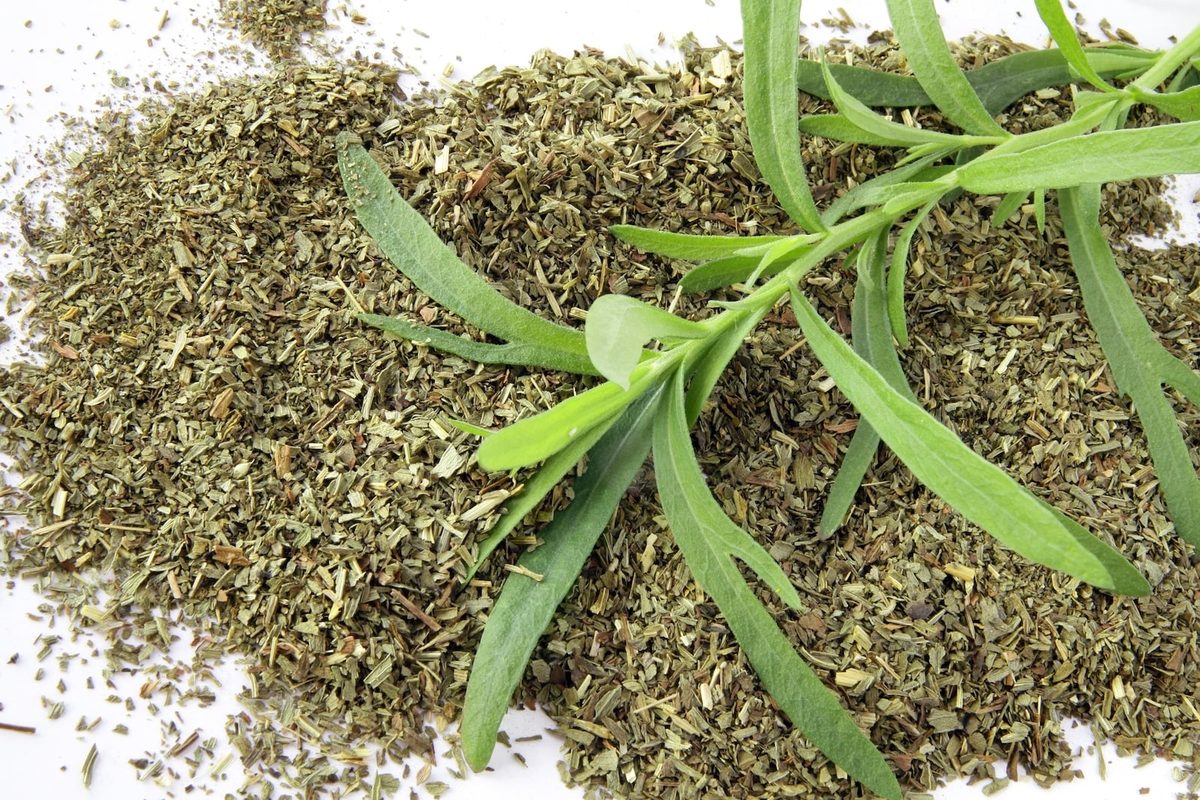
Fresh and dried tarragon are the same leaf of Artemisia dracunculus, but this is one herb where the dried form is a real compromise. The University of Illinois Extension advises using tarragon fresh whenever possible because its flavor is quickly lost when the leaves are dried,1 and America’s Test Kitchen counts it among the delicate herbs whose flavor compounds are more volatile.2 Dried tarragon still has uses, mainly in long-cooked dishes where it is one flavor among several.
Side by side
| Fresh tarragon | Dried tarragon | |
|---|---|---|
| Plant | Artemisia dracunculus L.3 | The same plant |
| Family | Asteraceae (daisy family)3 | Same |
| Native range | Temperate Northern Hemisphere to tropical mountains (Kew); PROSEA says the origin is uncertain, possibly Siberia34 | Same |
| Which tarragon | French tarragon, the cooking type. Seed sold as tarragon is Russian tarragon, which lacks French tarragon’s smell and flavor;1 a 2011 review says Russian tarragon lacks the anise-like taste5 | No source opened for this page says which type retail dried tarragon is made from |
| Key aroma compound | Estragole (methyl chavicol), 60–75% of tarragon oil6 | Same compound; how much survives depends on drying and storage (see below)7 |
| Flavor | Sweet, anise-like scent and a peculiar bittersweet flavor (PROSEA); licorice or anise (Illinois)41 | Flatter and grassier, with less anise (editorial) |
| Strength by volume | General herb rule: 3 parts fresh8 | 1 part dried; the rule fits hardy herbs better than tarragon (see below)28 |
| Best for | Béarnaise, egg and chicken dishes, vinegars, dressings419 | Stews, braises and sauces with other herbs (editorial) |
| Storage | Refrigerate or freeze (common practice) | Sealed, dark and dry (common practice); loses oil in storage (see below)7 |
| Regulation | No herb-specific limit found | The EU caps pyrrolizidine alkaloids in dried herbs, tarragon included, at 400 µg/kg10 |
For the plant itself, including the French and Russian types, see tarragon.
Why dried tarragon disappoints
Tarragon’s anise note comes from its essential oil. The European Commission’s Scientific Committee on Food puts estragole at 60 to 75 percent of tarragon oil,6 and PROSEA reports about 77 percent methyl chavicol, another name for estragole, in one French tarragon oil.4 Illinois Extension says that flavor is quickly lost when the leaves are dried.1
A 2007 study shows how much drying conditions and storage matter. Researchers dried tarragon leaves at 45, 60 and 90 °C and measured oil content right after drying and again after 15, 30, 60 and 120 days of storage.7
- Oil content fell during storage for every drying condition.7
- Leaves dried at 90 °C changed most, losing about half their essential oil within 30 days.7
- Drying at 45 °C produced the smallest losses.7
PROSEA’s guidance for commercial drying is similar: dry tarragon in the shade or in dryers that do not exceed 43 °C.4 The study measured oil content, not taste, and it did not test retail jars. Still, it points to a practical rule: a jar of dried tarragon that has sat open for months has probably lost much of what made it tarragon. Crush a pinch and smell it before relying on it.
How much to use
Ratio (Method): The general rule for herbs is 1 teaspoon dried for 1 tablespoon fresh, given by LSU AgCenter, NDSU and Penn State,81112 and the University of Delaware’s guide gives 3/4 to 1 teaspoon dried for 2 to 3 teaspoons fresh.13 America’s Test Kitchen tested the same proportion and found 1 part dried to 3 parts fresh came closest to equal strength,2 but its tasters preferred fresh herbs in all but one application, and ATK’s long-cooking success was with hardy herbs such as oregano, rosemary, sage and thyme, not tarragon.2 No source we found gives a measured conversion for tarragon itself.
- Dried for fresh: start with 1 teaspoon dried per tablespoon of fresh, add it in stages, and taste. Because dried tarragon loses oil in storage,7 an older jar may need more.
- Fresh for dried: start with the general rule’s 1 tablespoon of fresh per teaspoon of dried, then adjust. Fresh tarragon is assertive, so add it gradually (editorial).
When to use each
Fresh tarragon carries the classic French uses. Britannica calls it an essential ingredient in béarnaise,9 and it is one of the herbs commonly found in fines herbes, with parsley, chives and chervil.14 PROSEA says the leaves particularly suit chicken, egg and lobster dishes, and that tarragon vinegar is made by adding the herb to wine vinegar.4 Illinois Extension suggests it for vinegars, oils, marinades and salads.1 ATK counts tarragon among the delicate herbs,2 and by common practice those go in at the end of cooking or into food that isn’t cooked at all.
Dried tarragon is best treated as a background herb. By kitchen judgment, it works in a stew, a braise or a creamy soup alongside other herbs, where its loss of top notes matters less. Delaware’s guide counts French tarragon among its medium-strength herbs, at about 1 to 2 teaspoons for six servings.13 Its general advice for long simmering is to add herbs in the last 45 minutes.13
Can one stand in for the other?
Only partly. Fresh can always replace dried, using the Method ratio above. Dried in place of fresh works in cooked dishes but falls short where tarragon is the main flavor, as in béarnaise, a tarragon vinaigrette or chicken salad (editorial).
When fresh tarragon is what the recipe needs and you only have dried, a fresh herb may do better. A Couple Cooks calls fresh basil the best fresh tarragon substitute,15 and the Scientific Committee on Food puts estragole at 20 to 43 percent of sweet basil oil,6 which helps explain the overlap. Tarragon substitutes ranks the options by the job tarragon is doing, with each ratio’s treatment shown.
What isn’t known
- No published conversion has been measured for tarragon specifically. The 1-to-3 rule is a general herb rule.
- The storage study gives a figure (about 50% oil loss in 30 days) only for leaves dried at 90 °C; the smaller losses at lower temperatures are not quantified in the abstract we read.7
- We found no measurement of oil content in retail dried tarragon, and no shelf-life figure from a regulator or extension service.
- No source opened for this page says whether retail dried tarragon is French or Russian tarragon.
Related
- Dried herbs vs. fresh: the general rules for every herb.
- Tarragon, tarragon substitutes and tarragon uses
- How to dry tarragon, how to store tarragon and can you freeze tarragon?
- Too much tarragon? How to fix a dish.
- Fresh dill vs. dried dill and fresh parsley vs. dried: two more delicate herbs.
- Tarragon vs. thyme, tarragon vs. dill and tarragon vs. rosemary
Footnotes
-
“Tarragon: French”, University of Illinois Extension. extension.illinois.edu · Reference work ↩ ↩2 ↩3 ↩4 ↩5 ↩6
-
“Science: Substituting Dried Herbs for Fresh”, America’s Test Kitchen. americastestkitchen.com · Publication ↩ ↩2 ↩3 ↩4 ↩5
-
Artemisia dracunculus L., Plants of the World Online, Royal Botanic Gardens, Kew. powo.science.kew.org · Reference work ↩ ↩2 ↩3
-
C.C. de Guzman & R.A. Reglos, Artemisia dracunculus, Plant Resources of South-East Asia (PROSEA). uses.plantnet-project.org · Reference work ↩ ↩2 ↩3 ↩4 ↩5 ↩6
-
Obolskiy et al., “Artemisia dracunculus L. (Tarragon): A Critical Review”, Journal of Agricultural and Food Chemistry, 2011. discovery-pp.ucl.ac.uk · Peer-reviewed ↩
-
Opinion of the Scientific Committee on Food on Estragole, European Commission, 2001. food.ec.europa.eu · Regulator ↩ ↩2 ↩3
-
Arabhosseini et al., “Long term effects of drying conditions on the essential oil and color of tarragon leaves during storage”, Journal of Food Engineering, 2007 (abstract). agrar.uni-hohenheim.de · Peer-reviewed ↩ ↩2 ↩3 ↩4 ↩5 ↩6 ↩7 ↩8
-
“Flavorful Herbs”, LSU AgCenter. lsuagcenter.com · Reference work ↩ ↩2 ↩3
-
“Tarragon”, Encyclopaedia Britannica. britannica.com · Reference work ↩ ↩2
-
Commission Regulation (EU) 2023/915, Annex I, section 2.4. eur-lex.europa.eu · Regulator ↩
-
Julie Garden-Robinson, Ingredient Substitutions (FN198), NDSU Extension, 2018. ksre.ksu.edu · Reference work ↩
-
Stacy Reed, “Preserving Herbs by Drying”, Penn State Extension, 2024. extension.psu.edu · Reference work ↩
-
“Using Herbs and Spices”, University of Delaware Cooperative Extension, 2025. udel.edu · Reference work ↩ ↩2 ↩3
-
“Fines herbes”, Encyclopaedia Britannica. britannica.com · Reference work ↩
-
Sonja Overhiser, “Best Tarragon Substitute”, A Couple Cooks. acouplecooks.com · Publication ↩