Spice Substitutes · Substitutes
Tarragon Substitutes, Ranked by the Job Tarragon Is Doing
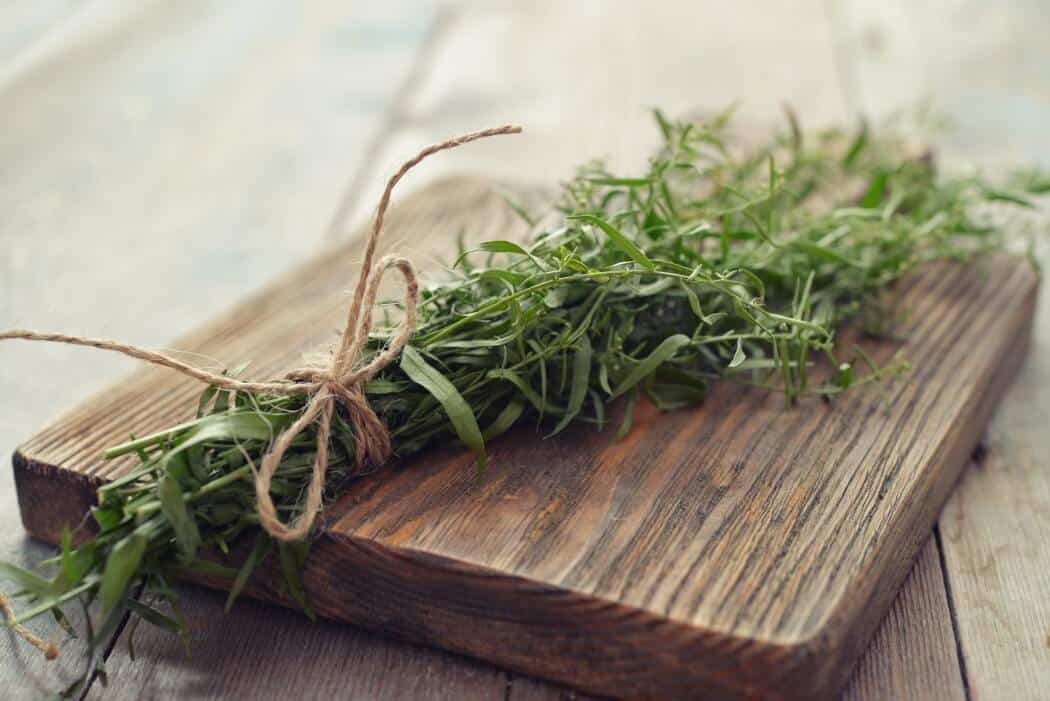
Tarragon is the leaf of Artemisia dracunculus, a relative of mugwort and wormwood and an essential ingredient in béarnaise sauce.1 PROSEA describes French tarragon as having a sweet anise-like scent and a peculiar bittersweet flavor, and lists chicken, egg and lobster dishes as the ones it suits best.2 The anise note has a clear chemical source: estragole, also called methyl chavicol, makes up 60 to 75 percent of tarragon oil according to the European Commission’s Scientific Committee on Food,3 and PROSEA reports 77.0 percent in one French tarragon oil.2 The best substitutes share some of that anise character. Which one to use depends on what tarragon is doing in your dish.
Quick answer
| What tarragon is doing | Best substitute | Starting amount, per 1 part tarragon | Treatment |
|---|---|---|---|
| Fresh leaves in a sauce, dressing, eggs or chicken | Fresh basil, thinly sliced | 1 part | Attributed |
| Part of fines herbes, or a delicate fish or egg dish | Chervil | 1 part, then more to taste | Method |
| Anise note in fish, soups or salads | Fennel fronds | 1 part | Method |
| Recipe calls for dried tarragon | Dried dill | 1 part | Attributed |
| Only a hint of licorice wanted | Crushed fennel or anise seed | 1/4 teaspoon per tablespoon fresh; 1/8 teaspoon per teaspoon dried | Attributed |
| You want the herb note without licorice | Marjoram or oregano | 1/2 part dried, then taste | Method |
How the ratios on this page are labeled
Every ratio carries one of four labels.
- Computed: based on a measurable physical relationship, with the source named.
- Attributed: a named source publishes this ratio. We quote it as theirs.
- Disputed: named sources give different answers to the same swap. We show each one and do not average them.
- Method: we found no published ratio. We give a direction and a cautious starting point, and say so.
None of the tarragon-substitute ratios we found say how they were reached. They are rules of thumb, not measurements of flavor strength.
If you have dried tarragon and the recipe wants fresh
Dried tarragon is a weak stand-in. The University of Illinois Extension says tarragon’s flavor is quickly lost if the leaves are dried.4 America’s Test Kitchen counts tarragon among the delicate herbs whose flavor compounds are more volatile, and in its tests tasters preferred fresh herbs to dried in all but one application.5
Ratio (Method): The general rule is 1 teaspoon of dried herbs for 1 tablespoon of fresh,6 but ATK’s work suggests that rule fits hardy herbs better than delicate ones.5 If dried is all you have, start at 1 teaspoon per tablespoon of fresh, add it toward the end, and taste before adding more. In a sauce where tarragon is the main flavor, a fresh substitute below will likely do better.
If fresh tarragon is flavoring a sauce, dressing, eggs or chicken
1. Basil
A Couple Cooks calls fresh basil the best fresh tarragon substitute, saying it has a vaguely anise or licorice finish.7 The chemistry backs that up. The Scientific Committee on Food puts estragole at 20 to 43 percent of sweet basil oil,3 and PROSEA reports 53.3 percent methyl chavicol in one French basil oil.8 PROSEA also recognizes at least six chemotypes of basil,8 so the strength of the anise note varies with the plant. In our judgment basil is greener and more peppery than tarragon.
Ratio (Attributed): A Couple Cooks says to use basil 1:1 and to slice it thinly to mimic tarragon’s narrow leaves.7
Like tarragon, basil is a delicate herb. LSU AgCenter groups it with the herbs added in the last minute or two of cooking.6
2. Chervil
Chervil is tarragon’s partner in fines herbes, which Britannica says commonly include parsley, chives, tarragon and chervil.9 It shares tarragon’s main compound: PROSEA describes chervil oil as characterized by undecane, methyl chavicol (estragole) and methyl eugenol.10 Britannica says chervil has a delicate aroma and a taste reminiscent of anise,11 and PROSEA calls its flavor light and parsley-like, with a hint of myrrh.10 In our judgment it is gentler than tarragon and suits eggs, fish and light sauces best.
Ratio (Method): We found no published ratio. Start with the same amount as the tarragon and add more if the anise note is too faint.
3. Fennel fronds
The University of Illinois Extension says herb fennel has an anise or licorice flavor and is used in fish dishes, soups and stews.12 A Couple Cooks also names fennel fronds as a fresh tarragon substitute.7 In fennel, the anise character comes from anethole, the major compound of sweet fennel oil,13 rather than from tarragon’s estragole. PROSEA notes that in mature fennel about 95 percent of the oil is in the fruit,13 so the seeds hold most of the plant’s oil.
Ratio (Method): No published ratio was found. Start with the same amount of finely chopped fronds and taste.
4. Dill
A Couple Cooks says dill has a different flavor profile from tarragon but works in a pinch, and that it also has a licorice note on the finish.7 LSU AgCenter lists dill leaves among the delicate herbs added at the end of cooking.6
Ratio (Attributed): A Couple Cooks says to use dill 1:1, fresh for fresh or dried for dried.7
If the recipe calls for dried tarragon
Most dried herbs are a compromise here, since dried tarragon has already lost much of its flavor.4
- Dried dill. A Couple Cooks says it can replace dried tarragon one for one.7
- Dried oregano or marjoram. A Couple Cooks says these might work and that the flavor is not nearly the same, but the herbal note mimics the way tarragon works in a recipe.7 Oregano oil is mostly carvacrol and thymol,14 not the estragole behind tarragon’s anise note.
- Herbes de Provence. A Couple Cooks says the blend usually contains tarragon.7 That depends on the brand: the French Label Rouge specification lists thyme, rosemary, savory, oregano and basil, not tarragon.15 Check the label.
Dried oregano or marjoram ratio (Method): No amount was published. Start with half as much as the dried tarragon and taste.
Herbes de Provence ratio (Attributed): A Couple Cooks says to use 1/2 teaspoon for 1 teaspoon of dried tarragon.7
If you only want a hint of licorice
Fennel seed and anise seed get their licorice flavor from anethole. Anise oil is 80 to 95 percent anethole, which PROSEA calls the character-impact compound,16 and anethole makes up as much as 70 to 80 percent of sweet fennel oil.13 A Couple Cooks suggests crushing them lightly.7 The small amounts below keep the seed from taking over.
Ratio (Attributed): A Couple Cooks says to use 1/4 teaspoon of seed per tablespoon of fresh tarragon, or 1/8 teaspoon per teaspoon of dried.7
If you don’t want the licorice note at all
Some cooks leave tarragon out because they dislike the anise flavor. Basil and dill are poor choices in that case, since A Couple Cooks notes a licorice finish in both.7 In our judgment marjoram or oregano gives an herbal note without the anise.
Ratio (Method): No published ratio was found. Use dried marjoram or oregano at half the tarragon amount, or fresh marjoram at the same amount, and taste.
If your tarragon is Russian tarragon
The University of Illinois Extension notes that seed sold as tarragon is Russian tarragon, which lacks the odor and flavor characteristics of French tarragon.4 French tarragon never sets viable seed, according to PROSEA.2 If your plant came from seed, it will not give a recipe the anise note it expects, and one of the substitutes above may do the job better.
What isn’t known
- No published measurement compares tarragon’s strength with any substitute.
- No credible source gives an amount for chervil or fennel fronds in place of tarragon, or a tested conversion between fresh and dried tarragon.
- Rosemary is sometimes listed as a one-for-one swap for dried tarragon. We found no source for it.
Related
- Tarragon, dried tarragon vs. fresh and how to store tarragon
- Tarragon vs. dill, tarragon vs. thyme and tarragon vs. rosemary
- Chervil, basil, dill, fennel seed, anise seed and marjoram
- Fines herbes and herbes de Provence
- Tarragon uses, too much tarragon? how to fix the dish and can you freeze tarragon?
Footnotes
-
“Tarragon”, Encyclopaedia Britannica. britannica.com · Reference work ↩
-
C.C. de Guzman and R.A. Reglos, Artemisia dracunculus, Plant Resources of South-East Asia (PROSEA). uses.plantnet-project.org · Reference work ↩ ↩2 ↩3
-
Opinion of the Scientific Committee on Food on Estragole, European Commission, 2001. food.ec.europa.eu · Regulator ↩ ↩2
-
“Tarragon: French”, University of Illinois Extension. extension.illinois.edu · Reference work ↩ ↩2 ↩3
-
“Science: Substituting Dried Herbs for Fresh”, America’s Test Kitchen. americastestkitchen.com · Publication ↩ ↩2
-
“Flavorful Herbs”, LSU AgCenter. lsuagcenter.com · Reference work ↩ ↩2 ↩3
-
Sonja Overhiser, “Best Tarragon Substitute”, A Couple Cooks, 2026. acouplecooks.com · Publication ↩ ↩2 ↩3 ↩4 ↩5 ↩6 ↩7 ↩8 ↩9 ↩10 ↩11 ↩12
-
Aguilar, Pham and Oyen, Ocimum basilicum, Plant Resources of South-East Asia (PROSEA). uses.plantnet-project.org · Reference work ↩ ↩2
-
“Fines herbes”, Encyclopaedia Britannica. britannica.com · Reference work ↩
-
M.A. Nichols, Anthriscus cerefolium, Plant Resources of South-East Asia (PROSEA). uses.plantnet-project.org · Reference work ↩ ↩2
-
“Chervil”, Encyclopaedia Britannica. britannica.com · Reference work ↩
-
“Fennel”, University of Illinois Extension. extension.illinois.edu · Reference work ↩
-
Purwaningsih, Harmida and Brink, Foeniculum vulgare, Plant Resources of South-East Asia (PROSEA). uses.plantnet-project.org · Reference work ↩ ↩2 ↩3
-
Lombrea et al., “A Recent Insight Regarding the Phytochemistry and Bioactivity of Origanum vulgare L. Essential Oil”, International Journal of Molecular Sciences, 2020. mdpi.com · Peer-reviewed ↩
-
Label Rouge “Herbes de Provence” (LA 02/03), specification modification request, INAO, 2014. extranet.inao.gouv.fr · Regulator ↩
-
Cardenas and de Guzman, Pimpinella anisum, Plant Resources of South-East Asia (PROSEA). uses.plantnet-project.org · Reference work ↩