Cooking · Storage
How to Store Tarragon: Keep It Fresh, Freeze It, and Why Drying Costs Flavor
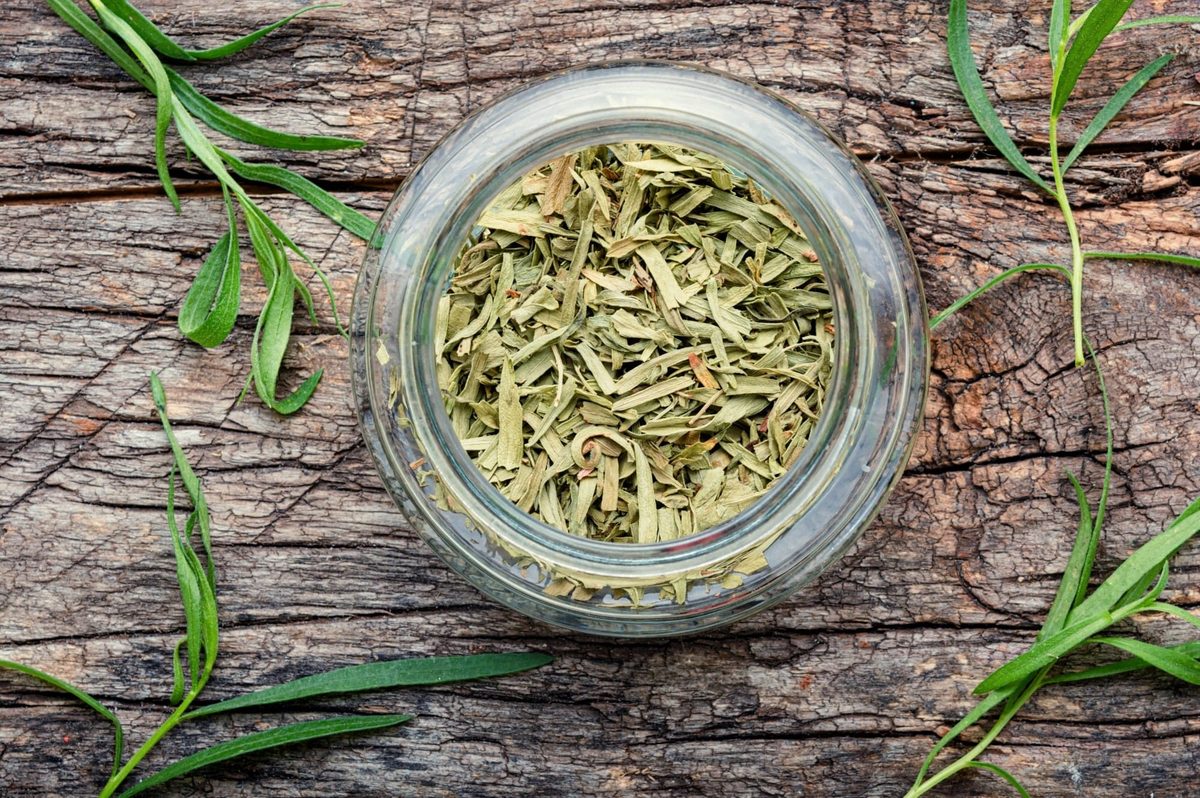
Tarragon is a delicate herb, in America’s Test Kitchen’s terms: its flavor compounds are more volatile than those of hearty herbs like thyme and sage.1 That shapes how to store it. Fresh tarragon needs moisture without sitting wet, freezing keeps it usable for months, and drying is a real compromise. The University of Illinois Extension advises using tarragon fresh whenever possible because its flavor is quickly lost when the leaves are dried.2
Britannica calls tarragon an essential ingredient in béarnaise,3 and the cooking type is French tarragon. Seed sold as tarragon is usually Russian tarragon, which lacks French tarragon’s smell and flavor,2 so if you grow your own, start from a French tarragon plant.
At a glance
| Method | How | How long | Notes |
|---|---|---|---|
| Refrigerator | Damp paper towels in an open bag, or stems in water; sources differ45 | “A few days” is the only figure we found6 | Longer figures are untraced |
| Freezer | Leaves frozen flat, or chopped into ice cube trays76 | 3 to 6 months for best quality76 | Best in cooked dishes8 |
| Dried | Gentle heat, at or below about 43–46°C (109–115°F)910 | Loses oil steadily in storage11 | Milder than fresh12 |
| In oil | Refrigerate and use within 4 days, or freeze13 | 4 days refrigerated | Never at room temperature |
| Tarragon vinegar | Steep in a cool, dark place14 | Up to 3 months cool and dark; 6 to 8 months refrigerated14 | A classic use9 |
Fresh tarragon in the refrigerator
The only refrigerator figure we found is general: Ohio State University Extension says harvested fresh herbs keep only a few days.6 Claims that tarragon lasts two weeks in a damp towel, or three weeks in a jar of water, have no source we could trace.
America’s Test Kitchen has published two methods:
| Source | Method for tarragon |
|---|---|
| America’s Test Kitchen, 20165 | Store in the refrigerator with its stems in water. |
| America’s Test Kitchen, 20194 | Delicate herbs, tarragon included: wrap in slightly damp paper towels, put in an open zipper-lock bag, and refrigerate. |
The 2019 guide explains that delicate herbs take in and release a lot of water, so they must be kept moist or they wilt, but that the leaves should not touch liquid, which encourages rot.4 The two methods are compatible in principle (stems in water, leaves dry), but neither article reports how long tarragon lasted, so we can’t rank them. With either method, discard leaves that have gone dark or slimy.
Freezing tarragon
The Royal Horticultural Society says tarragon leaves can be frozen for later use,12 and South Dakota State University Extension names tarragon among herbs that freeze well.7
- Flat freeze. Spread leaves, or leaves on their stems, on a baking sheet in a single layer, freeze, then move them to freezer bags.68 Illinois Extension warns that if the leaves thaw during the transfer, they freeze together.8 Lining the sheet makes the transfer easier (common practice).
- Ice cubes. Chop the leaves, pack them into ice cube trays, and cover with water, broth or oil before freezing.6 Cubes made with oil go straight into the freezer; herbs in oil should never sit at room temperature.7 Illinois Extension suggests herb cubes for soups, stews, sauces and other cooked dishes.8
- Blanching. Some guides tell you to blanch tarragon first. Illinois Extension calls blanching optional and not necessary.8 We found no tarragon-specific test either way.
How long frozen tarragon keeps:
| Source | Frozen herbs, best quality |
|---|---|
| Ohio State University Extension6 | Use within 3 to 6 months |
| South Dakota State University Extension7 | Up to 6 months in an airtight container |
A common claim is that frozen tarragon keeps indefinitely or for years. No source we found says so; the figures above are quality limits for herbs in general.
Drying tarragon
Dried tarragon works, but it is milder: the RHS notes dried leaves have a milder flavor,12 and Illinois Extension says the flavor is quickly lost on drying.2 The common claim that drying removes “most” of the flavor goes further than these sources do; nobody we found has measured how much is lost in taste terms.
What has been measured is the essential oil. A 2007 study dried tarragon leaves at 45, 60 and 90°C and tracked the oil over 120 days of storage.11
- Oil content fell in storage under every drying condition, and color changed too.11
- Leaves dried at 90°C changed most, losing about half their essential oil within 30 days.11
- Drying at 45°C produced the smallest quality changes.11
Low heat is the common thread in the guidance:
| Source | Drying guidance |
|---|---|
| PROSEA (commercial drying)9 | Shade, or dryers not exceeding 43°C (109°F) |
| National Center for Home Food Preservation10 | Dehydrator at 95 to 115°F (35 to 46°C); 1 to 4 hours |
| University of Illinois Extension2 | A cool, dark, well-ventilated place |
| Arabhosseini et al., 200711 | 45°C gave the smallest changes of the temperatures tested |
Tender herbs can also be air-dried in small bunches hung inside a bag closed with a rubber band; large bunches will mold.10 Illinois Extension does not recommend oven drying.8 The leaves are done when they are brittle and crumble when touched.8
Storing dried tarragon
Illinois Extension says to put tarragon into sealed containers quickly once it is dried,2 and the RHS says to store dried leaves in airtight containers.12 Keep them in a cool, dry, dark place,10 and leave the leaves whole until you use them, which Penn State says is preferred for dried herbs.15
General guidance gives most dried herbs about a year,15 but in our reading, tarragon’s oil loss in storage11 makes that generous for this herb. We found no tarragon-specific shelf-life figure. Crush a pinch before you cook: if the anise smell is faint, the jar has faded, and it is time to buy fresh or replace it.
Tarragon in oil and vinegar
Illinois Extension suggests tarragon for vinegars, oils, marinades and salads.2 Oil needs care. Herbs are low-acid foods that can carry Clostridium botulinum, and covering them with oil creates oxygen-free conditions. Oregon State University Extension says to refrigerate herb-and-oil mixtures and use them within 4 days, or freeze them.13
Vinegar is the traditional keeper: PROSEA says tarragon vinegar is made by adding the herb to wine vinegar.9 Colorado State University Extension lists tarragon among suitable fresh herbs and gives this method: heat commercial vinegar to just below boiling, use 3 to 4 sprigs per pint, steep in a cool, dark place for at least 10 days, strain, then refrigerate for up to six to eight months or keep in a cool, dark place (65°F or below) for up to three months.14
Not yet measured
- How long fresh tarragon lasts in the refrigerator under either America’s Test Kitchen method.
- A shelf-life figure for frozen or dried tarragon specifically.
- How much tarragon flavor survives drying, as tasted rather than as oil content.
- Whether blanching before freezing helps tarragon.
Related
- Tarragon, tarragon uses and tarragon substitutes
- How to dry tarragon and can you freeze tarragon?
- Dried vs. fresh tarragon and dried herbs vs. fresh
- Too much tarragon? and fines herbes
- Tarragon vs. thyme, tarragon vs. dill and tarragon vs. rosemary
- How to store galangal and how to store thyme
Footnotes
-
“Science: Substituting Dried Herbs for Fresh”, America’s Test Kitchen. americastestkitchen.com · Publication ↩
-
“Tarragon: French”, University of Illinois Extension. extension.illinois.edu · Reference work ↩ ↩2 ↩3 ↩4 ↩5 ↩6
-
“Tarragon”, Encyclopaedia Britannica. britannica.com · Reference work ↩
-
Liz Bomze, “Our Guide to Fresh Herbs”, America’s Test Kitchen, 2019. americastestkitchen.com · Publication ↩ ↩2 ↩3
-
“How & Where to Buy, Use, and Store Fresh Herbs”, America’s Test Kitchen, 2016. americastestkitchen.com · Publication ↩ ↩2
-
Shari Gallup, “Food Preservation: Preserving Herbs—Freezing and Drying”, Ohio State University Extension, 2026. ohioline.osu.edu · Reference work ↩ ↩2 ↩3 ↩4 ↩5 ↩6 ↩7
-
Lambert, Erickson and Kleine, “Preserving Herbs”, South Dakota State University Extension, 2022. extension.sdstate.edu · Reference work ↩ ↩2 ↩3 ↩4 ↩5
-
Emily Swihart, “Preserving garden-grown herbs”, University of Illinois Extension, 2025. extension.illinois.edu · Reference work ↩ ↩2 ↩3 ↩4 ↩5 ↩6 ↩7
-
C.C. de Guzman & R.A. Reglos, Artemisia dracunculus, Plant Resources of South-East Asia (PROSEA). uses.plantnet-project.org · Reference work ↩ ↩2 ↩3 ↩4
-
“Herbs”, National Center for Home Food Preservation (from So Easy to Preserve, 6th ed., 2014). nchfp.uga.edu · Reference work ↩ ↩2 ↩3 ↩4
-
Arabhosseini et al., “Long term effects of drying conditions on the essential oil and color of tarragon leaves during storage”, Journal of Food Engineering, 2007 (abstract). agrar.uni-hohenheim.de · Peer-reviewed ↩ ↩2 ↩3 ↩4 ↩5 ↩6 ↩7
-
“How to grow tarragon”, Royal Horticultural Society. rhs.org.uk · Reference work ↩ ↩2 ↩3 ↩4
-
Raab and Woodburn, “Herbs and vegetables in oil” (SP 50-701), Oregon State University Extension Service, 2025. extension.oregonstate.edu · Reference work ↩ ↩2
-
Grubb, Shackelton and Bunning, “Making Flavored Vinegar” (9.340), Colorado State University Extension, 2021. foodsmartcolorado.colostate.edu · Reference work ↩ ↩2 ↩3
-
Stacy Reed, “Preserving Herbs by Drying”, Penn State Extension, 2024. extension.psu.edu · Reference work ↩ ↩2