Cooking · Storage
How to Dry Tarragon Without Losing Its Flavor: Low Heat, Fast Drying, and When to Freeze Instead
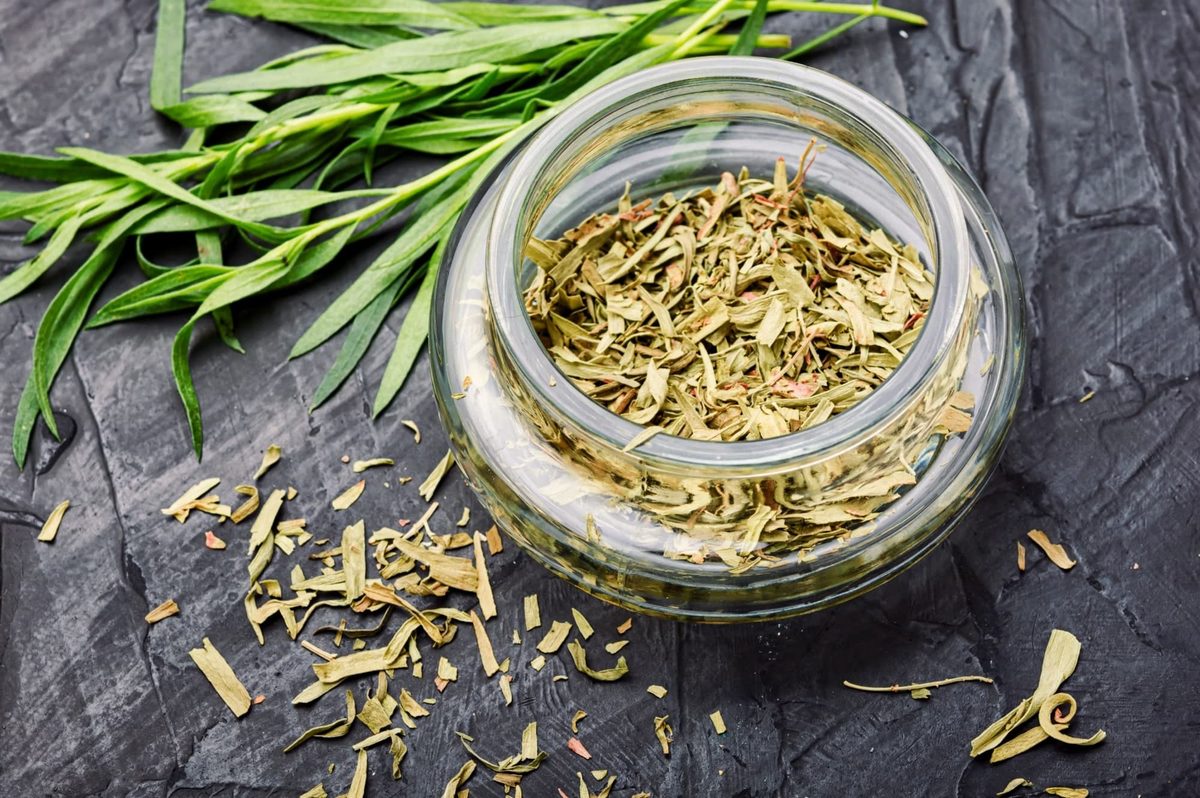
Tarragon is one of the harder herbs to dry well. University of Illinois Extension says its flavor is quickly lost when the leaves are dried,1 and America’s Test Kitchen (ATK) groups it with basil, chives, dill and parsley as delicate herbs whose flavor compounds are more volatile.2 It also has a lot of water in its leaves, so it can mold if it dries slowly.3 The answer to both problems is the same: dry it quickly, at low heat, and store it whole.
At a glance
| Method | Temperature | Verdict |
|---|---|---|
| Dehydrator | 95 to 115°F (NCHFP);3 95 to 110°F (Penn State)4 | The best home option for tarragon |
| Air drying | Room temperature, shaded, good airflow54 | Works, but risks mold if it dries slowly36 |
| Oven | Lowest setting, not above 180°F, door open4 | Not recommended by Penn State4 |
| Microwave | Short bursts, small batches | Fast, but sources disagree on timing |
Which tarragon you have
The flavor that makes drying worthwhile belongs to French tarragon. Illinois Extension notes that tarragon seed sold on racks and in catalogs is usually Russian tarragon, which lacks French tarragon’s odor and flavor,1 and describes French tarragon’s leaves as having a licorice or anise flavor.1 For more on the plant and its types, see tarragon.
Harvest and prepare
- When. Extension guidance for most herbs is to harvest for drying just before the flowers first open,43 mid-morning after the dew has evaporated.4 PROSEA, describing commercial growing, says leaves and tender tops can be harvested at intervals through the season.5
- Where to cut. Penn State says to cut stems just above a leaf or a pair of leaves.4
- Rinse. Rinse in cool water, shake off the excess,4 and discard bruised or damaged leaves.3
Why low heat matters for tarragon
A 2007 study dried tarragon leaves at 45, 60 and 90°C and measured their essential oil over 120 days of storage.7
- Oil content fell in storage for every drying condition.7
- Leaves dried at 90°C (194°F) changed most, losing about half their essential oil within 30 days.7
- Drying at 45°C (113°F) produced the smallest quality changes.7
PROSEA’s guidance for commercial drying lands in the same place: air-dry the shoots in the shade, or use dryers that do not exceed 43°C (109°F).5 Those figures sit right at the top of the extension services’ dehydrator ranges below.
Dehydrator (best for tarragon)
- Temperature. The National Center for Home Food Preservation (NCHFP) says to preheat to 95 to 115°F, and up to 125°F where humidity is high.3 Penn State says herbs can be dried in a dehydrator if it can be set between 95 and 110°F.4
- Time. NCHFP gives 1 to 4 hours; check periodically.3
- Layout. Lay the sprigs on the trays so they do not touch,4 in single layers with good air circulation between trays.6
- Afterward. Strip the dry leaves from the stems and store them whole (see storage below).
Air drying
Air drying is cheap but the least consistent method,6 and that matters more for tarragon than for sage or thyme. NCHFP lists tarragon among the high-moisture herbs that will mold if not dried quickly,3 and Colorado State University Extension advises drying tender-leaf herbs such as tarragon quickly, by its faster methods, to prevent mold.6
If you air dry anyway:
- Tie a few stems into a small bundle and hang it upside down by the tied end8 in a dry, well-ventilated place, away from the sink, stove or dishwasher.4
- Keep it out of direct sunlight and heat, which ATK says make flavor and color fade.8
- Keep the bunches small. NCHFP’s paper-bag method warns that large amounts will mold.3 A paper bag punched with holes keeps dust off.4
- Check it often, and throw out any bundle that molds (our judgment, not a sourced rule).
Oven
Penn State calls oven drying generally not recommended because even the lowest temperature destroys much of the flavor.4 Its method, if you use one, is the lowest setting no higher than 180°F (82°C), for 3 to 4 hours, with the door open.4 NCHFP suggests a very cool oven instead: the light of an electric oven or a gas pilot light can supply enough heat to dry herbs overnight.3
A common instruction is to set the oven to 250°F with the door open for an hour. We found no source for that temperature or time, and 250°F is well above both Penn State’s ceiling and the temperatures at which the 2007 study saw tarragon lose oil.47
Microwave
Microwaving is fast and suits small amounts,36 but the published methods differ:
| Source | Method |
|---|---|
| Penn State Extension4 | Between paper towels on high, 2 to 3 minutes per cup; start with 1 minute and stir every 30 seconds. |
| Colorado State University Extension6 | Between two paper towels with ½ cup of water in a cup beside the plate; stop every 15 seconds to check and turn. |
| America’s Test Kitchen9 | On a paper towel for 30 to 40 seconds. |
Penn State warns that paper towels can catch fire when there is too little herb on them.4 We found no study of how microwave drying affects tarragon’s flavor.
How to tell when it’s dry
The leaves should be crispy and crumble easily,4 and the stems should break when bent.3 Dry completely before storing, to prevent mold.4
Storing dried tarragon
- Keep the leaves whole until you cook. Whole dried herbs keep their flavor longer than crushed ones.6
- Use an airtight container in a cool, dry, dark place.3 Commercial dried tarragon is stored in well-closed barrels.5
- Expect it to fade. Penn State says most dried herbs keep well for up to a year,4 and ATK gives up to 3 months for microwave-dried herbs.9 Neither figure is specific to tarragon, and the 2007 study found tarragon’s oil falling throughout storage.7 Crush a leaf and smell it before relying on an older jar.
Cooking with home-dried tarragon
Dried tarragon will not replace fresh where tarragon is the main flavor. Sources disagree on when to add it:
- ATK advises adding dried herbs at the same point you would add fresh.9
- Colorado State advises adding dried herbs near the beginning of cooking, to give them time to rehydrate.6
We found no source that tests either approach with tarragon. For amounts and a fuller comparison, see dried tarragon vs fresh tarragon, and for technique, how to rehydrate herbs.
If you want the flavor, consider freezing or vinegar instead
Given how much flavor tarragon loses on drying, two other methods are worth knowing.
- Freezing. See can you freeze tarragon.
- Vinegar. PROSEA describes tarragon vinegar, made by adding the herb to wine vinegar,5 and Illinois Extension suggests tarragon for vinegars.1
- Oil: be careful. Oregon State University Extension says homemade fresh or dried herbs in oil must be refrigerated and used within 4 days, or frozen, because of the botulism risk.10
Not yet measured
- How long tarragon takes to air dry at home, and how often it molds.
- How long home-dried tarragon keeps its flavor in a kitchen cupboard.
- How microwave drying compares with a dehydrator for tarragon.
Related
- Tarragon
- Dried tarragon vs fresh tarragon
- How to store tarragon
- Can you freeze tarragon?
- Tarragon uses
- Tarragon substitutes
- Too much tarragon
- Tarragon vs rosemary
- Tarragon vs thyme
- How to dry sage
Footnotes
-
Tarragon: French, University of Illinois Extension. extension.illinois.edu · Reference work ↩ ↩2 ↩3 ↩4
-
Science: Substituting Dried Herbs for Fresh, America’s Test Kitchen. americastestkitchen.com · Publication ↩
-
Herbs (Drying), National Center for Home Food Preservation. nchfp.uga.edu · Reference work ↩ ↩2 ↩3 ↩4 ↩5 ↩6 ↩7 ↩8 ↩9 ↩10 ↩11 ↩12 ↩13
-
Let’s Preserve: Drying Herbs, Penn State Extension. extension.psu.edu · Reference work ↩ ↩2 ↩3 ↩4 ↩5 ↩6 ↩7 ↩8 ↩9 ↩10 ↩11 ↩12 ↩13 ↩14 ↩15 ↩16 ↩17 ↩18 ↩19 ↩20
-
Artemisia dracunculus (PROSEA), Plant Resources of South-East Asia. uses.plantnet-project.org · Reference work ↩ ↩2 ↩3 ↩4 ↩5
-
Herbs: Preserving and Using, Fact Sheet 9.335, Colorado State University Extension. ccfruitandnuts.ucanr.edu · Reference work ↩ ↩2 ↩3 ↩4 ↩5 ↩6 ↩7 ↩8
-
Arabhosseini et al., Journal of Food Engineering, 2007 (abstract). agrar.uni-hohenheim.de · Peer-reviewed ↩ ↩2 ↩3 ↩4 ↩5 ↩6
-
Dry Your Own Herbs and Spices, America’s Test Kitchen. americastestkitchen.com · Publication ↩ ↩2
-
When You Should Actually Use Dried Herbs, America’s Test Kitchen. americastestkitchen.com · Publication ↩ ↩2 ↩3
-
Herbs and vegetables in oil, SP 50-701, Oregon State University Extension Service. extension.oregonstate.edu · Reference work ↩