Spices · Profile
Coriander Seed: Flavor, Linalool, History and How to Use It
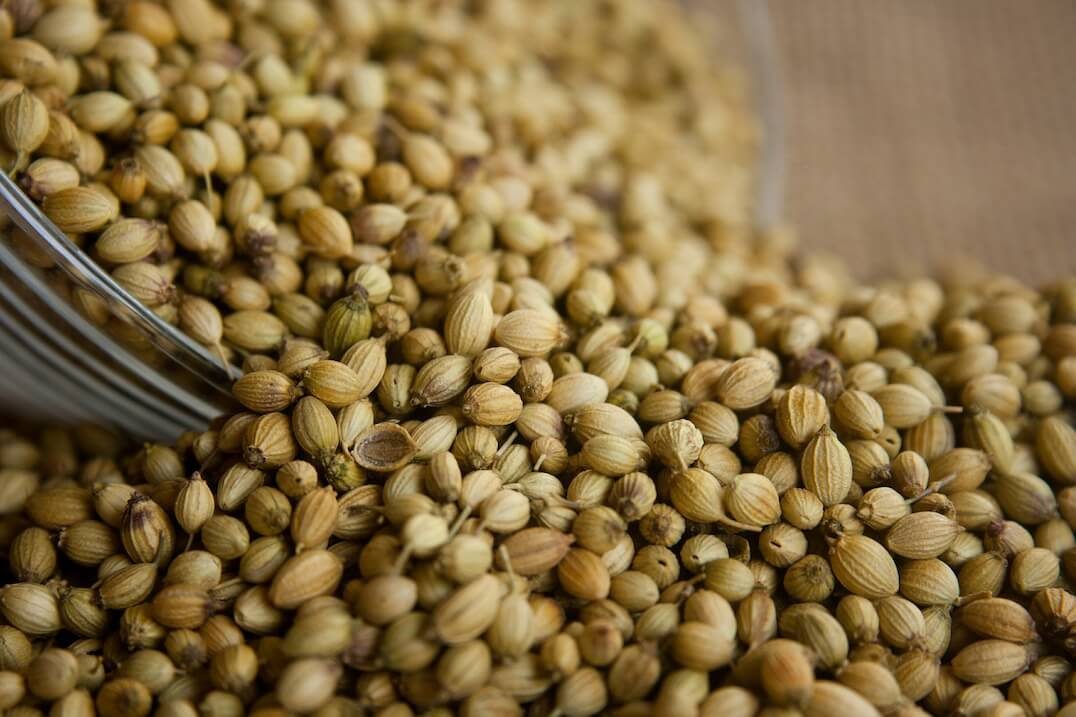
Coriander is the dried fruit of Coriandrum sativum, the plant whose fresh leaves are sold as cilantro. The two taste nothing alike: the leaf is driven by sharp aldehydes, the ripe seed by linalool, a sweet, floral compound. This page covers the seed: its flavor and chemistry, where it comes from, how it is used, and how to buy and keep it.
At a glance
| Botanical name | Coriandrum sativum L.1 |
| Plant family | Apiaceae (carrot/parsley family)12 |
| Part used | The dried fruit (a schizocarp), sold as “seed”; the leaves are cilantro3 |
| Native range | Eastern Mediterranean to western Pakistan (Kew)1 |
| Main producer | India (844,095 tonnes in 2024-25, final figure)4 |
| Key aroma compound | Linalool, usually more than 60% of the seed oil3 |
| Essential oil in the seed | Almost zero to 2% (PROSEA); 0.18–1.40% (2023 review)35 |
| Forms sold | Whole seed, ground, essential oil |
Measured values
5 figures, sourced| Measure | Value | Scope | Source |
|---|---|---|---|
| Linalool | usually more than 60 % of seed oil | PROSEASources differ | uses.plantnet-project.org |
| Linalool | 63.8 % of seed oil | PROSEA composition table | uses.plantnet-project.org |
| Terpene alcohols (linalool) | 60–80 % of seed oil | 2023 reviewSources differ | mdpi.com |
| Essential oil | almost zero to 2 % of seed | PROSEA; highest in small-fruited typesSources differ; different samples, not merged | uses.plantnet-project.org |
| Essential oil | 0.18–1.40 % of seed (v/w) | 2023 reviewSources differ; different samples, not merged | mdpi.com |
Each figure is quoted as its source states it, with the samples or standard it applies to. Where sources differ, both are shown; nothing is averaged. All measured values
What coriander is
The plant is an erect, branching annual up to 1.3 m tall.31 What the trade calls a seed is a fruit: PROSEA describes it as an ovoid to globose schizocarp up to 5 mm across, yellow-brown, with ten straight lengthwise ribs.3
PROSEA sorts cultivated coriander into groups by fruit. Small, round-fruited types (the Microcarpum group) have the highest oil content, while types from the Indian subcontinent (the Indicum group) have ovoid fruits with a low oil content that is nonetheless rich in linalool.3 So “coriander” on a label can mean seed of quite different strength and shape.
The name goes back through Old French and Latin to Greek koriannon. Botanists often link it to koris, “bedbug”, for the bad smell of the unripe fruit, though the Online Etymology Dictionary notes it may instead be a non-Indo-European word reshaped to match.6
Flavor and aroma
A 2023 review describes oil from the dried seeds as having a distinctive pleasant odor and “a mild, sweet, warm and aromatic flavor”.5 The Wisconsin Master Gardener program calls the seeds sweetly aromatic, nutty and spicy.7 In cooking it reads as citrusy and floral, softer and less bitter than cumin; that description is ours.
The compounds
PROSEA says the main component of the seed oil, usually more than 60% of it, is always linalool, and its composition table gives 63.8% linalool with camphor and p-cymene as minor components.3 The 2023 review gives 60–80% terpene alcohols (linalool).5 How much oil the seed contains varies widely: PROSEA gives almost zero to 2%, highest in small-fruited types, and the review gives a range of 0.18 to 1.40% (v/w).35 These come from different samples and are shown side by side rather than merged.
The seed’s chemistry changes as it ripens. The unripe fruit and the leaves carry aldehydes with a smell PROSEA calls bug-like; during ripening the aldehydic components disappear and the odor of the fruit changes notably.3 That is why ripe coriander seed does not taste like cilantro. For the leaf chemistry and the genetics of the soapy taste, see the cilantro page.
Origin and history
Kew gives the native range as the eastern Mediterranean to western Pakistan, listing it as native to Afghanistan, Iran, Lebanon-Syria, Palestine, Türkiye and the Caucasus, among other areas.1 Britannica says the Mediterranean and Middle East,2 and PROSEA says the Near East.3 All three point to the same broad region.
- Prehistory. PROSEA reports the oldest archaeological remains of coriander, dated to 6000 BC, from Israel.3
- Egypt. Coriander seeds have been found in large quantities in archaeological contexts including the tomb of Tutankhamun, according to the University of Michigan’s Kelsey Museum, which holds seeds from Karanis in Egypt dated to the 1st to 4th centuries CE.8
- The Bible. In Exodus, manna is described as “like coriander seed, white”.9
- Rome. By Roman times, the Kelsey Museum says, coriander was a very common cooking herb.8
- Asia and the Americas. PROSEA says coriander reached Southeast Asia from two directions, with small, round-fruited forms arriving from China after 400 AD.3 Spanish conquistadors introduced the plant to Mexico and Peru.7
Production and trade
India’s Spices Board reports coriander at 844,095 tonnes from 609,949 hectares in 2024-25 (final) and an advance estimate of 861,587 tonnes from 607,808 hectares for 2025-26.4 Output moves around: the same table gives 735,280 tonnes for 2021-22, 973,973 for 2022-23 and 836,524 for 2023-24, and notes that figures from 2020-21 onward are subject to revision.4
We found no current official world total. PROSEA estimated world output at about 600,000 tonnes of fruit from 550,000 hectares and named Ukraine, Russia, India, Morocco, Argentina, Mexico and Romania as the main producers.3 The entry cites trade data from the early 1990s, so the estimate is old; India alone now reports more than that.34
How coriander is used
PROSEA describes the fruits as a spice in a large number of dishes and an ingredient of curry powder, which can contain up to 40% coriander.3 USDA’s purchasing specification for curry powder lists coriander among its ingredients.10 The Wisconsin Master Gardener program lists cookies and other baked goods, soups, casseroles and sausages, notes that in England the seeds flavor liqueurs, and says Arabic cooking uses both leaves and seeds in pickles, curries and chutneys.7 The 2023 review adds stews, soups and salads.5 PROSEA notes the seed oil is used by the flavor industry.3
By common practice, coriander also appears in spice blends such as garam masala, dukkah and harissa, and is often paired with cumin. See cooking with coriander for more.
Technique
Whole seeds are usually toasted in a dry pan or bloomed in hot fat, then ground; that is common practice. America’s Test Kitchen warns that ground spices burn fairly quickly and gives blooming times from about 30 seconds to several minutes.11 For converting between forms, McCormick gives 1 teaspoon of coriander seeds as equal to 1¼ teaspoons ground.12 If a dish has gone over, see too much coriander.
Buying and quality
Because oil content depends so much on the type of seed, PROSEA’s grouping is a useful guide: small round seed has the highest oil content, and the ovoid Indian type a low one.3 Whole seed should look clean and evenly colored, with no dust or musty smell; that is kitchen judgment, not a grading standard. We did not find a Codex standard for coriander.
On adulteration, PROSEA notes that commercial coriander essential oil is sometimes cut with sweet-orange oil, cedarwood oil, turpentine, anethole or anise-fruit oil.3 We found no regulator report of adulterated coriander seed or ground coriander sold to consumers.
Storage
PROSEA says thoroughly dried fruits stored dry keep their essential oil for several years without loss, but once crushed, the oil quickly disappears.3 Buying whole and grinding as needed follows from that. See how to store coriander.
Health claims
Coriander has long been credited with benefits from better digestion to blood-sugar control and protection against cancer. This page makes no claim that coriander treats or prevents any condition.
Substitutes and comparisons
No other spice duplicates coriander’s linalool-led aroma. See coriander substitutes for ranked options, and:
Footnotes
-
Coriandrum sativum L., Plants of the World Online, Royal Botanic Gardens, Kew. powo.science.kew.org · Reference work ↩ ↩2 ↩3 ↩4 ↩5
-
“Coriander”, Encyclopaedia Britannica. britannica.com · Reference work ↩ ↩2
-
Coriandrum sativum, Plant Resources of South-East Asia (PROSEA). uses.plantnet-project.org · Reference work ↩ ↩2 ↩3 ↩4 ↩5 ↩6 ↩7 ↩8 ↩9 ↩10 ↩11 ↩12 ↩13 ↩14 ↩15 ↩16 ↩17 ↩18 ↩19
-
Spice wise area and production in India, 2021-22 to 2025-26, Spices Board India. indianspices.com · Regulator ↩ ↩2 ↩3 ↩4
-
Al-Khayri et al., “Essential Oil from Coriandrum sativum: A Review on Its Phytochemistry and Biological Activity”, Molecules, 2023. mdpi.com · Peer-reviewed ↩ ↩2 ↩3 ↩4 ↩5
-
“coriander”, Online Etymology Dictionary. etymonline.com · Reference work ↩
-
Susan Mahr, “Cilantro”, Wisconsin Master Gardener Program, University of Wisconsin-Madison, 2017. mastergardener.extension.wisc.edu · Reference work ↩ ↩2 ↩3
-
Suzanne Davis with Laura Motta, “Ugly Object of the Month: May 2022”, Kelsey Museum of Archaeology, University of Michigan. sites.lsa.umich.edu · Reference work ↩ ↩2
-
Exodus 16:31, King James Version, Bible Hub. biblehub.com · Reference work ↩
-
Commercial Item Description A-A-20001C: Spices and Spice Blends, USDA Agricultural Marketing Service, 2023. ams.usda.gov · Regulator ↩
-
“How to Bloom Spices”, America’s Test Kitchen, 2023. americastestkitchen.com · Publication ↩
-
“How to Grind Your Own Spices, Plus Spice Conversions”, McCormick, 2025. mccormick.com · Merchant ↩