Spices · Profile
Cumin: Flavor, Chemistry, History and How to Use It
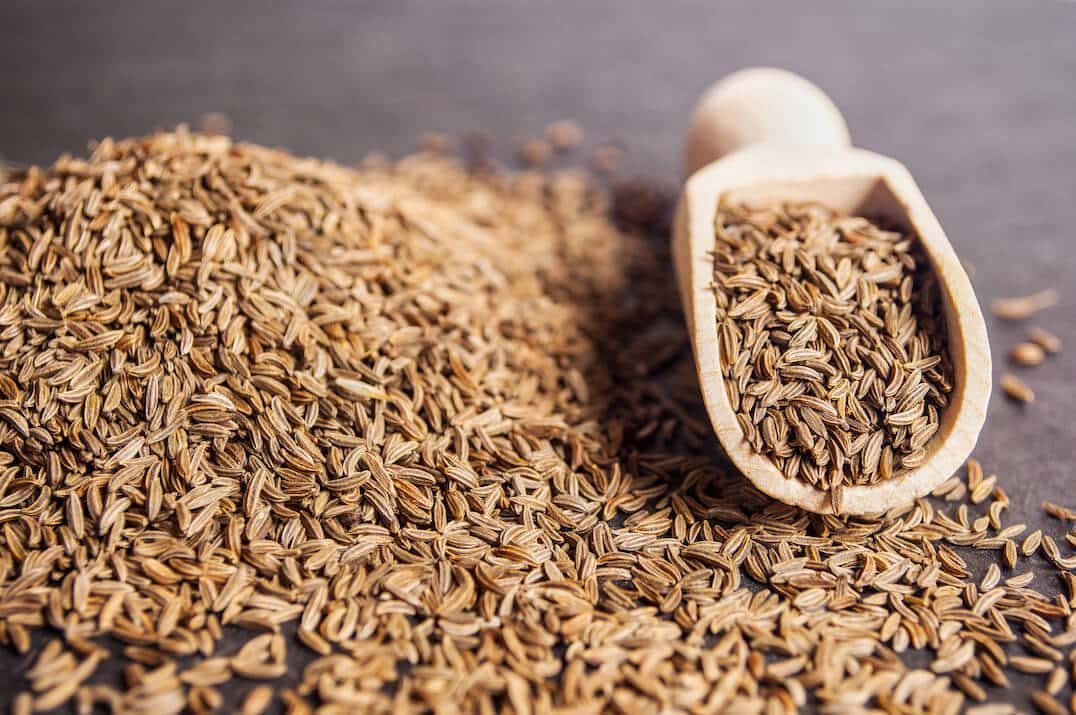
Cumin is the dried fruit of Cuminum cyminum, a small annual in the carrot and parsley family. It is the backbone of curry and chili powders, and the first thing into the hot oil in a great deal of Indian cooking. This page covers what it is, where its smell comes from, where it is grown, how it is used, how to judge quality, and the 2014–15 recalls that put cumin in allergy news.
At a glance
| Botanical name | Cuminum cyminum L.1 |
| Plant family | Apiaceae (carrot/parsley family)1 |
| Part used | The dried fruit (a schizocarp), sold as “seed”2 |
| Native range | Iraq to Afghanistan per Kew; other references say the Mediterranean (see Origin below)12 |
| Main producer | India (1,163,907 tonnes in 2024-25, final figure)3 |
| Key aroma compound | Cuminaldehyde, in widely varying proportions456 |
| Essential oil in the seed | 2.5–4.5% (Britannica); 2.5–5% (PROSEA)24 |
| Forms sold | Whole seed, ground, essential oil |
| International standard | Codex CXS 327-20177 |
Measured values
16 figures, sourced| Measure | Value | Scope | Source |
|---|---|---|---|
| Essential oil | 2.5–4.5 % of dried fruit | BritannicaSources differ | britannica.com |
| Essential oil | 2.5–5 % of dried fruit | PROSEASources differ | uses.plantnet-project.org |
| Essential oil | about 1 % of seed | one sample of seed collected in Iran's Alborz mountainsOutlier; oil dominated by α-pinene, limonene and 1,8-cineole | pmc.ncbi.nlm.nih.gov |
| Cuminaldehyde | 20–72 % of oil | range across the literature summarized by PROSEASources differ; not merged | uses.plantnet-project.org |
| Cuminaldehyde | 19.25–27.02 % of oil | lab-distilled oils from Turkish seed, steam and water distillation (Baser et al., 1992)Sources differ; not merged | agris.fao.org |
| Cuminaldehyde | 31.65–40.88 % of oil | four Indian varieties (RZ-19, RZ-223, RZ-341, RZ-345) from western RajasthanSources differ; not merged | phytojournal.com |
| p-Mentha-1,4-dien-7-al | 24.48–44.91 % of oil | lab-distilled oils from Turkish seed (Baser et al., 1992) | agris.fao.org |
| γ-Terpinene | 7.06–14.10 % of oil | lab-distilled oils from Turkish seed (Baser et al., 1992) | agris.fao.org |
| p-Cymene | 4.61–12.01 % of oil | lab-distilled oils from Turkish seed (Baser et al., 1992) | agris.fao.org |
| β-Pinene | 2.98–8.90 % of oil | lab-distilled oils from Turkish seed (Baser et al., 1992) | agris.fao.org |
| Volatile oil, minimum Limit | 2.0 / 1.5 / 1.5 / 1.3 ml/100 g | Codex CXS 327-2017, dry basis; whole/cracked Grade I / Grade II / Grade III / ground | fao.org |
| Total ash, maximum Limit | 8.5 / 10.0 / 12.0 / 9.5 % | Codex CXS 327-2017, dry basis; whole/cracked Grade I / Grade II / Grade III / ground | fao.org |
| Acid-insoluble ash, maximum Limit | 1.5 / 3.0 / 4.0 / 1.5 % | Codex CXS 327-2017, dry basis; whole/cracked Grade I / Grade II / Grade III / ground | fao.org |
| Moisture, maximum Limit | 10 % | Codex CXS 327-2017, all forms | fao.org |
| Foreign matter, maximum Limit | 0.1 / 0.5 / 0.5 % | Codex CXS 327-2017, Grade I / Grade II / Grade III | fao.org |
| Peanut (undeclared) | up to 5,000 (0.5%) ppm | some recalled products containing ground cumin, 2014-15 recall, FARRP testingContamination traced to two Turkish suppliers; not cumin generally | allergicliving.com |
Each figure is quoted as its source states it, with the samples or standard it applies to. Where sources differ, both are shown; nothing is averaged. All measured values
What cumin is
The cumin plant is slender and herbaceous, with finely divided leaves and flat-topped umbels of white or rose-colored flowers.2 PROSEA describes the petals as whitish at the base and pinkish to reddish at the tip.4 What the trade calls a seed is botanically a dry fruit. Each one is a thin, yellowish-brown oval about 6 mm long, with five prominent ridges running lengthwise and fainter secondary ridges between them that give the surface a fine grid pattern.2
Ground cumin is simply the milled fruit. For how the two forms behave differently in a dish, see cumin seeds vs. ground cumin.
Cumin and the other “cumins”
Several unrelated or distantly related plants carry a cumin name. They are not interchangeable botanically, and in most cases not in flavor either.
- Color types within true cumin. One production review describes cumin as coming in amber, white and black types, with amber the most widely accepted.8 PROSEA records a cultivar from Pakistan and Iran called “Black”, with small, dark, rather sweet fruits.4 So “black cumin” can mean a dark form of Cuminum cyminum itself.
- Nigella (Nigella sativa). Not in the carrot family at all: Kew places it in the buttercup family, Ranunculaceae, native from Romania to western and southwestern Iran.9 Kew’s economic botany records list “black cumin seed”, “false cumin” and “kala jira” among its common names.9 See our nigella seeds profile.
- Bunium bulbocastanum. An accepted species in the Apiaceae whose native range Kew gives as western and southern Europe.10
- Caraway (Carum carvi). A separate Apiaceae species native to temperate Eurasia.11 It is sometimes called “green cumin” or “Persian cumin”; no reliable source was found for either label, so this page does not use them. See caraway seeds and caraway vs. cumin.
Flavor and aroma
Cumin smells strong, warm and persistent, with a pungent edge.4 In the pan it reads as earthy and savory with a slight bitterness, and toasting pushes it toward nuttier, rounder notes. That description is ours; the chemistry behind it is below.
The compounds
The aroma lives in the seed’s essential oil, which makes up roughly 2.5–4.5% of the dried fruit according to Britannica and 2.5–5% according to PROSEA.24 Individual lots can fall well below that: one sample of seed collected in Iran’s Alborz mountains yielded about 1% oil.12
Cuminaldehyde is the compound most often named as cumin’s signature. Britannica calls it (as “cumaldehyde”) the principal component of the oil, and PROSEA calls it the most important constituent.24 How much of the oil it accounts for depends heavily on the seed and on how the oil was made:
| Scope | Cuminaldehyde share of the oil | Source |
|---|---|---|
| Range across the literature summarized by PROSEA | 20–72% | 4 |
| Lab-distilled oils from Turkish seed (steam and water distillation) | 19.25–27.02% | 5 |
| Four Indian varieties (RZ-19, RZ-223, RZ-341, RZ-345) from western Rajasthan | 31.65–40.88% | 6 |
These ranges come from different samples and methods and should not be merged into one number. The Turkish study is a good illustration of why: in those oils, a related compound, p-mentha-1,4-dien-7-al, reached 24.48–44.91%, often more than cuminaldehyde itself, alongside γ-terpinene (7.06–14.10%), p-cymene (4.61–12.01%) and β-pinene (2.98–8.90%).5 The authors found that the distillation method and whether the seed was ground first had a pronounced effect on the result, and that Turkish, Indian and Egyptian oils differed in their cuminaldehyde and p-menthadienal content.5 PROSEA, for its part, attributes cumin’s characteristic flavor “probably” to dihydrocuminaldehyde and monoterpenes, a hedged view rather than a settled one.4
The Alborz sample mentioned above is an outlier worth knowing about: its oil was dominated by α-pinene, limonene and 1,8-cineole rather than aldehydes.12 Cumin oil is not a fixed recipe.
Origin and history
Where it comes from
Kew’s Plants of the World Online gives cumin’s native range as Iraq to Afghanistan, listing it as native to Afghanistan, Iran and Iraq, and as introduced in India, Egypt, Morocco, Spain, Uzbekistan, Xinjiang, northeastern Mexico and Texas, among other places.1 Britannica instead calls it native to the Mediterranean region.2 PROSEA says the exact origin is not known and places it somewhere from the southeastern Mediterranean eastward.4 AramcoWorld’s history of the spice likewise says the evidence points broadly to the eastern Mediterranean, the Nile Valley or western Asia.13 We treat Kew as the botanical authority but the honest answer is that the wild origin is not pinned down.
Ancient records
- Mesopotamia. The earliest written record cited by AramcoWorld is a set of three Old Babylonian clay tablets from about 1700 BCE, in Akkadian, where the word appears as kamûnu in recipes for dishes including meat broths.13
- Egypt. Archaeologists found a basket of cumin seeds in the Theban tomb of Kha, a royal architect of the 14th century BCE.13 It is often said that cumin was used as a preservative in mummification; no source was found for that.
- The Bible. Cumin (“cummin” in the King James Version) appears in Isaiah 28, in a passage about how a farmer sows it and beats it out with a rod rather than threshing it with a cart wheel.1415 In the New Testament, Matthew 23:23 has Jesus rebuke those who tithe mint, anise and cummin while neglecting justice, mercy and faith.16
- Rome. Pliny the Elder called cumin the seasoning best suited to delicate stomachs, and ranked cumin from Carpetania as the most esteemed in his part of the world, while noting that others preferred African, Ethiopian or Egyptian cumin.17
- Greece. The claim that Greeks kept cumin in its own container at the table, much as we keep pepper, circulates widely, but no source for it could be traced.
It is also often said that cumin seeds from a second-millennium-BCE site in Syria have been dated. That claim may well rest on archaeobotanical literature, but no source for it could be opened during this review.
Spread to the Americas
According to AramcoWorld, Phoenicians carried cumin across North Africa to Iberia, and the Spanish took it on to the Americas; in Mexico it arrived with Spanish colonists and traders.13
Production and trade
India dominates cumin production, and its government publishes the figures. The Spices Board of India’s latest table gives cumin at 1,163,907 tonnes from 1,560,742 hectares in 2024-25 (marked final) and an advance estimate of 1,143,442 tonnes from 1,542,630 hectares for 2025-26.3 The same table revises 2023-24 to 894,565 tonnes from 1,302,336 hectares, up from the Board’s earlier advance estimate of 860,087 tonnes from 1,187,609 hectares, and keeps 2022-23 at 577,273 tonnes.183 The Board notes that figures from 2020-21 onward are subject to revision.3 Production swings sharply from year to year: the Board’s figures run from 912,040 tonnes in 2019-20 down to 555,789 tonnes in 2021-22 and up to more than twice that in 2024-25.183
India’s share of world output is harder to pin down. A 2022 production review puts India’s world market share at 70%, followed by Syria (13%), Turkey (5%) and the UAE (3%), and says India consumes 90% of what it grows.8 AramcoWorld also gives “some 70 percent”, grown mostly in Gujarat and Rajasthan.13 Neither gives the year the share was measured, and we found no FAO or other official world total for cumin alone to check it against. Treat 70% as a widely repeated estimate, not a measured figure.
On trade, India’s Press Information Bureau reports cumin exports worth USD 700.23 million in financial year 2023-24, making it one of the country’s leading spice exports by value.19
Widely repeated figures of 63% of world consumption and 300,000 tonnes of world production could not be traced to any source. For scale, PROSEA estimated world production at 50,000 tonnes while noting that statistics are rare; the entry cites early-1990s trade data, so the estimate is old, and it is far below what India alone now reports.418
How cumin is used
Cumin is a standard ingredient in many mixed spices, chutneys, and chili and curry powders, and is especially popular in Asian, North African and Latin American cooking.2 PROSEA singles out ground cumin as essential to curry and chili powder in India, Egypt and Turkey, and lists its use worldwide in soups, rice, meat dishes, stews, cheese, bread and pickles.4
- India. AramcoWorld counts cumin among the “Big Four” of Indian spices with chili, turmeric and coriander, and notes that it is often the first thing added to the hot pan.13 Its aloo dum recipe heats cumin seeds in oil until they start to jump before the garlic-ginger paste goes in.13
- Mexico. Cumin is used in moles, pipianes and adobos, usually in small amounts, and is more prominent in northern Mexico; AramcoWorld links its role in tacos al pastor to the shawarma-style cooking brought by Lebanese and other eastern Mediterranean settlers.13
- Morocco. Ground cumin often sits on the table in a small dish next to the salt, a custom AramcoWorld traces back to the Roman Empire.13
- United States. By common practice, it goes into chili powder and taco seasoning blends.
Technique
Whole seeds are usually toasted in a dry pan or bloomed in hot oil at the start of cooking; ground cumin is easier to scatter into rubs, sauces and stews. These are kitchen judgments rather than measured facts, and timing (early for a mellow background, later for a sharper note) is a matter of taste. For more ideas, see cumin uses. If a dish has gone over, see too much cumin.
Pairings
Cumin is most often paired with coriander, turmeric, chili powder, cayenne, paprika, garlic, ginger, oregano and cinnamon. Coriander, turmeric and chili are its “Big Four” companions in Indian cooking.13 The rest of the list is cooking judgment. For side-by-side comparisons, see coriander vs. cumin, turmeric vs. cumin, cumin vs. curry powder and fennel seeds vs. cumin seeds.
Buying and quality
The Codex Alimentarius standard for cumin (CXS 327-2017) sets three grades for whole or cracked cumin and one for ground.7 Key limits, on a dry basis:
| Requirement | Whole/cracked Grade I | Grade II | Grade III | Ground |
|---|---|---|---|---|
| Volatile oil, minimum (ml/100 g) | 2.0 | 1.5 | 1.5 | 1.3 |
| Total ash, maximum (%) | 8.5 | 10.0 | 12.0 | 9.5 |
| Acid-insoluble ash, maximum (%) | 1.5 | 3.0 | 4.0 | 1.5 |
All forms may contain no more than 10% moisture, and foreign matter is capped at 0.1% for Grade I and 0.5% for Grades II and III.7 In practice, a shopper can check that whole seed is intact, ridged and uniform in color, with no grit and no musty smell; that is kitchen judgment, not part of the standard.
Known adulteration takes two forms in the sources we reviewed. Cumin essential oil is sometimes cut with synthetic cuminaldehyde, which PROSEA notes is difficult to detect.4 And ground cumin was at the center of the peanut recalls described below.
Storage
PROSEA says the fruits keep well for a long time if stored dry.4 We found no published shelf-life figure for whole or ground cumin from a regulator or standards body; the one- to four-year spans that circulate online have no traceable source. Because the flavor is carried in a volatile oil, the practical test is smell: rub a pinch between your fingers, and if the aroma is faint, the cumin has faded.
Safety
The 2014–15 peanut and almond recalls
Between late 2014 and mid-2015, more than 675 food products in the US, from spice mixes to taco kits, were recalled over undeclared peanut traced to ground cumin.20 On 18 February 2015 the FDA issued consumer advice telling people highly allergic to peanuts to consider avoiding certain products containing ground cumin.21 FDA investigators later determined that two suppliers in Turkey had exported the contaminated cumin to the US, and testing by the Food Allergy Research and Resource Program (FARRP) found cumin in some recalled products containing up to 5,000 parts per million of peanut, or 0.5%.20
How the peanut got there is disputed:
- ASTA, the US spice trade body, said at the time that such findings were usually the result of incidental cross-contact where cumin and peanuts are grown in the same regions, producing very low residues.21
- A later joint report by FARRP and ASTA suggested economically motivated adulteration, while the FDA said it lacked conclusive evidence about whether the contamination was intentional.20
ASTA also said it knew of no case where whole cumin sold at retail had tested positive for peanut protein.21
A parallel almond scare turned out to be a testing artifact. Canada issued recall warnings in March 2015 for cumin said to contain undeclared almond, then rescinded them on 30 April 2015 after finding the positives were “highly likely” caused by mahaleb, a cherry-pit spice that cross-reacts with almond test kits.22 In the UK, where most of the related almond recalls involved paprika rather than cumin, the Food Standards Agency kept its recalls in place while it investigated possible mahaleb cross-reactivity.23
Health claims
Cumin has a long history in traditional medicine (Pliny recommended it for delicate stomachs17, and Britannica notes it was once widely used as a home medicine2), but this page makes no claim that cumin treats or prevents any condition.
Substitutes
Caraway is the closest substitute in shape and in its warm, slightly bitter character, though it is sweeter and more anise-leaning. Coriander and chili powder (which usually contains cumin) can fill in for different parts of what cumin does. No source we found gives a tested swap ratio. See cumin substitutes for the full ranked list and caraway vs. cumin for how the two differ.
Related pages
Footnotes
-
Cuminum cyminum L., Plants of the World Online, Royal Botanic Gardens, Kew. powo.science.kew.org · Reference work ↩ ↩2 ↩3 ↩4
-
“Cumin”, Encyclopaedia Britannica. britannica.com · Reference work ↩ ↩2 ↩3 ↩4 ↩5 ↩6 ↩7 ↩8 ↩9 ↩10
-
Spice wise area and production in India, 2021-22 to 2025-26, Spices Board India. indianspices.com · Regulator ↩ ↩2 ↩3 ↩4 ↩5
-
P.C.M. Jansen, Cuminum cyminum, Plant Resources of South-East Asia (PROSEA). uses.plantnet-project.org · Reference work ↩ ↩2 ↩3 ↩4 ↩5 ↩6 ↩7 ↩8 ↩9 ↩10 ↩11 ↩12 ↩13 ↩14
-
Baser, Kurkcuoglu and Ozek, “Composition of the Turkish cumin seed oil”, Journal of Essential Oil Research, 1992. agris.fao.org · Peer-reviewed ↩ ↩2 ↩3 ↩4
-
Khan et al., “Evaluation of volatile phytochemical constituents in cumin genotypes by GC-MS”, Journal of Pharmacognosy and Phytochemistry, 2017. phytojournal.com · Peer-reviewed ↩ ↩2
-
Standard for Cumin, CXS 327-2017, Codex Alimentarius. fao.org · Standard ↩ ↩2 ↩3
-
Brar et al., “Cumin: A Seed Spice Crop with Adopted Production Technology”, IntechOpen, 2022. intechopen.com · Peer-reviewed ↩ ↩2
-
Nigella sativa L., Plants of the World Online, Royal Botanic Gardens, Kew. powo.science.kew.org · Reference work ↩ ↩2
-
Bunium bulbocastanum L., Plants of the World Online, Royal Botanic Gardens, Kew. powo.science.kew.org · Reference work ↩
-
Carum carvi L., Plants of the World Online, Royal Botanic Gardens, Kew. powo.science.kew.org · Reference work ↩
-
Mohammadpour et al., “Chemical Composition and Antifungal Activity of Cuminum cyminum L. Essential Oil From Alborz Mountain”, Jundishapur Journal of Natural Pharmaceutical Products, 2012. pmc.ncbi.nlm.nih.gov · Peer-reviewed ↩ ↩2
-
Jeff Koehler, “Spice Migrations: Cumin”, AramcoWorld, 2021. aramcoworld.com · Publication ↩ ↩2 ↩3 ↩4 ↩5 ↩6 ↩7 ↩8 ↩9 ↩10
-
Isaiah 28:25, King James Version, Bible Hub. biblehub.com · Reference work ↩
-
Isaiah 28:27, King James Version, Bible Hub. biblehub.com · Reference work ↩
-
Matthew 23:23, King James Version, Bible Hub. biblehub.com · Reference work ↩
-
Pliny the Elder, Natural History 19.47, Perseus Digital Library. perseus.tufts.edu · Reference work ↩ ↩2
-
Spice wise area and production in India, 2019-20 to 2023-24, Spices Board India. indianspices.com · Regulator ↩ ↩2 ↩3
-
“Trading Aromas: The Rise of the Spice Economy”, Press Information Bureau, Government of India, 2025. static.pib.gov.in · Regulator ↩
-
Ishani Nath, “Special Report: Investigating Motive and Spice Safety in the Big Peanut-Tainted Cumin Recalls”, Allergic Living, 2016. allergicliving.com · Publication ↩ ↩2 ↩3
-
ASTA statement on FDA consumer advice on ground cumin with undeclared peanuts, American Spice Trade Association, 2015. astaspice.org · Standard ↩ ↩2 ↩3
-
Rescindment of food recall warnings: cumin and cumin-containing products, Canadian Food Inspection Agency, 2015. recalls-rappels.canada.ca · Regulator ↩
-
Joseph James Whitworth, “CFIA: Recalled cumin products do not contain almond”, FoodNavigator, 2015. foodnavigator.com · Publication ↩