Cooking · Cooking with
Cooking With Chervil: Eggs, Béarnaise, Salads and When to Add It
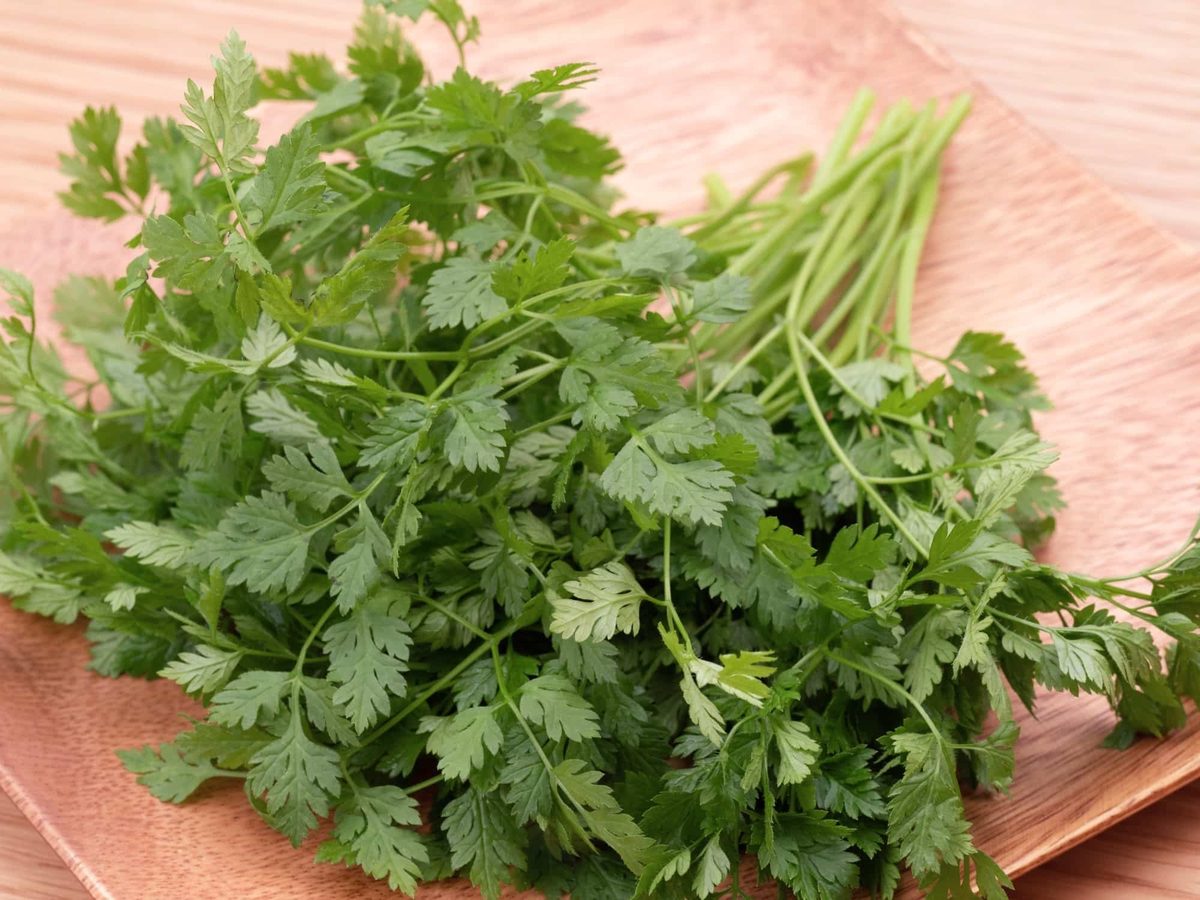
Chervil is a lacy herb in the parsley family with a delicate aroma and a taste Britannica compares to anise.1 Illinois Extension describes it as tasting like a mix of parsley and anise.2 The flavor is light, so the practical questions are where it shows up best and how to keep from losing it. For what chervil is and what is in it, see the chervil profile.
Where chervil works
| Use | What the sources say |
|---|---|
| Eggs and omelets | PROSEA singles out eggs, particularly omelets; Pépin’s fines herbes omelet uses it34 |
| Fines herbes | One of the usual four, with parsley, chives and tarragon5 |
| Béarnaise | Traditional in the reduction, alongside tarragon6 |
| Salads | Listed by PROSEA, Britannica and Illinois Extension132 |
| Fish | Listed by Britannica, including stuffings for fish1 |
| Soups and sauces | Listed by PROSEA and Illinois Extension32 |
| Cheese dishes | Listed by Illinois Extension2 |
| Garnish | Illinois Extension2 |
Illinois Extension sums it up: the leaves are used much as parsley is, and both leaves and stems go into cooking.2
Eggs and the fines herbes omelet
Eggs are the classic home for chervil. PROSEA lists eggs among chervil’s main uses and names omelets in particular.3 Britannica describes fines herbes as a mix that commonly includes parsley, chives, tarragon and chervil, and lists omelets, fish, chicken, stews and sauces as typical uses.5
Amount (Attributed): Jacques Pépin’s fine-herbes omelet uses 1 tablespoon of finely chopped parsley and 1 tablespoon of a finely chopped mixture of chervil, tarragon and chives.4 He beats the herbs into the eggs with the salt and pepper before cooking,4 so in an omelet chervil goes in at the start rather than at the end. The eggs cook quickly enough that this is the usual exception to adding chervil late. For scrambled eggs, a sprinkle of chopped chervil just before serving is common practice. See fines herbes for more on the blend.
Béarnaise: with tarragon, not instead of it
Tarragon is the defining herb of béarnaise; Britannica calls it an essential ingredient in the sauce.7 Chervil belongs there too. In his book on sauces, James Peterson notes that traditional recipes call for chervil in the flavor reduction, though he makes it optional in his version, since tarragon’s much stronger flavor tends to cover it.6 So chervil is a supporting herb in béarnaise, not a lighter replacement for tarragon. If you want a gentler sauce, using less tarragon and more chervil in the reduction and the finishing herbs is a reasonable experiment; that suggestion is ours, not a classic recipe.
Salads, fish and soups
Britannica lists fish, salads, soups, eggs, meat dishes and stuffings for poultry and fish among chervil’s uses.1 PROSEA adds casseroles and sauces.3 In practice:
- Salads. Whole sprigs or roughly torn leaves can go into a green salad like any other tender herb. Pairing them with sharper greens is a matter of taste.
- Fish. Chopped chervil folded into a butter or cream sauce, or scattered over steamed or poached white fish, keeps its flavor in front. Lighter fish let it show; that judgment is common practice.
- Soups. Stir it in off the heat or use it as a garnish.
When to add it
No source we found measures how quickly chervil’s flavor fades with heat. Adding it at the end of cooking, or after the pan comes off the heat, is common practice, and so is using it more generously than you would a stronger herb. Omelets, as above, are the exception.
Use leaves and tender stems. Illinois Extension notes both are used in cooking and advises harvesting leaves when fully open but still tender.2
Flowering chervil
Chervil bolts readily. Illinois Extension notes that it goes to flower easily and suggests sowing every 3 to 4 weeks through the season to keep fresh leaves coming.2 PROSEA advises picking leaves and stems before the flower buds open.3 Neither source describes how the flavor of flowering plants changes, so treat flowering as a sign the leaves are past their best for harvest, not as a measured flavor fault.
Fresh or dried
Most cooks treat chervil as a fresh herb, and the uses above assume fresh leaves. The sources do not quite agree on dried chervil. Illinois Extension gives air drying and sealed storage as a way to keep it,2 and Tasting Table’s Sylvia Tomczak suggests fresh chervil for garnishes and final additions while saying dried is better for cooking.8 We found no test of how much flavor dried chervil keeps. If you use it, add it to a cooked dish rather than sprinkling it on as a garnish. PROSEA’s alternative is to chop fresh chervil and freeze it with water in ice cube trays.3
Blends it belongs in
Chervil is a fines herbes herb.5 It is not part of herbes de Provence: the French Label Rouge specification for that blend is built on thyme, rosemary, savory and oregano.9 See herbes de Provence for the full recipe.
Related pages
- Chervil uses
- Chervil substitutes
- Chervil vs. parsley and chervil vs. cilantro
- Tarragon, parsley and cilantro
Footnotes
-
“Chervil”, Encyclopaedia Britannica. britannica.com · Reference work ↩ ↩2 ↩3 ↩4
-
“Chervil”, University of Illinois Extension, Herb Gardening. extension.illinois.edu · Reference work ↩ ↩2 ↩3 ↩4 ↩5 ↩6 ↩7 ↩8 ↩9
-
M.A. Nichols, Anthriscus cerefolium, Plant Resources of South-East Asia (PROSEA). uses.plantnet-project.org · Reference work ↩ ↩2 ↩3 ↩4 ↩5 ↩6 ↩7
-
Jacques Pépin, “Fine-Herbes Omelet: Conventional and Classic”, KQED (Alfred A. Knopf, 2001). kqed.org · Publication ↩ ↩2 ↩3
-
“Fines herbes”, Encyclopaedia Britannica. britannica.com · Reference work ↩ ↩2 ↩3
-
James Peterson, “Sauce Béarnaise”, Sauces: Classical and Contemporary Sauce Making (1991), via ckbk. app.ckbk.com · Publication ↩ ↩2
-
“Tarragon”, Encyclopaedia Britannica. britannica.com · Reference work ↩
-
Sylvia Tomczak, “Chervil Is The Parsley Substitute You Should Try”, Tasting Table, 2023. tastingtable.com · Publication ↩
-
Cahier des charges du Label Rouge LA 02/03 « Herbes de Provence », INAO, 2014. extranet.inao.gouv.fr · Regulator ↩