Spice Substitutes · Substitutes
Chervil Substitutes, Ranked by the Job Chervil Is Doing
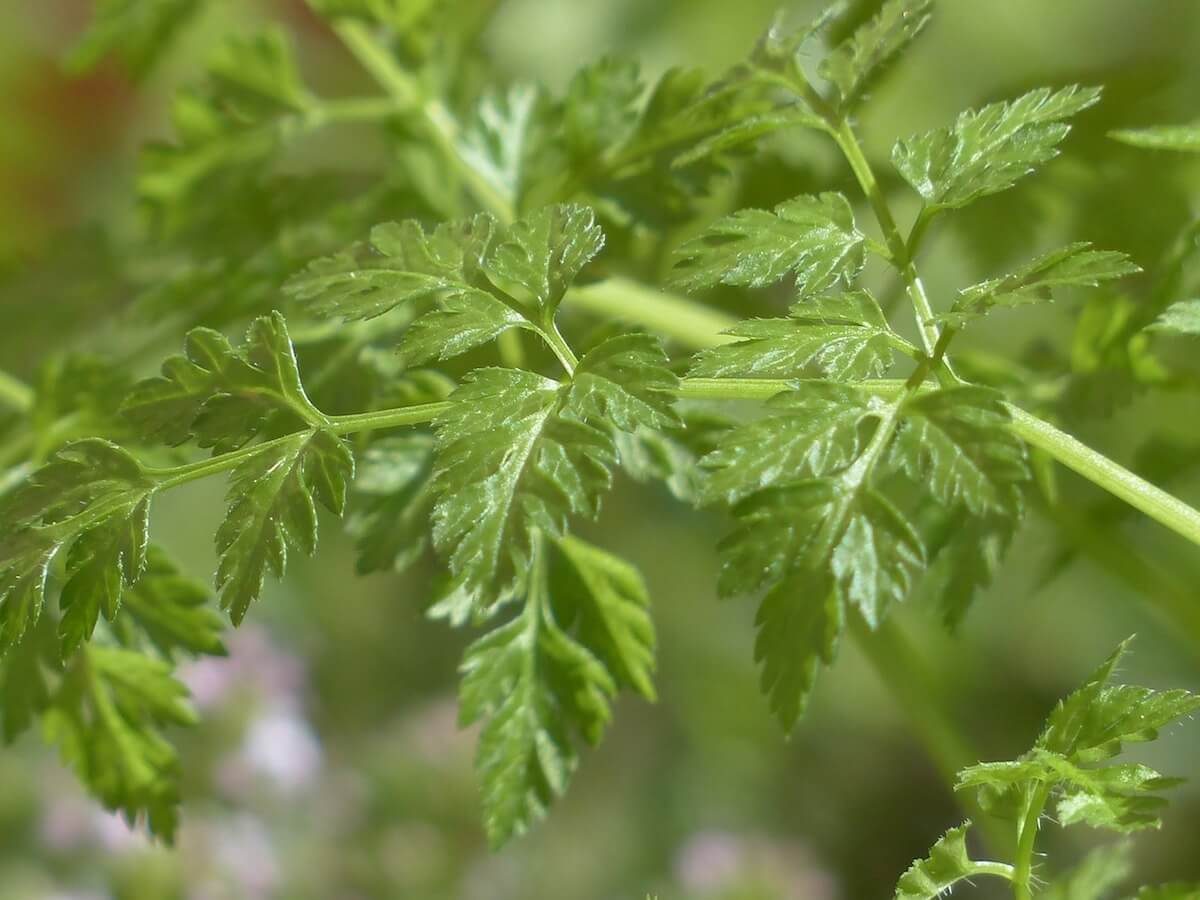
Chervil is the leaf of Anthriscus cerefolium, a small herb of the parsley family (Apiaceae).1 Britannica describes a delicate aroma and a taste reminiscent of anise,1 and PROSEA calls the flavor light and parsley-like with a hint of myrrh.2 Its oil is characterized by undecane, methyl chavicol (also called estragole) and methyl eugenol,2 and in one wild Turkish sample methyl chavicol made up 83.10% of it.3 That chemistry points to the two halves of a good substitute: something green and mild like parsley, and a little of something that carries estragole’s anise note.
Quick answer
| What chervil is doing | Best substitute | Starting amount, per 1 part chervil | Treatment |
|---|---|---|---|
| Soft anise note in sauces, eggs, fish or chicken | Equal parts flat-leaf parsley and tarragon, mixed | 1/2 part of the mix, then add parsley to taste | Attributed mix; amount Method |
| Same job, tarragon only | Fresh tarragon | 1/4 part, then taste | Method |
| Raw garnish or salad herb | Flat-leaf parsley, with a few fennel fronds | 1 part parsley | Method |
| One of the four fines herbes | More of the other three | Make up the volume with parsley | Method |
The rest of the page explains each choice.
How the ratios on this page are labeled
Every ratio carries one of four labels.
- Computed: based on a measurable physical relationship, such as converting fresh herbs to dried, with the source named.
- Attributed: a named source publishes this ratio. We quote it as theirs.
- Disputed: named sources give different answers to the same swap. We show each one and do not average them.
- Method: we found no published ratio. We give a direction and a cautious starting point, and say so.
We found no published ratio for replacing chervil with any single herb. The one attributed figure on this page is a blend proportion.
If chervil is a soft anise note in a cooked or sauced dish
Britannica lists fish, soups, eggs, meat dishes and stuffings for poultry and fish among chervil’s uses,1 and PROSEA singles out eggs, particularly omelets.2 In these dishes chervil gives a faint sweetness and anise lift, not a strong flavor.
1. Parsley and tarragon, mixed
Tasting Table’s Sylvia Tomczak describes chervil as faintly reminiscent of both parsley and tarragon, and says the usual way to approximate it is to use equal amounts of the two.4 The chemistry explains why the pair works. Tarragon’s oil is mostly the same compound that leads chervil’s: the EU Scientific Committee on Food puts estragole at 60 to 75% of tarragon oil,5 and PROSEA cites a French tarragon oil at about 77% methyl chavicol.6 Parsley supplies the green, mild body. Tomczak also notes that chervil has the more delicate profile of the two herbs,4 so the parsley keeps the mix from tasting of tarragon alone.
Ratio (Attributed blend, Method amount): Tasting Table gives equal parts parsley and tarragon for the blend.4 It does not say how much of the blend to use in place of chervil. Because tarragon is assertive, we start with about half the chervil quantity of the mixed herbs, taste, and make up the rest with parsley if the dish needs more green.
Use French tarragon. Illinois Extension notes that the tarragon sold as seed is Russian tarragon, which lacks the odor and flavor characteristics of French tarragon.7
2. Tarragon alone
PROSEA describes tarragon’s scent as sweet and anise-like, with a peculiar bittersweet flavor.6 Used alone it brings the anise note without chervil’s softness. How much more strongly it tastes than chervil has not been measured: the two oils share estragole, but no source we found compares the amount of oil in the fresh leaves.
Ratio (Method): No published ratio was found. Start with about a quarter of the chervil amount, chopped fine, taste, and add more in small steps.
If chervil is a raw garnish or salad herb
PROSEA lists salads among chervil’s uses.2 Raw, chervil’s lacy look and mild flavor matter as much as its anise note.
1. Flat-leaf parsley
Parsley is chervil’s family relative and the closest in role: Britannica describes it as a carrot-family herb with a mildly aromatic flavor popular with fish, meats, soups, sauces and salads.8 It is not as gentle as chervil. PROSEA describes parsley herb oil as warm but slightly burning and bitter, and notes that flat-leaved parsley is stronger flavored than curly.9 Like chervil, it belongs at the end: LSU AgCenter lists parsley among the delicate herbs to add in the last minute or two of cooking.10
Ratio (Method): No published ratio was found. Start with the same amount of parsley as chervil. For the anise note, add a few chopped fennel fronds or a small pinch of tarragon.
2. Fennel fronds
Illinois Extension says both kinds of fennel have an anise or licorice flavor, and that herb fennel is used in fish dishes, soups and stews.11 Alan Bergo notes that young, purple bronze-fennel fronds have a licorice flavor, while fronds turn green and vegetal later in the season.12 Fronds are coarser than chervil, so chop them fine.
Ratio (Method): No published ratio was found. Use them as an accent with parsley rather than alone: start with about a quarter of the chervil amount.
3. Sweet cicely
Sweet cicely, Myrrhis odorata, is sometimes called Spanish or sweet chervil, and Katzer says its leaves may be used instead of chervil.13 It is not milder. Katzer describes a strong fragrance reminiscent of licorice or anise and a sweet taste, and puts anethole at about 85% of the leaf oil.13 The Herb Society says its natural sweetness has been used to cut sugar when stewing tart fruit, and that the leaves can also go into soups, stews and omelets.14
Ratio (Method): No published ratio was found. Because it is sweeter and stronger, start with about half the chervil amount.
If chervil is one of the fines herbes
Britannica describes fines herbes as a seasoning or garnish mix that commonly includes parsley, chives, tarragon and chervil, though the exact herbs vary.15 If chervil is the one you’re missing, the other three already cover its ground: parsley for the green, tarragon for the anise.
Ratio (Method): No published ratio was found. Make up chervil’s share with extra parsley, and resist adding more tarragon, which can take over. See fines herbes substitutes for the blend as a whole.
Dill: a common suggestion that misses the anise
Dill often appears on chervil-substitute lists, usually on the grounds that it tastes of anise. Its chemistry says otherwise. PROSEA gives the chief components of dill herb oil as phellandrene (35%) and dill ether (25%),16 with no estragole or anethole among them, and Britannica describes dill’s flavor as warm, slightly sharp and somewhat reminiscent of caraway.17 Use dill only where its own flavor suits the dish, as with eggs or fish.
Ratio (Method): No published ratio was found. If you use it, start with about half the chervil amount.
Dried chervil and the fresh-to-dried rule
Tasting Table’s Tomczak suggests fresh chervil for garnishes and final additions and says dried is better for cooking.4 For converting between the two, the extension services give a general rule for herbs, not a chervil measurement:
| Source | Fresh herbs | Dried, crumbled | Ground |
|---|---|---|---|
| NDSU Extension | 1 tablespoon | 1 teaspoon | 1/2 teaspoon18 |
| Penn State Extension | 1 tablespoon | 1 teaspoon | 1/4 teaspoon (powdered)19 |
| NMSU Extension | 1 tablespoon | 1 teaspoon | not given20 |
| LSU AgCenter | 1 tablespoon | 1 teaspoon | not given10 |
| America’s Test Kitchen, tasting test | 3 parts | 1 part | not given21 |
Fresh to dried (Computed, with a caveat): The sources agree on roughly one part dried to three parts fresh. ATK’s testing found that 1 part dried to 3 parts fresh came closest to equal strength, but its testers preferred fresh herbs in all but one application, and it notes that the flavor compounds of delicate herbs such as parsley, dill and tarragon tend to be more volatile.21 ATK’s Danielle Lapierre lists parsley among the herbs that are better fresh, saying they are much weaker in flavor when dried.22 Neither ATK piece mentions chervil, so whether the 3:1 rule holds for dried chervil has not been tested. If you are using dried parsley in place of fresh chervil, NMSU’s conversion is the same: 1 teaspoon dried parsley for 3 teaspoons fresh.20
Dried to ground (Disputed): NDSU and Penn State differ by a factor of two on ground herbs (1/2 teaspoon against 1/4 teaspoon per tablespoon fresh).1819 Ground chervil is rarely sold, so this matters mainly if you are swapping in a ground substitute; start at the lower figure.
What isn’t known
- No source publishes a ratio for replacing chervil with tarragon, parsley, fennel, sweet cicely or dill. Every amount above except Tasting Table’s blend proportion is a Method starting point.
- No source compares the oil content of fresh chervil and fresh tarragon, so how much stronger tarragon tastes is a cook’s judgment.
- Chervil’s oil figures come from a single wild Turkish population, read from an abstract.3
- Tarragon and chervil share estragole, which the EU Scientific Committee on Food judged genotoxic and carcinogenic in 2001, mainly on studies of mice given it orally.5 That committee gave no figure for herbs used in cooking; see the tarragon and chervil profiles for the details.
Related
- Chervil, chervil uses and cooking with chervil
- Chervil vs. parsley and chervil vs. cilantro
- Tarragon, tarragon substitutes and dried vs. fresh tarragon
- Parsley, flat-leaf vs. Italian parsley and fresh vs. dried parsley
- Sweet cicely, bronze fennel, dill and fennel vs. dill
- Fines herbes and fines herbes substitutes
Footnotes
-
“Chervil”, Encyclopaedia Britannica. britannica.com · Reference work ↩ ↩2 ↩3
-
M.A. Nichols, Anthriscus cerefolium, Plant Resources of South-East Asia (PROSEA). uses.plantnet-project.org · Reference work ↩ ↩2 ↩3 ↩4
-
Baser, Ermin and Demirçakmak, “The essential oil of Anthriscus cerefolium (L.) Hoffm. (chervil) growing wild in Turkey”, Journal of Essential Oil Research, 1998. avesis.anadolu.edu.tr · Peer-reviewed ↩ ↩2
-
Sylvia Tomczak, “Chervil Is The Parsley Substitute You Should Try”, Tasting Table, 2023. tastingtable.com · Publication ↩ ↩2 ↩3 ↩4
-
Opinion of the Scientific Committee on Food on Estragole, European Commission, 2001. food.ec.europa.eu · Regulator ↩ ↩2
-
C.C. de Guzman and R.A. Reglos, Artemisia dracunculus, Plant Resources of South-East Asia (PROSEA). uses.plantnet-project.org · Reference work ↩ ↩2
-
“Tarragon: French”, University of Illinois Extension. extension.illinois.edu · Reference work ↩
-
“Parsley”, Encyclopaedia Britannica. britannica.com · Reference work ↩
-
I.B. Ipor and L.P.A. Oyen, Petroselinum crispum, Plant Resources of South-East Asia (PROSEA). uses.plantnet-project.org · Reference work ↩
-
“Flavorful Herbs”, LSU AgCenter. lsuagcenter.com · Reference work ↩ ↩2
-
“Fennel”, University of Illinois Extension. extension.illinois.edu · Reference work ↩
-
Alan Bergo, “Bronze Fennel”, Forager Chef, 2025. foragerchef.com · Publication ↩
-
Gernot Katzer, “Cicely (Myrrhis odorata)”, Gernot Katzer’s Spice Pages. gernot-katzers-spice-pages.com · Reference work ↩ ↩2
-
Julia Russell, “All about Sweet Cicely”, The Herb Society, 2020. herbsociety.org.uk · Publication ↩
-
“Fines herbes”, Encyclopaedia Britannica. britannica.com · Reference work ↩
-
Nguyen Thi Tâm, C.C. de Guzman and P.C.M. Jansen, Anethum graveolens, Plant Resources of South-East Asia (PROSEA). uses.plantnet-project.org · Reference work ↩
-
“Dill”, Encyclopaedia Britannica. britannica.com · Reference work ↩
-
Julie Garden-Robinson, Ingredient Substitutions (FN198), NDSU Extension, 2018. ksre.ksu.edu · Reference work ↩ ↩2
-
Stacy Reed, “Preserving Herbs by Drying”, Penn State Extension, 2024. extension.psu.edu · Reference work ↩ ↩2
-
In a Pinch Ingredient Substitution (E-131), NMSU Cooperative Extension, 2016. pubs.nmsu.edu · Reference work ↩ ↩2
-
“Science: Substituting Dried Herbs for Fresh”, America’s Test Kitchen. americastestkitchen.com · Publication ↩ ↩2
-
Danielle Lapierre, “When You Should Actually Use Dried Herbs (and Which Ones to Avoid)”, America’s Test Kitchen, 2022. americastestkitchen.com · Publication ↩