Blog · Uses
Chervil Uses: Eggs, Fines Herbes, Béarnaise, Ravigote, Soup and More
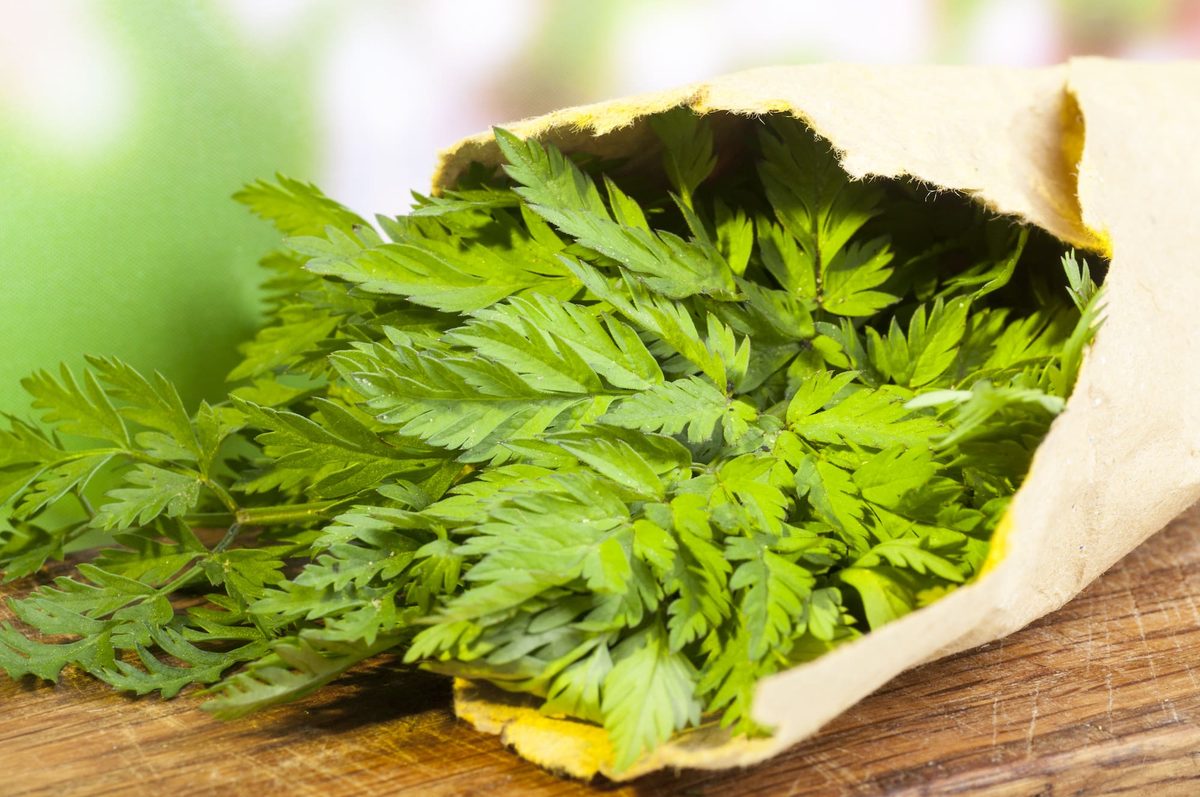
Chervil is a lacy herb of the parsley family with a delicate aroma and a taste Britannica compares to anise.1 The Royal Horticultural Society notes that its delicate flavor does not withstand cooking, and that the leaves go into salads and into hot dishes with egg, chicken and fish just before serving.2 That sums up where chervil belongs: dishes mild enough to let a light herb show. This page is the list of those dishes. For how to handle the herb (timing, stems, fresh or dried), see cooking with chervil.
Chervil uses at a glance
| Use | Where it comes from | Source |
|---|---|---|
| Omelets and egg dishes | Fines herbes omelet; eggs are a main use | Pépin, PROSEA34 |
| Fines herbes | One of the usual four herbs | Britannica5 |
| Béarnaise | In the traditional reduction, with tarragon | Peterson6 |
| Sauce ravigote | Half a cup in Boulud’s recipe | Saveur7 |
| Cream of chervil soup | German Kerbelsuppe | Saveur8 |
| Salads | Leaves added raw | Britannica, PROSEA, RHS142 |
| Fish and chicken | Added just before serving; fish stuffings | RHS, Britannica21 |
| Cheese dishes and garnish | Used much as parsley is | Illinois Extension9 |
| Herb vinegar | General extension method, not chervil-specific | UMaine, Oregon State1011 |
Eggs and omelets
Eggs are chervil’s best-known partner. PROSEA lists eggs among its main uses and names omelets in particular,4 and the RHS puts egg dishes first among the hot dishes it suits.2
Fines herbes omelet (Attributed). Jacques Pépin’s version calls for 1 tablespoon of finely chopped parsley and 1 tablespoon of a finely chopped mix of chervil, tarragon and chives.3 Scrambled eggs, egg salad and quiche are natural places for it too; those are common kitchen uses rather than sourced dishes.
Fines herbes
Britannica describes fines herbes as a French mix whose herbs vary but commonly include parsley, chives, tarragon and chervil, used for fish, chicken, stews, sauces and omelets.5 A common claim says the four go in equal parts. We found no source that fixes the proportion: Pépin’s omelet, for example, uses as much parsley as the other three herbs combined.3 See fines herbes and fines herbes substitutes.
Two French sauces
Béarnaise. Tarragon leads in béarnaise. James Peterson notes that traditional recipes put chervil in the flavor reduction, though he treats it as optional because tarragon’s stronger flavor tends to cover it.6 So chervil is a supporting herb here, not a lighter stand-in for tarragon.
Sauce ravigote (Attributed). Daniel Boulud’s ravigote for Saveur is a sharp, herb-heavy sauce built on red wine vinegar, Dijon mustard, stock and sunflower oil. For about 2 cups of sauce it takes 1 cup of chives, 3/4 cup of parsley, 1/2 cup each of chervil and tarragon, capers, shallots and a chopped hard-boiled egg.7 Boulud notes it can be prepared hot or cold and suits fish and grilled meat.7 It is one of the few recipes that uses chervil by the half cup rather than the pinch.
Soup
Kerbelsuppe (Attributed). In this German cream of chervil soup, from Nadia Hassani’s Spoonfuls of Germany via Saveur, the herb is split in two: 6 ounces of chervil, stems and leaves separated, serves 4.8 The stems simmer in the stock and are strained out, and the raw leaves are puréed with cream, parsley and egg yolks before being whisked into the broth.8 Saveur says the soup is traditionally served in German homes on the Thursday before Good Friday.8 It is a useful model for any chervil soup: cook the stems for flavor, keep the leaves out of the heat until the end.
Britannica and PROSEA both list soups among chervil’s uses in general.14 Stirring chopped leaves into a finished potato, pea or asparagus soup is common practice.
Salads
Salads are on every list: Britannica, PROSEA and the RHS all name them.142 Whole sprigs or torn leaves can go into a green salad like any tender herb, and chopped chervil works in potato salad or with mayonnaise-based dressings. Those last two are kitchen judgment, not sourced dishes.
Fish, chicken and vegetables
The RHS names chicken and fish among the hot dishes chervil suits, added just before serving.2 Britannica lists fish, meat dishes, and stuffings for poultry and fish.1 PROSEA adds casseroles and sauces.4 Practical ways in:
- A spoonful of chopped chervil in the butter or cream sauce for poached or steamed white fish.
- Scattered over roast or poached chicken as it comes to the table.
- Tossed with buttered carrots, peas, green beans or new potatoes off the heat.
- Beaten into softened butter with a little salt to top grilled fish or vegetables.
Those four are common practice rather than named recipes. A common claim says chervil brings out the sweetness of carrots; we found no source for it.
Cheese dishes and garnish
Illinois Extension says chervil leaves are used much as parsley is, including in cheese and egg dishes, and also as a garnish.9 Soft fresh cheeses are the obvious match; that is a judgment, not a citation.
Chervil vinegar
Herb vinegar is a general method, and none of the extension guides we read names chervil. Here is what they say about herb vinegars in general:
| Step | University of Maine Extension | Oregon State Extension |
|---|---|---|
| Herb per pint of vinegar | Two to three sprigs10 | About 3 to 4 sprigs of fresh herbs11 |
| Which vinegar | White or wine vinegar in its herb pairings10 | Distilled white is a good choice for delicate herbs11 |
| Steeping | Room temperature, 3 to 4 weeks10 | A cool, dark place, 3 to 4 weeks11 |
| Keeping | Refrigerate and use within 3 months10 | Cool, dark place; best within 4 to 6 months; refrigeration best for flavor11 |
The two guides differ on how long the vinegar keeps and whether it needs the refrigerator, so we show both. Oregon State says vinegar showing mold, bubbling, cloudiness or sliminess should be thrown out without tasting.11 Chervil’s light flavor makes a mild vinegar; a white wine vinegar keeps it from being drowned out (our judgment). Use it in vinaigrettes or to sharpen a homemade mayonnaise.
What chervil is not used for
Long-cooked dishes. With its delicate flavor easily lost to heat,2 chervil is not a braising or stewing herb; use thyme or bay leaves there and add chervil at the end if you want its note. It is also not part of herbes de Provence (see herbes de Provence).
Not yet sourced
- A named recipe for a classic chervil cream sauce (sauce cerfeuil) for poultry or scallops.
- A named Swedish dish pairing chervil with fish and crème fraîche.
- Any measurement of how much chervil flavor survives heat.
Related
- Chervil profile and cooking with chervil
- Chervil substitutes
- Chervil vs. parsley and chervil vs. cilantro
- Tarragon, parsley and chives
Footnotes
-
“Chervil”, Encyclopaedia Britannica. britannica.com · Reference work ↩ ↩2 ↩3 ↩4 ↩5 ↩6
-
“How to Grow Chervil”, Royal Horticultural Society. rhs.org.uk · Reference work ↩ ↩2 ↩3 ↩4 ↩5 ↩6 ↩7
-
Jacques Pépin, “Fine-Herbes Omelet: Conventional and Classic”, KQED (Alfred A. Knopf, 2001). kqed.org · Publication ↩ ↩2 ↩3
-
M.A. Nichols, Anthriscus cerefolium, Plant Resources of South-East Asia (PROSEA). uses.plantnet-project.org · Reference work ↩ ↩2 ↩3 ↩4 ↩5 ↩6
-
“Fines herbes”, Encyclopaedia Britannica. britannica.com · Reference work ↩ ↩2
-
James Peterson, “Sauce Béarnaise”, Sauces: Classical and Contemporary Sauce Making (1991), via ckbk. app.ckbk.com · Publication ↩ ↩2
-
Daniel Boulud, “Ravigote Sauce”, Saveur, 2016. saveur.com · Publication ↩ ↩2 ↩3
-
“Kerbelsuppe (Cream of Chervil Soup)”, from Nadia Hassani, Spoonfuls of Germany, via Saveur, 2014. saveur.com · Publication ↩ ↩2 ↩3 ↩4
-
“Chervil”, University of Illinois Extension, Herb Gardening. extension.illinois.edu · Reference work ↩ ↩2
-
Kathleen Savoie, “Let’s Preserve: Herbal Vinegar” (Bulletin #4049), University of Maine Cooperative Extension. extension.umaine.edu · Reference work ↩ ↩2 ↩3 ↩4 ↩5
-
Nellie Oehler, “Flavored Vinegars” (SP 50-736), Oregon State University Extension Service, 2025. extension.oregonstate.edu · Reference work ↩ ↩2 ↩3 ↩4 ↩5 ↩6