Spice Comparisons · Comparison
Chervil vs. Cilantro: Two Parsley-Family Herbs with Very Different Chemistry
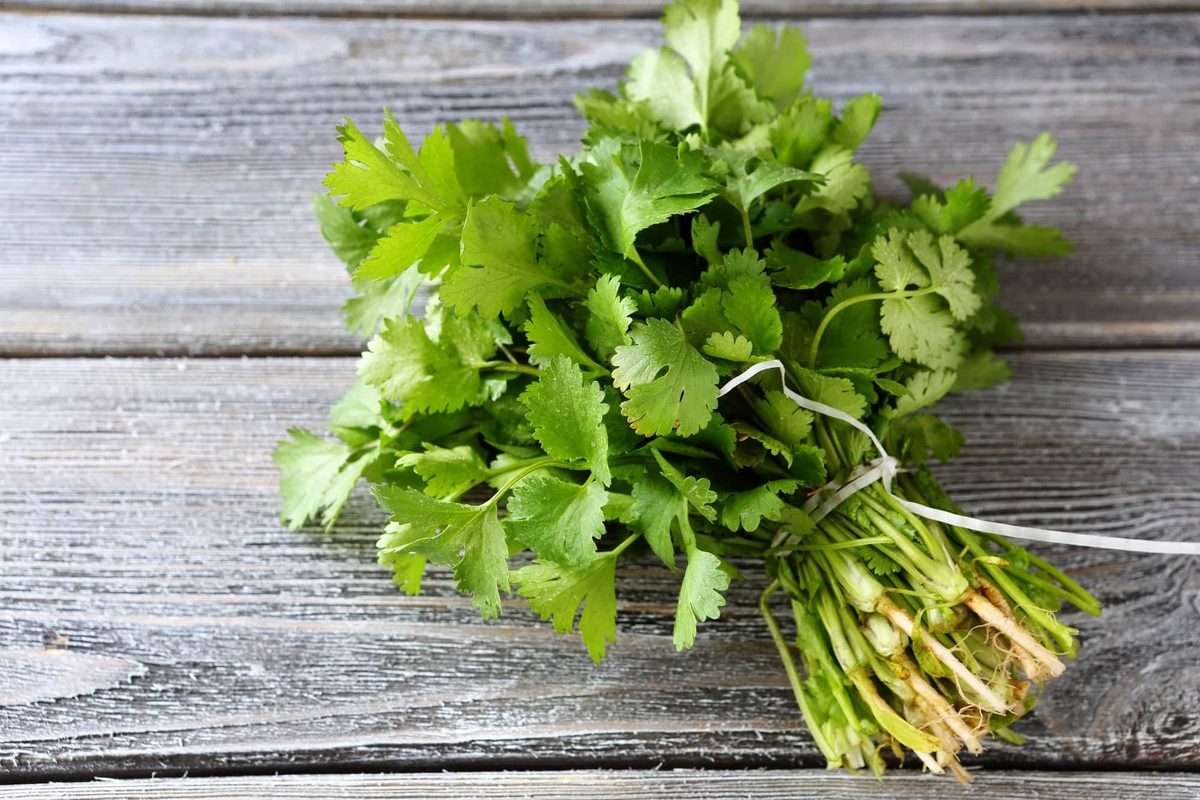
Chervil and cilantro are both soft-leaved herbs of the parsley family, Apiaceae, and both are usually added at the last minute.12 That is about where the resemblance ends. Chervil has a delicate aroma and a taste reminiscent of anise,1 and its oil is led by methyl chavicol, also called estragole.34 Cilantro’s aroma comes from a group of aldehydes, the same compounds that make it taste of soap to some people.56 They come from different kitchens and rarely stand in for each other well.
Side by side
| Chervil | Cilantro | |
|---|---|---|
| Species | Anthriscus cerefolium7 | Coriandrum sativum; the dried fruit of the same plant is the spice coriander82 |
| Family | Apiaceae1 | Apiaceae2 |
| Native range (Kew) | East-central Europe to northwest and northern Iran7 | Eastern Mediterranean to western Pakistan8 |
| Part used | Fresh leaves and stems3 | Leaves and stems; in China and Thailand the taproots are eaten too5 |
| Leaves | Lacy and finely divided;1 lower blades triangular in outline, two or three times pinnate3 | Lowest leaves simple and ovate, cleft into lobes; upper leaves divided into narrow segments; shiny green5 |
| Key aroma compounds | Methyl chavicol (estragole) leads; 83.10% of the oil in one wild Turkish sample34 | Aldehydes, more than 80% of the leaf’s volatile oil; (E)-2-dodecenal largest at 15.6%5 |
| Oil in the fresh leaf | No published figure found | About 4 mg per gram of fresh leaves5 |
| Flavor | Delicate, reminiscent of anise (Britannica);1 light and parsley-like with a hint of myrrh (PROSEA)3 | From citrusy with a biting tang to soapy, depending on who is eating it (Wisconsin Extension)9 |
| Best known in | French cooking, as one of the fines herbes310 | Latin American, Indian and Chinese dishes (Britannica);2 Thai and Vietnamese (Wisconsin Extension)9 |
| Trade | “Of minor importance in trade” (PROSEA)3 | No trade figure found in the sources reviewed |
| Safety note | Estragole, judged genotoxic and carcinogenic by the EU Scientific Committee on Food in 200111 | FDA import alert on fresh cilantro from Puebla, Mexico, over Cyclospora12 |
The two compound rows come from different studies of different samples, measured different ways, so read them as which compounds lead in each herb, not as percentages to set side by side.
Flavor, and the chemistry behind it
Chervil. PROSEA characterizes chervil oil by three constituents: undecane, methyl chavicol and methyl eugenol.3 In one analysis of oil from chervil growing wild in Turkey, methyl chavicol made up 83.10%, 1-allyl-2,4-dimethoxybenzene 15.15% and undecane 1.75%.4 Methyl chavicol is also the main compound in tarragon oil, at 60–75% according to the EU Scientific Committee on Food,11 so chervil and tarragon share their lead compound. No source measures how much of chervil’s anise note it accounts for. The chervil analysis covers one wild population, read from an abstract, so treat the numbers as one sample.
Cilantro. PROSEA says aldehydes make up more than 80% of the leaf’s volatile oil, with (E)-2-dodecenal (15.6%), (E)-2-tetradecenal (12.7%) and (E)-2-decenal (12.1%) the largest.5 Eriksson and colleagues note that the (E)-2-alkenals in cilantro are described as soapy, fatty, “like cilantro” or pungent.6 In a genetic study of 14,604 people of European ancestry, they linked reports of a soapy taste to a variant near a cluster of smell-receptor genes, one of which, OR6A2, binds several of cilantro’s aldehydes.6 Genes explain only part of it: the heritability tagged by common variants was about 0.087.6
What that means for a cook. The three compounds in the Turkish chervil analysis add up to 100% of the oil (our arithmetic), and none of them is one of cilantro’s aldehydes.4 So, as far as that one sample shows, chervil doesn’t carry the compounds behind cilantro’s soapy taste. No study we found tests whether people who dislike cilantro like chervil.
How each is used
Chervil. Britannica lists fish, salads, soups, eggs, meat dishes and stuffings for poultry and fish.1 PROSEA adds casseroles and sauces, and singles out eggs, particularly omelets.3 It is one of the classic French fines herbes, a mix that commonly includes parsley, chives, tarragon and chervil, though the exact herbs vary.103 A widely repeated claim puts chervil in herbes de Provence; we found no source for that. By common practice, chervil goes in raw or at the very end, often in generous amounts, and suits herb butters, potatoes and spring vegetables. See chervil uses and cooking with chervil.
Cilantro. Wisconsin Extension calls it an essential ingredient in many Latin American, Caribbean and Asian dishes, especially Thai and Vietnamese, and notes it goes into Mexican salsas and meat dishes and some Chinese soups.9 Arabic cooking uses both leaves and seeds in pickles, curries and chutneys.9 In China and Thailand the aromatic taproots are eaten as a vegetable.5 By common practice it is scattered over tacos and folded into guacamole. See cooking with cilantro.
Timing. Both are late additions. Wisconsin Extension says to add cilantro at the very end to avoid overcooking it,9 and LSU AgCenter lists it among the delicate herbs to add in the last minute or two, since prolonged heat costs flavor and aroma.13 No source we found tests chervil the same way, but cooks treat it the same.
Finding them. PROSEA calls chervil of minor importance in trade, though it is now grown in all parts of the world.3 Cilantro is the one most grocery stores stock; that is a general observation, not a measured figure.
Can one stand in for the other?
Not well. The flavors are built from different compounds, and no source we found gives a ratio for either swap.
| Swap | When it works | Starting amount | Treatment |
|---|---|---|---|
| Chervil for cilantro | As a green garnish, or in fish and egg dishes for someone who finds cilantro soapy. It will not taste like cilantro. | Same amount, then taste | Method |
| Cilantro for chervil | As a garnish only. In a delicate French sauce or omelet, its flavor takes over. | About half the chervil amount, then taste | Method |
Both starting points are our judgment, not published ratios. For closer matches, see chervil substitutes, which ranks a parsley-and-tarragon mix first, and cilantro substitutes, which ranks culantro and parsley.
Safety
Chervil. Chervil is generally recognized as safe in the United States (GRAS 2279).3 PROSEA notes that methyl chavicol and methyl eugenol, two of its oil compounds, are carcinogenic in rats.3 The EU Scientific Committee on Food concluded in 2001 that estragole is genotoxic and carcinogenic, mainly from studies in which mice were given it orally, and recommended reducing exposure.11 It gave no figure for chervil used as a kitchen herb.
Cilantro. The FDA links recurring outbreaks of cyclosporiasis in the United States in 2012, 2013, 2014 and 2015 to fresh cilantro from the state of Puebla, Mexico.12 Under Import Alert 24-23, fresh cilantro from Puebla offered for entry from April 1 through August 31 of each year can be detained without physical examination.12
What isn’t known
- No study compares chervil and cilantro directly, in flavor or in chemistry.
- Chervil’s oil figures come from one wild Turkish population, read from an abstract.4 No published figure gives the oil content of fresh chervil leaves.
- No source publishes a substitution ratio either way.
- No study tests whether people who find cilantro soapy dislike chervil too.
Related
- Chervil and cilantro, the full profiles
- Chervil substitutes and cilantro substitutes
- Chervil vs. parsley and cilantro vs. parsley
- Coriander vs. cilantro and culantro vs. cilantro
- Fines herbes and tarragon
- Too much cilantro
Footnotes
-
“Chervil”, Encyclopaedia Britannica. britannica.com · Reference work ↩ ↩2 ↩3 ↩4 ↩5 ↩6
-
“Coriander”, Encyclopaedia Britannica. britannica.com · Reference work ↩ ↩2 ↩3 ↩4
-
M.A. Nichols, Anthriscus cerefolium, Plant Resources of South-East Asia (PROSEA). uses.plantnet-project.org · Reference work ↩ ↩2 ↩3 ↩4 ↩5 ↩6 ↩7 ↩8 ↩9 ↩10 ↩11 ↩12 ↩13
-
Baser, Ermin and Demirçakmak, “The essential oil of Anthriscus cerefolium (L.) Hoffm. (chervil) growing wild in Turkey”, Journal of Essential Oil Research, 1998 (abstract). avesis.anadolu.edu.tr · Peer-reviewed ↩ ↩2 ↩3 ↩4 ↩5
-
Coriandrum sativum, Plant Resources of South-East Asia (PROSEA). uses.plantnet-project.org · Reference work ↩ ↩2 ↩3 ↩4 ↩5 ↩6 ↩7
-
Eriksson et al., “A genetic variant near olfactory receptor genes influences cilantro preference”, Flavour, 2012. link.springer.com · Peer-reviewed ↩ ↩2 ↩3 ↩4
-
Anthriscus cerefolium, Plants of the World Online, Royal Botanic Gardens, Kew. powo.science.kew.org · Reference work ↩ ↩2
-
Coriandrum sativum L., Plants of the World Online, Royal Botanic Gardens, Kew. powo.science.kew.org · Reference work ↩ ↩2
-
Susan Mahr, “Cilantro”, Wisconsin Master Gardener Program, University of Wisconsin-Madison, 2017. mastergardener.extension.wisc.edu · Reference work ↩ ↩2 ↩3 ↩4 ↩5
-
“Fines herbes”, Encyclopaedia Britannica. britannica.com · Reference work ↩ ↩2
-
Opinion of the Scientific Committee on Food on Estragole, European Commission, 2001. food.ec.europa.eu · Regulator ↩ ↩2 ↩3
-
Import Alert 24-23, U.S. Food and Drug Administration. accessdata.fda.gov · Regulator ↩ ↩2 ↩3
-
“Flavorful Herbs”, LSU AgCenter. lsuagcenter.com · Reference work ↩