Spice Comparisons · Comparison
Chervil vs. Parsley: Close Relatives with Different Oils
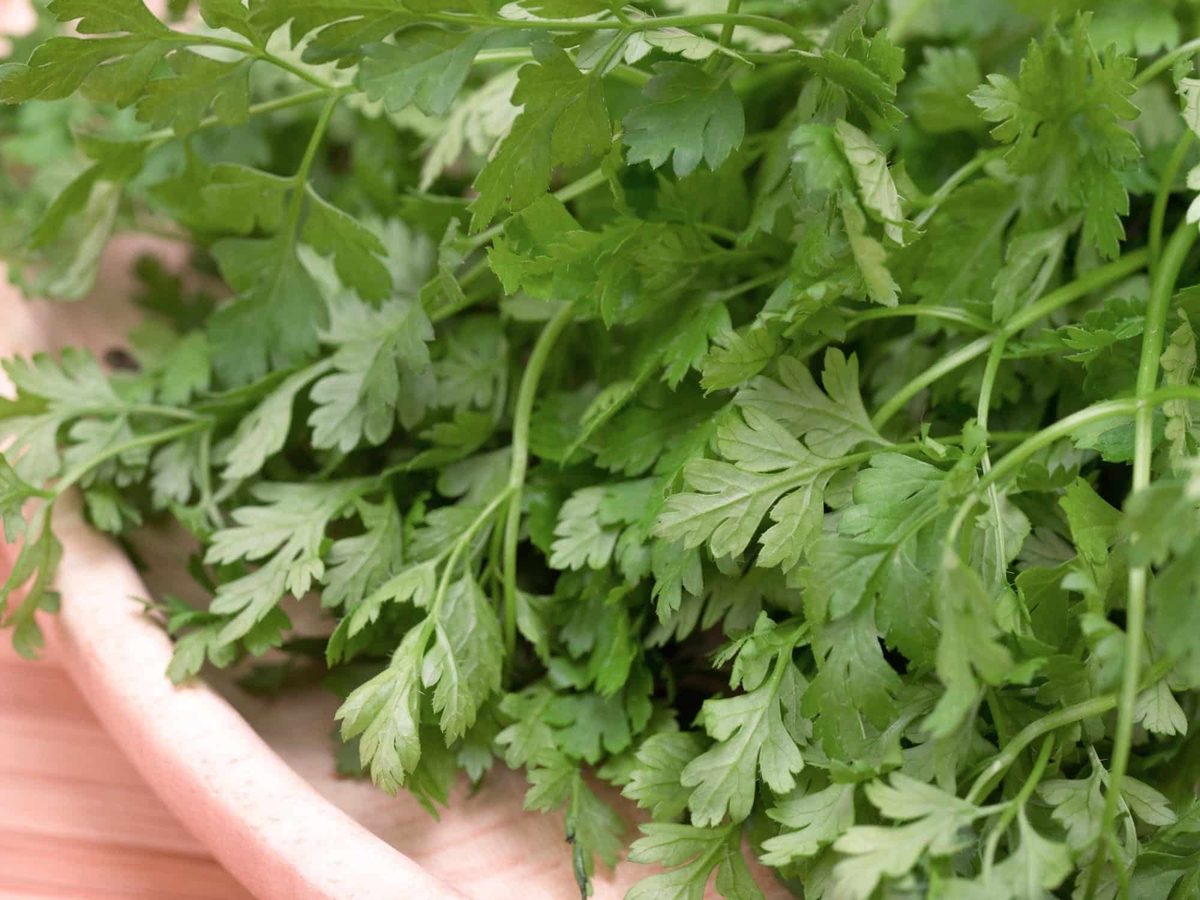
Chervil and parsley are close relatives in the carrot family, Apiaceae, and they look enough alike that one can stand in for the other on a plate.12 The difference is in the oil. Chervil’s is led by methyl chavicol (estragole), the compound that gives tarragon its anise note,345 and its flavor is light, parsley-like and faintly anise.13 Parsley tastes greener and slightly bitter,6 and its leaf oil carries compounds such as 1,3,8-p-menthatriene and myristicin instead.6 Put simply, chervil is the gentler herb, and parsley is the one with more presence.
Side by side
| Chervil | Parsley | |
|---|---|---|
| Species | Anthriscus cerefolium7 | Petroselinum crispum8 |
| Family | Apiaceae1 | Apiaceae (carrot family, also called the parsley family)2 |
| Native range (Kew) | East-central Europe to northwest and northern Iran7 | Northwest Africa and the Balkan Peninsula8 |
| Types | No cultivar groups described in the sources reviewed | Curly-leaved, flat-leaved, and turnip-rooted (Hamburg)6 |
| Part used | Fresh leaves and stems3 | Leaves; the root of Hamburg parsley26 |
| Leaves | Lacy and finely divided;1 lower blades triangular in outline, two or three times pinnate3 | Deep green, tender, flat or deeply frilled (Britannica);2 dark green and glossy (PROSEA)6 |
| Key aroma compounds | Methyl chavicol (estragole) leads: 83.10% of the oil in one wild Turkish sample4 | Leaf oil, German-grown samples: 1,3,8-p-menthatriene about 20% in both types; myristicin 32% (curly) vs 9.1% (flat)6 |
| Oil in the fresh herb | No published figure found | 0.07–0.15% curly, 0.04% flat-leaved, 0.05% turnip-rooted6 |
| Flavor | Delicate, reminiscent of anise (Britannica);1 light and parsley-like with a hint of myrrh (PROSEA)3 | Mildly aromatic (Britannica);2 warm, slightly burning and bitter (PROSEA, of the herb oil)6 |
| Typical uses | Fish, salads, soups, eggs, meat dishes, stuffings;1 omelets3 | Fish, meats, soups, sauces, salads2 |
| French fines herbes | Yes9 | Yes9 |
| Trade | “Of minor importance in trade” (PROSEA)3 | Over half the UK area planted with culinary herbs, in an undated PROSEA figure6 |
| Safety note | Estragole, judged genotoxic and carcinogenic by the EU Scientific Committee on Food in 20015 | Can affect warfarin; keep intake steady (MedlinePlus)10 |
The two compound rows come from different studies of different samples, so they show which compounds lead each oil, not percentages to compare directly.
Flavor, and what’s behind it
Chervil. Britannica describes a delicate aroma and a taste reminiscent of anise.1 PROSEA calls the flavor light and parsley-like with a hint of myrrh, and characterizes the oil by three constituents: undecane, methyl chavicol and methyl eugenol.3 In one analysis of oil from wild Turkish chervil, methyl chavicol made up 83.10%.4 The EU Scientific Committee on Food puts estragole, the same compound, at 60–75% of tarragon oil.5 So chervil and tarragon share their lead compound; no source we found measures how much of chervil’s anise note comes from it.
Parsley. Britannica calls parsley’s flavor mildly aromatic.2 PROSEA describes the herb oil’s flavor as warm but slightly burning and bitter, and says flat-leaved parsley is stronger flavored than curly.6 The oil differs by type: in PROSEA’s figures for German-grown leaves, both types carried about 20% 1,3,8-p-menthatriene, but curly parsley’s oil had 32% myristicin against 9.1% in flat-leaved, and flat-leaved had more limonene (18% against 14%).6
In the cook’s terms, parsley tastes green and fresh with a light bitterness, and chervil tastes like a softer, sweeter parsley with a whisper of tarragon. That is our description, but it follows the chemistry.
How they look
Chervil’s leaves are lacy and finely divided, and the lower blades are triangular in outline.13 Parsley’s are deep green and tender, either flat or deeply frilled.2 Flat-leaf parsley is the one more easily confused with chervil, though chervil’s leaflets are smaller and more delicate; that comparison is ours. No source we found describes chervil’s leaf color, so we can’t confirm the common claim that it is paler.
How each is used
Chervil. Britannica lists fish, salads, soups, eggs, meat dishes and stuffings for poultry and fish.1 PROSEA adds casseroles and sauces, and singles out eggs, particularly omelets.3 By common practice it is added raw or at the very end, and often in generous amounts. See chervil uses and cooking with chervil.
Parsley. Britannica lists fish, meats, soups, sauces and salads, and notes that the ancient Greeks and Romans used the leaves as a flavoring and garnish.2 By common practice it is the main herb in tabbouleh, chimichurri, gremolata and salsa verde. LSU AgCenter groups it with the delicate herbs best added in the last minute or two of cooking.11
Together. Both belong to the French fines herbes, which commonly combine parsley, chives, tarragon and chervil, though the mix varies.9 See fines herbes.
Two widely repeated claims don’t hold up in the sources we checked. We found no source that places chervil in herbes de Provence, and none that calls chervil “French parsley”; PROSEA gives its English names as chervil and garden chervil.3
Finding them. PROSEA calls chervil of minor importance in trade, though it is now grown in all parts of the world.3 Parsley is a much bigger crop: PROSEA reports, without a date, that it accounts for over half the area planted with culinary herbs in the United Kingdom.6
Can one stand in for the other?
Yes, with a change in flavor. Each herb’s substitute page ranks the other near the top.
| Swap | Starting amount | Treatment | Notes |
|---|---|---|---|
| Chervil for parsley | 1 part, then more to taste | Method | Healthline says you’ll need more chervil than parsley in cooking because it is milder, but gives no figure12 |
| Parsley for chervil, raw garnish or salad | 1 part | Method | Supplies the green, not the anise |
| Parsley and tarragon for chervil, in sauces, eggs, fish or chicken | Equal parts of the two herbs, mixed (Tasting Table);13 start with about half the chervil amount of the mix, then add parsley to taste | Attributed blend; amount Method | Tarragon adds the anise note that parsley lacks |
| Dried parsley for fresh parsley (or for fresh chervil) | 1 teaspoon dried for 3 teaspoons fresh (NMSU)14 | Computed, with a caveat | ATK’s Lapierre lists parsley among herbs that are much weaker dried15 |
Chervil for parsley. The Spice House and Healthline both describe chervil as closely related to parsley but milder.1612 As a garnish it works almost unnoticed. In a parsley-led dish such as tabbouleh, you’ll taste the difference; that is our judgment.
Parsley for chervil. Parsley gives the green body but not chervil’s anise. Tasting Table’s Sylvia Tomczak says the usual approximation is equal amounts of parsley and tarragon.13 Because tarragon is assertive, we start with about half the chervil quantity of the mix and make up the rest with parsley. Details are on the chervil substitutes and parsley substitutes pages.
Safety
Chervil. PROSEA notes that chervil is generally recognized as safe in the United States (GRAS 2279), and that methyl chavicol and methyl eugenol are carcinogenic in rats.3 The EU Scientific Committee on Food concluded in 2001 that estragole is genotoxic and carcinogenic, mainly on studies in which mice were given it orally, and recommended reducing exposure.5 It gave no figure for chervil used as a kitchen herb.
Parsley. MedlinePlus lists parsley among foods that can change how the blood thinner warfarin works, and advises not avoiding them but keeping the amount small and steady from day to day.10 Britannica warns that parsley seed oil, or large amounts of other parsley preparations, can cause potentially lethal reactions;2 culinary amounts of the leaf are not the concern. See the parsley profile.
What isn’t known
- No study compares chervil and parsley directly.
- Chervil’s oil figures come from one wild Turkish population, read from an abstract.4 No published figure gives the oil content of fresh chervil.
- No source publishes a ratio for a straight chervil-parsley swap; only Tasting Table’s blend proportion is attributable.
- No source describes chervil’s leaf color or compares the two herbs’ prices.
- A widely repeated claim says chervil holds its flavor through long cooking better than parsley; no source we found supports it.
Related
- Chervil and parsley, the full profiles
- Chervil substitutes and parsley substitutes
- Chervil vs. cilantro and cilantro vs. parsley
- Italian parsley vs. curly parsley and fresh vs. dried parsley
- Fines herbes and tarragon
Footnotes
-
“Chervil”, Encyclopaedia Britannica. britannica.com · Reference work ↩ ↩2 ↩3 ↩4 ↩5 ↩6 ↩7 ↩8 ↩9
-
“Parsley”, Encyclopaedia Britannica. britannica.com · Reference work ↩ ↩2 ↩3 ↩4 ↩5 ↩6 ↩7 ↩8 ↩9 ↩10
-
M.A. Nichols, Anthriscus cerefolium, Plant Resources of South-East Asia (PROSEA). uses.plantnet-project.org · Reference work ↩ ↩2 ↩3 ↩4 ↩5 ↩6 ↩7 ↩8 ↩9 ↩10 ↩11 ↩12 ↩13
-
Baser, Ermin and Demirçakmak, “The essential oil of Anthriscus cerefolium (L.) Hoffm. (chervil) growing wild in Turkey”, Journal of Essential Oil Research, 1998 (abstract). avesis.anadolu.edu.tr · Peer-reviewed ↩ ↩2 ↩3 ↩4
-
Opinion of the Scientific Committee on Food on Estragole, European Commission, 2001. food.ec.europa.eu · Regulator ↩ ↩2 ↩3 ↩4
-
I.B. Ipor and L.P.A. Oyen, Petroselinum crispum, Plant Resources of South-East Asia (PROSEA). uses.plantnet-project.org · Reference work ↩ ↩2 ↩3 ↩4 ↩5 ↩6 ↩7 ↩8 ↩9 ↩10 ↩11 ↩12
-
Anthriscus cerefolium, Plants of the World Online, Royal Botanic Gardens, Kew. powo.science.kew.org · Reference work ↩ ↩2
-
Petroselinum crispum, Plants of the World Online, Royal Botanic Gardens, Kew. powo.science.kew.org · Reference work ↩ ↩2
-
“Fines herbes”, Encyclopaedia Britannica. britannica.com · Reference work ↩ ↩2 ↩3
-
“Taking warfarin”, MedlinePlus, U.S. National Library of Medicine. medlineplus.gov · Regulator ↩ ↩2
-
“Flavorful Herbs”, LSU AgCenter. lsuagcenter.com · Reference work ↩
-
SaVanna Shoemaker, “10 Tasty Parsley Substitutes”, Healthline, 2020. healthline.com · Publication ↩ ↩2
-
Sylvia Tomczak, “Chervil Is The Parsley Substitute You Should Try”, Tasting Table, 2023. tastingtable.com · Publication ↩ ↩2
-
In a Pinch Ingredient Substitution (E-131), NMSU Cooperative Extension, 2016. pubs.nmsu.edu · Reference work ↩
-
Danielle Lapierre, “When You Should Actually Use Dried Herbs (and Which Ones to Avoid)”, America’s Test Kitchen, 2022. americastestkitchen.com · Publication ↩
-
“The 8 Best Parsley Substitutes”, The Spice House, 2018. thespicehouse.com · Merchant ↩