Cooking · Cooking with
Cooking With Cinnamon Basil: Desserts, Drinks, Stems and Storage
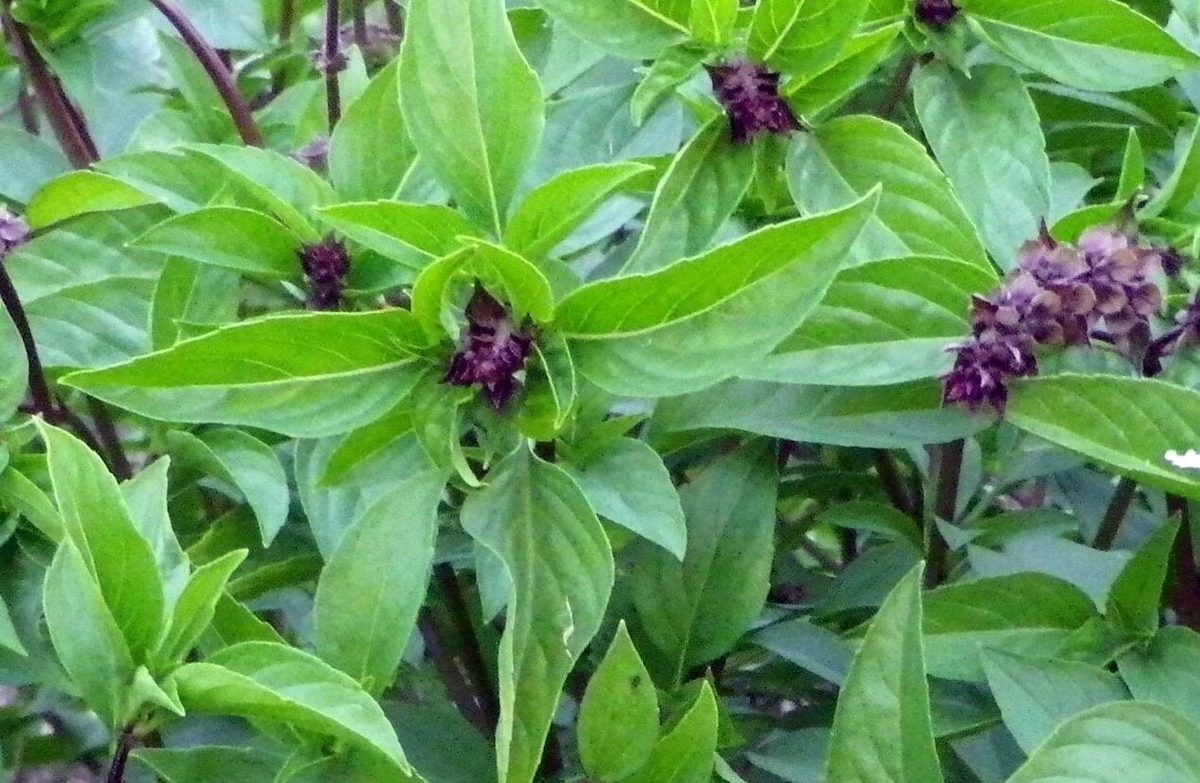
Cinnamon basil is a cultivar of sweet basil, Ocimum basilicum, not a separate species.1 It cooks like any basil, but its warm, spicy scent points it toward drinks, syrups and desserts as much as toward savory food. This page covers where it works, how to handle it, and how to keep it. For what it is and what is in it, see the cinnamon basil profile.
What you are working with
In a Purdue trial of North American commercial basil seed, the ‘Cinnamon’ cultivar’s essential oil was 47% linalool and 30% methyl cinnamate, against 77% linalool and 12% 1,8-cineole for ‘Genovese’ grown in the same trial.1 Methyl cinnamate is what sets it apart. PROSEA notes that basil is chemically variable and that some selections are rich in methyl cinnamate.2
The cinnamon in the name is a resemblance, not shared chemistry. The bark oil of true cinnamon is dominated by cinnamaldehyde, at 50 to 75% of Ceylon cinnamon bark oil according to PROSEA.3 So cinnamon basil adds a cinnamon-like note to a dish, but it will not taste like ground cinnamon and is not a stand-in for it in a recipe built on the spice. That last point is our cooking judgment.
The Herb Society of America describes the leaves as having a spicy aroma that leaves a warm feeling on the tongue.4
Where it works
| Use | Source |
|---|---|
| Teas and baked goods | The Herb Society calls the cultivar good in both4 |
| Desserts | The Herb Society suggests lemon and cinnamon basils as additions to desserts4 |
| Herb syrups | The Herb Society’s basil syrup steeps 8 to 10 sprigs of anise, cinnamon, green or lemon basil4 |
| Anywhere sweet basil goes | Same species;1 a warmer result is our judgment |
Teas and syrups. Steeping is the easiest way to use cinnamon basil, since it pulls the scent into liquid without cooking the leaves for long. The Herb Society’s basil syrup recipe calls for about 8 to 10 sprigs of basil, and lists cinnamon basil among the options.4 A syrup like that can sweeten iced tea, lemonade or a cocktail.
Baked goods and desserts. The Herb Society’s guide calls cinnamon basil good in baked goods and includes it in recipes such as a pound cake and muffins; one of its recipes calls for 2 tablespoons of finely chopped cinnamon basil.4 Fruit is the other natural partner. Cinnamon basil with peaches, plums, berries or melon is a cook’s pairing rather than a sourced one.
Drinks. Basil and mint are in the same plant family, the mint family (Lamiaceae),5 and cinnamon basil can be muddled in place of mint in a mojito-style drink. That is a kitchen suggestion, not a tested recipe.
Savory food. It can go where sweet basil goes: salads, tomato dishes, stir-fries. PROSEA lists pizzas, pasta, chicken and cheese dishes among sweet basil’s uses in Italian cooking.2 The warmer note suits roasted squash, pork and grilled fruit salsas, which again is judgment.
When to add it
LSU AgCenter groups basil with the delicate herbs that should be added a minute or two before the end of cooking, or sprinkled on just before serving.6 That guidance covers basil in general; no one has measured cinnamon basil separately. For syrups and teas, steeping in hot liquid off the heat is common practice.
Leaves and stems
America’s Test Kitchen tasted basil stems against leaves. Its tasters found the tender, thinner, younger stems clean and sweet, comparable to the leaves, while in the thicker stems, particularly the lower part of the central stem, bitter flavors began to dominate.7 In a side-by-side test of two batches of pesto, tasters were unable to tell them apart, and ATK’s advice is to use the tender stems but not to process thick stems in pesto.7 That test used ordinary basil; the same handling is a reasonable default for cinnamon basil.
Keeping it fresh
Basil is sensitive to cold. Rutgers Cooperative Extension gives 55°F as the optimal storage temperature for basil and lists blackened leaves, stem discoloration and loss of aroma as signs of chilling injury.8 Rutgers also notes that standing stems in water can reduce water loss.8 A UC Davis study found that cultivars differ in how much cold they tolerate: ‘Lemon’ and ‘Genovese’ were more sensitive than ‘Purple’, ‘Thai’ and ‘Holy’.9 ‘Cinnamon’ was not among those tested, so its tolerance is not known.
In a home kitchen that points to a jar of water on the counter for a few days, the way many cooks keep basil; see how to store basil for the comparison of methods.
Freezing. Oklahoma State Extension suggests blanching basil leaves for 15 seconds and plunging them into ice water before freezing, to stop enzyme reactions.10 Penn State Extension says frozen herbs can be used in the same proportion as fresh.11 Freezing chopped leaves in ice cube trays is also common practice. If you freeze basil in oil, Oregon State Extension says herb-and-oil mixtures must be refrigerated and used within 4 days or frozen for longer storage, because of the botulism risk.12 See can you freeze basil?.
Drying. America’s Test Kitchen lists basil among the herbs that are better fresh, since such delicate herbs are much weaker in flavor once dried.13 No study has looked at how much methyl cinnamate survives drying. See how to dry basil, dried herbs vs. fresh and how to rehydrate herbs.
Related pages
- Cinnamon basil vs. Thai basil
- Basil, Thai basil, lemon basil and holy basil
- Cinnamon
- The master list of herbs and spices
Footnotes
-
“Comparative evaluation of North American commercially available Ocimum basil cultivars”, Table 1, Perspectives on New Crops and New Uses (1999), Purdue NewCROP. hort.purdue.edu · Peer-reviewed ↩ ↩2 ↩3
-
N.O. Aguilar, Pham Truong Thi Tho and L.P.A. Oyen, Ocimum basilicum, Plant Resources of South-East Asia (PROSEA). uses.plantnet-project.org · Reference work ↩ ↩2
-
Cinnamomum verum, PROSEA Handbook No. 13: Spices. prosea.prota4u.org · Reference work ↩
-
Michele Meyers, Basil: An Herb Society of America Guide, The Herb Society of America, 2003. herbsociety.org · Reference work ↩ ↩2 ↩3 ↩4 ↩5 ↩6
-
“Basil”, Encyclopaedia Britannica, 2026. britannica.com · Reference work ↩
-
“Flavorful Herbs”, LSU AgCenter. lsuagcenter.com · Reference work ↩
-
“Using Basil Stems in Recipes”, America’s Test Kitchen. americastestkitchen.com · Publication ↩ ↩2
-
Fact Sheet FS1283, Rutgers Cooperative Extension, 2018. njaes.rutgers.edu · Reference work ↩ ↩2
-
Arlan James Dimailig Rodeo, “Basil Postharvest Chilling Sensitivity and the Impact of Storage Temperature and Atmosphere on Sensory Quality”, PhD dissertation, UC Davis, 2023. escholarship.org · Reference work ↩
-
“Freezing Herbs”, Oklahoma State University Extension, 2026. extension.okstate.edu · Reference work ↩
-
Martha Zepp, “Freezing Herbs”, Penn State Extension, 2025. extension.psu.edu · Reference work ↩
-
Carolyn Raab and Margy Woodburn, “Herbs and vegetables in oil” (SP 50-701), Oregon State University Extension Service. extension.oregonstate.edu · Reference work ↩
-
Danielle Lapierre, “When You Should Actually Use Dried Herbs (and Which Ones to Avoid)”, America’s Test Kitchen, 2022. americastestkitchen.com · Publication ↩