Blog · Storage
How to Store Basil: Why the Fridge Turns It Black, and What to Do Instead
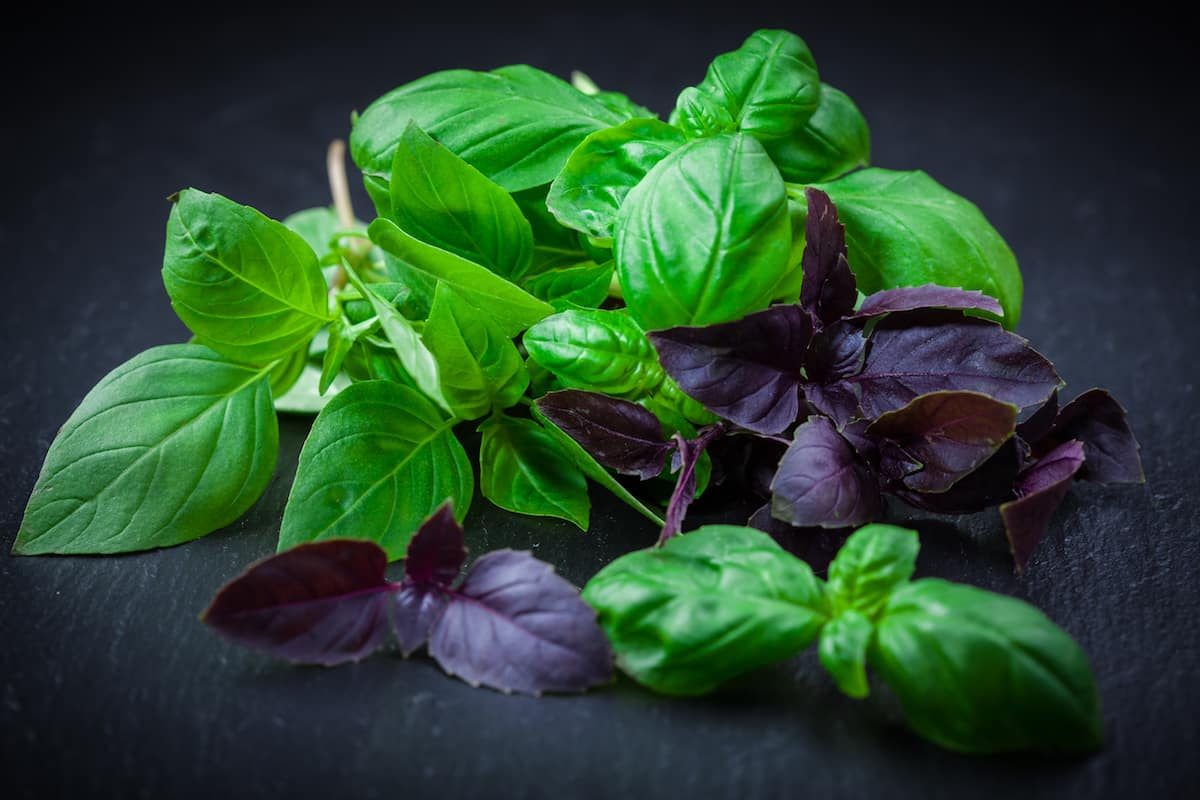
Basil is sensitive to chilling, and cold storage can blacken its leaves and dull its aroma.12 So the usual herb advice, wrap it and refrigerate it, is a compromise for basil. For a few days, keep it cool but not cold. For months, freeze it.
At a glance
| How long you need it | Best option | Notes |
|---|---|---|
| A few days | Stems in water, loosely covered, at cool room temperature3 | Sources disagree on the fridge; see below |
| Up to a year | Frozen, in water or oil cubes or blanched leaves45 | Frozen herbs go limp when thawed, so use them in cooked dishes5 |
| Pesto or basil in oil | Refrigerate and use within 4 days, or freeze6 | A botulism precaution, not a quality tip |
| Long term, for cooking only | Dried | Much weaker than fresh7 |
Why basil hates the cold
Rutgers Cooperative Extension, writing for growers, says basil is susceptible to chilling injury, with symptoms that include blackened leaves, discolored stems and loss of aroma.1 It puts the optimal storage temperature at 55°F and the ideal relative humidity at 90 to 95%, and reports that basil stored between 50 and 68°F was in markedly better shape after 10 days.1
How quickly the damage shows depends on both the temperature and the time spent there, according to UC Davis’s Postharvest Research and Extension Center.8 A 2023 UC Davis dissertation adds two details useful at home:
- Some basils are touchier than others. Lemon and Genovese basil were more sensitive to chilling than purple, Thai and holy basil.2
- Cold dulls flavor, not just looks. Storing Genovese basil at the chilling temperature of 5°C (41°F) reduced its volatile compounds enough to affect perceived aroma and flavor.2
These are growers’ and researchers’ figures for commercial handling. No source we found measured basil in a home refrigerator. UC Agriculture and Natural Resources describes a home refrigerator as typically 40°F (4°C),9 which is colder than Rutgers’ recommended range and a little colder than the 5°C in the dissertation.
Short term: counter or fridge?
The sources split:
| Source | Advice |
|---|---|
| The Kitchn (Emily Han)3 | Trim the stems, stand them in a glass of water like cut flowers, cover loosely with a plastic bag and leave on the counter. Says this can keep basil fresh and green for up to a week or two, and that refrigeration can turn the leaves black. |
| America’s Test Kitchen10 | Treats basil as a delicate herb: wrap in slightly damp paper towels, put in an open zipper-lock bag, and refrigerate. Delicate herbs should not touch liquid, which encourages rot. |
| Rutgers Cooperative Extension1 | For growers: 55°F is optimal; standing stems in water can reduce water loss. |
ATK’s method keeps delicate herbs moist,10 but it puts basil at fridge temperature, which the chilling research says is too cold.12 Method: for basil you’ll use within a few days, a jar of water on a cool counter out of direct sun is the option most consistent with the chilling research. If your kitchen is hot or you need it to last longer, the fridge is the trade-off: expect some darkening. That is our reading of the sources above, not a tested comparison.
Washing. If you wash basil before storing, dry it thoroughly; ATK recommends spinning herbs in a salad spinner lined with paper towels.10
Freezing basil
Freezing is the way to keep basil for months. Colorado State University Extension says quick-frozen herbs keep up to a year if well packaged, and that they are best in cooked dishes because they go limp when thawed.5 Oklahoma State University Extension adds: do not thaw herbs before adding them to cooked dishes.4
Water cubes. Fill an ice cube tray halfway with water, add about 1 tablespoon of chopped leaves to each section and freeze. The next day, top off with water so the herbs are fully covered, and freeze again.5
Oil cubes. Oklahoma State mixes 1/3 to 1/2 cup of oil with 2 cups of chopped herbs,4 roughly 1 part oil to 4 to 6 parts herbs by volume. It notes that herbs frozen in oil hold their color better than herbs frozen on their own.4 Keep these cubes frozen and add them straight to the pan. Oregon State University Extension says homemade fresh herbs in oil must be used within 4 days or frozen,6 so a cube that has thawed belongs in the fridge and should be used within 4 days.
Blanched leaves. Oklahoma State suggests blanching the leaves of larger herbs such as basil for 15 seconds to stop enzyme reactions, then plunging them into ice water.4 Pat them dry and freeze them flat in zipper-lock bags; laid flat, herbs freeze and thaw quickly, and you can break off what you need.4 A common claim says blanching is what keeps basil bright green. Oklahoma State gives stopping enzyme reactions as the reason, and its color note is about freezing in oil.4
Packaging. Strong-smelling herbs should be double-wrapped in foil or kept in freezer jars so their odor doesn’t spread.4
More detail: can you freeze basil.
Pesto and basil in oil: a safety rule
Fresh basil in oil, including pesto, is a low-acid food in an oxygen-free environment, the conditions in which Clostridium botulinum can grow.6 Oregon State’s rule for homemade pesto is to refrigerate it and use it within 4 days, or freeze it; pesto can be frozen in ice cube trays, then wrapped cube by cube.6 The same 4-day limit applies to dried herbs in oil.6
PROSEA records an Italian practice of keeping dried basil leaves in olive oil, which it says turn black but keep their flavor for several months.11 That describes a tradition, not a tested safe method. For a homemade mixture, follow the extension rule: refrigerate and use within 4 days, or freeze.6
Drying basil
Drying keeps basil for months but costs most of what makes it worth having. ATK puts basil among the herbs that are better fresh and much weaker once dried.7 If you dry it anyway, do it fast and cool:
- Mold risk. The National Center for Home Food Preservation (NCHFP) lists basil among the high-moisture herbs that will mold if not dried quickly.12
- Temperature. PROSEA says basil leaves should be dried at no more than 35°C (95°F).11 NCHFP’s dehydrator range is 95 to 115°F,12 and Penn State’s is 95 to 110°F.13
- Microwave. Penn State says basil dries well in some microwaves,13 and Colorado State says basil should be dried on the microwave’s low setting, checking every 15 seconds.5
- Air drying. In a 2004 laboratory study, basil air-dried at room temperature lost only small amounts of aroma compounds, while oven drying at 45°C and freeze-drying caused considerable losses.14 At home the catch is speed: slow air drying is when basil molds.12
- Done when the leaves crumble and the stems break when bent.12
Penn State says most dried herbs keep well for up to a year.13 For the full method, see how to dry basil.
Using stored basil
However it is stored, basil is a finishing herb. LSU AgCenter lists it among the delicate herbs that should go in a minute or two before the end of cooking.15 Frozen cubes can go straight into a sauce near the end.4
Not yet measured
- How long basil lasts in a home refrigerator compared with a jar on the counter, in a controlled test.
- How long frozen basil keeps its aroma, measured on basil rather than herbs in general.
- Whether blanching changes frozen basil’s color or flavor.
Related
- Basil
- Can you freeze basil?
- How to dry basil
- Dried basil vs fresh
- Cooking with basil
- Basil uses
- Basil vs Thai basil
- Genovese basil
- Too much basil
- How to store cilantro
- How to rehydrate herbs
Footnotes
-
Fact Sheet FS1283, Rutgers Cooperative Extension. njaes.rutgers.edu · Reference work ↩ ↩2 ↩3 ↩4 ↩5
-
Rodeo, Basil Postharvest Chilling Sensitivity, PhD dissertation, UC Davis, 2023 (abstract). escholarship.org · Reference work ↩ ↩2 ↩3 ↩4
-
The Best Way to Keep Basil Fresh, The Kitchn. thekitchn.com · Publication ↩ ↩2
-
Freezing Herbs, Oklahoma State University Extension. extension.okstate.edu · Reference work ↩ ↩2 ↩3 ↩4 ↩5 ↩6 ↩7 ↩8 ↩9
-
Herbs: Preserving and Using, Fact Sheet 9.335, Colorado State University Extension. ccfruitandnuts.ucanr.edu · Reference work ↩ ↩2 ↩3 ↩4 ↩5
-
Herbs and vegetables in oil, SP 50-701, Oregon State University Extension Service. extension.oregonstate.edu · Reference work ↩ ↩2 ↩3 ↩4 ↩5 ↩6
-
When You Should Actually Use Dried Herbs, America’s Test Kitchen. americastestkitchen.com · Publication ↩ ↩2
-
How long does it take to show chilling injury on basil?, UC Davis Postharvest Research and Extension Center. postharvest.ucdavis.edu · Reference work ↩
-
Garlic: Safe Methods to Store, Preserve, and Enjoy, ANR Publication 8568, UC Agriculture and Natural Resources. ccfruitandnuts.ucanr.edu · Reference work ↩
-
Our Guide to Fresh Herbs, America’s Test Kitchen. americastestkitchen.com · Publication ↩ ↩2 ↩3
-
Ocimum basilicum (PROSEA), Plant Resources of South-East Asia. uses.plantnet-project.org · Reference work ↩ ↩2
-
Herbs (Drying), National Center for Home Food Preservation. nchfp.uga.edu · Reference work ↩ ↩2 ↩3 ↩4
-
Let’s Preserve: Drying Herbs, Penn State Extension. extension.psu.edu · Reference work ↩ ↩2 ↩3
-
Díaz-Maroto et al., Journal of the Science of Food and Agriculture, 2004 (abstract). agris.fao.org · Peer-reviewed ↩
-
Flavorful Herbs, LSU AgCenter. lsuagcenter.com · Reference work ↩