Spices · Comparison
Cinnamon Basil vs. Thai Basil: Two Sweet Basils, Two Different Scents
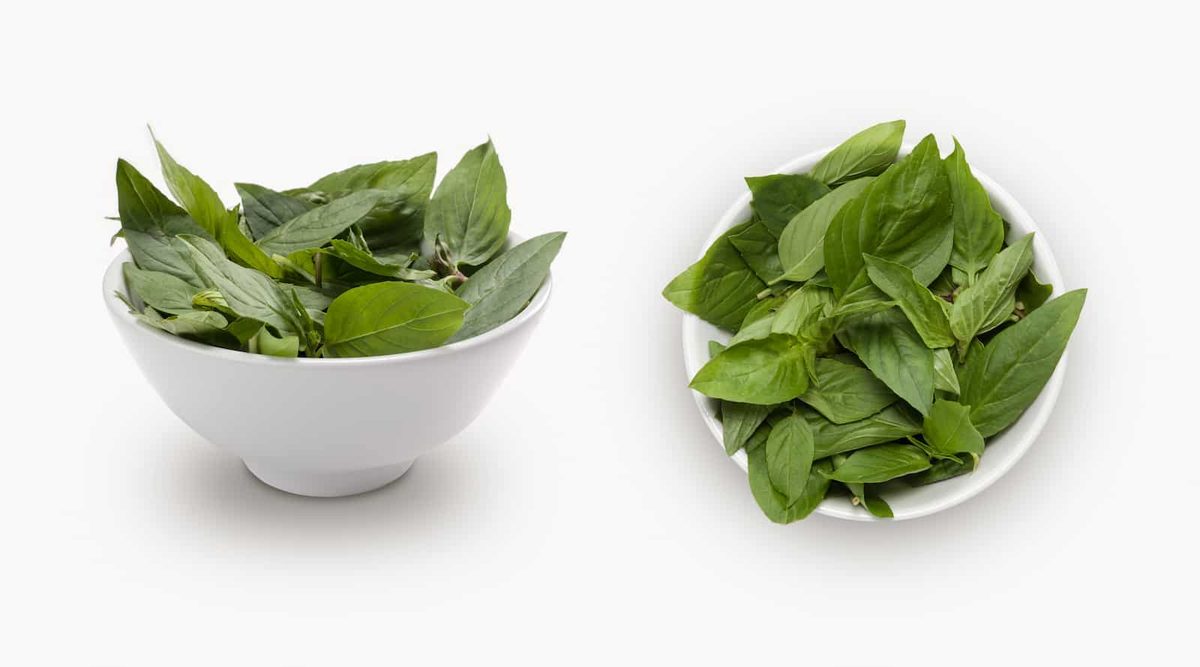
Cinnamon basil and Thai basil are not two species. Both are forms of sweet basil, Ocimum basilicum: a US cultivar trial lists ‘Cinnamon’ under that species, and Kew treats the old Thai basil name Ocimum thyrsiflorum as a synonym of ordinary sweet basil.12 What separates them is the smell. In the one analysis of the ‘Cinnamon’ cultivar we found, methyl cinnamate made up 30% of the oil;1 in a Thai study, Thai basil’s oil was led by estragole, and the authors linked it to anise, lime-like and fresh aromas.3 Thai basil, horapha in Thai, is a staple of Thai cooking,4 while cinnamon basil is mostly a garden basil that suits teas, baked goods and desserts.5
Side by side
| Cinnamon basil | Thai basil | |
|---|---|---|
| Botanical name | Ocimum basilicum, cultivar ‘Cinnamon’1 | Ocimum basilicum; often labeled var. thyrsiflora, a name Kew does not keep separate62 |
| Family | Lamiaceae (mint family)6 | Lamiaceae (mint family)6 |
| Native range of the species | Tropical and subtropical Asia to northern Australia7 | Tropical and subtropical Asia to northern Australia7 |
| Thai name | No source found | Horapha4 |
| Look | Green leaves, purple stems, pink flowers on purple spikes, in one US trial1 | Often purple-stemmed8 |
| Leading oil compounds | Linalool 47%, methyl cinnamate 30% (one US trial, share of oil)1 | Estragole 452.80 µg/mL, geranial 180.57 µg/mL, neral 151.16 µg/mL (one Thai study, concentration)3 |
| Aroma, as the sources describe it | Spicy, leaving a warm feeling on the tongue5 | Anise, lime-like and fresh3 |
| Flavor (editorial) | Sweet basil with the anise turned down and a warm, cinnamon-like edge | Strong anise and licorice with a peppery bite |
| Typical uses | Teas, baked goods and desserts5 | Stirred into Thai curries right before serving;9 raw on the pho herb plate10 |
| Estragole | Not among the major compounds reported in the one trial1 | The leading compound in the Thai study3 |
| Forms (editorial) | Mostly grown from seed or bought as plants | Fresh bunches at Asian groceries |
The two chemistry rows come from different studies, of different plants, reported in different units: the Purdue trial gives each compound as a share of the oil, the Thai study as a concentration in µg/mL. They show which compounds lead in each basil, not how much stronger one is. For the individual herbs, see cinnamon basil and Thai basil.
Where the cinnamon comes from
The Herb Society of America names trans-methyl cinnamate as the compound behind basil’s cinnamon scent.5 PROSEA notes that some selections of sweet basil are rich in methyl cinnamate,4 and the Purdue paper records commercial production of methyl cinnamate-rich basil in Bulgaria.1 In the Purdue trial, ‘Cinnamon’ still had linalool as its largest single compound, at 47%; the Genovese basil in the same trial was 77% linalool.1 So cinnamon basil reads as a sweet basil with an extra spicy layer, not as cinnamon.
The resemblance to cinnamon is only that. True cinnamon bark oil is dominated by a different compound, cinnamaldehyde, at 50 to 75% of Ceylon cinnamon bark oil according to PROSEA.11
Where Thai basil’s anise comes from
In the 2018 Chiang Mai study of five basils used as food in Thailand, Thai basil oil was led by estragole (methyl chavicol), followed by geranial and neral, and the authors linked it to anise, lime-like and fresh aromas.3 A widely repeated description also gives Thai basil a strong camphor note. Camphor is not among the main compounds in that study.
Which “Thai basil”?
Three different basils are sold under Thai names, and cinnamon basil is sometimes said to be one of them.
- Horapha is Thai basil, the anise-scented form of sweet basil described on this page.4
- Kaphrao is holy basil, a different species, Ocimum tenuiflorum.12 Andy Ricker describes it as “holy or hot basil,” with a peppery flavor, and warns that “holy basil” labels are sometimes put on purple-stemmed Thai or sweet basil.8 See Thai basil vs. holy basil.
- Maenglak is the Thai name PROSEA gives for Ocimum americanum, hoary basil, which is often sold as lemon basil.13 See lemon basil.
A circulating claim says cinnamon basil is itself called Thai basil, or bai maengluk, in Thailand. We found no source for either, and PROSEA attaches maenglak to a different species.13 Nor did we find a source placing cinnamon basil in Thai cooking.
In the kitchen
Thai basil goes in at the end. Sherri Pengjad of Thai Foodie says it is stirred into green curry right before serving for its licorice-like aroma, and that it is sturdier than Italian basil and holds up much better in hot dishes.9 That is a cook’s assessment; we found no test of it. In Vietnamese cooking it goes raw onto the herb plate for pho: Andrea Nguyen adds Thai basil to hers in the warmer months when it is at its peak.10 PROSEA calls sweet basil an important ingredient of Thai cuisine.4
Cinnamon basil suits sweet uses. The Herb Society of America calls the ‘Cinnamon’ cultivar good in teas and baked goods and suggests cinnamon basil in desserts; its basil syrup steeps 8 to 10 sprigs of anise, cinnamon, green or lemon basil.5 Fruit salads, stone fruit and tomato dishes are other natural homes, in our judgment.
Heat. LSU AgCenter groups basil with the delicate herbs best added in the last minute or two of cooking.14 No source we found tests either cinnamon basil or Thai basil under long cooking, so the safe course for both is to add them late. See cooking with cinnamon basil.
Safety
Estragole, the compound that leads Thai basil’s oil in the Thai study,3 is a compound food regulators have assessed. The European Commission’s Scientific Committee on Food concluded in 2001 that estragole is genotoxic and carcinogenic in animal studies, and that it could not establish a safe exposure limit.15 Estragole was not among the major compounds the Purdue trial reported for ‘Cinnamon’,1 but that is a single analysis of one seed source. Our basil profile covers the estragole evidence in more detail.
Can one stand in for the other?
They are the same species, so either works as a basil. What changes is the top note. No source gives a ratio for this pair, so both directions are Method: a direction and starting point, not a tested number.
| Swap | Treatment | Starting amount | What to expect |
|---|---|---|---|
| Cinnamon basil in place of Thai basil | Method | Same amount | A warm, spicy basil without Thai basil’s anise. For the related swap of Italian basil for Thai basil, Pailin Chongchitnant’s pad kra pao recipe uses holy, regular or Thai basil in the same 1 1/4 cups (Attributed).16 Pengjad also calls Italian basil the best substitute.9 Neither names cinnamon basil. |
| Thai basil in place of cinnamon basil | Method | Same amount | An anise-led result instead of a cinnamon-like one. In teas and desserts this changes the character of the dish, in our judgment. Sweet basil with a small pinch of ground cinnamon is closer (Method, untested). |
For more options, see Thai basil substitutes, which ranks Italian basil, holy basil, mint and anise-scented herbs by the job Thai basil is doing.
What isn’t known
- Only one composition analysis of the ‘Cinnamon’ cultivar was found (Purdue, 1999), and only one of Thai basil (Tangpao et al., 2018). Basil oils vary by seed source and growing conditions.
- No study analyzes the two basils side by side.
- No source tests how either basil holds up to long cooking.
- No source documents where or when either type was selected, or any use of cinnamon basil in Thai cooking.
- It is sometimes said that the two are nutritionally similar. No nutrient analysis of either cultivar was found.
Related
- Cinnamon basil and cooking with cinnamon basil
- Thai basil, Thai basil substitutes and Thai basil vs. holy basil
- Basil, basil vs. Thai basil, Genovese basil vs. Thai basil and lemon basil vs. basil
- Holy basil, too much basil and how to store basil
Footnotes
-
“Comparative evaluation of North American commercially available Ocimum basil cultivars”, Table 1, Perspectives on New Crops and New Uses (1999), Purdue NewCROP. hort.purdue.edu · Peer-reviewed ↩ ↩2 ↩3 ↩4 ↩5 ↩6 ↩7 ↩8 ↩9
-
Ocimum thyrsiflorum L. (synonym of O. basilicum var. basilicum), Plants of the World Online, Royal Botanic Gardens, Kew. powo.science.kew.org · Reference work ↩ ↩2
-
Tangpao, Chung and Sommano, “Aromatic Profiles of Essential Oils from Five Commonly Used Thai Basils”, Foods, 2018. mdpi.com · Peer-reviewed ↩ ↩2 ↩3 ↩4 ↩5 ↩6
-
N.O. Aguilar, Pham Truong Thi Tho and L.P.A. Oyen, Ocimum basilicum, Plant Resources of South-East Asia (PROSEA). uses.plantnet-project.org · Reference work ↩ ↩2 ↩3 ↩4 ↩5
-
Michele Meyers, Basil: An Herb Society of America Guide, The Herb Society of America, 2003. herbsociety.org · Reference work ↩ ↩2 ↩3 ↩4 ↩5
-
“Basil”, Encyclopaedia Britannica, 2026. britannica.com · Reference work ↩ ↩2 ↩3
-
Ocimum basilicum L., Plants of the World Online, Royal Botanic Gardens, Kew. powo.science.kew.org · Reference work ↩ ↩2
-
Andy Ricker with J.J. Goode, “Stir-fried chicken with hot basil”, from Pok Pok, via The Splendid Table. splendidtable.org · Publication ↩ ↩2
-
Sherri Pengjad, “Thai Basil: What It Is and How to Use It”, Thai Foodie, 2026. thai-foodie.com · Publication ↩ ↩2 ↩3
-
Andrea Nguyen, “Pho Garnish Plate”, from The Pho Cookbook, via The Splendid Table, 2017. splendidtable.org · Publication ↩ ↩2
-
Cinnamomum verum, PROSEA Handbook No. 13: Spices. prosea.prota4u.org · Reference work ↩
-
Ocimum tenuiflorum L., Plants of the World Online, Royal Botanic Gardens, Kew. powo.science.kew.org · Reference work ↩
-
A.T. Sunarto, Ocimum americanum, Plant Resources of South-East Asia (PROSEA). uses.plantnet-project.org · Reference work ↩ ↩2
-
“Flavorful Herbs”, LSU AgCenter. lsuagcenter.com · Reference work ↩
-
Opinion of the Scientific Committee on Food on Estragole, European Commission, 2001. food.ec.europa.eu · Regulator ↩
-
Pailin Chongchitnant, pad kra pao beef recipe, Hot Thai Kitchen. hot-thai-kitchen.com · Publication ↩