Blog · Storage
How to Dry Basil: Methods, Temperatures and What Drying Does to the Flavor
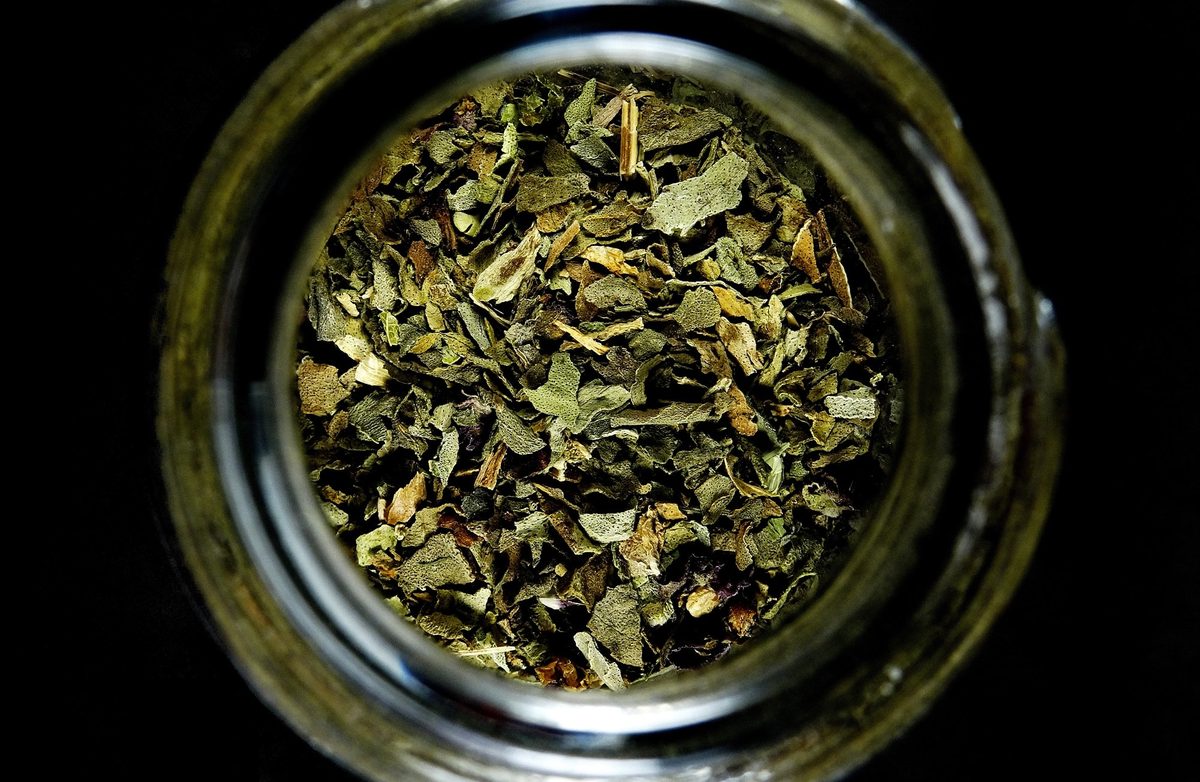
Basil can be dried, but it gives up more in the process than most herbs. America’s Test Kitchen puts basil on its list of herbs that are better fresh and much weaker in flavor once dried,1 and the Herb Society of America’s basil guide says there is no comparison between the two.2 Drying is still a sensible way to keep a garden surplus for soups, sauces and stews. The method matters: in the one study we found that compared heated and unheated drying of basil, leaves dried at room temperature kept the most aroma.3 If you want basil that tastes closer to fresh, freezing is the other route; see can you freeze basil?
At a glance
| Step | What the guidance says |
|---|---|
| When to pick | Just before the flowers open.4 Illinois Extension says to pinch off flower buds as soon as they form, because leaving them affects the flavor of the leaves.5 |
| Prep | Rinse in cool water, shake off the excess, and discard bruised or damaged leaves.4 |
| Easiest method | Small bunches hung inside paper bags punched with holes.4 |
| Dehydrator | 95 to 115°F (35 to 46°C), up to 125°F in humid areas, 1 to 4 hours, per the National Center for Home Food Preservation (NCHFP).4 Penn State says 95 to 110°F.6 |
| Oven | Penn State calls it generally not recommended; if used, no hotter than 180°F (82°C), door open, 3 to 4 hours.6 |
| Microwave | Small amounts only. Sources disagree on time (see below). |
| Sun | Not recommended.47 |
| Done when | Leaves are crispy and crumble easily between your fingers.6 |
| Storage | Airtight, in a cool, dry, dark place, leaves left whole.6 |
What drying does to basil
Two lab studies show how much the method matters. They measured different things, so their numbers can’t be lined up against each other.
- Heat costs aroma. Díaz-Maroto and colleagues dried basil three ways: in an oven at 45°C (113°F), in air at room temperature, and by freeze-drying. Aroma compounds fell considerably with the oven and with freeze-drying, while air drying caused only small losses. Their panel described the dried samples as mentholated, spicy, hay-like and earthy, a long way from the fresh leaf.3
- Fast drying under vacuum kept more. Yousif and colleagues compared air drying with vacuum-microwave drying, a commercial process rather than a kitchen microwave. The vacuum-microwave basil had about 2.5 times the linalool and 1.5 times the methyl chavicol of the air-dried samples, and the air-dried leaves were darker and less green.8
PROSEA, a reference work on Southeast Asian plants, advises drying basil leaves at no more than 35°C (95°F).9 Taken together, the published guidance points to low heat, which matches the bottom of the dehydrator range below and argues against the hot-oven methods that circulate online.
A common claim says a kitchen microwave keeps basil bright green. The only evidence we found on color is the vacuum-microwave study above, and that is not the same process. We found no test of an ordinary microwave on basil.
Method 1: Hang it in paper bags
This is the NCHFP’s method for tender-leaf herbs, and it names basil among them.4
- Tie a small bunch of stems together. Keep it small: the NCHFP warns that large amounts will mold.4
- Tear or punch holes in the sides of a paper bag, put the bunch inside, and close the top around the stems with a rubber band.4
- Hang it where air moves freely.4 Penn State adds that humidity must be low, and that herbs should hang away from the sink, stove or dishwasher.6 Illinois Extension says to keep them out of the sun.10
- Wait. Illinois Extension says air drying can take up to a month.10 We found no basil-specific drying time.
The bag keeps dust off, which is Penn State’s reason for it.6
Method 2: A food dehydrator
Spread the leaves in a single layer on the trays.4 Published temperatures for leafy herbs:
| Source | Temperature | Time |
|---|---|---|
| NCHFP4 | 95 to 115°F (35 to 46°C); up to 125°F (52°C) in humid areas | 1 to 4 hours; check periodically |
| Penn State Extension6 | 95 to 110°F (35 to 43°C) | not given |
| PROSEA, basil specifically9 | no more than 35°C (95°F) | not given |
| Illinois Extension10 | follow the owner’s manual | not given |
These agree more than they differ. All of them are at or below about 115°F unless the air is humid. Herbs are done when they crumble and the stems break when bent.4 Illinois Extension says home dehydrators do an excellent job of drying herbs,10 though no source we found compares a dehydrator with air drying for basil’s flavor.
Method 3: The oven
Penn State says oven drying is generally not recommended. If you use it, set the lowest temperature, no higher than 180°F (82°C), and dry for 3 to 4 hours with the door open.6 Illinois Extension calls 90 to 110°F the ideal oven temperature, again for 3 to 4 hours, if your oven can hold it.10 The NCHFP describes a gentler version for single leaves laid on paper towels: the oven light of an electric range or the pilot light of a gas range gives enough heat to dry them overnight.4 Its examples are mint, sage and bay leaf, not basil.
A widely repeated method heats basil at 250°F for 20 to 30 minutes and then leaves it in the cooling oven. None of the sources above supports that temperature, and in the lab study an oven at just 45°C (113°F) already cost basil a considerable share of its aroma.3
Method 4: The microwave
The NCHFP calls the microwave a fast way to dry herbs when only small amounts are involved, and refers you to your oven’s instructions.4 The sources that give times disagree:
| Source | Method |
|---|---|
| Penn State Extension6 | Single layer between microwave-safe paper towels; high for 2 to 3 minutes per cup; start with 1 minute and mix every 30 seconds |
| Illinois Extension10 | Between two paper towels on high for 1 to 3 minutes; check every 30 seconds and turn the herbs |
| America’s Test Kitchen1 | 30 to 40 seconds |
Microwaves vary, so start with the shortest time and check often. Penn State gives two warnings: a microwave rated 1,000 watts or more may heat too fast for this, and with too little herb in the oven the paper towels can catch fire.6 ATK suggests storing microwave-dried herbs airtight for up to 3 months.1
Why not the sun
Both the NCHFP and Penn State advise against sun drying; the NCHFP says herbs lose flavor and color that way.47
Storing dried basil
Pack the leaves whole in airtight containers and keep them in a cool, dry, dark place, away from the stove and sink.6 Whole leaves are preferred because they hold their oils and flavor longer; crumble them as you use them.64 How long they last depends on whom you ask:
| Source | Scope | Keeps |
|---|---|---|
| Penn State Extension6 | Most home-dried herbs | up to a year |
| Illinois Extension10 | Most home-dried herbs, properly stored | flavor for about a year |
| America’s Test Kitchen1 | Herbs dried in the microwave | up to 3 months |
None of these was measured on basil. By common practice, smell is the test: crumble a leaf, and if the aroma has faded, so has the flavor. More: how to store basil.
Dried basil in oil
PROSEA records an Italian practice of keeping dried basil leaves in olive oil, where they turn black but keep their flavor for several months.9 U.S. food-safety guidance is stricter. Oregon State University Extension says low-acid herbs can carry Clostridium botulinum, the bacterium behind botulism, and that oil seasoned with dried herbs must be refrigerated and used within 4 days, or frozen for longer storage.11 Follow the extension rule.
Cooking with home-dried basil
Use home-dried basil in dishes that cook. ATK warns that dried herbs used as a finishing touch can add an unpleasant, dry texture.1 For how much to use in place of fresh, and why the usual 3-to-1 herb rule overstates dried basil’s strength, see dried basil vs. fresh. For dried leaves that need softening first, see how to rehydrate herbs.
Not yet measured
- How long basil takes to air-dry in a home, as opposed to herbs in general.
- How a kitchen microwave or a home dehydrator compares with air drying for basil’s aroma or color.
- Shelf life of home-dried basil, measured on basil.
Related
- Basil
- Dried basil vs. fresh
- How to store basil
- Can you freeze basil?
- Basil uses
- Dried herbs vs. fresh
- How to dry oregano
- How to dry mint
Footnotes
-
Danielle Lapierre, When You Should Actually Use Dried Herbs, America’s Test Kitchen, 2022. americastestkitchen.com · Publication ↩ ↩2 ↩3 ↩4 ↩5
-
Basil: An Herb Society of America Guide, 2003. herbsociety.org · Reference work ↩
-
Díaz-Maroto et al., Journal of the Science of Food and Agriculture, 2004 (abstract, via FAO AGRIS). agris.fao.org · Peer-reviewed ↩ ↩2 ↩3
-
Drying Herbs, National Center for Home Food Preservation. nchfp.uga.edu · Reference work ↩ ↩2 ↩3 ↩4 ↩5 ↩6 ↩7 ↩8 ↩9 ↩10 ↩11 ↩12 ↩13 ↩14 ↩15 ↩16
-
Herb Gardening: Basil, University of Illinois Extension. extension.illinois.edu · Reference work ↩
-
Zepp, Hirneisen and LaBorde, Let’s Preserve: Drying Herbs, Penn State Extension, 2023. extension.psu.edu · Reference work ↩ ↩2 ↩3 ↩4 ↩5 ↩6 ↩7 ↩8 ↩9 ↩10 ↩11 ↩12 ↩13
-
Stacy Reed, Preserving Herbs by Drying, Penn State Extension, 2024. extension.psu.edu · Reference work ↩ ↩2
-
Yousif et al., Journal of Agricultural and Food Chemistry, 1999 (abstract, via FAO AGRIS). agris.fao.org · Peer-reviewed ↩
-
Ocimum basilicum, PROSEA (Plant Resources of South-East Asia). uses.plantnet-project.org · Reference work ↩ ↩2 ↩3
-
Herb Gardening: Preserving, University of Illinois Extension. extension.illinois.edu · Reference work ↩ ↩2 ↩3 ↩4 ↩5 ↩6 ↩7
-
Raab and Woodburn, Herbs and vegetables in oil, Oregon State University Extension Service, 2025. extension.oregonstate.edu · Reference work ↩