Cooking · Cooking with
Cooking With Curry Leaves: Tempering, Dishes, Amounts and Storage
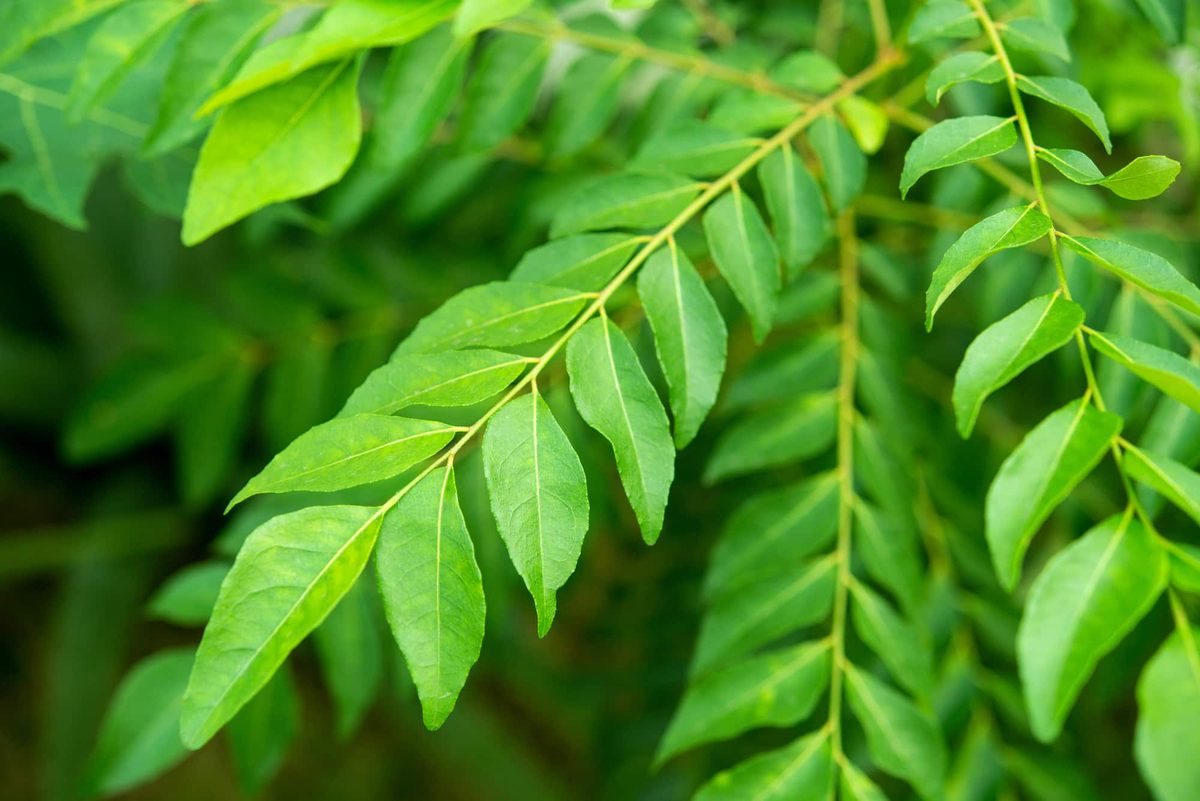
Curry leaves come from the curry tree, a shrub of the citrus family (Rutaceae) whose aromatic leaves are used extensively in Indian cooking.12 Almost everything about cooking with them follows from one fact: their flavor compounds are mostly oil-soluble, so they are usually fried in fat first.3 Get the fat, the timing and the amount right and the rest is choosing a dish.
At a glance
| Question | Short answer |
|---|---|
| Fresh or dried? | Fresh. Dried leaves lose their fragrance soon after drying.2 |
| Basic technique | Fry lightly in oil or butter, at the start of a dish or as a tempering poured on at the end.23 |
| How many? | ATK needed 8 to 10 leaves where some recipes call for 3 or 4.3 Saveur’s rasam uses 15.4 |
| Eat or remove? | They are tender enough to eat.23 |
| Classic partners | Mustard seeds, cumin, fenugreek, dried chiles;45 asafoetida in the same pot.5 |
| Storage | Fridge for a short time; freezing is better, up to a month per ATK.23 |
Why fat comes first
America’s Test Kitchen explains that heating curry leaves in fat helps draw out their flavor compounds, which are mostly oil-soluble, and that the leaves are typically fried lightly in oil or butter before other ingredients go in.3 Gernot Katzer’s Spice Pages says the leaves develop their flavor best after a short heating.2 Nik Sharma describes frying them in hot oil until they turn crisp and translucent, and notes that their aromas intensify during frying.6
Fried this way, Katzer writes, the leaves keep their dark green color and fragrance and pick up a pleasant crispy texture.2
Two ways to temper
Indian cooks use curry leaves at either end of a recipe.
At the start. The leaves are fried in butter or oil as part of the spice mix that opens a preparation.2 ATK describes the same order: leaves into the fat before the other ingredients.3
At the end. In South India they often go into a tempering that flavors a dish after it has cooked, just before serving.2 Katzer calls this a tarka-like preparation. Two published recipes show how it runs:
| Recipe | Fat | What goes in, in order | When it meets the dish |
|---|---|---|---|
| Smita Chandra’s rasam (Saveur)4 | Oil | Mustard, cumin and fenugreek seeds, curry leaves and chiles de árbol, cooked until the seeds pop | Stirred into the finished soup |
| Bincy Lenin’s simple sambar (Onmanorama)5 | Coconut oil | Mustard and fenugreek seeds spluttered first, then dried chiles, curry leaves and a little sambar powder | Added after the sambar comes off the stove |
The sambar recipe puts the seeds in first and the leaves after them.5 The rasam puts everything in together and judges doneness by the seeds popping.4 Either way, both recipes take their cue from the seeds, not the leaves.
Whatever the order, the leaves stay in. The tempering, oil and all, goes into the dish. Katzer notes that curry leaves are never removed before serving and can be eaten without any hazard,2 and ATK says they are tender enough to eat, though they can be taken out if you prefer.3
What goes with curry leaves
The partners that turn up in named recipes are the seeds fried alongside them: black mustard, cumin and fenugreek, with dried chiles.45 In the Onmanorama sambar, asafoetida cooks with the dal in the pressure cooker while the curry leaves go into the final tempering, so the two share a dish without sharing the pan.5 Coconut oil is the fat in that recipe.5 For the seeds, see black mustard seeds and cooking with fenugreek.
Dishes that use curry leaves
| Dish or use | Where | Source |
|---|---|---|
| Thin lentil and vegetable curries | South India | Katzer2 |
| Dry curries of vegetables sautéed with spices | South India | Katzer2 |
| Rice dishes such as bisi bele bath | South India | Katzer2 |
| Rasam, a peppery tamarind soup | South India | Saveur4 |
| Sambar, served with rice, idli or dosa | South India (recipe from a Kerala publication) | Onmanorama5 |
| Masoor dal (red lentils) | ATK test | ATK3 |
| Samosa stuffings | North India | Katzer;2 ATK tested a potato samosa filling3 |
| Chicken and beef curries, kottu roti, buriyani with crisp fried leaves | Sri Lanka | Katzer2 |
| Dal, cooked grains, seafood, meat | General | Sharma6 |
Katzer notes that because South Indian cooking is mainly vegetarian, curry leaves there appear mostly in vegetable and lentil dishes, while Sri Lankan cooks also use them in meat curries.2 He also says that outside the Indian sphere of influence they are rarely found.2 That is a statement about tradition, not a rule. Sharma’s list of grains, seafood and meat is broad enough to start from if you want to try them elsewhere.6
How many leaves
Amounts in recipes vary widely, and nobody has published a standard.
| Source | Amount | Context |
|---|---|---|
| America’s Test Kitchen3 | 8 to 10 leaves | What its testers needed, against the 3 or 4 some recipes call for |
| Saveur (Smita Chandra)4 | 15 fresh or frozen leaves | One pot of rasam |
| Onmanorama (Bincy Lenin)5 | “As needed” | Sambar for a ½ cup of dal |
If a recipe gives no number, start with ATK’s 8 to 10 leaves for one pot of dal and adjust next time. That is our starting point drawn from ATK’s figure, not a measured standard.
Fresh vs dried
Use fresh leaves whenever you can. Katzer says dried curry leaves lose their delicate fragrance soon after drying,2 and Sharma says dried leaves are less intense than fresh.6 If dried leaves are all you have, Sharma finds doubling the quantity safer.6 That is his rule of thumb, not a measured ratio. No source we found tested how dried leaves behave in hot oil, so we cannot say whether they belong in a tempering at the same moment as fresh ones.
Storing fresh leaves
- Keep them on the stem. Katzer advises against tearing the leaves from their stems before use.2
- Fridge, briefly. Curry leaves keep in the refrigerator for some time, but Katzer says they keep better frozen.2 We found no source giving a number of days.
- Freezer. ATK says to freeze fresh leaves in a zipper-lock bag for up to a month to preserve their flavor.3 Saveur’s rasam calls for fresh or frozen leaves interchangeably.4
- Dried leaves. General spice guidance applies: a tightly covered container, away from air, light, moisture and heat, which speed flavor and color loss.7
Common confusion
Curry leaves are unrelated to curry powder, rarely appear in it, and cannot stand in for it.3 See curry leaves vs. bay leaves for the other common mix-up, and curry leaf substitutes if you have none.
Not yet measured
- How many days fresh curry leaves keep in a home refrigerator.
- How frozen leaves compare with fresh in strength, and how long they keep beyond ATK’s month.
- How dried leaves behave in a tempering compared with fresh.
Related
- Curry leaves
- Curry leaves uses
- Curry leaf substitutes
- Curry leaves vs. bay leaves
- Asafoetida
- Black mustard seeds
Footnotes
-
Frannie Comstock, “Curry tree”, Encyclopaedia Britannica. britannica.com · Reference work ↩
-
Curry Leaves, Gernot Katzer’s Spice Pages. gernot-katzers-spice-pages.com · Reference work ↩ ↩2 ↩3 ↩4 ↩5 ↩6 ↩7 ↩8 ↩9 ↩10 ↩11 ↩12 ↩13 ↩14 ↩15 ↩16 ↩17 ↩18 ↩19 ↩20
-
Fresh Curry Leaves, America’s Test Kitchen. americastestkitchen.com · Publication ↩ ↩2 ↩3 ↩4 ↩5 ↩6 ↩7 ↩8 ↩9 ↩10 ↩11 ↩12 ↩13
-
“Smita Chandra’s Rasam (Spicy Tamarind Soup)”, Saveur, 2015. saveur.com · Publication ↩ ↩2 ↩3 ↩4 ↩5 ↩6 ↩7 ↩8
-
Bincy Lenin, “Simple sambar”, Onmanorama, 2021. onmanorama.com · Publication ↩ ↩2 ↩3 ↩4 ↩5 ↩6 ↩7 ↩8 ↩9
-
Nik Sharma, “A Guide to Curry Leaves”, Nik Sharma Cooks, 2022. niksharmacooks.com · Publication ↩ ↩2 ↩3 ↩4 ↩5
-
Add a Little Spice to Your Life! Part II, University of California Cooperative Extension, 2002. ucanr.edu · Reference work ↩