Spice Comparisons · Comparison
Curry Leaves vs. Bay Leaves: Unrelated Plants, Opposite Handling
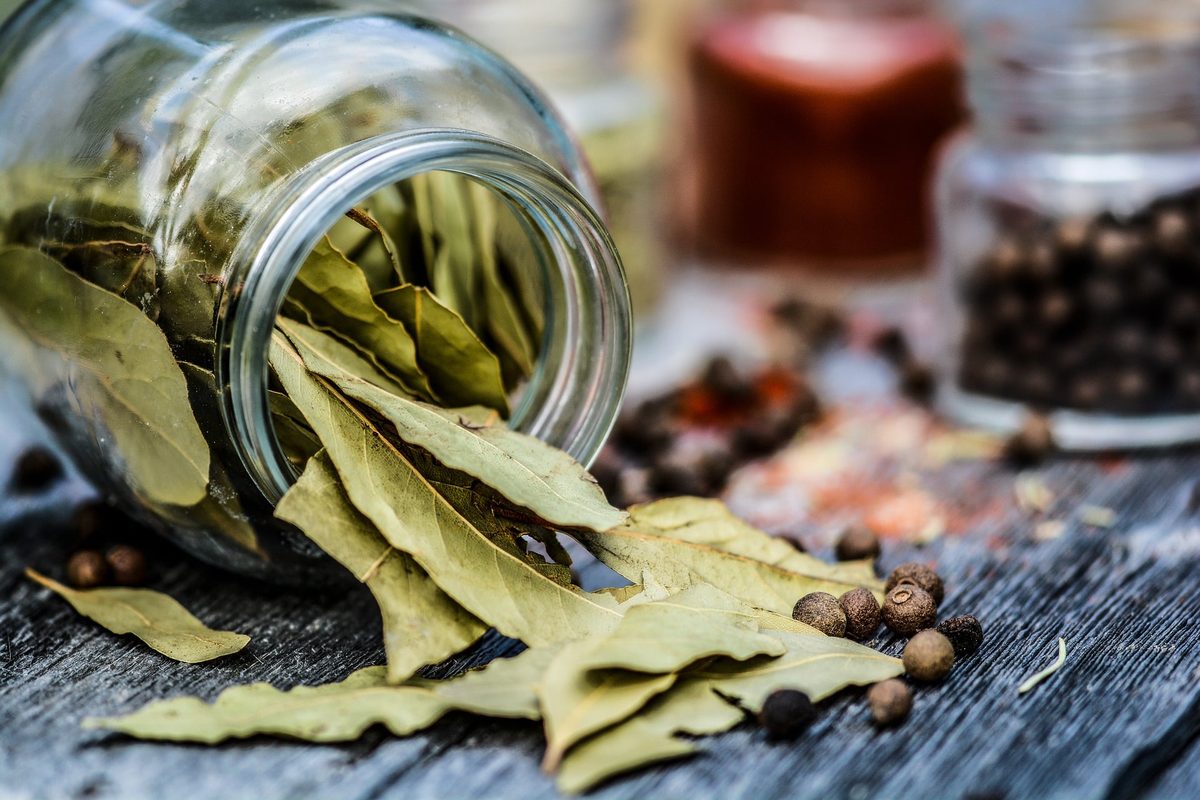
Curry leaves and bay leaves are both aromatic leaves that go into a pot, and that is most of what they share. Curry leaves come from a shrub in the citrus family, Rutaceae;12 bay leaves come from the bay laurel, Laurus nobilis, in the laurel family, Lauraceae, the same family as cinnamon.34 In the kitchen they are handled in nearly opposite ways. Curry leaves are best fresh, are fried in fat at the start of cooking and are eaten with the dish.2 Bay leaves are usually dried, simmered for a long time and taken out before serving.56
Side by side
| Curry leaves | Bay leaves | |
|---|---|---|
| Species | Bergera koenigii, still widely sold under its synonym Murraya koenigii7 | Laurus nobilis3 |
| Family | Rutaceae, the citrus family12 | Lauraceae, the laurel family, shared with cinnamon34 |
| Native range | Indian subcontinent to southern China, peninsular Malaysia and southern Hainan7 | The Mediterranean3 |
| The plant | A medium-size shrub;1 Kew places it in the wet tropical biome7 | A tree of the subtropical biome3 |
| The leaf | Compound: up to 20 leaflets arranged in pairs along a central rib; the leaflets are what cooks use2 | A single tough leaf;5 whole leaves are rigid, with sharp points and margins8 |
| Best form | Fresh. Katzer: dried leaves lose their delicate fragrance soon after drying2 | Dried. Katzer: fresh leaves are strongly aromatic but quite bitter, and proper drying reduces the bitterness5 |
| Leading oil compound (one sample each) | 3-carene, 54.2% of the oil (leaves from Bangladesh)9 | 1,8-cineole, 31.9% (leaves from Italy); 44.97 to 58.59% in studies from Turkey, Tunisia, Cyprus and Morocco10 |
| Aroma (sourced) | Fresh, remotely reminiscent of tangerines (Katzer);2 citrusy, grassy and burnt-sulfur-like (Nik Sharma);11 faintly lemony and complex (America’s Test Kitchen)12 | Herbal, bitter and slightly piney (Atlas Obscura);13 a very subtle flavor (J. Kenji López-Alt)6 |
| How it’s cooked | Fried in butter or oil as part of the spice mix that starts a dish2 | Simmered; it can cook a long time without much loss of aroma5 |
| At the table | Never removed; soft enough to eat2 | Removed: tough, and whole leaves have lodged in the throat and gut (case reports)6148 |
| Where it’s used most | Extensively in southern India and Sri Lanka2 | Soups, stews, sauces and pickles;5 part of the classic bouquet garni15 |
| Storage | Refrigerate for a while, freeze for longer, on the stem (Katzer);2 freeze up to a month (America’s Test Kitchen)12 | No more than a year after picking (Katzer);5 indefinitely in the freezer (López-Alt)6 |
The two oil figures come from different studies on different samples, so they show which compound leads each leaf’s oil, not a like-for-like measurement. They do show that the two leaves don’t share a dominant aroma compound.
Why they get mixed up
The names don’t help. “Curry leaf” suggests curry powder, but America’s Test Kitchen says curry leaves are unrelated to curry powder and only rarely found in it.12 Britannica gives “sweet neem” as another name for the curry tree,1 and Katzer notes that the neem (nim) tree has similar foliage.2 None of that makes it a relative of bay. The relative of cinnamon here is the bay laurel itself: Kew places both Laurus nobilis and true cinnamon, Cinnamomum verum, in the Lauraceae.34
A third leaf adds to the confusion. The Indian bay leaf, or tejpatta, is neither curry leaf nor Mediterranean bay; it comes from a relative of cinnamon native to the Himalayas,5 and Atlas Obscura describes it as closely related to the cinnamon tree.13 Britannica lists both curry leaves and bay leaves among the ingredients that may go into Indian curries,16 but does not say which bay leaf it means. When an Indian recipe calls for “bay leaf,” it may mean tejpatta.
The leaves also look different up close. A curry leaf is compound, with up to 20 leaflets in pairs along a rib, and cooks usually tear the leaflets off the rib.2 A bay leaf is a single, tough leaf.5
Fresh or dried: opposite answers
This is the most useful difference for a cook. Katzer advises getting curry leaves fresh and not wasting time on dried ones, which lose their fragrance soon after drying.2 Nik Sharma agrees that dried leaves are less intense than fresh.11
Bay works the other way. Fresh bay leaves are strongly aromatic but quite bitter, and Katzer says a proper drying process reduces the bitterness and can even improve the flavor.5 He judges quality by color: the greener the dried leaf, the better.5
How each is cooked
Curry leaves go into hot fat first. They are often fried in butter or oil as part of the spice mix that opens a dish.2 Sharma fries them until crisp and translucent and notes that the aromas intensify during frying,11 and America’s Test Kitchen says heating in fat helps draw out their mostly oil-soluble flavor compounds.12 Sharma uses them in dal, grains, seafood and meat dishes.11 In a South Indian rasam, for example, mustard, cumin and fenugreek seeds, curry leaves and chiles go into the hot oil together until the seeds pop.17
Bay leaves go into the liquid and stay there. Unlike most leaf spices, bay can be cooked for a long time without losing much aroma, which is why it suits soups, stews and sauces.5 López-Alt says bay brings out the meaty flavors of beef and chicken.6
Eat it or take it out?
Curry leaves are soft and are never removed before serving; Katzer says they can be eaten without any hazard.2
Bay leaves should come out. López-Alt compares biting one to eating a fish bone.6 Doctors have reported two cases of bay leaves lodged in the esophagus,14 and one in which a 2 cm piece of bay leaf penetrated the bowel wall; that report notes that bay leaves are rigid, with sharp points and margins.8 These are case reports, so they show the hazard exists, not how often it happens. Bay leaves are not poisonous; Atlas Obscura calls that idea a misconception.13
Can one stand in for the other?
Only loosely. They have different leading aroma compounds,910 so either swap changes the dish.
Bay leaf in place of curry leaves (Method). Mediterranean bay adds a savory, herbal background, not curry leaves’ citrus note.13 We found no published ratio. Our curry leaf substitutes page suggests starting with one bay leaf for every 8 to 10 curry leaves, simmered rather than fried, and removed before serving.
Curry leaves in place of bay (Method). We found no published ratio either. In a South Asian dish, a small sprig of 8 to 10 leaflets per bay leaf is a reasonable starting point, fried in the fat at the start. In a European stock or sauce, curry leaves will add citrus where bay adds a piney, cineole note, and in our judgment they are a poor fit there. See bay leaf substitutes for closer options.
Dried curry leaves in place of fresh (Attributed). Nik Sharma suggests doubling the quantity if you must use dried leaves.11
What isn’t known
- Only one published analysis of curry leaf oil was used here, from a single site in Bangladesh; how much the oil varies by origin is not established in the sources reviewed.
- No study compares the flavor strength of curry leaves and bay leaves, so the swap amounts are starting points, not tested ratios.
- Storage advice differs (Katzer, America’s Test Kitchen and López-Alt), and none of it comes with measurements.
Related
- Curry leaves, curry leaves uses, cooking with curry leaves and curry leaf substitutes
- Bay leaves, cooking with bay leaves, bay leaf substitutes, too much bay leaf? and crushed vs. whole bay leaves
- Bay leaves vs. basil and curry powder
Footnotes
-
Frannie Comstock, “Curry tree”, Encyclopaedia Britannica. britannica.com · Reference work ↩ ↩2 ↩3 ↩4
-
Gernot Katzer, “Curry Leaves (Murraya koenigii)”, Gernot Katzer’s Spice Pages. gernot-katzers-spice-pages.com · Reference work ↩ ↩2 ↩3 ↩4 ↩5 ↩6 ↩7 ↩8 ↩9 ↩10 ↩11 ↩12 ↩13 ↩14 ↩15
-
Laurus nobilis L., Plants of the World Online, Royal Botanic Gardens, Kew. powo.science.kew.org · Reference work ↩ ↩2 ↩3 ↩4 ↩5 ↩6
-
Cinnamomum verum J.Presl, Plants of the World Online, Royal Botanic Gardens, Kew. powo.science.kew.org · Reference work ↩ ↩2 ↩3
-
Gernot Katzer, “Bay Leaf (Laurus nobilis)”, Gernot Katzer’s Spice Pages. gernot-katzers-spice-pages.com · Reference work ↩ ↩2 ↩3 ↩4 ↩5 ↩6 ↩7 ↩8 ↩9 ↩10 ↩11
-
David Leite with J. Kenji López-Alt, “Bay leaves are an optional ingredient”, The Splendid Table. splendidtable.org · Publication ↩ ↩2 ↩3 ↩4 ↩5 ↩6
-
Bergera koenigii L. (synonym Murraya koenigii), Plants of the World Online, Royal Botanic Gardens, Kew. powo.science.kew.org · Reference work ↩ ↩2 ↩3
-
Bell and Mustard, “Bay leaf perforation of Meckel’s diverticulum”, Canadian Journal of Surgery, 1997. canjsurg.ca · Peer-reviewed ↩ ↩2 ↩3
-
“Chemical composition of the leaf essential oils of Murraya koenigii and Murraya paniculata”, Bangladesh Journal of Pharmacology. bdpsjournal.org · Peer-reviewed ↩ ↩2
-
Caputo et al., “Laurus nobilis: Composition of Essential Oil and Its Biological Activities”, Molecules, 2017. mdpi.com · Peer-reviewed ↩ ↩2
-
Nik Sharma, “A Guide to Curry Leaves”, Nik Sharma Cooks, 2022. niksharmacooks.com · Publication ↩ ↩2 ↩3 ↩4 ↩5
-
“Fresh Curry Leaves”, America’s Test Kitchen. americastestkitchen.com · Publication ↩ ↩2 ↩3 ↩4
-
Andrew Coletti, “What Is a Bay Leaf, Exactly?”, Atlas Obscura, 2023. atlasobscura.com · Publication ↩ ↩2 ↩3 ↩4
-
Ahmed and McCormick, “Bay-leaf: an unusual oesophageal foreign body”, Journal of Laryngology & Otology, 1993. cambridge.org · Peer-reviewed ↩ ↩2
-
“Bouquet garni”, Encyclopaedia Britannica. britannica.com · Reference work ↩
-
“Curry”, Encyclopaedia Britannica. britannica.com · Reference work ↩
-
“Smita Chandra’s Rasam (Spicy Tamarind Soup)”, Saveur, 2015. saveur.com · Publication ↩