Spice Substitutes · Substitutes
Curry Leaf Substitutes: What Works, What Doesn’t, and Why
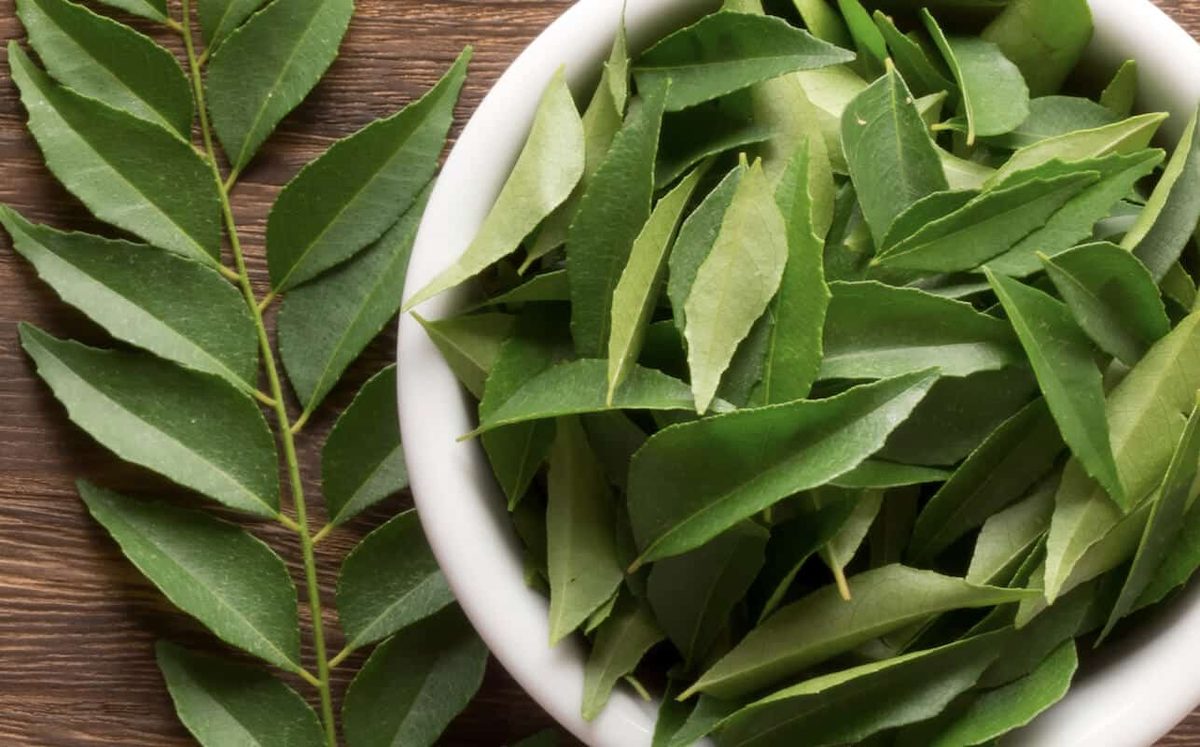
Curry leaves come from the curry tree, a shrub in the Rutaceae native to South and Southeast Asia, and Britannica notes they are used extensively in Indian cooking.1 Nik Sharma describes their smell as a mix of citrusy, grassy and burnt, sulfur-like aromas that grow stronger when the leaves are fried.2 America’s Test Kitchen calls the aroma faintly lemony and the flavor complex.3 Nothing else has that combination, so this page starts with the ways to keep using real curry leaves and then ranks the stand-ins by what they can and cannot replace.
Quick answer
| What curry leaves are doing | Best substitute | Starting amount | Treatment |
|---|---|---|---|
| Fried in oil for a tempering (dal, rasam, chutney) | Frozen curry leaves | Same number as fresh | Method |
| Same | Dried curry leaves | Twice the fresh amount | Attributed |
| Same, with no curry leaves at all | Makrut lime leaf, very finely shredded | 1 leaf for every 8 to 10 curry leaves | Method |
| Simmered in a sauce or stew | Makrut lime leaf, or a bay leaf | 1 leaf for every 8 to 10 curry leaves | Method |
| A citrus lift at the end | Lime zest | A little, to taste | Method |
Curry powder is not on the list. Despite the name, it is a different thing (see below).
How the ratios on this page are labeled
Every ratio carries one of four labels.
- Computed: based on a measurable physical relationship, with the source named.
- Attributed: a named source publishes this ratio. We quote it as theirs.
- Disputed: named sources give different answers to the same swap. We show each one and do not average them.
- Method: we found no published ratio. We give a direction and a cautious starting point, and say so.
Only one ratio here is published, for dried curry leaves. For every other stand-in we found no credible figure, so the amounts are starting points.
Why nothing matches exactly
Few analyses of curry leaf oil are published. In one, from leaves collected in Chittagong, Bangladesh, the oil was led by 3-carene at 54.2 percent, with caryophyllene at 9.5 percent.4 That is a single sample from one site. None of the substitutes below is known to share that profile: makrut lime leaf oil is dominated by citronellal,5 bay leaf oil by 1,8-cineole,6 and lemon balm oil by citral and related aldehydes.7 Each can echo the citrus or herbal side of curry leaves, but not the whole.
If curry leaves are fried in oil for a tempering
This is the classic use. Sharma describes frying the leaves in hot oil until crisp and translucent, then using the oil to flavor dal, grains, seafood or meat.2 ATK explains why the fat matters: heating in fat helps draw out flavor compounds that are mostly oil-soluble.3 In Smita Chandra’s rasam, published by Saveur, mustard, cumin and fenugreek seeds, curry leaves and dried chiles go into hot oil together until the seeds pop.8
1. Frozen curry leaves
ATK says to freeze fresh leaves in a zipper-lock bag for up to a month to preserve their flavor.3 If you can get fresh leaves occasionally, this is the most faithful substitute.
Ratio (Method): No source compares frozen with fresh. Use the same number of leaves as the recipe calls for fresh.
2. Dried curry leaves
Sharma recommends fresh whenever possible, because dried leaves are less intense.2
Ratio (Attributed): Nik Sharma says that if you have to use dried leaves, he finds doubling the quantity safer.2
3. Makrut lime leaf
PROSEA notes that the leaves of makrut lime (Citrus hystrix) are used to season food.9 In a 2023 analysis of leaves from Malaysian orchards, citronellal made up 77.7 percent of its oil.5 That gives a strong, clean citrus note that overlaps with the lemony side of curry leaves but has none of their grassy, sulfurous depth. Slice it very thin, removing the tough center rib, so it can fry evenly; that is common practice rather than a tested method.
Ratio (Method): We found no published ratio. A makrut lime leaf is much larger than a curry leaf, and its flavor is strong, so start with one leaf for every eight to 10 curry leaves.
4. Leave them out
If the tempering also contains mustard seeds, cumin, chiles or asafoetida, the dish will still taste complete without curry leaves, just less aromatic. In our judgment this is often a better choice than a substitute that pulls the flavor somewhere else.
If curry leaves are simmered in a sauce or stew
When the leaves go into a liquid, a whole leaf that can be fished out later is an easy stand-in.
1. Makrut lime leaf
Use it whole and remove it before serving.
Ratio (Method): One leaf for every eight to 10 curry leaves, as above.
2. Bay leaf
Mediterranean bay leaf (Laurus nobilis) is a different flavor altogether. Atlas Obscura describes it as herbal, bitter and slightly piney,10 and in one Italian sample 1,8-cineole made up 31.9 percent of the oil.6 It adds a background savory note, not curry leaves’ citrus.
A different leaf, the Indian bay leaf or tejpatta, is closely related to the cinnamon tree, Atlas Obscura notes.10 It is not a curry leaf substitute either.
Ratio (Method): We found no published ratio. Start with one bay leaf for every eight to 10 curry leaves and remove it before serving.
If you want a citrus lift
1. Lime zest
ATK describes curry leaves’ aroma as faintly lemony.3 A little lime zest can echo that one note at the end of cooking. It will not replace anything else.
Ratio (Method): No published ratio was found. Start with a small pinch of finely grated zest per dish and add more to taste.
2. Lemon balm
Lemon balm is a mint-family herb with lemon-scented leaves.11 The European Medicines Agency’s assessment gives its essential oil as 0.06 to 0.8 percent of the leaf, mainly citral, neral and citronellal.7 Like lime zest, it offers lemon and nothing more.
Ratio (Method): No published ratio was found. Add a few torn leaves at the end and taste.
Why curry powder is not a substitute
The two share a name and nothing else. ATK says curry leaves are unrelated to curry powder and only rarely found in it, and that they are definitely not a curry powder substitute.3 The USDA’s purchasing specification lists turmeric, coriander, fenugreek, cinnamon, cumin, black pepper, ginger and cardamom as curry powder ingredients, with no curry leaves.12 Adding curry powder in their place changes the color and the whole spice balance of a dish.
How many leaves to use
Recipes vary. ATK says it needed eight to 10 leaves rather than the three or four that some recipes recommend.3 Saveur’s rasam uses 15 fresh or frozen leaves.8 Keep that range in mind when scaling any substitute.
What isn’t known
- No published ratio exists for makrut lime leaf, bay leaf, lime zest, lemon balm or basil in place of curry leaves. The amounts above are Method starting points.
- No source we found compares the strength of frozen and fresh curry leaves, or says how long frozen leaves keep beyond ATK’s month.
- Only one analysis of curry leaf oil was opened for this page, so the chemistry comparisons rest on a single sample.
- It is sometimes said that lemon balm or basil smells like curry leaves. No source reviewed here supports that.
Related
- Curry leaves, cooking with curry leaves and curry leaf uses
- Curry leaves vs. bay leaves, bay leaves and bay leaf substitutes
- Makrut lime leaves and makrut lime leaf substitutes
- Lemon balm, curry powder and Indian spices
Footnotes
-
Frannie Comstock, Curry tree, Encyclopaedia Britannica. britannica.com · Reference work ↩
-
Nik Sharma, A Guide to Curry Leaves, Nik Sharma Cooks, 2022. niksharmacooks.com · Publication ↩ ↩2 ↩3 ↩4
-
Fresh Curry Leaves, America’s Test Kitchen. americastestkitchen.com · Publication ↩ ↩2 ↩3 ↩4 ↩5 ↩6
-
Chowdhury, Bhuiyan and Yusuf, Chemical composition of the leaf essential oils of Murraya koenigii and Murraya paniculata, Bangladesh Journal of Pharmacology, 2008. bdpsjournal.org · Peer-reviewed ↩
-
Al Othman et al., Phytochemical Composition … of Citrus hystrix, Citrus limon, Citrus pyriformis, and Citrus microcarpa Leaf Essential Oils, Plants, 2023. mdpi.com · Peer-reviewed ↩ ↩2
-
Caputo et al., Laurus nobilis: Composition of Essential Oil and Its Biological Activities, Molecules, 2017. mdpi.com · Peer-reviewed ↩ ↩2
-
Assessment report on Melissa officinalis L., folium, European Medicines Agency. ema.europa.eu · Regulator ↩ ↩2
-
Smita Chandra’s Rasam (Spicy Tamarind Soup), Saveur, 2015. saveur.com · Publication ↩ ↩2
-
Citrus hystrix, Plant Resources of South-East Asia (PROSEA). uses.plantnet-project.org · Reference work ↩
-
Andrew Coletti, What Is a Bay Leaf, Exactly?, Atlas Obscura, 2023. atlasobscura.com · Publication ↩ ↩2
-
Melissa Petruzzello, Lemon balm, Encyclopaedia Britannica. britannica.com · Reference work ↩
-
Commercial Item Description A-A-20001C, Spices and Spice Blends, USDA Agricultural Marketing Service, 2023. ams.usda.gov · Regulator ↩