Cooking · Cooking with
Cooking With Fenugreek: Toasting, Tempering, Leaves and Amounts
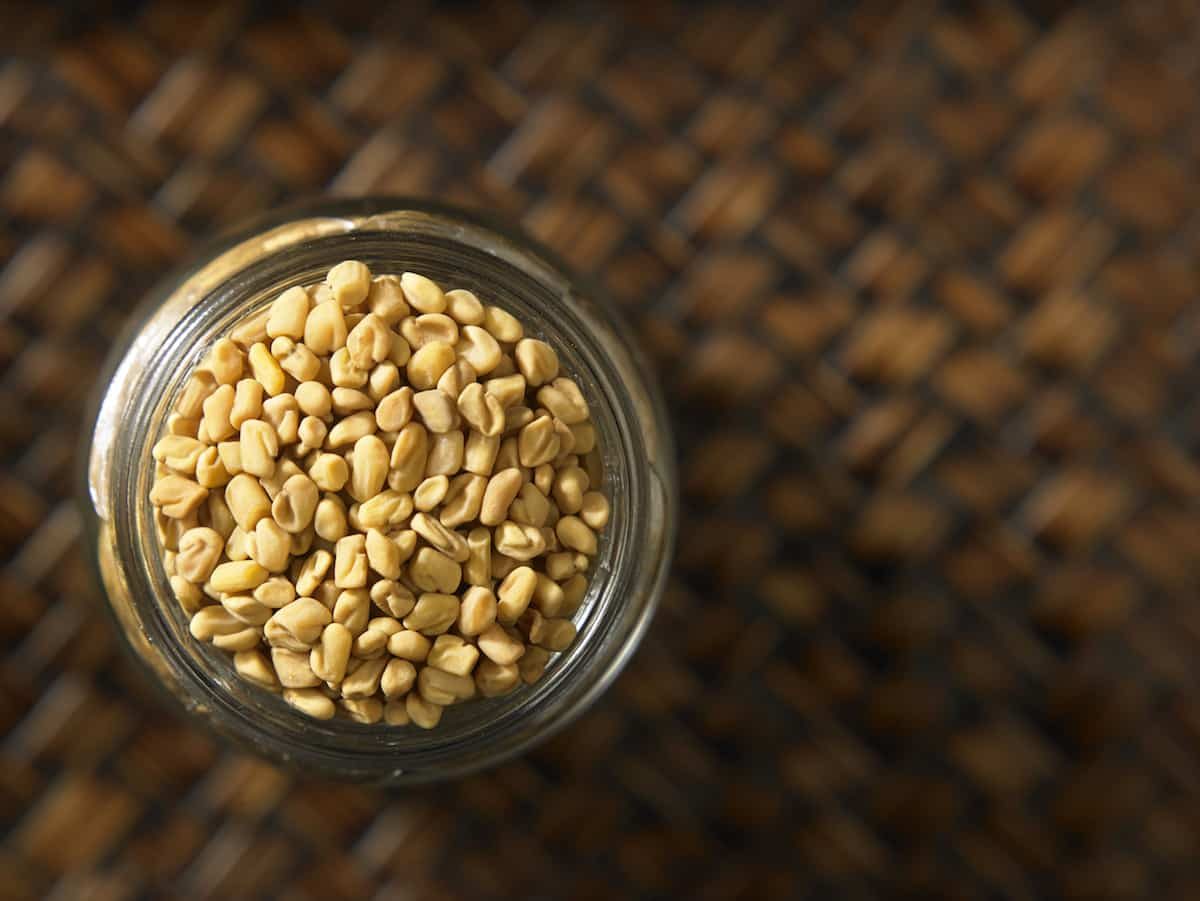
Fenugreek is two ingredients: small seeds used as a spice, and leaves used fresh as a vegetable or dried as kasuri methi.12 Britannica describes the seed’s aroma and taste as strong, sweetish and somewhat bitter, reminiscent of burnt sugar,3 and PROSEA credits a compound called sotolon with fenugreek’s characteristic curry aroma.1 Cooking with it well is mostly about two things: heat control, because toasting changes the bitterness, and restraint, because a little goes a long way.
At a glance
| Question | Short answer |
|---|---|
| Toast or fry? | Both are traditional: toasted and ground with other spices, or fried in oil.2 |
| Main risk | Overheating. Toasting helps only if the seeds are not overheated.2 |
| How much? | Small amounts in blends;2 ¼ teaspoon in one sambar tempering.4 |
| Whole or ground? | Buy whole; grinding for storage speeds aroma loss.5 |
| Leaves | Fresh cooked like spinach; dried (kasuri methi) for sauces, curries and naan.12 |
| Safety | Safe in food amounts; not in pregnancy above food amounts.6 |
Toasting the seeds
Gernot Katzer’s Spice Pages says dry toasting can enhance fenugreek’s flavor and reduce its bitterness, provided care is taken not to overheat the seeds.2 He attributes the nuttier flavor of toasted seeds to a different group of aroma compounds, pyrazines.2 Reduce is the word: toasting tames the bitterness rather than removing it.
Overdo it and the seeds turn black and bitter. Katzer notes that in some Newari salads from Nepal, that burnt and bitter flavor is deliberate, as a contrast.2 In most kitchens it is a mistake. He also notes that, as a general rule, South Indian cooks toast their spices to a darker color and flavor than cooks in the North.2
Saveur’s berbere recipe gives a working cue for toasting fenugreek with other whole spices: over medium heat, swirling the skillet constantly, until fragrant, about 4 minutes.7 A common tip says to pick over the seeds for small stones before toasting; that is sensible practice with any whole spice, though we found no source specific to fenugreek.
Frying the seeds in a tempering
Katzer says fenugreek seeds are either toasted and ground with other spices into blends or fried in oil to improve their flavor.2 In a South Indian tempering, the seeds go into hot oil whole with mustard seeds:
| Recipe | Fenugreek | With | How |
|---|---|---|---|
| Bincy Lenin’s simple sambar (Onmanorama)4 | ¼ teaspoon | Mustard seeds, then dried chiles, curry leaves, sambar powder | Spluttered with mustard seeds in coconut oil, poured into the finished sambar |
| Panch phoron (Bong Eats)8 | 1 tablespoon in the blend | The other seeds of the Bengali five-spice mix | Used in dals, vegetables, chutneys and pickles |
For the tempering technique and its other leaves, see cooking with curry leaves.
Grinding
Oregon State University Extension says crushing or grinding herbs and seeds for storage increases the loss of aroma and flavor.5 So buy whole seeds and grind what you need. A common claim says fenugreek seeds are too hard to grind by hand; we found no source that tests this. Saveur’s niter kibbeh simply calls for the seeds coarsely crushed.9
Fenugreek in blends
| Blend or dish | Where | What fenugreek does there | Source |
|---|---|---|---|
| Curry powder | British-style blends | Listed among the ingredients curry powder should include; Katzer says small amounts belong in any good curry powder | USDA,10 Katzer2 |
| Sambar podi | Tamil cooking | One of the spices in the ubiquitous Tamil mix | Katzer2 |
| Panch phoron | Bengal | An essential part of the five-spice mix | Katzer,2 Bong Eats8 |
| Berbere | Ethiopia | Small amounts, in a chile-spice blend essential to many Ethiopian dishes | Katzer,2 Saveur7 |
| Niter kibbeh | Ethiopia | Coarsely crushed seeds in spiced clarified butter | Saveur9 |
| Hilbeh | Yemen | The national sauce, mainly fenugreek seeds and chiles | Katzer2 |
| Kirihodi | Sri Lanka | A soupy dish of cow or coconut milk with a sediment of fenugreek seeds, eaten with rice | Katzer2 |
| Imitation maple syrup | Industry | Fenugreek is used to make it | Britannica3 |
Notice the pattern: outside hilbeh, fenugreek is one voice in a blend, not the lead. The USDA’s curry powder specification lists it alongside turmeric, coriander, cinnamon, cumin, black pepper, ginger and cardamom.10 A common claim says cheap curry powders taste mostly of fenugreek; we found no source that tests it.
How much fenugreek
No source gives a general rule, and recipes treat fenugreek as a minor ingredient.
| Source | Amount | Context |
|---|---|---|
| Onmanorama (Bincy Lenin)4 | ¼ teaspoon | Tempering for a sambar made with ½ cup dal |
| Saveur (niter kibbeh)9 | 1 teaspoon, coarsely crushed | Spiced clarified butter |
| Bong Eats8 | 1 tablespoon | A batch of panch phoron |
| Katzer2 | “Small amounts” | Curry powder and berbere |
If a recipe lacks a figure, start with ¼ teaspoon of seeds for a pot of dal made from about ½ cup of dried lentils, as in the sambar above, and adjust next time. That is our starting point, not a tested rule. If you overshoot, see too much fenugreek.
Cooking with the leaves
The leaves taste different from the seeds. Katzer notes that fresh fenugreek leaves have no remarkable scent, that the dried leaves’ fragrance slightly resembles lovage, and that dried and soaked leaves give superior flavor.2 PROSEA says the leaves are important as a vegetable and condiment in India in spite of their bitter taste.1 Food writer Michelle Minnaar finds the seeds stronger in taste than the leaves.11
| Form | Use | Source |
|---|---|---|
| Fresh leaves (methi, sag methi) | Eaten as a vegetable, prepared like spinach | Katzer2 |
| Dried leaves (kasuri methi) | Flavor sauces and gravies | PROSEA1 |
| Dried leaves | Spicy chickpea curries known as dal fry, mainly in the North; potato curries (alu methi); methi naan | Katzer2 |
| Leaves | Ghorme sabzi, the Iranian herb sauce soured with dried limes, in which mutton is slowly stewed | Katzer2 |
Using seeds and leaves in the same dish is fine, but they are not interchangeable flavors. If you replace fresh leaves with kasuri methi, Minnaar suggests using only a third of the amount.11 That is her rule of thumb. See kasuri methi and fenugreek leaves vs. seeds.
Buying and storing
India grows fenugreek on a large scale: the Spices Board of India puts the country’s 2024-25 crop at 260,803 tonnes.12 PROSEA describes the seeds being dried and stored, preferably in airtight containers.1 At home, keep whole seeds airtight and buy amounts you will use. We found no fenugreek-specific shelf life.
Safety
The NIH’s National Center for Complementary and Integrative Health says fenugreek is believed to be safe for adults and children in the amounts commonly found in foods, but not safe during pregnancy in amounts greater than those found in food, and that it can cause allergic reactions, including serious ones, in some people.6 Sprouting the seeds carries its own risk: in 2011, EFSA’s task force traced E. coli outbreaks in Germany and France most likely to one lot of fenugreek seeds imported from Egypt and used to produce sprouts.13 Katzer notes that Newari cooks use fenugreek sprouts in pickles and soups.2
Not yet measured
- A typical amount of fenugreek per serving across recipes.
- Whether hand-grinding fenugreek is harder than other seeds.
- How long ground or whole fenugreek keeps its aroma at home.
Related
- Fenugreek
- Fenugreek uses
- Fenugreek substitutes
- Fenugreek leaves vs. seeds
- Fenugreek vs. fennel seed
- Kasuri methi
- Too much fenugreek
- Curry powder
Footnotes
-
Trigonella foenum-graecum, Plant Resources of South-East Asia (PROSEA), via Pl@ntUse. uses.plantnet-project.org · Reference work ↩ ↩2 ↩3 ↩4 ↩5 ↩6
-
Fenugreek, Gernot Katzer’s Spice Pages. gernot-katzers-spice-pages.com · Reference work ↩ ↩2 ↩3 ↩4 ↩5 ↩6 ↩7 ↩8 ↩9 ↩10 ↩11 ↩12 ↩13 ↩14 ↩15 ↩16 ↩17 ↩18 ↩19 ↩20 ↩21 ↩22
-
“Fenugreek”, Encyclopaedia Britannica, 2026. britannica.com · Reference work ↩ ↩2
-
Bincy Lenin, “Simple sambar”, Onmanorama, 2021. onmanorama.com · Publication ↩ ↩2 ↩3
-
Nellie Oehler, “Drying herbs”, Oregon State University Extension Service, 2025. extension.oregonstate.edu · Reference work ↩ ↩2
-
Fenugreek, National Center for Complementary and Integrative Health, 2025. nccih.nih.gov · Regulator ↩ ↩2
-
Ethiopian Spice Mix (Berbere), Saveur, 2008. saveur.com · Publication ↩ ↩2
-
Panch phoron, Bong Eats, 2017. bongeats.com · Publication ↩ ↩2 ↩3
-
Ethiopian Spiced Clarified Butter (Niter Kibbeh), Saveur, 2019. saveur.com · Publication ↩ ↩2 ↩3
-
Commercial Item Description A-A-20001C, Spices and Spice Blends, USDA Agricultural Marketing Service, 2023. ams.usda.gov · Regulator ↩ ↩2
-
Michelle Minnaar, “Fenugreek Leaves Substitutes”, Greedy Gourmet, 2023. greedygourmet.com · Publication ↩ ↩2
-
Spice wise area and production, Spices Board India, 2025. indianspices.com · Regulator ↩
-
EFSA Task Force report on the 2011 E. coli O104:H4 outbreaks, European Food Safety Authority, 2011. efsa.europa.eu · Regulator ↩