Herbs · Profile
Curry Leaves: What They Are, How They Taste, and Why They Have Nothing to Do With Curry Powder
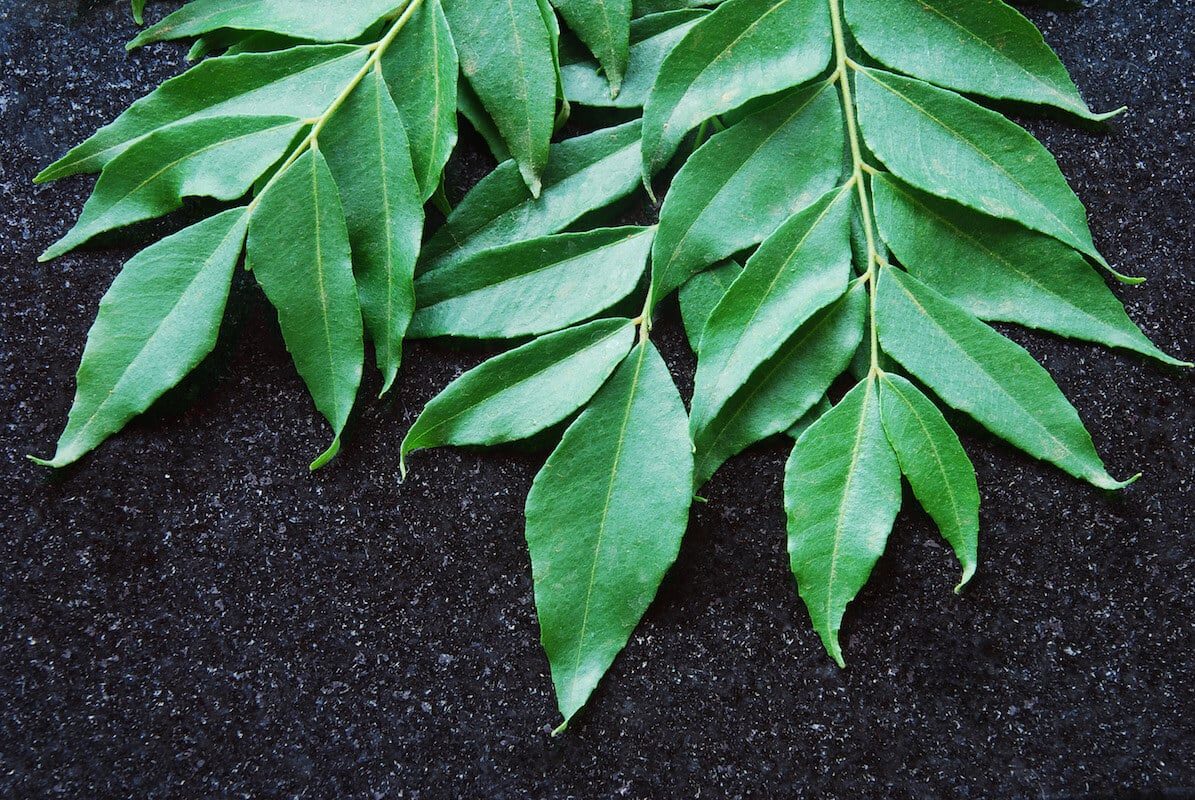
Curry leaves are the aromatic leaves of the curry tree, a shrub native from the Indian subcontinent to southern China. They are used extensively in Indian cooking, usually fried in hot oil, and they smell citrusy, grassy and faintly sulfurous. Despite the name, they are not an ingredient of curry powder and come from an unrelated plant. This page covers what they are, the chemistry of their aroma, how cooks use them, buying and storage, and the one regulatory issue that affects their trade.
At a glance
| Botanical name | Bergera koenigii L. per Kew; widely known as Murraya koenigii12 |
| Plant family | Rutaceae13 |
| Plant | Shrub12 |
| Other names | Curry tree, curry leaf tree, sweet neem2 |
| Native range | Indian subcontinent to southern China and peninsular Malaysia1 |
| Part used | Fresh leaves, also dried or as a powder34 |
| Main aroma compounds | 3-Carene and caryophyllene in one Bangladeshi leaf oil5 |
| Related to curry powder? | No: the name is shared, the plant is not46 |
Measured values
3 figures, sourced| Measure | Value | Scope | Source |
|---|---|---|---|
| Essential oil | 1.0 % of dried leaf | leaves collected June 2007 on a research campus in Chittagong, Bangladesh, air-dried and hydrodistilled; one sample from one site | bdpsjournal.org |
| 3-Carene | 54.2 % of oil | same Chittagong sample; not a typical figure | bdpsjournal.org |
| Caryophyllene | 9.5 % of oil | same Chittagong sample | bdpsjournal.org |
Each figure is quoted as its source states it, with the samples or standard it applies to. Where sources differ, both are shown; nothing is averaged. All measured values
What curry leaves are
Britannica describes the curry tree as a flowering shrub of medium size in the Rutaceae, native to South and Southeast Asia, whose aromatic leaves are used extensively in Indian cooking.2 Kew’s Plants of the World Online now places the species in the genus Bergera, as Bergera koenigii, and lists Murraya koenigii as a synonym; most cookbooks and research papers still use the Murraya name.1
Kew gives the native range as the Indian subcontinent to southern China (southern Yunnan and Guangdong), peninsular Malaysia and southern Hainan, listing it as native to India, Sri Lanka, Bangladesh, Nepal, Pakistan, Thailand, Laos, Cambodia and Vietnam among others, and as introduced in places including Java, Sumatra, Fiji, the Maldives and the Gulf States.1 It grows mainly in the wet tropics.1 Two common statements do not match this: the tree is not confined to the Himalayan foothills, and it was not carried to Malaysia by migrants, since Kew counts peninsular Malaysia as part of its native range.1
Not related to curry powder
Curry powder is a ground spice blend. The USDA’s purchasing specification for curry powder says it should include, but is not limited to, turmeric, coriander, fenugreek, cinnamon, cumin, black pepper, ginger and cardamom; curry leaves are not on that list.6 Britannica describes curry powder as a blend adapted by British settlers in India, and derives the word “curry” from the Tamil kari, “sauce”.7 Nik Sharma puts it plainly: curry leaves have nothing to do with curry, and a curry can exist without them.4 We found no source showing which commercial curry powders, if any, contain curry leaves. See curry powder and curry spices.
Flavor and aroma
Nik Sharma describes curry leaves as a mix of citrusy, grassy and burnt, sulfur-like aromas that grow stronger when the leaves are fried.4 He recommends fresh leaves whenever possible, because dried leaves are less intense, and says to use more if using dried.4
The compounds
Few analyses of the leaf oil were opened for this page. In one, leaves collected in June 2007 from trees on a research campus in Chittagong, Bangladesh, were air-dried for about a week and hydrodistilled.5 The oil made up 1.0% of the dried leaf and contained 39 compounds, led by 3-carene (54.2%) and caryophyllene (9.5%).5 That is one sample from one site, and this page does not treat 54.2% as a typical figure. In the same study, the leaf oil of a related species, Murraya paniculata, differed from it both in which compounds it contained and in how much.5
The leaves, roots and bark are also rich in carbazole alkaloids, a group of compounds that includes mahanimbine, koenimbine and girinimbine; these are the subject of most pharmacological research on the plant.3 No source we opened links them to the leaves’ flavor.
How curry leaves are used
The classic technique is tempering: frying the leaves in hot fat so that the fat carries their aroma into the dish. Nik Sharma describes frying them in hot oil until crisp and translucent, then using the oil to flavor a dish, and notes that the fat (ghee, coconut oil, olive oil) captures the aroma.4
- Dal and grains. Sharma lists dal, cooked grains, seafood and meat among the dishes that take a curry leaf tempering.4
- Rasam. Rasam is a peppery, tamarind-soured South Indian soup. In Smita Chandra’s version, published by Saveur, mustard seeds, cumin seeds, fenugreek seeds, curry leaves and dried chiles are cooked in hot oil until the seeds pop, and that oil is stirred into the soup.8
- Powder. A 2020 review notes that fresh leaf powder and the leaf oil are used to season food.3
Mustard seeds, as in the rasam above, are one natural partner. Pairing curry leaves with asafoetida is also common practice, though we did not open a source for it. For more ideas, see curry leaves uses and cooking with curry leaves; for mustard seeds, see black mustard seeds.
Buying and storage
Sharma advises choosing fresh over dried.4 We found no regulator or standards body giving shelf-life or storage guidance for curry leaves. Freezing fresh sprigs is a common home practice, but no source we opened tests how well the aroma survives it.
Safety
EU import controls. When the EU set out its rules for stepped-up checks on high-risk imports in October 2019, it placed curry leaves (Bergera/Murraya koenigii, fresh, chilled, frozen or dried) from India on its list of goods subject to special conditions because of pesticide residues, with identity and physical checks on 20% of consignments.9 That list is amended regularly, and we did not check whether curry leaves from India remain on the current version.
Health claims
Curry leaves are often credited with protecting the liver, fighting cancer and treating diarrhea. A 2020 review of the plant’s pharmacology says that limited studies have evaluated its medicinal efficacy and calls for more work in cell and animal models; most of the research it summarizes is laboratory and animal work, not human trials.3 The NIH’s National Center for Complementary and Integrative Health has no fact sheet on curry leaves.10 This page makes no claim that curry leaves treat or prevent any condition. The review describes the leaves as a significant source of several vitamins;3 we found no figure for how much a typical dish supplies.
Substitutes and comparisons
Nothing tastes quite like curry leaves. Sharma suggests using more if dried leaves are all you have.4 See curry leaf substitutes and curry leaves vs. bay leaves, which are often confused but are unrelated.
Related pages
Footnotes
-
Bergera koenigii L., Plants of the World Online, Royal Botanic Gardens, Kew. powo.science.kew.org · Reference work ↩ ↩2 ↩3 ↩4 ↩5 ↩6 ↩7 ↩8
-
Frannie Comstock, “Curry tree”, Encyclopaedia Britannica. britannica.com · Reference work ↩ ↩2 ↩3 ↩4
-
Balakrishnan et al., “Medicinal Profile, Phytochemistry, and Pharmacological Activities of Murraya koenigii and its Primary Bioactive Compounds”, Antioxidants, 2020. mdpi.com · Peer-reviewed ↩ ↩2 ↩3 ↩4 ↩5 ↩6
-
Nik Sharma, “A Guide to Curry Leaves”, Nik Sharma Cooks, 2022. niksharmacooks.com · Publication ↩ ↩2 ↩3 ↩4 ↩5 ↩6 ↩7 ↩8 ↩9
-
Chowdhury, Bhuiyan and Yusuf, “Chemical composition of the leaf essential oils of Murraya koenigii and Murraya paniculata”, Bangladesh Journal of Pharmacology, 2008. bdpsjournal.org · Peer-reviewed ↩ ↩2 ↩3 ↩4
-
Commercial Item Description A-A-20001C, Spices and Spice Blends, USDA Agricultural Marketing Service, 2023. ams.usda.gov · Regulator ↩ ↩2
-
“Curry”, Encyclopaedia Britannica, 2026. britannica.com · Reference work ↩
-
“Smita Chandra’s Rasam (Spicy Tamarind Soup)”, Saveur, 2015. saveur.com · Publication ↩
-
Commission Implementing Regulation (EU) 2019/1793, EUR-Lex, 2019. eur-lex.europa.eu · Regulator ↩
-
Herbs at a Glance, National Center for Complementary and Integrative Health. nccih.nih.gov · Regulator ↩