Spices · Profile
Black Mustard Seeds: The Hottest Mustard, and Why It Turns Nutty in Hot Oil
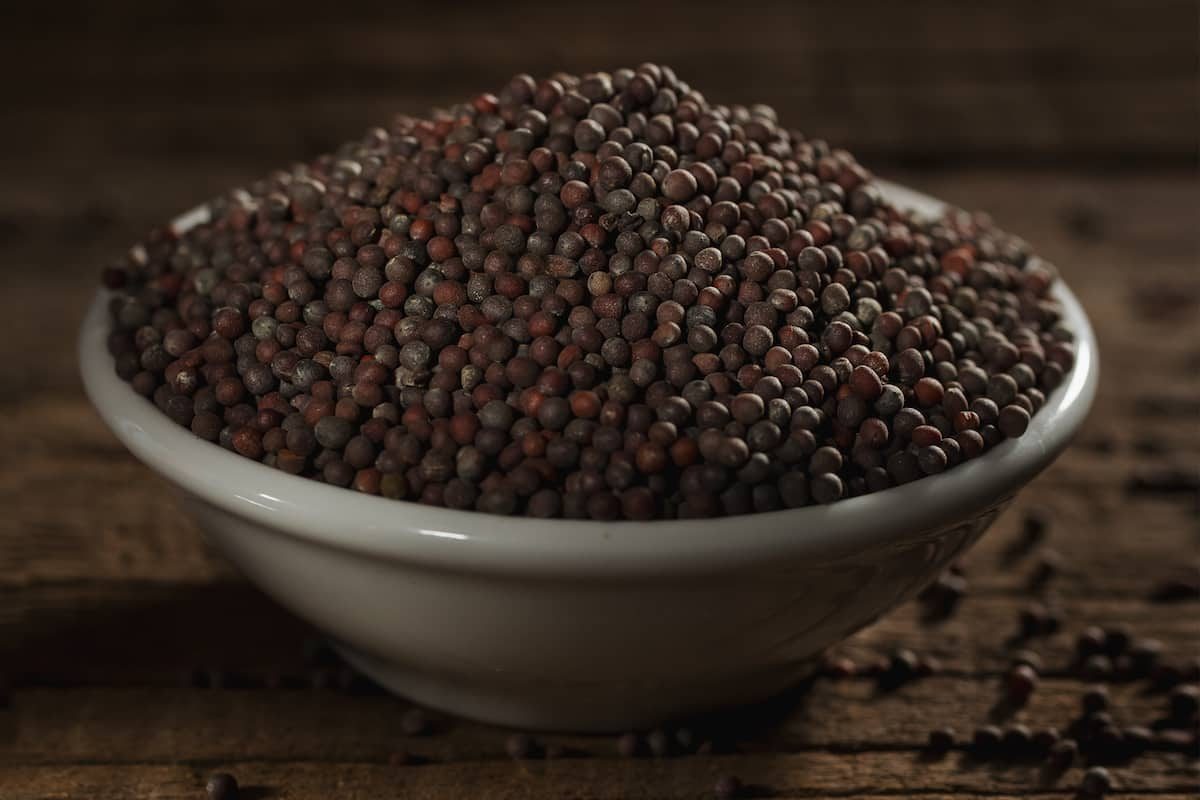
Black mustard seeds are the tiny, dark seeds of Mutarda nigra, long known as Brassica nigra, the most pungent of the three mustards used as spices.12 Crushed and wet, they bite hard; fried whole in hot oil, they lose that bite and turn nutty, a technique common in South Indian cooking.1 Black mustard has also largely disappeared from farming, replaced by brown mustard.3 This page covers the plant, the chemistry of its heat, its uses, and what you are likely buying when a label says “black.”
At a glance
| Botanical name | Mutarda nigra (L.) Bernh.; homotypic synonym Brassica nigra4 |
| Plant family | Brassicaceae (cabbage and mustard family)4 |
| Part used | Seed |
| Seed | Round, about 1 mm across, black to red-brown, minutely pitted3 |
| Native range | Europe to western and northern China, and the Mediterranean to Ethiopia, per Kew4 |
| Source of heat | Allyl isothiocyanate, released from the glucosinolate sinigrin31 |
| Sinigrin in seed | 110–140 µmol/g (PROSEA); about 1% (Katzer)31 |
| Trade today | Minimal; largely replaced by brown mustard3 |
| Forms sold | Whole seed; in some ground mustard and prepared mustard3 |
Measured values
8 figures, sourced| Measure | Value | Scope | Source |
|---|---|---|---|
| Sinigrin | 110–140 µmol/g of seed | PROSEASources differ in unit and figure; not converted | uses.plantnet-project.org |
| Sinigrin | about 1 % of seed | KatzerSources differ in unit and figure; not converted | gernot-katzers-spice-pages.com |
| Water Nutrient | 8 g per 100 g edible portion | black mustard seed (PROSEA) | uses.plantnet-project.org |
| Protein Nutrient | 29 g per 100 g edible portion | black mustard seed (PROSEA) | uses.plantnet-project.org |
| Fat Nutrient | 28 g per 100 g edible portion | black mustard seed (PROSEA) | uses.plantnet-project.org |
| Carbohydrates Nutrient | 19 g per 100 g edible portion | black mustard seed (PROSEA) | uses.plantnet-project.org |
| Fiber Nutrient | 11 g per 100 g edible portion | black mustard seed (PROSEA) | uses.plantnet-project.org |
| Iron Nutrient | 21 mg per 100 g edible portion | black mustard seed (PROSEA) | uses.plantnet-project.org |
Each figure is quoted as its source states it, with the samples or standard it applies to. Where sources differ, both are shown; nothing is averaged. All measured values
What black mustard is
Black mustard is a much-branched annual herb 0.5–1.5 m tall with a firm taproot.3 Kew now accepts it as Mutarda nigra, with Brassica nigra as a synonym,4 so older books, seed catalogs and labels use the Brassica name for the same plant.
Black, brown and white
Three plants supply mustard seed: black mustard, brown mustard (Brassica juncea) and white or yellow mustard (Sinapis alba).1 Katzer describes black and brown mustard as botanically different but of equal use in the kitchen, with black mustard’s pungency slightly stronger than brown’s.1 Popular Science gives the general rule of thumb that the darker the seed, the spicier.2
Why true black mustard is scarce
Black mustard has dropped out of large-scale farming. PROSEA explains that its shattering pods make it unsuitable for large-scale, mechanized cultivation, and that brown mustard has largely replaced it; black mustard’s importance in international trade has become minimal.3 Katzer makes the same point: brown mustard, unlike black, can be harvested by machine, and black mustard is hardly planted in Europe anymore.1 Britannica says brown mustard has entirely replaced black mustard in commercial cropping and that black mustard now occurs mainly as an introduced weed.5
No survey of what retail “black mustard seed” actually contains was found, so whether a given jar is true black mustard or dark brown mustard is not something this page can answer. The botanical name on the label, where there is one, is the only guide.
Where it comes from
Sources disagree on black mustard’s origin:
| Source | Origin or native range |
|---|---|
| Kew Plants of the World Online | Europe to western and northern China, and the Mediterranean to Ethiopia4 |
| PROSEA | Most probably the Asia Minor to Iran area; now wild in the Mediterranean, central Europe, the Middle East and the Ethiopian highlands3 |
| Katzer’s Spice Pages | Probably the southern Mediterranean, cultivated for thousands of years1 |
PROSEA says the seed has been used as a spice and medicine since ancient times in the Middle East, India and Greece.3
Flavor and the chemistry of the heat
PROSEA describes finely ground black mustard as a neutral, odorless powder.3 The heat appears only when the seed is crushed and wet: the enzyme myrosinase acts on the glucosinolate sinigrin and releases allyl isothiocyanate, a volatile compound.31 PROSEA describes allyl isothiocyanate as aggressive and responsible for the pungent taste, and notes that it irritates mucous membranes and skin.3 Myrosinase is the enzyme that makes the hot compound, not the hot compound itself.
Heat changes everything. Katzer notes that boiling inactivates the enzymes needed to form the pungent taste, and that heating quickly destroys isothiocyanate that has already formed.1 Seeds fried in fat or dry-toasted are no longer pungent but take on a nutty, smoky taste.1
For the practical side of controlling mustard’s heat with water temperature and vinegar, see mustard powder.
How black mustard seeds are used
In South Asian cooking
Katzer describes frying the whole seeds in fat as a typical South Indian technique, and notes that they often appear in Tamil vegetable curries alongside curry leaves.1 Black mustard seed is also a component of the Bengali spice mix panch phoron,1 and West Bengal and Bangladesh are, in Katzer’s words, the epicenter of mustard oil use.1 The seeds also go into pickled raw vegetables, and in Andhra Pradesh a paste of ground seed is used in the mango pickle avakaya.1
The technique, by common practice: heat oil until shimmering, add the seeds, cover the pan loosely, and wait for the popping to slow before adding curry leaves, chilies or the next ingredient. Seeds that are not fried long enough stay bitter and sharp; seeds fried too long burn. These are kitchen judgments.
As mustard
PROSEA notes that finely ground black mustard seed gives mustard meal, an odorless powder that becomes table mustard when mixed with vinegar.3 The condiment’s name comes from its early recipe: mixing must, unfermented grape juice (Latin vinum mustum), into the crushed seed.6 Katzer credits the Romans with making mustard seed popular in Central and Western Europe and with mixing it with must.1
For more ideas, see mustard seed uses.
The mustard seed of the Gospels
In Luke 13:19, the King James Version says the mustard seed “waxed a great tree,” and most modern translations say it “became a tree.”7 It is often said that this mustard was black mustard and that black mustard grows over ten feet tall. Neither point could be confirmed. PROSEA gives black mustard’s height as 0.5–1.5 m (about 1.5 to 5 feet),3 and Katzer argues that a tree reading is hard to defend for an annual herb whose tender branches cannot hold birds.1 Which plant the passage meant is a question for biblical scholarship, not settled here.
Buying and storage
Look for whole seeds that are small, round, uniformly dark and free of dust and debris; true black mustard seed is about 1 mm across.3 The rest of that buying advice is kitchen judgment.
Because the pungent compound forms only after the seed is crushed and wet,31 the smell of dry seed says little about its strength. No published shelf-life figure for whole black mustard seed was found. Store airtight, dry and away from heat. To check an old jar, crush a few seeds with a drop of cool water and smell after a minute or two.
Nutrition
PROSEA gives this composition for black mustard seed, per 100 g edible portion: water 8 g, protein 29 g, fat 28 g, carbohydrates 19 g, fiber 11 g, and iron 21 mg.3 Since seeds are used by the teaspoon, their contribution to a day’s diet is small.
Claims that black mustard is a notable source of zinc, magnesium, carotenes, lutein or zeaxanthin could not be traced to a source. No claim is made here that black mustard seed treats or prevents cancer, high cholesterol or any other disease.
Safety
- Allergy. Mustard is one of the 14 allergens food businesses in the UK must declare.8 It is not one of the nine major food allergens under US law, which are milk, eggs, fish, crustacean shellfish, tree nuts, peanuts, wheat, soybeans and sesame.9 US allergen labeling rules apply to those nine foods, so mustard is not covered by them.9
- Skin and eyes. Allyl isothiocyanate irritates mucous membranes and skin.3 Wash your hands after handling crushed, wet seed or homemade mustard paste.
- Erucic acid (EU). EU law caps erucic acid at 35 g/kg in mustard as a condiment and 50 g/kg in mustard oil, with an exemption for mustard oil produced and consumed locally.10
- Folk remedies. PROSEA records mustard plasters and seed teas as traditional remedies.3 They are not recommended here.
Substitutes and comparisons
Brown mustard seed is the closest substitute; Katzer treats the two as of equal use in the kitchen, with black slightly more pungent.1 Yellow mustard seed is milder;2 in our judgment it does not stand in well for frying. No tested ratio was found; as a Method starting point, swap brown for black one for one and taste.
- Black mustard seed substitutes
- Brown mustard seeds and yellow mustard seeds
- Yellow vs. black mustard seeds
- Mustard powder and mustard powder vs. mustard seed
- Panch phoron
Footnotes
-
Gernot Katzer, “Mustard”, Gernot Katzer’s Spice Pages. gernot-katzers-spice-pages.com · Reference work ↩ ↩2 ↩3 ↩4 ↩5 ↩6 ↩7 ↩8 ↩9 ↩10 ↩11 ↩12 ↩13 ↩14 ↩15 ↩16 ↩17 ↩18 ↩19
-
Sandra Gutierrez G., “When the mustard shortage hits, make your own”, Popular Science, 2022. popsci.com · Publication ↩ ↩2 ↩3
-
H. Toxopeus and I. Utomo, Brassica nigra, Plant Resources of South-East Asia (PROSEA). uses.plantnet-project.org · Reference work ↩ ↩2 ↩3 ↩4 ↩5 ↩6 ↩7 ↩8 ↩9 ↩10 ↩11 ↩12 ↩13 ↩14 ↩15 ↩16 ↩17 ↩18 ↩19 ↩20
-
Mutarda nigra (L.) Bernh., Plants of the World Online, Royal Botanic Gardens, Kew. powo.science.kew.org · Reference work ↩ ↩2 ↩3 ↩4 ↩5
-
“Black mustard”, Encyclopaedia Britannica. britannica.com · Reference work ↩
-
mustard (n.), Online Etymology Dictionary. etymonline.com · Reference work ↩
-
Luke 13:19, Bible Hub. biblehub.com · Reference work ↩
-
Allergen guidance for food businesses, Food Standards Agency. gov.uk · Regulator ↩
-
Food Allergies, U.S. Food and Drug Administration. fda.gov · Regulator ↩ ↩2
-
Commission Regulation (EU) 2023/915, EUR-Lex. eur-lex.europa.eu · Regulator ↩