Cooking · Cooking with
Cooking With Dill: When to Add It, What to Pair It With, How to Keep It
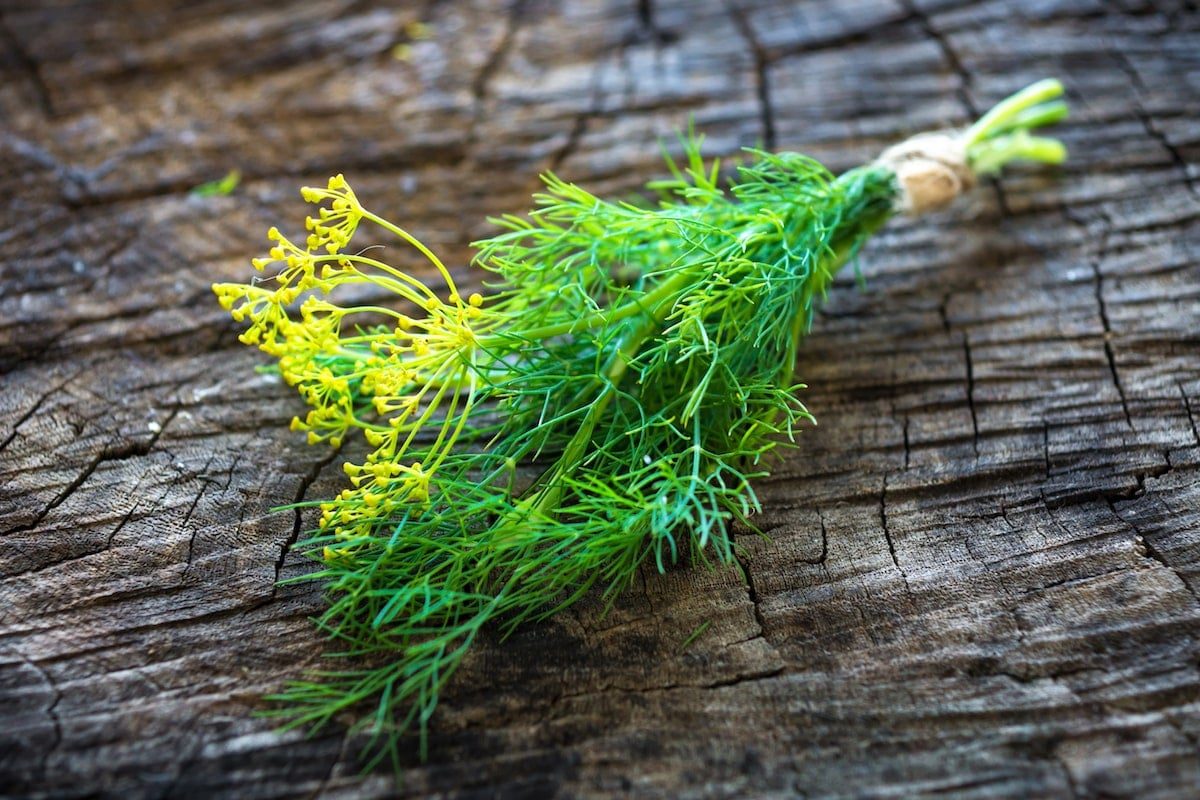
Dill gives a cook two ingredients from one plant: the feathery leaves, often sold as dill weed, and the small dried fruits sold as dill seed. Britannica notes the fruits are often mistaken for seeds.1 The leaves are delicate and lose their aroma to heat; the seeds are sturdier and are often cooked longer.2 Almost every decision about cooking with dill comes down to which of the two you are holding.
At a glance
| Question | Dill leaves (weed) | Dill seed |
|---|---|---|
| When to add | A minute or two before the end of cooking2 | Up to the last 20 minutes2 |
| How to bring out flavor | Add raw or at the last minute3 | Fry briefly in hot fat, as in Indian cooking4 |
| Classic uses | Fish and shellfish, boiled potatoes, cucumbers, soups, sauces14 | Pickles, breads and pastries, Indian dals54 |
| Fresh vs dried | Fresh is much more aromatic4 | Sold dried |
| Fridge life | About two days, per Purdue6 | Not applicable |
Dill leaves: add them late
The leaf is the delicate part. LSU AgCenter puts dill leaves in its group of delicate herbs, along with basil, chives, cilantro, parsley and mint, and says to add them a minute or two before the end of cooking, because prolonged heat costs flavor and aroma.2 America’s Test Kitchen’s herb guide files dill under delicate herbs to add at the last minute.3 ATK also explains why: delicate herbs tend to have more volatile flavor compounds.7
So in a soup, stew or sauce, stir chopped dill in as the pot comes off the heat. A common tip says five minutes before the end; the extension figure is shorter. For cold dishes such as salads, dressings and dips, there is no heat to worry about.
Prep
- Chop close to serving. ATK says to gather the leaves into a tight pile under your guiding hand rather than running the knife over a loose pile.3 Chopping just before use is common kitchen practice for delicate herbs.
- Use the tender parts. Britannica says the leaves, small stems and immature flower umbels are used, fresh or dried.1 We found no source on cooking the thicker lower stems.
- Wash, then dry well. ATK’s advice for delicate herbs is to dry them thoroughly after rinsing, for example in a salad spinner lined with paper towels.3 It also says their leaves should not sit in liquid, which encourages rot.3 Our reading is that rinsing just before use, rather than before storing, keeps that water out of the fridge; no source states this directly.
Dill seed: cook it
The fruits carry more oil than the leaves. PROSEA gives an essential oil content of 2 to 6% for the fruits and 0.1 to 1.5% for the herb.5 The oils differ too: PROSEA lists limonene (up to 70%) and carvone (up to 60%) as the main components of the fruit oil, and phellandrene (35%) and dill ether (25%) for the herb oil.5 Britannica says dill’s flavor is somewhat reminiscent of caraway.1
LSU says dill seeds can go in for about the last 20 minutes of cooking.2 In India, where Katzer notes the dried fruits rather than the leaves are used, they are briefly fried in hot fat to develop their aroma and go into dals; in Gujarat they also appear in quickly fried vegetables.4
What to cook with dill
| Use | Part | Where | Source |
|---|---|---|---|
| Fish and shellfish, flavored directly with dill | Leaves preferred | Scandinavia, where Katzer calls it a kind of national spice | Katzer4 |
| Fish soups and stews | Leaves | Germany | Katzer4 |
| Chopped over boiled potatoes and other foods | Leaves | Baltic states | Katzer4 |
| Cucumbers, bread, vegetables, pickles | Not specified | Europe generally | Katzer4 |
| Pickled cucumbers, onions, flavored vinegar | Flower heads and ripe seed | Russia and northeastern Europe, among others | PROSEA,5 Katzer4 |
| Soups, salads, sauces, sandwich fillings | Leaves | General | Britannica,1 PROSEA5 |
| Pastries and bread | Seed | General | PROSEA5 |
| Bean dishes; rice with fava beans | Not specified | Iran | Katzer4 |
| Chopped over spicy dishes; dried in spice blends | Leaves | Georgia | Katzer4 |
| Dals and quickly fried vegetables | Seed, fried in fat | India | Katzer4 |
Britannica sums up its reach as especially popular in eastern European and Scandinavian cooking.1
Dill pickles
For home-canned pickles, use a tested recipe and follow it exactly. The National Center for Home Food Preservation says not to alter the proportions of vinegar, food or water.8 Its quick fresh-pack dill pickle recipe uses about 14 heads of fresh dill, 1½ heads per pint jar, or 4½ tablespoons of dill seed, 1½ teaspoons per pint.9 Those flower heads are not the same as the chopped leaves you buy in a clamshell.
Fresh, frozen or dried
Fresh is the benchmark. Katzer calls fresh dill much more aromatic than dried,4 and in ATK’s tests of dried herbs in place of fresh, tasters preferred fresh in all but one application.7
Dried dill loses much of what makes dill smell like dill. A 1985 study found severe losses of the main aroma compounds when dill was dried; the compound the authors called the most important aroma component was retained at only trace to 1.3% in hot-air-dried samples, and freeze-dried dill kept about a quarter of the total.10 If you substitute, the extension rule is about 1 part dried to 3 parts fresh:
| Source | Fresh | Dried |
|---|---|---|
| LSU AgCenter2 | 1 tablespoon | 1 teaspoon |
| NDSU Extension11 | 1 tablespoon | 1 teaspoon |
| University of Delaware12 | 2 to 3 teaspoons | ¾ to 1 teaspoon |
| America’s Test Kitchen7 | 3 parts | 1 part |
These are general herb rules, not measured on dill. Delaware also suggests crushing dried herbs first to release some of their oils.12
Frozen dill works in cooked dishes. Penn State Extension lists dill among herbs that freeze well, says frozen herbs can be used in the same proportion as fresh, and says not to thaw them before adding them to a cooked dish.13
Keeping fresh dill
| Method | What the source says |
|---|---|
| Fridge, in damp paper towels | ATK: wrap in slightly damp paper towels, place in an open zipper-lock bag, refrigerate.3 Purdue: about two days.6 |
| Stems in a glass of water | Purdue lists this too, with the same short life.6 |
| Freezer | Purdue: chopped or whole, in a freezer-proof container.6 Penn State: chopped in ice cube trays with water, or spread on a sheet and frozen.13 |
| Dehydrator | Oregon State: preheat to 95 to 115°F; high temperatures cause flavor loss.14 |
| Air-drying | Oregon State: small bunches in a vented paper bag, or on paper towels for 5 to 10 days.14 |
Dill in oil: a safety note
If you make dill oil or freeze dill in oil, know that herbs stored in oil create the low-oxygen conditions in which botulism toxin can form.1516 Oregon State Extension says to refrigerate homemade herb oils, use them within 4 days, or freeze them.15 Penn State says to add oil to herbs only if they will be frozen, and never to store herbs in oil at room temperature.13 For more, see how to store dill.
Not yet measured
- How many minutes of simmering dill leaves can take before the loss is noticeable.
- How much aroma dill seed gains from frying in fat.
- Whether a dull knife darkens dill faster. A common claim says so; we found no tested source.
Related
- Dill
- How to store dill
- Fresh dill vs. dried dill
- Dill seed vs. dill weed
- Dill substitutes
- Too much dill
- Fennel vs. dill
- Tarragon vs. dill
Footnotes
-
“Dill”, Encyclopaedia Britannica, 2026. britannica.com · Reference work ↩ ↩2 ↩3 ↩4 ↩5 ↩6
-
Flavorful Herbs, LSU AgCenter. lsuagcenter.com · Reference work ↩ ↩2 ↩3 ↩4 ↩5 ↩6
-
Liz Bomze, “Our Guide to Fresh Herbs”, America’s Test Kitchen, 2019. americastestkitchen.com · Publication ↩ ↩2 ↩3 ↩4 ↩5 ↩6
-
Dill, Gernot Katzer’s Spice Pages. gernot-katzers-spice-pages.com · Reference work ↩ ↩2 ↩3 ↩4 ↩5 ↩6 ↩7 ↩8 ↩9 ↩10 ↩11 ↩12 ↩13 ↩14
-
Anethum graveolens, Plant Resources of South-East Asia (PROSEA), via Pl@ntUse. uses.plantnet-project.org · Reference work ↩ ↩2 ↩3 ↩4 ↩5 ↩6
-
FoodLink: Dill, Purdue University Extension. extension.purdue.edu · Reference work ↩ ↩2 ↩3 ↩4
-
Science: Substituting Dried Herbs for Fresh, America’s Test Kitchen. americastestkitchen.com · Publication ↩ ↩2 ↩3
-
General Information on Pickling, National Center for Home Food Preservation. nchfp.uga.edu · Reference work ↩
-
Quick Fresh-Pack Dill Pickles, National Center for Home Food Preservation. nchfp.uga.edu · Reference work ↩
-
Huopalahti, “Effect of hot air and freeze drying on the volatile compounds of dill herb”, 1985. journal.fi · Peer-reviewed ↩
-
Julie Garden-Robinson, “Ingredient Substitutions” (FN198), NDSU Extension, 2018. ksre.ksu.edu · Reference work ↩
-
“Using Herbs and Spices”, University of Delaware Cooperative Extension, 2025. udel.edu · Reference work ↩ ↩2
-
Martha Zepp, “Freezing Herbs”, Penn State Extension, 2025. extension.psu.edu · Reference work ↩ ↩2 ↩3
-
Nellie Oehler, “Drying herbs”, Oregon State University Extension Service, 2025. extension.oregonstate.edu · Reference work ↩ ↩2
-
Carolyn Raab and Margy Woodburn, “Herbs and Vegetables in Oil” (SP 50-701), Oregon State University Extension Service, 2025. extension.oregonstate.edu · Reference work ↩ ↩2
-
Nummer, Schaffner, Fraser and Andress, “Current Food Safety Issues of Home-prepared Vegetables and Herbs Stored in Oil”, Food Protection Trends, 2011. foodprotection.org · Peer-reviewed ↩