Spice Comparisons · Comparison
Fresh Dill vs. Dried Dill: What Drying Takes Out
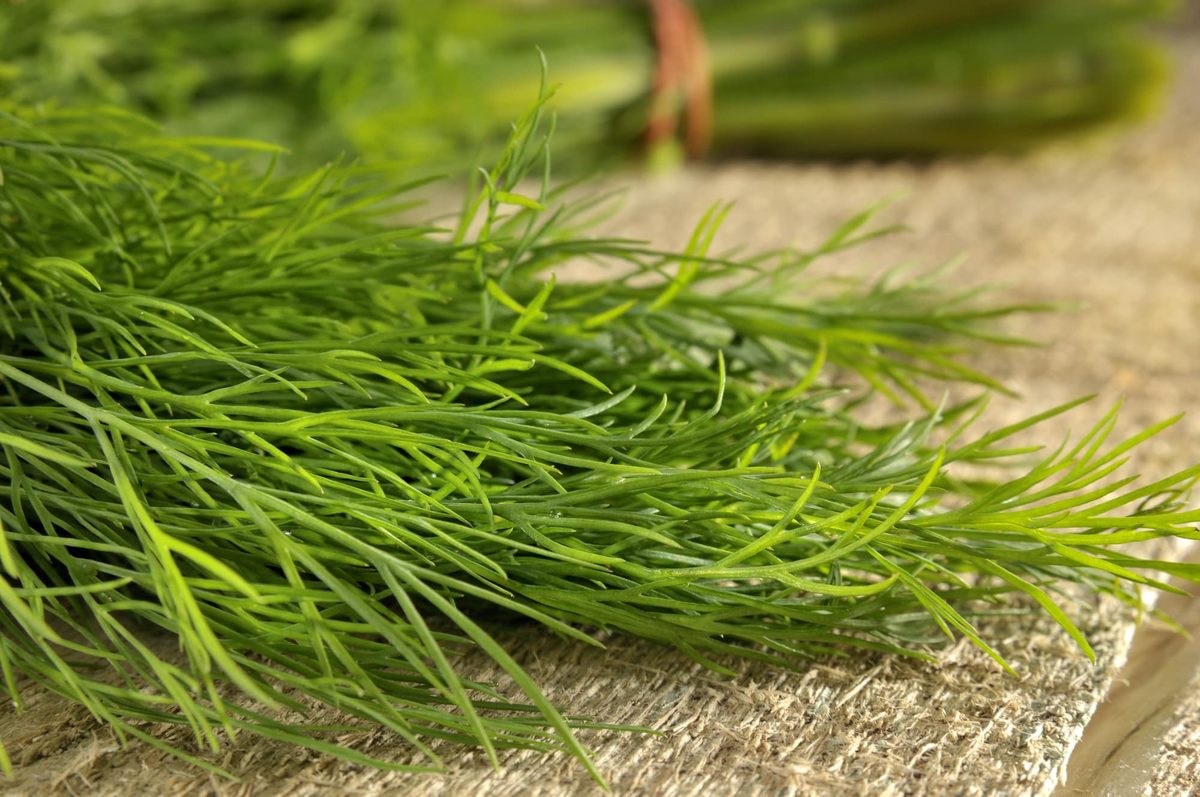
Fresh dill and dried dill are the same feathery leaf of Anethum graveolens, sold dried as dill weed.12 Dried dill measures stronger by volume, so 1 teaspoon stands in for 1 tablespoon of fresh,34 but it carries much less of fresh dill’s aroma: in a Finnish study, even the best drying method kept only about a quarter of the fresh herb’s aroma compounds.5 Fresh dill is the one to buy when dill is the point of the dish.
Side by side
| Fresh dill | Dried dill (dill weed) | |
|---|---|---|
| Plant | Anethum graveolens L.1 | The same plant |
| Family | Apiaceae (parsley or carrot family)6 | Same |
| Native range | North Africa to Chad, and Iran to the Arabian Peninsula (Kew); Britannica says the Mediterranean and southeastern Europe16 | Same |
| Part used | Leaves and young flower heads2 | Dried leaves2 |
| Key aroma compounds | Herb oil led by phellandrene (35%) and 3,9-epoxy-p-menth-1-ene (25%), per PROSEA2 | Much reduced; drying forms new compounds that make up over half the volatiles (see below)5 |
| Strength by volume | 3 parts | 1 part73 |
| Flavor (editorial) | Grassy, fresh, faintly anise-like | Duller and hay-like, still recognizably dill |
| Look (editorial) | Bright green fronds | Dark, grayish-green flakes |
| Quality standard | No figure found | PROSEA: dried product should have at least 0.15% essential oil2 |
| Best for | Salads, fish, sauces, pickles, garnish6 | Dips, dressings, rubs and soups (editorial) |
| Regulation | No herb-specific limit found | The EU caps pyrrolizidine alkaloids in dried herbs, dill included, at 400 µg/kg8 |
Dill seed is a different product with a different oil; see dill seed vs. dill weed. For the plant itself, see dill.
What drying does to dill
A 1985 Finnish study measured the volatile compounds in fresh dill, hot-air-dried dill and freeze-dried dill.5 Its findings are the clearest explanation for why dried dill tastes flat:
- Severe losses. The main aroma compounds, including α-phellandrene, β-phellandrene, limonene and myristicin, were severely reduced by drying.5
- The key compound nearly vanished. The authors identify a benzofuran compound as the most important aroma component of dill herb. Hot-air-dried samples kept only trace amounts to 1.3% of it; freeze-dried samples kept 3.5 to 20%.5
- New compounds appeared. Drying produced secondary aroma compounds, mainly phytadienes and especially neophytadiene, which made up over 50% of the total volatiles in the dried herb.5
- Best case: one quarter. Freeze drying gave the best result, and even that product held only about a quarter of the aroma compounds in fresh dill.5
PROSEA makes the same point for commercial drying: leaving cut dill to dry too long in the field loses a lot of oil to evaporation.2 The study is from 1985 and measured compounds, not taste, so it does not tell us how a modern retail jar compares. It does show that drying changes dill’s aroma, not just its water content.
How much to use
Ratio (Computed): A Couple Cooks gives 1 tablespoon of fresh dill to 1 teaspoon of dried.4 That matches the general extension rule.
| Source | Fresh | Dried |
|---|---|---|
| A Couple Cooks (for dill) | 1 tablespoon | 1 teaspoon4 |
| LSU AgCenter (herbs in general) | 1 tablespoon | 1 teaspoon9 |
| Penn State Extension (herbs in general) | 1 tablespoon | 1 teaspoon3 |
| NDSU Extension (herbs in general) | 1 tablespoon | 1 teaspoon10 |
| University of Delaware (herbs in general) | 2 to 3 teaspoons | 3/4 to 1 teaspoon11 |
| America’s Test Kitchen, tasting test | 3 parts | 1 part7 |
ATK found that 1 part dried to 3 parts fresh came closest to equal strength, but its tasters preferred fresh herbs in all but one application, and it lists dill among the delicate herbs with more volatile flavor compounds.7 Treat the ratio as a starting point for strength, not a promise of the same flavor.
When to use each
Fresh dill goes where dill’s flavor and color are the point. Britannica lists soups, salads, sauces, fish, sandwich fillings and, above all, pickles,6 and says dill is especially popular in eastern European and Scandinavian cooking.6 LSU AgCenter counts dill leaves among the delicate herbs to add at the end, because prolonged heat costs flavor and aroma.9 By kitchen judgment, that means stirring it into a soup or braise just before serving, and using it raw in potato salad, cucumber salad, yogurt sauces and on salmon.
Dried dill is most useful where fresh texture doesn’t matter and other flavors carry the dish: dips, dressings, spice rubs and soups (editorial). The University of Delaware’s guide suggests crushing dried herbs first to release some of their oils.11 ATK’s finding that some dried herbs hold up in long-cooked dishes covered hardy herbs such as oregano, rosemary, sage and thyme,7 not dill, so adding dried dill early in a long simmer has no tested advantage.
Pickles. The National Center for Home Food Preservation’s tested recipe for quick fresh-pack dill pickles uses either 1 1/2 heads of fresh dill or 1 1/2 teaspoons of dill seed per pint jar.12 Neither option is dried dill weed. The NCHFP also says to use only recipes with tested proportions and not to alter the vinegar, food or water proportions,13 so when canning, follow a tested recipe exactly.
Can one stand in for the other?
In cooked dishes and creamy dips, yes, at 1 teaspoon dried per tablespoon of fresh (Computed). For a garnish, a cucumber salad or anywhere fresh dill’s green, grassy note is the point, dried dill is a weak substitute. A Couple Cooks puts it plainly: dill is hard to replace.4
If you have neither, dill substitutes covers tarragon, fennel fronds and the other options, each with its ratio treatment.
What isn’t known
- No study we found compares fresh and dried dill in a finished dish. The ratio is a rule of thumb; A Couple Cooks does not say how its dill figure was reached.
- The drying study dates from 1985 and reports aroma compounds, not taste or modern retail product.
- We found no shelf-life figure for dried dill from a regulator or extension service. See how to store dill.
- The claim that dill stems belong in pickle brine could not be traced to a tested recipe; we left it out.
Related
- Dried herbs vs. fresh: the general rules for every herb.
- Dill, dill substitutes, cooking with dill and too much dill?
- Dill seed vs. dill weed, fennel vs. dill and tarragon vs. dill
- Dried vs. fresh tarragon and fresh parsley vs. dried: two more delicate herbs.
Footnotes
-
Anethum graveolens L., Plants of the World Online, Royal Botanic Gardens, Kew. powo.science.kew.org · Reference work ↩ ↩2 ↩3
-
Nguyen Thi Tâm, C.C. de Guzman & P.C.M. Jansen, Anethum graveolens, Plant Resources of South-East Asia (PROSEA). uses.plantnet-project.org · Reference work ↩ ↩2 ↩3 ↩4 ↩5 ↩6
-
Stacy Reed, “Preserving Herbs by Drying”, Penn State Extension, 2024. extension.psu.edu · Reference work ↩ ↩2 ↩3
-
Sonja Overhiser, “Best Dill Substitute”, A Couple Cooks. acouplecooks.com · Publication ↩ ↩2 ↩3 ↩4
-
Huopalahti, Kesälahti & Linko, “Effect of hot air and freeze drying on the volatile compounds of dill (Anethum graveolens L.) herb”, Journal of Agricultural Science in Finland, 1985. journal.fi · Peer-reviewed ↩ ↩2 ↩3 ↩4 ↩5 ↩6 ↩7
-
“Dill”, Encyclopaedia Britannica. britannica.com · Reference work ↩ ↩2 ↩3 ↩4 ↩5
-
“Science: Substituting Dried Herbs for Fresh”, America’s Test Kitchen. americastestkitchen.com · Publication ↩ ↩2 ↩3 ↩4
-
Commission Regulation (EU) 2023/915, Annex I, section 2.4. eur-lex.europa.eu · Regulator ↩
-
“Flavorful Herbs”, LSU AgCenter. lsuagcenter.com · Reference work ↩ ↩2
-
Julie Garden-Robinson, Ingredient Substitutions (FN198), NDSU Extension, 2018. ksre.ksu.edu · Reference work ↩
-
“Using Herbs and Spices”, University of Delaware Cooperative Extension, 2025. udel.edu · Reference work ↩ ↩2
-
“Quick Fresh-Pack Dill Pickles”, National Center for Home Food Preservation. nchfp.uga.edu · Reference work ↩
-
“General Information on Pickling”, National Center for Home Food Preservation. nchfp.uga.edu · Reference work ↩