Spice Comparisons · Comparison
Tarragon vs. Dill: Two Licorice-Edged Herbs With Different Chemistry
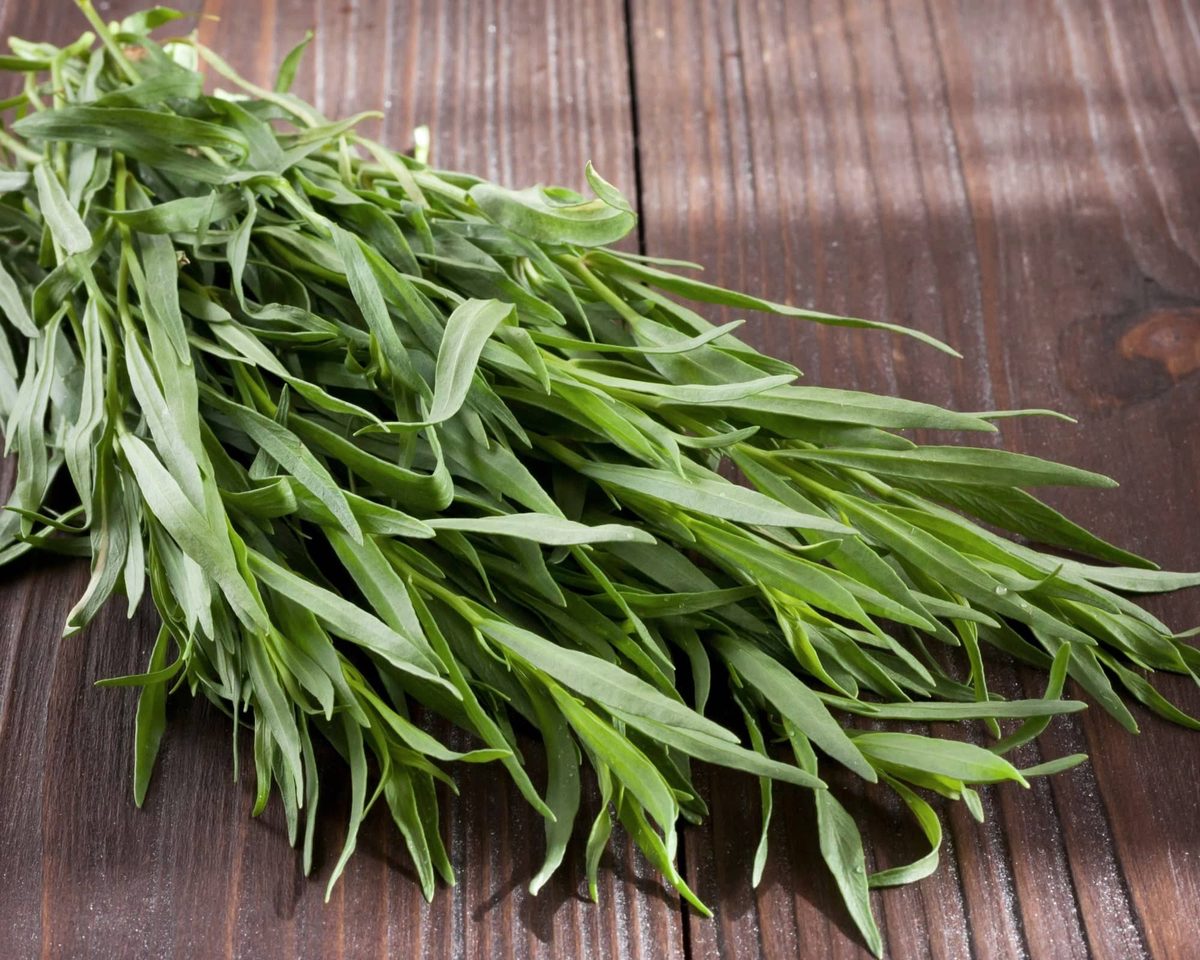
Tarragon and dill are both soft, green herbs that cooks add at the end, and both carry a hint of licorice. They are not related, and their oils are built from different compounds. Tarragon is the stronger of the two, according to a food writer who gives swap ratios in both directions,1 and its oil is mostly estragole.2 Dill is gentler, warmer and closer to caraway.3
Side by side
| Tarragon | Dill | |
|---|---|---|
| Species | Artemisia dracunculus L.4 | Anethum graveolens L.5 |
| Family | Asteraceae (daisy family)4 | Apiaceae (carrot and parsley family)3 |
| Life cycle | Perennial, about 2 to 3 feet tall (French tarragon)6 | Annual, up to 1.5 m tall7 |
| Native range | Temperate Northern Hemisphere to tropical mountains (Kew)4 | North Africa to Chad and Iran to the Arabian Peninsula (Kew); Britannica says the Mediterranean and southeastern Europe53 |
| Leaves | Dark green, narrow and slightly twisted6 | Finely divided into many thread-like segments3 |
| Types | French (the cooking type) and Russian (sets seed, lacks French tarragon’s flavor)86 | Leaf (dill weed) and seed, which taste different7 |
| Main compounds in the leaf oil | Estragole: 60 to 75% of tarragon oil (EU Scientific Committee on Food); about 77% in one French oil (PROSEA)28 | Phellandrene about 35% and dill ether about 25% of dill herb oil (PROSEA)7 |
| Oil in the dried herb | 0.2 to 1.0%8 | 0.1 to 1.5%7 |
| Flavor, per the sources | Sweet anise-like scent, a peculiar bittersweet flavor (PROSEA)8 | Warm, slightly sharp, somewhat like caraway (Britannica);3 slightly bitter and pungent (PROSEA)7 |
| Flavor (editorial) | Assertive, cool anise | Fresh, grassy, faintly anise |
| Heat | A delicate, volatile herb9 | A delicate, volatile herb; add the leaves at the end910 |
| Signature uses | Béarnaise, fines herbes, tarragon vinegar11128 | Pickles, fish, eastern European and Scandinavian cooking3 |
The oil figures come from different studies of different samples, collected by different reference works, so they show what dominates each oil, not a head-to-head measurement. The oil-content figures are both PROSEA’s, for dried herb.
Why they taste different
Both herbs get described as licorice-like, which is why they are swapped so often. A Couple Cooks says tarragon has a licorice or anise finish similar to dill’s, but much stronger.1 The University of Illinois Extension calls tarragon’s taste licorice or anise.6
The chemistry behind them is not the same. Tarragon’s oil is dominated by estragole, also called methyl chavicol.28 Dill leaf oil is led instead by phellandrene and a compound PROSEA calls 3,9-epoxy-p-menth-1-ene, known as dill ether.7 No source reviewed here tests which compound produces the anise impression in either herb, so this page names the dominant compounds without claiming they cause the flavor.
Dill seed is a third flavor again. Its oil is led by limonene and carvone,7 the reason Britannica compares dill to caraway.3 Dill seed is not a stand-in for tarragon; see dill seed vs. dill weed.
Fresh, dried and heat
Both herbs are best fresh and late. America’s Test Kitchen lists dill and tarragon among the delicate herbs whose flavor compounds are more volatile, and its tasters preferred fresh herbs to dried in all but one application.9 LSU AgCenter puts dill leaves with the herbs added at the end of cooking.10
Drying costs tarragon more. The University of Illinois Extension says its flavor is quickly lost when the leaves are dried, and recommends using it fresh whenever possible.6 For dried amounts, LSU’s general rule is one tablespoon of finely cut fresh herbs to one teaspoon of crumbled dried, a rule for herbs in general rather than for either of these.10 See dried tarragon vs. fresh and fresh dill vs. dried dill.
Can one stand in for the other?
In a pinch, yes, with an eye on strength. These are a food writer’s rules of thumb; no source measures how strong the two herbs are relative to each other.
| Swap | Ratio | Treatment |
|---|---|---|
| Fresh tarragon for fresh dill | Equal amounts (A Couple Cooks)1 | Attributed |
| Dried tarragon for dried dill | Equal amounts (A Couple Cooks)1 | Attributed |
| Dill for tarragon, fresh for fresh or dried for dried | 1:1 (A Couple Cooks)13 | Attributed |
Tarragon in place of dill. Because the same source calls tarragon much stronger,1 a cautious cook might start with half and add more after tasting; that is our suggestion, not theirs. Add it at the end, as you would dill. There is no sourced reason to cook tarragon longer to tame it, and both herbs lose flavor to heat.9 If you are using dried tarragon, check that it still smells of anise, given how quickly drying costs it flavor.6
Dill in place of tarragon. A Couple Cooks says dill has a different flavor profile from tarragon but works in a pinch.13 In a béarnaise, where tarragon is essential,11 it will make a different sauce. In eggs, fish and creamy dressings the swap is more forgiving. That is our judgment.
For other options, see tarragon substitutes and dill substitutes.
Where each belongs
Tarragon. Britannica calls tarragon an essential ingredient in béarnaise.11 It is one of the herbs commonly found in fines herbes, with parsley, chives and chervil.12 PROSEA says the leaves suit chicken, egg and lobster dishes especially well, and that tarragon vinegar is made by adding the herb to wine vinegar.8 Illinois Extension adds oils, marinades and salads.6
Dill. Britannica lists soups, salads, sauces, fish, sandwich fillings and above all pickles, and says dill is especially popular in eastern European and Scandinavian cooking.3 Gravlax, borscht, potatoes and yogurt sauces are common uses (editorial).
A note on estragole
Estragole is the compound that brings tarragon into food-safety discussions. The European Commission’s Scientific Committee on Food concluded in 2001 that it is genotoxic and carcinogenic, based mainly on studies in mice, and could not set a safe exposure limit.2 A 2011 review judged the cancer risk to humans extremely small.14 Neither gives a safe or unsafe amount of tarragon leaf in cooking. See tarragon for more.
What isn’t known
- No published measurement compares the flavor strength of tarragon and dill. The ratios above are rules of thumb.
- No source tests which compound gives either herb its anise note.
- Tarragon is often called the “king of herbs” in France, and often said to be harder to find than dill outside France. No source for either was found.
Related
- Tarragon, tarragon substitutes, tarragon uses and too much tarragon
- Dill, dill substitutes, cooking with dill and too much dill
- Fennel vs. dill, tarragon vs. thyme and tarragon vs. rosemary
- Fines herbes
Footnotes
-
Sonja Overhiser, “Best Dill Substitute”, A Couple Cooks. acouplecooks.com · Publication ↩ ↩2 ↩3 ↩4 ↩5
-
Opinion of the Scientific Committee on Food on Estragole, European Commission, 2001. food.ec.europa.eu · Regulator ↩ ↩2 ↩3 ↩4
-
“Dill”, Encyclopaedia Britannica. britannica.com · Reference work ↩ ↩2 ↩3 ↩4 ↩5 ↩6 ↩7 ↩8
-
Artemisia dracunculus L., Plants of the World Online, Royal Botanic Gardens, Kew. powo.science.kew.org · Reference work ↩ ↩2 ↩3
-
Anethum graveolens L., Plants of the World Online, Royal Botanic Gardens, Kew. powo.science.kew.org · Reference work ↩ ↩2
-
“Tarragon: French”, University of Illinois Extension. extension.illinois.edu · Reference work ↩ ↩2 ↩3 ↩4 ↩5 ↩6 ↩7
-
Nguyen Thi Tâm, C.C. de Guzman and P.C.M. Jansen, Anethum graveolens, Plant Resources of South-East Asia (PROSEA). uses.plantnet-project.org · Reference work ↩ ↩2 ↩3 ↩4 ↩5 ↩6 ↩7
-
C.C. de Guzman and R.A. Reglos, Artemisia dracunculus, Plant Resources of South-East Asia (PROSEA). uses.plantnet-project.org · Reference work ↩ ↩2 ↩3 ↩4 ↩5 ↩6 ↩7
-
“Science: Substituting Dried Herbs for Fresh”, America’s Test Kitchen. americastestkitchen.com · Publication ↩ ↩2 ↩3 ↩4
-
“Flavorful Herbs”, LSU AgCenter. lsuagcenter.com · Reference work ↩ ↩2 ↩3
-
“Tarragon”, Encyclopaedia Britannica. britannica.com · Reference work ↩ ↩2 ↩3
-
“Fines herbes”, Encyclopaedia Britannica. britannica.com · Reference work ↩ ↩2
-
Sonja Overhiser, “Best Tarragon Substitute”, A Couple Cooks, 2026. acouplecooks.com · Publication ↩ ↩2
-
Obolskiy et al., “Artemisia dracunculus L. (Tarragon): A Critical Review”, Journal of Agricultural and Food Chemistry, 2011. discovery-pp.ucl.ac.uk · Peer-reviewed ↩